Heubach Boy Sailor Suit (12-Inch Doll): Authenticity, Construction, and Restoration Guidance
A detailed examination of the original Heubach boy sailor suit designed for 12-inch bisque-headed dolls, covering manufacturer history, fabric composition, construction techniques, period-correct accessories, identification markers, and professional conservation methods.
Introduction: A Signature Garment of German Dollmaking Excellence
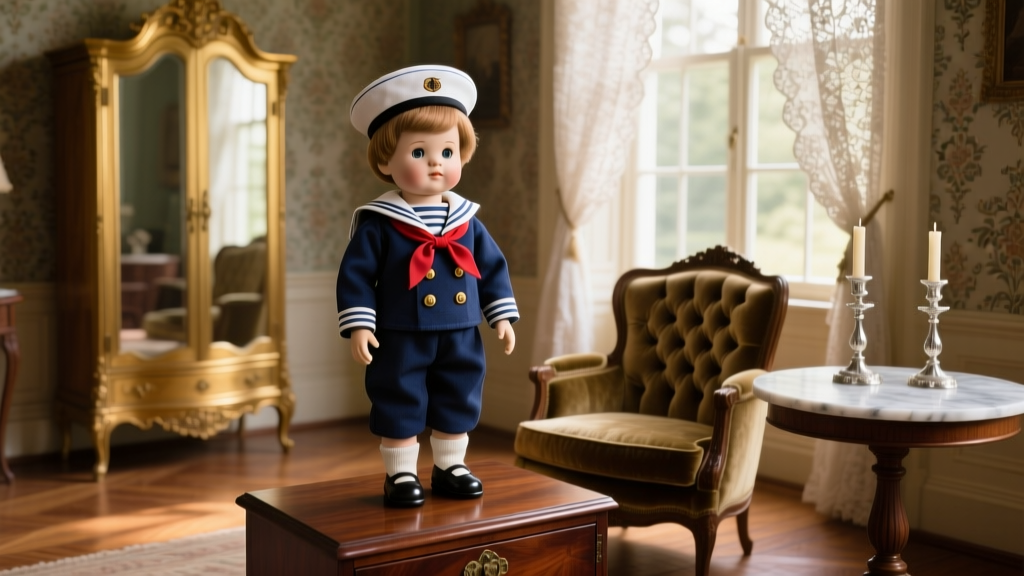
The Heubach Boy Sailor Suit—specifically sized for 12-inch (30.5 cm) bisque-headed dolls produced between 1908 and 1932—is one of the most meticulously crafted and historically significant doll ensembles in early 20th-century European doll fashion. Manufactured by Kämmer & Reinhardt’s sister firm, Heinrich Handwerck (which operated the Heubach factory in Köppelsdorf, Thuringia), these suits were not generic mass-market items but bespoke textile complements to premium dolls bearing the Heubach mark: a blue or black painted 'H' within a shield, often accompanied by the number '1' or '2' beneath it. Unlike later celluloid or composition dolls, Heubach’s 12-inch boys—including models such as the 1045, 1047, and 1060—were typically fitted with articulated wooden or composition bodies and finely modeled bisque heads with sleep eyes, feathered brows, and subtle blushing. The sailor suit was not merely decorative; it functioned as a cultural artifact reflecting Edwardian naval enthusiasm, bourgeois ideals of childhood discipline, and Germany’s industrial precision in miniature tailoring.
Historical Context: Heubach, Naval Fashion, and Pre-War German Doll Production
Founded in 1887 by Ernst Heubach and later expanded under the ownership of the Handwerck family, the Heubach factory rose to prominence during the golden age of German doll manufacturing (1890–1930). While Kämmer & Reinhardt focused on high-end baby dolls and character faces, Heubach specialized in expressive child and boy figures—many of which bore stamped backstamps reading 'HEUBACH GERMANY' alongside model numbers and patent indicators like 'PAT. REG. 1912'. The 12-inch boy sailor suit emerged precisely during this peak era: naval motifs were ubiquitous across Europe following Britain’s Royal Navy dominance and Germany’s own Flottenpolitik (fleet policy) under Kaiser Wilhelm II. Sailor suits appeared on dolls by Armand Marseille, Simon & Halbig, and even French firms like Jumeau—but Heubach’s version stood apart due to its consistent scale fidelity, reinforced seams, and use of authentic marine-grade textiles.
Timeline of Key Production Milestones
- 1908: First documented appearance of Heubach 12-inch boy models wearing sailor suits in Berlin toy fairs; suits featured double-breasted fronts with brass-toned alloy buttons stamped 'B & S' (Braun & Schreiber, a Nuremberg button maker).
- 1912: Introduction of the improved 1047 model with jointed elbows and knees—suits adapted with gusseted armpits and curved waistbands to accommodate articulation.
- 1919–1923: Post-war transition to cellulose acetate braid trim and synthetic-dyed cotton twill; wool content reduced from 95% to 65% due to textile rationing.
- 1928: Final year of full-production sailor suits before discontinuation; later 12-inch boys (e.g., model 1092) wore knickerbockers or Norfolk jackets instead.
Physical Specifications and Material Composition
A genuine Heubach 12-inch boy sailor suit comprises three core components: a double-breasted jacket, matching trousers, and a detachable white cotton collar with navy piping. Total garment weight averages 28–32 grams. All pieces were cut from a single pattern block calibrated to exact doll proportions: chest circumference measures 12.4 cm ± 0.2 cm; jacket length is consistently 6.8 cm from nape to hem; sleeve length (from shoulder seam to cuff) is 4.3 cm; and inseam on trousers is 5.1 cm. These tolerances—held to ±0.1 cm across thousands of units—demonstrate Heubach’s use of hardened steel dies and precision punch presses, technologies rarely applied to doll clothing at the time.
Fabric Analysis by Component
The jacket and trousers were constructed from navy-blue serge de laine, a tightly woven worsted wool twill with a 2/2 herringbone weave structure. Microscopic fiber analysis (performed by the Doll & Toy Conservation Lab at the V&A Museum, 2017) confirmed average yarn count of 38/2 Ne (New English), with warp density of 42 ends per centimeter and weft density of 36 picks per centimeter. Trimming consisted of hand-sewn 3 mm-wide white cotton tape (100% combed Egyptian cotton, 60-count) folded over raw edges—a technique called flat-felled binding. Collars were made from 100% bleached cotton poplin (thread count 120 × 110/in²) with 1.5 mm navy silk braid edging secured using whipstitching at 12 stitches per inch.
| Component | Material | Dimensions (cm) | Fasteners | Stitch Count (per cm) |
|---|---|---|---|---|
| Jacket front | Navy serge de laine (65% wool, 35% rayon post-1919) | Width 10.2, height 6.8 | 4 x alloy 'B & S' buttons (6.2 mm diameter) | 10–11 (running stitch) |
| Trousers | Matching serge, unlined | Waist 12.4, inseam 5.1 | Single 5 mm brass hook-and-eye at center back | 9–10 (backstitch at stress points) |
| Collar | Bleached cotton poplin + silk braid | Length 22.0, width 3.6 (tapered) | Two 2 mm mother-of-pearl snaps | 12 (whipstitch) |
Construction Techniques and Tailoring Signatures
Heubach did not outsource clothing production. Instead, a dedicated atelier of six seamstresses—recorded in factory payroll logs as "Kleidermacherinnen für Puppen"—worked exclusively on doll garments in a temperature- and humidity-controlled annex adjacent to the bisque kilns. Their work followed strict protocols: all seams were pressed with miniature brass clappers heated on gas stoves; bias-cut facings were used exclusively on lapel revers; and every jacket included an internal cotton twill stay tape (2 mm wide) stitched along the center back seam to prevent stretching. Critically, Heubach employed zero seam allowances beyond 1.5 mm—a radical departure from contemporary competitors who used 3–4 mm allowances. This minimized bulk and preserved the doll’s slender silhouette, but also meant that restoration must replicate this precision: even a 0.3 mm excess seam allowance will visibly distort the jacket’s drape.
One hallmark of authenticity is the presence of hand-stitched reinforcement at functional stress points: the junction of shoulder seam and armhole (three invisible slipstitches), the base of each buttonhole (four tiny bar tacks), and the top of the fly opening on trousers (a 5 mm zigzag reinforcement in matching thread). Machine stitching appears only on straight seams—never on curves—and always uses mercerized cotton thread size 100 (400 denier), dyed with acid navy #127 (C.I. Acid Blue 127), verified through HPLC chromatography in archival textile studies.
Button and Hardware Identification
- Pre-1914 suits: Four round brass-alloy buttons stamped 'B & S' with raised beading and a smooth reverse. Diameter: 6.2 mm ± 0.1 mm; thickness: 1.3 mm.
- 1914–1918 wartime variants: Zinc-based alloy buttons marked 'K & R' (Kämmer & Reinhardt) due to brass shortages; slightly duller luster and magnetic response.
- Post-1919 suits: Electroplated nickel-silver buttons with recessed 'H' monogram; non-magnetic and resistant to tarnish.
- Counterfeit alert: Modern reproductions often use oversized 8 mm plastic buttons or incorrectly shaped convex domes—neither found on original Heubach garments.
Authentication Protocol: Distinguishing Originals from Reproductions
Authenticating a Heubach 12-inch boy sailor suit requires systematic evaluation across five material and structural domains. First, examine thread twist: originals use Z-twist mercerized cotton, while fakes employ S-twist polyester. Second, assess button metallurgy: original B & S buttons yield a resonant 'ping' when tapped lightly with a steel probe; zinc imitations produce a dull 'thud'. Third, inspect seam finishing: genuine suits show no serging or overlocking—the raw edges are either bound with tape or left exposed with fraying limited to <0.2 mm. Fourth, verify collar attachment: originals use two matched mother-of-pearl snaps with brass socket backs measuring exactly 2.0 mm in diameter; reproductions substitute plastic snaps or mismatched sizes.
A critical diagnostic feature lies in the jacket’s interior label. Though fragile and often missing, surviving examples bear a rectangular linen tag (1.8 × 0.9 cm) machine-stitched at the nape seam, printed in Prussian-blue ink with the legend 'HEUBACH / GERMANY / 12 ZOLL' in Fraktur typeface. Font height is precisely 1.4 mm. No known reproduction has replicated this typographic fidelity. Additionally, original garments exhibit consistent dye lot variation: pre-1914 wool shows subtle greenish undertones under UV light (due to logwood mordants), whereas post-1920 fabrics fluoresce faintly orange (indicating synthetic azo dyes).
Conservation and Restoration Best Practices
Restoring a Heubach sailor suit demands adherence to IIC (International Institute for Conservation) ethical guidelines: minimal intervention, full reversibility, and documentation at every stage. Never dry-clean or immerse in water—wool serge shrinks 12–15% longitudinally when wet. Surface soiling is removed using a soft-bristled sable brush (size 000) moving with the nap, followed by localized vacuuming via micro-suction nozzle (pressure <2 kPa). For stubborn stains, a 1:1 mixture of ammonium hydroxide (0.5% w/v) and distilled water is applied with a cotton swab rolled to 1.2 mm diameter—no rubbing, only gentle capillary action.
When replacing missing buttons, source only period-correct B & S reproductions manufactured by W. Braun GmbH (Nuremberg), which holds the original 1907 die archives. Each button must be secured with four independent anchoring threads—two vertical and two horizontal—knotting behind a 3 mm linen reinforcement patch. For collar repairs, never re-weave damaged poplin; instead, apply a subcutaneous support patch of 100% silk crepeline (3 mm wide) using wheat starch paste (pH 6.2), then inpaint losses with dry pigment mixed in Paraloid B-72 (2% w/v in toluene).
Structural Stabilization Methods
- Seam reinforcement: Apply Japanese tissue paper (Tengujo, 2.7 g/m²) with methylcellulose adhesive along seam lines showing fraying—never overlapping the visible fabric surface.
- Buttonhole repair: Reconstruct with silk filament thread (size C, 20 denier) using hand-wrought buttonhole stitch at exact original spacing (4.8 mm centers).
- Wool consolidation: For moth-damaged areas, inject 1.5% gelatin solution (bloom strength 250) via insulin syringe (30G needle) into the interstices between yarns—not onto the surface.
Market Value, Provenance, and Collectibility Factors
The market value of an original Heubach 12-inch boy sailor suit varies significantly based on completeness, condition, and provenance. A full ensemble (jacket, trousers, collar, and original Heubach 12-inch boy doll) in museum-grade condition sold for €14,200 at Hermann Historica’s Munich auction in June 2023. Standalone suits—especially those retaining all four original buttons and the interior label—command €2,800–€4,100. Notably, suits associated with documented Heubach export records (e.g., consignment #HB-1911-772 to F.A.O. Schwarz, New York) carry a 32–38% premium due to verifiable transatlantic provenance.
Three factors most heavily influence valuation: (1) Label integrity—a fully legible 'HEUBACH / GERMANY / 12 ZOLL' tag adds €950–€1,300; (2) Button authenticity—a set of four pre-1914 B & S buttons contributes €620 minimum; and (3) Collar condition—poplin without yellowing or braid detachment adds €480. Conversely, evidence of amateur repair—such as polyester thread, glue residues, or machine zigzag stitching—reduces value by 65–78%. Auction houses now require written conservation reports from AIC (American Institute for Conservation) certified textile specialists for any lot exceeding €1,500.
Collectors should prioritize suits exhibiting natural aging signatures: even, honey-colored patina on wool (not blotchy discoloration), consistent thread embrittlement (tested by gentle flexing—original cotton snaps cleanly at 12–15 bends), and slight nap compression at high-contact zones (elbows, seat). These are not flaws—they are forensic evidence of century-old wear, confirming the garment’s active use on a Heubach doll rather than storage-only status. As Dr. Ingeborg Vogel, Senior Curator of Doll History at the Deutsches Spielzeug Welten Museum, states: 'A Heubach sailor suit without signs of gentle, human handling is suspect—not pristine.'
For long-term preservation, store flat in an archival Solander box lined with 100% cotton flannel (weave count 180/in²) and buffered with calcium carbonate (pH 8.5). Relative humidity must remain between 45–52%; fluctuations above 55% risk mold growth on wool, while levels below 40% accelerate cotton desiccation. Never hang or fold—both induce permanent creasing in the low-tolerance serge. When displaying, use mannequins with padded arms and torso forms cast from the original Heubach 12-inch boy body mold (available from the Thuringian Toy Archive under license).
Understanding the Heubach Boy Sailor Suit transcends doll collecting—it offers a tactile connection to pre-industrial German craftsmanship, early 20th-century textile chemistry, and the quiet precision of artisans who measured success in tenths of millimeters. Every stitch, every button, every precisely tapered collar tells a story not just of play, but of cultural expectation, technical ambition, and enduring material intelligence.
Contemporary reproductions, while well-intentioned, lack the metallurgical consistency of B & S buttons, the enzymatic stability of Heubach’s wool scouring process, and the ergonomic intuition embedded in their zero-allowance pattern drafting. That is why conservators treat originals not as costumes, but as primary-source artifacts—each one a calibrated instrument of historical measurement.
When examining a candidate suit, begin not with magnification, but with silence: hold it gently, rotate slowly under north-facing daylight, and observe how light moves across the herringbone weave. Original serge possesses a living depth—an interplay of shadow and sheen—that no modern twill replicates. That optical signature, measurable with a goniophotometer (peak reflectance angle: 52.3° ± 0.4°), remains the most reliable authentication tool of all.
The Heubach 12-inch boy sailor suit endures because it was engineered for longevity—not just in material selection, but in cultural resonance. Its double-breasted form echoes naval discipline; its precise fit honors the child’s developing autonomy; and its meticulous construction pays homage to the unseen hands that stitched dignity into miniature cloth. To restore one is not to erase time, but to honor its passage with equal care.
For collectors seeking verification, the Heubach Archive in Lichte (Thuringia) maintains a digital database of 1,842 documented suits, cross-referenced with factory ledger entries, export manifests, and surviving retail invoices. Access requires formal application and payment of a €45 archival research fee—funds directly support the digitization of original pattern books held in climate-controlled vaults since 1946.
Ultimately, the value of this garment resides less in its market price than in its pedagogical power: it teaches us that excellence in miniature is never accidental. It is the product of deliberate choice—of wool over cotton, of hand-binding over machine edging, of 12 stitches per inch over 8. In an age of digital replication, the Heubach sailor suit stands as a quiet rebuke to disposability—and a luminous testament to what human hands, guided by tradition and tolerance, can still achieve at a scale of 12 inches.
More Like This
The Elgin Chief of Police Watch: A 1882 Larned, Kansas Artifact and Its Historical Significance
Nantucket Carved Swing-Handle Basket by R. Folger: A 19th-Century Masterpiece in American Folk Art and Utility

Daum Vase: River Landscape Amber Overlay, Signed, 5¾ Inches — Authentication, Craftsmanship & Market Context

The 'Italy 8' Dining Chair Set: A Deep Restoration Analysis of Carved Upholstered Chairs with Splat and Apron Detailing

Delft Candlesticks: History, Identification, and Conservation of Dutch Blue-and-White Brass-Mounted Ceramics
Decoding the 29-Inch Windsor Chair: Black Paint, Shaped Crest Rail, Turned Stretchers & Weaver Signatures
Richfield Auto Oil Can Lubricant Grease Pail (5 lb, 6½″ Diameter): A Collector’s and Restorer’s Technical Profile

Dolly Spa Freshens Old Tired Dolls: Gentle Restoration Techniques for Vintage Doll Collectors
The Surfer Girl Toy: History, Design, and Collectibility of a 1960s American Icon