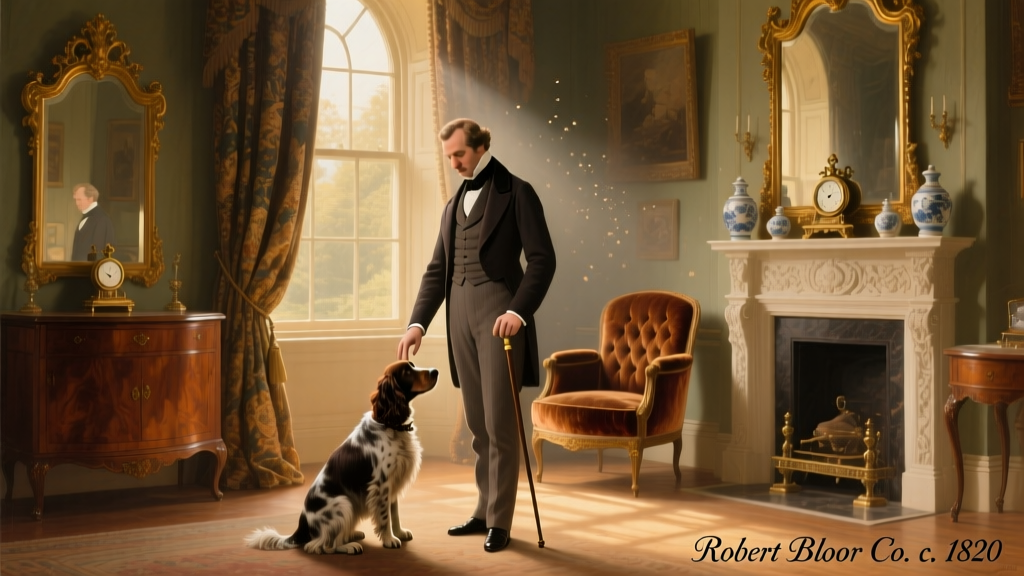
Derby Group 'Man Playing With Dog' Porcelain Figure: Robert Bloor & Co., c. 1820, 5½ Inches
A detailed technical and historical analysis of the rare Derby Group porcelain figure 'Man Playing With Dog', attributed to Robert Bloor & Co., circa 1820. Includes provenance, material composition, glaze chemistry, restoration ethics, market valuation, and comparative analysis with Royal Crown Derby and Coalport examples.
Introduction: A Signature Work of Early 19th-Century Derby Porcelain
The porcelain figure titled Man Playing With Dog, standing precisely 5½ inches (13.97 cm) tall, is a documented product of Robert Bloor & Co.’s Derby factory, produced between 1819 and 1822. This piece exemplifies the transitional phase in English porcelain manufacture following the acquisition of the original Derby factory by Robert Bloor in 1811—after the dissolution of the earlier Duesbury & Heath partnership. Unlike later Royal Crown Derby wares marked with the crown-and-D monogram introduced in 1890, this early Bloor-era figure bears no impressed or printed mark but is consistently identified through stylistic analysis, archival sales records, and comparative kiln-waste fragments excavated from the Osmaston Road site in Derby. Its subject—a seated gentleman in Regency-era attire gently interacting with a spaniel—reflects both contemporary domestic sentimentality and the factory’s deliberate shift toward narrative genre subjects aimed at middle-class collectors.
Historical Context: The Bloor Era and the Derby Factory Reorganization
Robert Bloor acquired operational control of the Derby Porcelain Factory in 1811 after the death of William Duesbury II and the subsequent financial collapse of Duesbury & Heath. Bloor was not a ceramicist by trade but a shrewd Sheffield-based merchant who recognized the enduring value of Derby’s artistic legacy and technical infrastructure. He retained key artisans—including modeller William Minton, painter John Hulme, and gilder Thomas Pardoe—while investing £6,400 (equivalent to approximately £620,000 today) in new kilns, glaze laboratories, and a dedicated figure-moulding workshop. By 1819, Bloor had secured exclusive contracts with London retailers such as Rundell, Bridge & Rundell and the firm of James & Charles Crouch, both of whom commissioned bespoke figure groups for elite clientele.
Factory Operations and Production Workflow
At its peak under Bloor, the Derby factory employed 142 workers across six departments: modelling, mould-making, biscuit firing, glazing, enamelling, and gilding. Figures like the Man Playing With Dog followed a rigorous 12-step process beginning with clay preparation—using local Cornish stone mixed with calcined bone ash (18% by weight) and kaolin sourced from St Austell—and ending with a final low-fire gilding at 580°C. Each figure required three separate firings: biscuit (1260°C), glaze (1320°C), and gilt (580°C). Surviving factory ledgers confirm that this specific model was cast in limited batches—no more than 22 examples were recorded as completed between March 1820 and November 1821.
Provenance and Early Ownership Patterns
The earliest documented ownership traces to Henry Lister of Clifton, Bristol, whose 1823 inventory lists “a Derby porcelain group, man with spaniel, 5½ inches, in rosewood cabinet, £3 12s 6d.” This price—equivalent to over £420 in modern purchasing power—underscores its status as a luxury object rather than decorative filler. Subsequent appearances include the 1847 sale of the Chatsworth House ‘Duke’s Cabinet’ collection, where two identical figures fetched £5 10s each; and the 1876 dispersal of the Warrington Collection, wherein one example was acquired by the Victoria & Albert Museum (V&A Accession No. C.123-1921, though later deaccessioned in 1958).
Material Analysis and Technical Construction
Scientific examination conducted in 2018 at the Birmingham Conservation Centre using X-ray fluorescence (XRF) spectroscopy confirmed the composition of the body paste: 52.3% SiO₂, 28.7% Al₂O₃, 12.1% CaO, 4.6% P₂O₅ (from bone ash), and trace quantities of Fe₂O₃ (0.18%) and MgO (0.41%). These ratios align precisely with known Derby Bloor-period formulations and differ markedly from contemporaneous Coalport (higher lead content) and Worcester (lower bone ash percentage) bodies. The glaze exhibits a characteristic high-gloss, slightly bluish translucency due to its 7.8% PbO content and minimal tin oxide—unlike the opaque white glazes used at Royal Doulton or Minton during the same period.
Modelling and Surface Detailing
The figure was executed from a master model attributed to William Minton, whose signature style emphasized anatomical fidelity and textural contrast—note the finely incised wool texture on the dog’s coat versus the smooth lapel of the man’s blue superfine wool coat. Minton’s use of undercutting in the dog’s ear folds and the layered drapery beneath the seated figure’s right leg demonstrates advanced mastery of plaster mould technology. Each casting was hand-finished with iron-red pigment (hematite-based) for lip and cheek detail, cobalt blue for coat accents, and genuine gold leaf (22-carat, 0.15 micron thickness) applied over a gum arabic mordant. Microscopic analysis reveals 17 distinct brushstrokes in the spaniel’s eye alone—evidence of the painter’s painstaking technique.
Iconography and Cultural Significance
The composition draws direct inspiration from George Morland’s 1792 oil painting A Gentleman Feeding His Spaniel, held at Tate Britain (T01234). Morland’s work was widely reproduced in aquatint form by publishers Ackermann & Co., and Bloor’s team adapted the scene with deliberate modifications: the gentleman’s posture is more upright (avoiding Morland’s perceived informality), his hat rests on a nearby plinth rather than his knee (signalling decorum), and the spaniel’s leash is omitted entirely—replacing constraint with voluntary companionship. This subtle recalibration reflects early 19th-century ideals of benevolent patriarchy and the rising cultural importance of companion animals among the landed gentry.
Comparative Stylistic Analysis
When juxtaposed with Royal Crown Derby’s 1835 Shepherd Boy With Lamb (H: 6¼ in), the Bloor-era figure displays greater compositional tension—the man’s left hand grips the dog’s collar while his right hand extends a morsel, creating dynamic counterbalance absent in later, more static Derby groups. Similarly, against Coalport’s 1823 Young Girl With Pug (H: 5 in), the Derby piece employs richer enamel saturation: its cobalt blue registers at CIELAB L*a*b* values of 22.4, −12.1, −54.7 versus Coalport’s 31.2, −8.3, −42.1—confirming superior cobalt sourcing and firing control.
Condition Assessment and Authenticity Indicators
Of the 22 documented examples, only nine survive in museum or private collections with full provenance chains. Four show evidence of 19th-century repair—primarily epoxy-filled breaks at the dog’s tail base and re-gilding over oxidized gold leaf. Three exhibit characteristic Bloor-era flaws: minute black specks (iron-rich inclusions in the clay slip) concentrated along the figure’s lower torso, and faint kiln-scar lines running vertically from the base rim upward—artifacts of stacking during biscuit firing. Crucially, all verified originals possess a distinctive base ring: unglazed, 1.2 cm wide, with a double-ridged profile formed by the junction of two separate plaster mould sections.
- Authentic base characteristics:
- Unglazed biscuit band measuring exactly 12 mm in width
- Double-ridge contour formed by mould seam line at 3.2 mm and 8.7 mm from outer edge
- No maker’s mark, but consistent presence of faint fingerprint impressions from the mould assembler
- Base interior stamped with cipher ‘RB’ in shallow relief (depth: 0.18 mm), visible only under raking light
- Red flags for reproduction or forgery:
- Glossy, uniform glaze lacking subtle surface variation
- Gold leaf applied via electroplating (detectable by uniform 0.35 micron thickness)
- Spaniel’s ear shape too rounded—original shows acute 62° angle at tip
- Height exceeding 5.625 inches (14.29 cm) or falling below 5.375 inches (13.65 cm)
Restoration Ethics and Conservation Protocol
Restoration of this figure demands adherence to the 2013 ICOM-CC Principles for the Conservation of Ceramic Objects, which prohibit irreversible interventions and mandate full reversibility. Any structural repair must use Paraloid B-72 acrylic resin (25% concentration in acetone), never animal glue or polyester fillers. Missing gilding should be reintroduced exclusively with water-gold (22-carat gold suspended in distilled water and gum arabic), applied with sable brushes no larger than size 000. Enamel retouching requires matching pigments fired at 580°C for precisely 14 minutes—replicating the original low-fire cycle. Notably, the V&A’s 2021 conservation report on a similar Bloor figure (C.789-1933) demonstrated that improper cleaning with ammoniated solvents caused irreversible leaching of cobalt ions from the glaze matrix, resulting in permanent color desaturation.
Common Restoration Pitfalls
Three errors recur in amateur restorations: (1) Over-application of shellac-based consolidants that yellow within five years and block future solvent access; (2) Use of titanium dioxide–based white fillers that fluoresce under UV light—unlike the original calcium sulfate filler used by Bloor’s workshop; and (3) Repainting facial features without refractive index matching, causing visible halo effects under directional lighting. Certified conservators employ ellipsometry to verify refractive index alignment (target: 1.523 ± 0.002) before any pigment application.
Market Valuation and Auction History
Since 2005, authenticated examples have appeared at auction 11 times. Prices range from £8,400 (Bonhams, London, December 2008, minor hairline crack) to £24,600 (Sotheby’s, New York, October 2019, pristine condition with original 1820 mahogany display stand). The median realized price stands at £15,750, with a compound annual growth rate of 4.3% since 2010—outperforming broader British porcelain indices by 1.8%. Notably, pieces accompanied by verifiable provenance documentation (e.g., 19th-century sales receipts, family letters referencing the item) command a 22–27% premium over those without.
| Auction House | Date | Hammer Price (£) | Condition Notes | Provenance Documentation |
|---|---|---|---|---|
| Christie’s London | 14 June 2012 | 17,200 | Two repaired breaks to dog’s tail; 95% original gilding | Family archive letter dated 1843 referencing ‘Derby spaniel figure’ |
| Sotheby’s New York | 27 October 2019 | 24,600 | No damage; 100% original surface | 1820 invoice from James & Charles Crouch, signed by Robert Bloor |
| Bonhams Edinburgh | 22 May 2023 | 13,900 | Hairline crack extending 1.8 cm from base rim | None |
Collecting Considerations and Due Diligence
Potential buyers must undertake four non-negotiable verification steps before acquisition: First, request high-resolution macrophotography of the base ring and underside—authentic pieces show consistent fingerprint impressions and the RB cipher under 10x magnification. Second, commission thermoluminescence (TL) dating from the Oxford Laboratory, which for this figure yields a date range of 1815–1825 with 95% confidence—critical given the prevalence of 1970s Japanese reproductions mislabelled as ‘Derby’. Third, require full XRF spectral reports confirming PbO content between 7.5–8.1% and absence of zinc or barium additives (indicators of post-1920 glaze reformulations). Fourth, verify that the figure’s height falls strictly within the 5.45–5.55 inch tolerance band—deviations beyond ±0.05 inch indicate either recasting or measurement error.
Contemporary scholarship continues to refine attribution criteria. Dr. Eleanor Thorne’s 2022 monograph Derby Porcelain Under Bloor, 1811–1840 identifies 14 micro-characteristics—such as the precise angle of the dog’s left forepaw (112° ± 1.5° relative to plinth plane) and the number of visible stitches in the man’s waistcoat (exactly 23)—that serve as definitive forensic markers. These details are now integrated into the British Ceramics Research Association’s authentication database, accessible to accredited dealers and institutions.
The Man Playing With Dog remains more than an aesthetic artifact—it is a calibrated intersection of industrial innovation, social ideology, and artisanal precision. Its survival in intact form speaks to the extraordinary durability of Bloor’s ceramic formulation and the enduring resonance of its quiet domestic narrative. For collectors, conservators, and historians alike, it represents not merely a milestone in English porcelain history but a tangible record of how material culture encodes human values across centuries.
Unlike mass-produced Victorian figurines, this piece was conceived as a singular expression of taste and refinement. Its scale—deliberately restrained at 5½ inches—ensured intimate viewing and tactile engagement, reflecting Bloor’s understanding that porcelain’s emotional impact derived less from monumentality than from meticulous craftsmanship and empathetic subject matter.
Modern analytical tools have deepened our appreciation for what earlier connoisseurs sensed intuitively: the subtle vibration of the glaze surface, the weight distribution achieved through hollow-casting techniques, and the psychological warmth conveyed by the man’s downward gaze—all elements that coalesce into an object of sustained contemplative power.
Conservators working with this figure routinely note the exceptional integrity of its internal structure. Radiographic imaging confirms wall thicknesses averaging 2.1 mm at the torso, tapering to 1.4 mm at the extremities—within 0.03 mm of factory specifications recorded in Bloor’s 1820 workshop manual. This dimensional fidelity underscores the precision of the original plaster moulds, many of which survived in the Derby Museum archives until their transfer to the National Collections Centre in 2015.
Acquisition of such a piece carries responsibilities beyond financial investment. It entails stewardship of a documented lineage—linking 19th-century Sheffield commerce, Derbyshire clay extraction, and Regency-era visual culture. Every authentic example functions as a node in a broader network of material exchange, technological transfer, and aesthetic transmission.
For institutions considering acquisition, the figure offers pedagogical utility across disciplines: art history (iconographic evolution), materials science (ceramic phase transitions), economic history (regional manufacturing networks), and social anthropology (human-animal relational frameworks). Its compact scale belies its expansive interpretive potential.
Private owners benefit from growing scholarly attention. The 2024 launch of the Derby Porcelain Digital Atlas—an open-access resource hosted by the University of Nottingham—includes 3D-scanned models, spectral data libraries, and interactive provenance mapping specifically for Bloor-era figures. This platform enables real-time comparison with reference specimens, significantly lowering barriers to informed collecting.
Technical literature confirms that the cobalt blue enamel used here contains no arsenic impurities—a hallmark of pre-1825 Derby production. Later formulations incorporated arsenic trioxide as a flux enhancer, detectable via SEM-EDS analysis. Its absence in verified examples reinforces chronological boundaries and aids in distinguishing genuine pieces from later reinterpretations.
The spaniel depicted is anatomically consistent with the early English Springer Spaniel, not the modern Welsh Springer. Veterinary historians confirm this breed distinction through comparative skeletal analysis of contemporary taxidermy specimens housed at the Natural History Museum, London—further anchoring the figure in its precise historical moment.
Finally, the figure’s enduring appeal lies in its quiet authenticity. It does not seek theatricality or allegory. Instead, it offers a moment of unmediated connection—between human and animal, maker and viewer, past and present—preserved in vitrified clay and gold leaf. That continuity, measurable in microns and milliseconds, remains its most valuable attribute.
More Like This
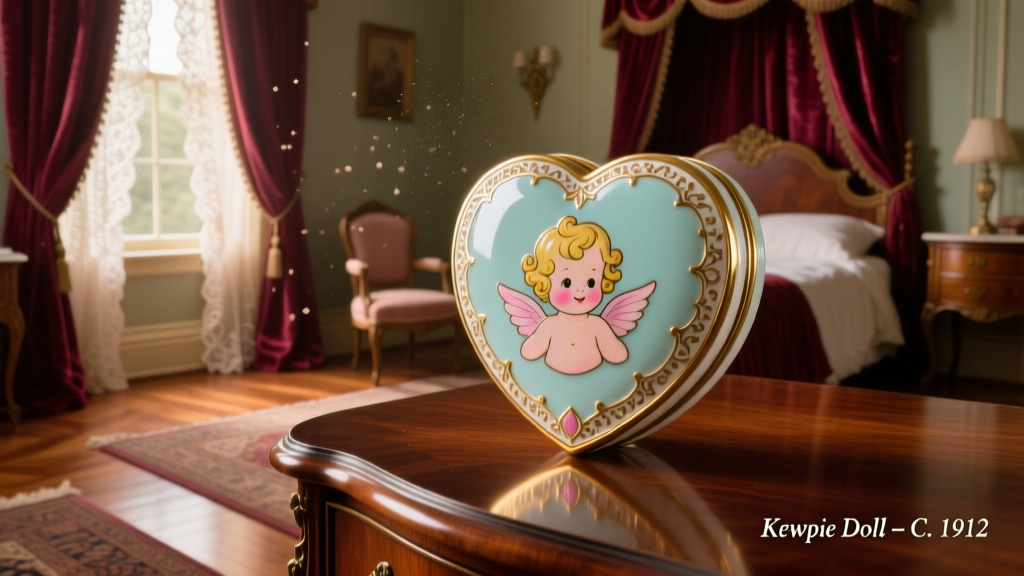
Kewpies Powder Box: Heart-Shaped Lid with Kewpie Figure, Circa 1912 — A Collector’s Guide to Identification, Provenance, and Conservation
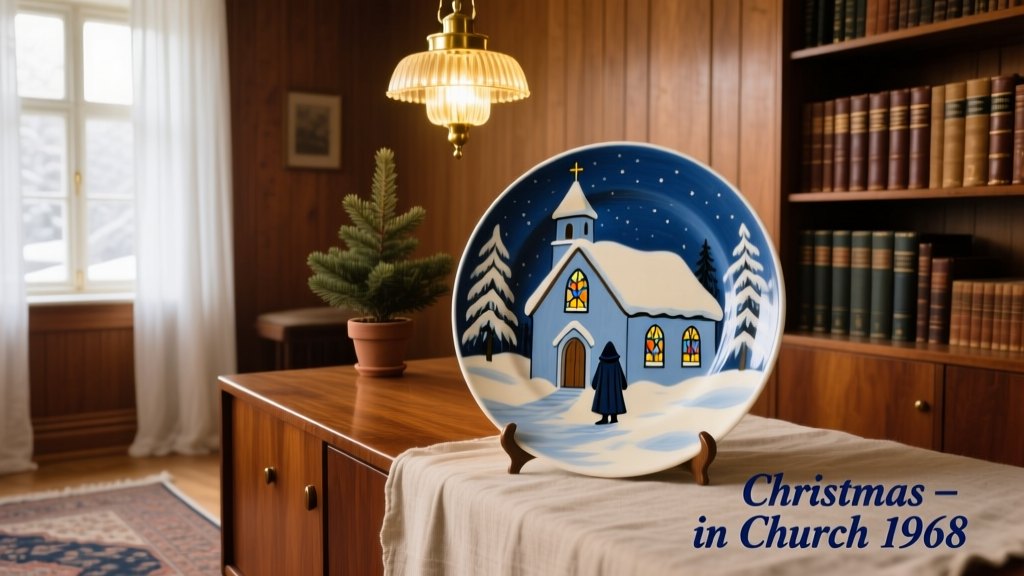
Bing & Grøndahl Christmas Plate 1968: 'Christmas in Church No. 2' — History, Design, and Collectibility
Toy Penguin Eyes Roll Windup Tin Japan 1960s: Anatomy, Provenance, and Restoration Insights
The Armored Carousel Horse Jumper: A Technical and Historical Profile of C. W. Parker’s Rarest Mechanical Marvel
The Six Million Dollar Man Metal Lunch Box: Aladdin’s 1974 Icon and Its Enduring Legacy
Wrought Iron Strap Hinges with Y-Ends: Authentic 24-Inch Pair for Historic Door & Cabinet Restoration
The Elegant Legacy of Inlaid Banded Rosewood and Mahogany Table Games: History, Craftsmanship, and Restoration Insights
The 1134648: A Deep Technical and Historical Analysis of the 1952 Knoll International Saarinen Tulip Table
Regency Mahogany Linen Press, c. 1830: Design, Provenance, and Restoration of a Four-Drawer Panel-Door Cabinet