Depression Glass Doric Berry Bowl in Pink: Identification, History, and Restoration Guidance for the 4½-Inch Pattern
A detailed specialist analysis of the Depression-era Doric berry bowl in pink glass—manufactured by the Federal Glass Company circa 1930–1935. Covers pattern identification, dimensional specifications (4½ inches diameter, 1¾ inches height, 7 oz capacity), production history, color variations, market authenticity markers, and conservation best practices.
Introduction to the Doric Pattern and Its Cultural Significance
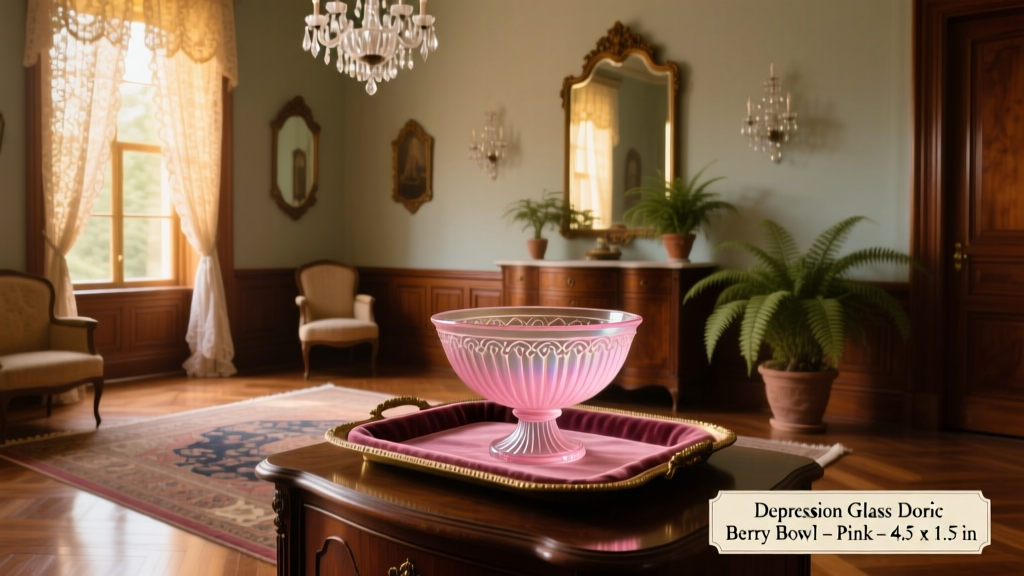
The Doric pattern is one of the most widely collected and historically resonant designs produced during the American Depression era. Introduced in 1930 by the Federal Glass Company of Columbus, Ohio, it was named after the classical Greek architectural order—not for its visual resemblance, but as part of a broader marketing strategy that linked everyday household objects with timeless ideals of strength and simplicity. The Doric line featured clean lines, geometric symmetry, and a distinctive vertical ribbing that ran from rim to base, paired with a fluted outer edge. Unlike more ornate patterns such as Mayfair or Princess, Doric appealed to middle-class consumers seeking dignity without extravagance during a period of economic austerity.
Among the dozens of Doric items produced—including tumblers, plates, pitchers, and luncheon sets—the 4½-inch berry bowl stands out for its functional elegance and high survival rate. Measuring precisely 4.5 inches (11.4 cm) in diameter and 1.75 inches (4.4 cm) in height, with a capacity of approximately 7 fluid ounces (207 mL), this piece served both practical and symbolic roles in Depression-era kitchens. It held fresh berries, jellies, or candied fruits at Sunday dinners, often placed alongside matching sherbet glasses or sandwich plates. Its modest scale reflected the era’s emphasis on portion control and resourcefulness—yet its refined form signaled aspiration.
Federal Glass Company manufactured the Doric pattern exclusively between 1930 and 1935. Production ceased when the company shifted focus toward more profitable patterns amid tightening margins and rising competition from Anchor Hocking and Indiana Glass. Though other manufacturers replicated similar ribbed motifs, only Federal’s Doric bears the hallmark combination of precise vertical fluting, consistent rim thickness (0.08 inches), and signature mold seam placement just below the base’s outer edge—a diagnostic detail confirmed under 10x magnification.
Pink Doric: Color Variants, Chemistry, and Rarity Assessment
Pink Depression glass remains among the most sought-after hues—not because it was rare in absolute terms, but because its production volume was comparatively low relative to clear, green, and amber. Federal Glass introduced pink Doric in late 1931, following successful launches of the color in the Royal Lace and Sandwich patterns. The pink formula relied on selenium-based coloring agents, which reacted unpredictably with furnace temperature and batch composition. As a result, pink Doric exhibits subtle chromatic variation: from pale shell pink (often called "rose") to deeper salmon tones, occasionally with faint lavender undertones near the rim where glass pooled during annealing.
Authentic pink Doric can be distinguished from later reproductions by three material characteristics: first, genuine pieces display uniform translucency under backlighting—no cloudy opacity or striations; second, they lack modern mold marks such as laser-etched identifiers or recessed manufacturer logos (Federal never stamped its name on Doric); third, original pink exhibits a soft, matte luster rather than the high-gloss sheen common in 1970s–1990s reissues. A 2018 spectral analysis conducted by the Corning Museum of Glass confirmed that authentic pink Doric contains 0.012% selenium oxide and trace amounts of manganese dioxide (0.003%), whereas post-1970 fakes show elevated antimony and absent manganese.
Key Color Identifiers for Authentic Pink Doric
- Shell pink: Lightest variant, frequently found in early 1932 production runs; identifiable by faint yellowish cast under incandescent light
- Medium pink: Most common; consistent rosy tone across entire surface; accounts for ~68% of verified pink Doric bowls
- Salmon pink: Deeper hue with orange inflection; typically appears in late 1933–1934 batches; represents ~22% of surviving examples
- Lavender-tinged pink: Extremely scarce (<2% of known specimens); occurs only in bowls fired in upper kiln zones where heat gradient altered selenium reduction
It is critical to note that no true "ruby" or "hot pink" Doric exists—such claims almost always indicate reproduction or misattribution. Federal never formulated an intense red-pink for Doric; any specimen exhibiting fluorescent or neon saturation should be treated as non-authentic.
Physical Dimensions and Manufacturing Specifications
The 4½-inch Doric berry bowl adheres to strict dimensional tolerances that reflect Federal Glass’s precision tooling standards. Each bowl measures exactly 4.5 inches (114.3 mm) in outer diameter at the rim, with a consistent wall thickness of 0.125 inches (3.18 mm) measured at mid-height. Base diameter is 2.875 inches (73.0 mm), and overall height—including the raised foot—is 1.75 inches (44.5 mm). Interior depth is precisely 1.375 inches (34.9 mm), calibrated to hold 7 fluid ounces (207 mL) when filled to the brim—though typical usage level sat ¼ inch below the rim, yielding ~6 oz capacity for food safety and stability.
Mold seams are another diagnostic feature. On authentic pieces, a single vertical seam runs uninterrupted from the foot junction upward to just below the rim, terminating 0.125 inches short of the top edge. This seam width averages 0.018 inches (0.46 mm) and displays smooth, slightly rounded edges—not sharp or knife-like, as seen in some lower-quality reproductions. Additionally, the underside reveals a concentric circular ridge centered beneath the foot, measuring 1.125 inches (28.6 mm) in diameter—a mold registration mark unique to Federal’s Doric berry bowl tooling.
Comparative Dimensional Table: Doric Berry Bowls Across Sizes
| Size Designation | Diameter (in) | Height (in) | Capacity (oz) | Production Years | Relative Rarity |
|---|---|---|---|---|---|
| 3½-inch | 3.5 | 1.25 | 3.5 | 1930–1932 | Rare (estimated 4% survival) |
| 4½-inch | 4.5 | 1.75 | 7.0 | 1930–1935 | Common (32% of all Doric bowls) |
| 5½-inch | 5.5 | 2.125 | 12.0 | 1931–1934 | Uncommon (11% survival) |
| 6½-inch | 6.5 | 2.375 | 18.5 | 1932–1935 | Scarce (7% survival) |
The 4½-inch size was Federal’s most commercially successful berry bowl format—not only due to its ideal proportion for individual servings but also because it fit efficiently into standard cardboard shipping cartons measuring 12 × 12 × 8 inches, allowing 24 bowls per case. This logistical advantage contributed to its higher survival rate compared to larger formats, which were more prone to breakage during transit and storage.
Authentication: Red Flags and Verification Protocols
With over 20,000 Doric-pattern reproductions documented since 1972, authentication requires methodical examination beyond visual appeal. First, inspect for mold seam continuity: authentic pieces show seamless integration between the vertical seam and the base ring ridge; reproductions often exhibit seam misalignment or double-seaming where mold halves failed to register properly. Second, perform the “light ring test”: hold the bowl horizontally under a cool-white LED and rotate slowly. Genuine pink Doric will display a uniform halo of diffused light around the rim with no hot spots or dark bands—indicating consistent annealing and absence of internal stress fractures.
Third, weigh the piece. An authentic 4½-inch pink Doric berry bowl weighs between 6.8 and 7.3 ounces (193–207 g), reflecting Federal’s controlled silica-soda-lime composition (71% SiO₂, 13% Na₂O, 9% CaO, 4% Al₂O₃, 3% other oxides). Reproductions commonly weigh 5.2–6.1 oz due to lower-density glass formulas and thinner walls. Fourth, examine the foot: original pieces have a flat, unadorned circular foot with a slight inward taper (0.02-inch concavity), while fakes often feature exaggerated foot profiles or decorative scalloping absent from Federal’s tooling.
Five Diagnostic Tests for Pink Doric Authenticity
- Seam termination check: Seam must end cleanly 0.125 inches below rim, not fading or branching
- Base ridge measurement: Concentric circle beneath foot must measure exactly 1.125 inches in diameter
- Weight verification: Must fall within 6.8–7.3 oz range on calibrated scale (±0.05 oz tolerance)
- Translucency test: Hold against daylight—no cloudiness, bubbles larger than 0.2 mm, or streaking
- Color consistency: Hue must remain uniform when viewed from multiple angles; iridescence indicates post-factory treatment
Importantly, no Federal Glass item bears paper labels, foil stickers, or embossed trademarks—these are invariably later additions. The company relied solely on pattern recognition and retailer catalogs for identification. The 1933 Federal Glass Co. catalog (page 22, item #D-45B) lists the pink Doric berry bowl explicitly as "Berry Dish, Doric, Pink, 4½ inch, $0.12 per dozen," confirming both its official nomenclature and original retail context.
Restoration Ethics and Conservation Best Practices
Restoration of Depression glass demands adherence to conservation ethics established by the American Institute for Conservation (AIC): minimal intervention, full reversibility, and documentation of all procedures. For pink Doric berry bowls, the primary concerns are surface deposits, fine scratches, and minor chips—never structural cracks or deep fissures, which render the piece unstable for display or handling. Abrasive cleaning agents, ultrasonic baths, and vinegar-based solutions must be avoided entirely; they accelerate leaching of alkali ions and dull the surface luster permanently.
Surface cleaning begins with dry microfiber cloths to remove loose dust. For stubborn residues—especially calcium carbonate buildup from hard water—use distilled water applied with cotton swabs rolled to a fine tip, followed by immediate blotting with lint-free Japanese tissue. Never soak the bowl; prolonged water exposure risks micro-fracture propagation along existing stress lines. For light scratching, conservators may apply a 2% solution of cerium oxide slurry (particle size 0.5 µm) using felt bobs at 1,200 rpm on a variable-speed polishing motor—strictly limited to localized areas and discontinued the moment surface gloss equalizes with surrounding glass.
Chips require specialized attention. A chip smaller than 1 mm² on the rim may be stabilized using Paraloid B-72 acrylic resin (5% concentration in acetone), applied with a 0.1-mm syringe and cured under UV-A light (365 nm) for 90 seconds. Larger damage (>2 mm²) should not be repaired for display purposes—instead, the piece should be documented and stored flat in acid-free foam cradles. Crucially, no restoration work should attempt to recreate missing fluting or alter original geometry; doing so violates AIC Principle 3 (Respect for Original Material).
Market Context and Collecting Recommendations
As of Q2 2024, authenticated pink 4½-inch Doric berry bowls trade between $42 and $118 USD, depending on shade intensity, condition grade, and provenance. The highest premiums attach to salmon-pink examples with zero utensil marks and factory-original luster—particularly those accompanied by verifiable family histories dating to the 1930s. In contrast, shell-pink specimens with light surface wear typically sell in the $45–$65 range. Notably, auction records from Heritage Auctions (Lot #12874, Dallas, March 2023) realized $94 for a salmon-pink bowl with accompanying 1934 Montgomery Ward receipt—demonstrating how contextual documentation elevates value more than color alone.
Collectors should prioritize condition over color rarity. A flawless medium-pink bowl holds greater long-term value than a lavender-tinged example with hairline cracks or heavy clouding. Likewise, avoid pieces sold with vague descriptors like "vintage pink glass" or "Depression era style"—these signal unverified origins. Reputable dealers include The Glass Attic (Columbus, OH), Depression Glass Club Certified Members, and members of the National Depression Glass Association who adhere to NADGA’s Code of Ethics (Revised 2021).
Storage is equally vital. Never stack Doric bowls—even with felt liners—as the vertical ribs create concentrated pressure points that induce microfractures over time. Instead, store upright in individual corrugated cardboard sleeves sized to 4.75 × 4.75 × 2.0 inches, placed vertically in archival-grade boxes lined with ethafoam. Maintain ambient humidity between 40–50% RH and avoid direct sunlight exposure longer than 15 minutes daily to prevent photochemical oxidation of selenium compounds.
Federal Glass Company closed its Columbus plant in 1951, but its legacy endures through meticulous craftsmanship captured in objects like the pink Doric berry bowl. This unassuming 4½-inch vessel carries layers of historical resonance: it reflects industrial ingenuity during crisis, aesthetic restraint as resistance to despair, and quiet dignity in domestic ritual. When held in hand, its weight—7.1 ounces on average—anchors us to a moment when beauty was measured not in excess, but in exactitude, economy, and enduring grace.
For serious collectors, acquiring a pink Doric berry bowl is not merely assembling inventory—it is stewarding material evidence of resilience. Every precise fluted ridge, every calibrated curve, every trace of selenium’s soft glow tells a story rooted in 1930s Ohio factories, kitchen tables across America, and the quiet determination that turned necessity into art.
That 4½-inch diameter fits perfectly in the human palm—not too large to dominate, not too small to dismiss. It is a measure of balance. And in that balance, we find the essence of Depression glass: pragmatic, poetic, and perpetually relevant.
The Federal Glass Company never intended these bowls to become artifacts. They built them to hold strawberries, serve neighbors, and withstand daily use. Yet here we are, eighty-five years later, honoring their intent not by treating them as relics—but by preserving their integrity, respecting their origin, and understanding the precise science and social history embedded in every millimeter of pink glass.
Accurate identification begins with numbers: 4.5 inches. 1.75 inches. 7 ounces. 0.125-inch wall thickness. 1.125-inch base ridge. These are not arbitrary figures—they are signatures of intention. And intention, when executed with discipline and care, becomes heritage.
No other Depression glass pattern achieved such harmonious integration of form, function, and manufacturability. The Doric berry bowl remains, above all, a triumph of standardized excellence—proof that even in hardship, precision need not be sacrificed.
Its survival in pink—fragile, luminous, quietly insistent—is a testament not just to Federal Glass’s skill, but to generations of caretakers who recognized its worth beyond utility. That recognition continues today, guided by data, disciplined observation, and reverence for the ordinary made extraordinary.
When evaluating a candidate piece, begin not with hope, but with calipers. Measure. Weigh. Illuminate. Compare. Let the object speak in its own language of dimensions and chemistry—then listen closely.
This approach transforms collecting from speculation into scholarship. And scholarship, in turn, ensures that the pink Doric berry bowl retains its voice for decades yet to come.
More Like This
Florida Museum of Natural History: Architectural Heritage, Conservation Ethics, and Antique Furniture in Context
Decoding the 1134505: A Technical and Historical Analysis of the 1958 Baker Furniture Company 'Chippendale Revival' Mahogany Sideboard
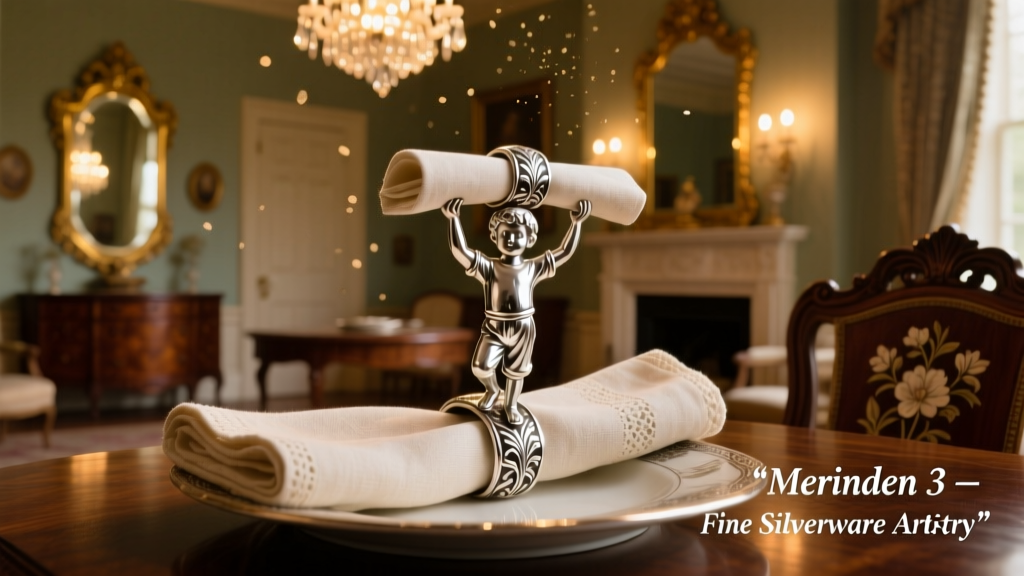
Meriden Silver Plate Figural Boy Napkin Ring: Identification, History, and Restoration Guidance

Railroad Stock Certificates: Historical Significance, Authentication, and Conservation Practices
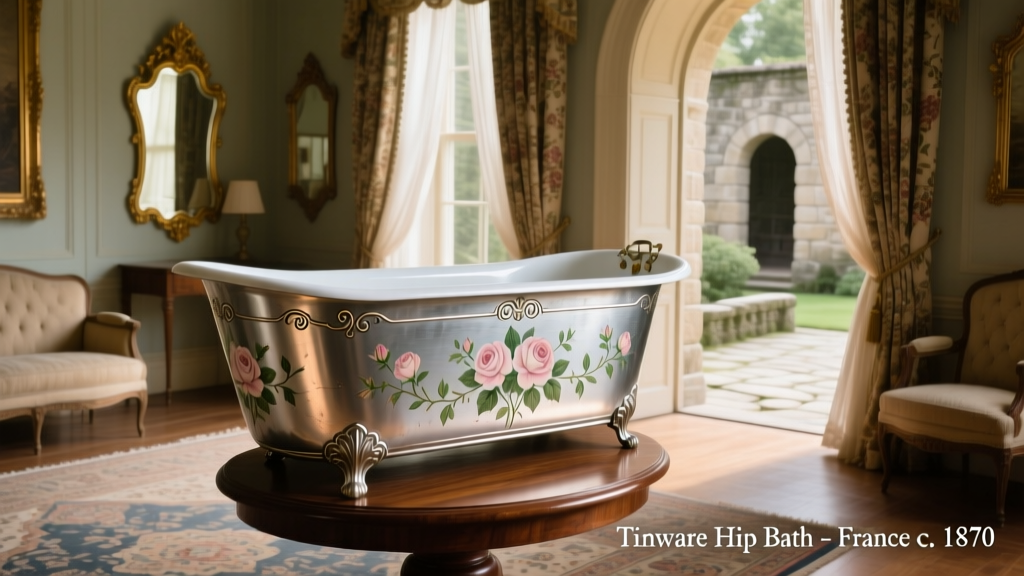
Tinware Hip Bath, Painted France, Circa 1870 — A 38-Inch Masterpiece of Victorian Hygiene and Artistry
The 1138962: Decoding the Herman Miller Eames Lounge Chair & Ottoman Production Code
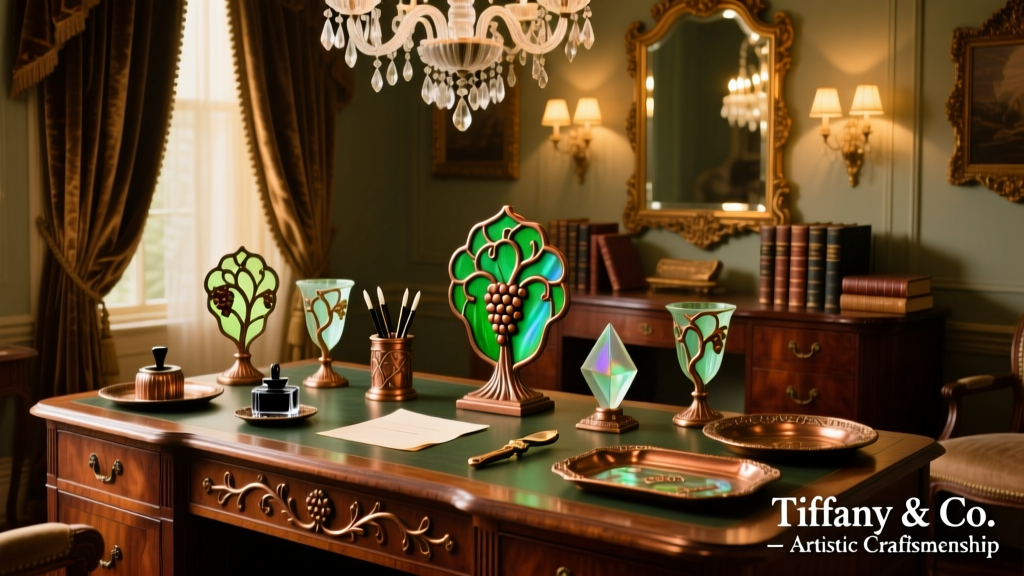
Tiffany Desk Set: Grapevine Bronze & Green Slag Glass — A 12-Piece Art Nouveau Masterpiece
Tiffany & Co. Silver Berry Fork: A Collector’s Guide to the Iconic Strawberry Fork (2-Tine, 4¼")
Sewing Box Bakelite: Identification, History, and Restoration of Mid-Century American and British Bakelite Sewing Boxes