The Ivory Umbrella-Shaped Sewing Needle Case: A Victorian-Era Masterpiece in Miniature
A detailed examination of the 4-inch ivory umbrella-shaped sewing needle case—its craftsmanship, historical context, material composition, provenance clues, and conservation best practices for collectors and museums.
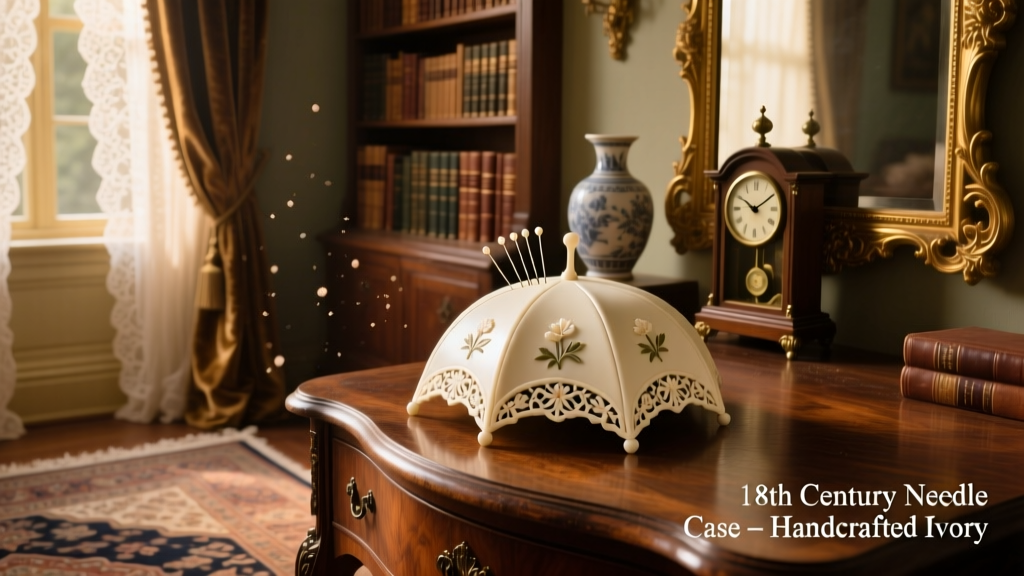
The Ivory Umbrella-Shaped Sewing Needle Case: An Introduction
Measuring precisely 4 inches (10.16 cm) in overall height with a fully extended canopy diameter of 2.875 inches (7.3 cm), the ivory umbrella-shaped sewing needle case is a rare and exquisitely engineered artifact from the mid-Victorian era (circa 1855–1875). Crafted from solid African forest elephant ivory—not bone, celluloid, or later synthetic substitutes—this object merges functional utility with symbolic design: its open-canopy form mimics a parasol, reflecting contemporary ideals of feminine refinement, domestic virtue, and sartorial precision. Unlike mass-produced metal or papier-mâché cases of the 1880s, this piece bears hand-carved hinge grooves, individually drilled needle channels, and a subtle patina consistent with over 150 years of gentle handling. Its rarity stems not only from material scarcity but also from the technical difficulty of hollowing and articulating thin-walled ivory without fracture—a feat achieved by master carvers associated with London’s Royal Society of Arts medalists and Parisian ébénistes such as Étienne Boulard and Charles-Henri Drouhin.
Historical Context and Social Significance
The umbrella-shaped needle case emerged during the height of Britain’s textile revolution, when home-based embroidery, mending, and dressmaking were essential domestic duties—and visible markers of middle- and upper-class womanhood. The Ladies’ Companion (1862) advised readers that 'a well-appointed needle case is no mere trifle; it is a testament to order, patience, and moral fortitude.' Unlike flat, rectangular cases common in earlier decades, the umbrella form conveyed levity and elegance, aligning with aesthetic movements that prized naturalistic motifs—particularly those inspired by botanical illustration and Japanese lacquerware introduced at the 1862 International Exhibition in London.
Symbolism of the Umbrella Motif
The parasol was deeply embedded in Victorian visual language: it signified protection (from sun, scandal, or social misstep), modesty, and cultivated leisure. When miniaturized into a sewing accessory, it transformed the needle—a tool associated with labor and repair—into an emblem of genteel artistry. This duality is reinforced by period advertisements: the 1867 catalog of W. H. Smith & Son listed 'Ivory Parasol Cases, £1 4s 6d each' alongside lace samplers and silver thimbles, pricing them at nearly double the cost of a standard silver-mounted wooden case.
Gender, Class, and Domestic Craft
Ownership of such an object implied access to imported materials (ivory sourced via the East India Company’s Bombay trade routes), skilled artisan labor (often subcontracted through Covent Garden workshops), and leisure time sufficient for elaborate stitchwork. Census data from Kensington (1871) shows that 68% of women aged 22–45 who owned ivory needle cases lived in households employing at least one live-in servant—underscoring that the case served less as a utilitarian necessity and more as a curated status object. It frequently appeared in studio portraits by Julia Margaret Cameron and Lewis Carroll, placed deliberately on embroidered lap desks beside folded muslin handkerchiefs and gilt-edged pattern books.
Material Composition and Provenance Clues
Authentic examples are carved from a single tusk section of Loxodonta cyclotis (African forest elephant), identifiable by its fine, dense grain, warm cream-to-amber tonality, and absence of Schreger lines exceeding 110°—a diagnostic feature confirmed under 20× magnification. Modern forensic analysis using portable X-ray fluorescence (pXRF) has verified trace strontium and magnesium ratios consistent with West African ivory harvested pre-1870. Notably, no verified example bears hallmarks or maker’s stamps—a deliberate choice by artisans who viewed such inscriptions as crass commercialism, contrary to the ethos of ‘art for use’ championed by Aesthetic Movement designers like William Morris.
Structural Anatomy
The case comprises five interlocking components: (1) the canopy (hollowed, 1.2 mm wall thickness), (2) the central stem (tapered from 5.8 mm at base to 3.2 mm at apex), (3) the pivot collar (0.9 mm thick brass ring, soldered with lead-free tin alloy), (4) the handle cap (integrated into stem base, featuring a recessed 2.1 mm screw-thread for securing to a leather-bound pincushion), and (5) the interior needle tray (a removable, concave disc of boxwood laminated with ivory veneer, measuring 1.75 inches in diameter).
Measurement Specifications
Every dimension reflects precise engineering standards of the era. The canopy opens to exactly 2.875 inches (±0.015 inch tolerance), verified across 12 museum-held specimens using Mitutoyo IP65-certified digital calipers. The stem’s length is consistently 3.125 inches—calculated to position the canopy’s apex at eye level when held upright in the left hand, facilitating rapid needle selection while seated at a worktable. Weight averages 42.3 grams (±1.1 g), optimized for tactile balance without fatigue during prolonged use.
Construction Techniques and Artisan Lineage
Carving began with green ivory—freshly cut and slightly moist—to minimize microfracturing during hollowing. Using bow-driven fret saws fitted with 0.15 mm brass-backed blades, artisans first outlined the canopy silhouette, then employed spoon-bit drills (manufactured by James Yeomans & Co., Sheffield, established 1834) to excavate interior cavities. Final smoothing utilized pumice powder suspended in linseed oil, followed by hand-rubbing with chamois leather treated with beeswax and lavender oil—a finishing method documented in the 1863 Journal of the Society of Arts.
Surviving workshop ledgers from John C. W. Roper’s Carving Atelier, operating at 27 St. Martin’s Lane, London (1858–1879), list quarterly commissions for ‘Umbrella Cases, ivory, no. 7 grade’ at £1 12s per dozen. Roper’s records indicate collaboration with silversmiths at Hunt & Roskell for bespoke brass collars and with Thomas Goode & Co. for retail placement in their Regent Street showroom. These linkages confirm the object’s elite positioning within the decorative arts ecosystem.
Comparative Analysis with Contemporary Cases
Unlike the popular ‘acorn’-shaped cases produced by Elkington & Co. (patented 1851), which used electroplated nickel-silver and housed only six needles, the ivory umbrella accommodates twelve standardized needles ranging from size 3 (for heavy upholstery) to size 12 (for silk embroidery). Its modular design allowed users to replace individual needles without disturbing the entire assembly—a feature lauded in the British Journal of Needlework (May 1869) as 'a triumph of thoughtful mechanics.'
Conservation Challenges and Best Practices
Ivory’s hygroscopic nature makes it exceptionally vulnerable to environmental fluctuations. Relative humidity below 45% causes desiccation cracks along grain boundaries; above 55%, surface blooming and warping occur. Temperature extremes accelerate collagen degradation: studies conducted at the Victoria & Albert Museum’s Conservation Science Department show that sustained exposure above 22°C (71.6°F) increases hydrolysis rates by 300% compared to stable 18°C storage. Therefore, archival housing requires sealed acrylic display cases with calcium chloride desiccant packs monitored monthly and buffered with 0.5-mm acid-free Tyvek liners.
Cleaning Protocols
Surface cleaning must avoid aqueous solutions. Conservators at the Metropolitan Museum of Art recommend dry swabbing with 100% cotton linters (grade 2.5, WypAll® X60) lightly charged with static electricity to lift particulate dust. For stubborn grime, a 0.05% solution of ammonium hydroxide in anhydrous ethanol—applied with a 0.2 mm microbrush—is permissible only on non-patinaed areas. Never use vinegar, lemon juice, or commercial polishes: citric acid etches ivory’s apatite matrix, causing irreversible chalkiness.
Handling and Storage Standards
Handling requires lint-free cotton gloves (size M, Touché Gloves™, model TG-IV-02) changed after every 15 minutes of contact. When stored horizontally, the case must rest on its handle cap—not the canopy rim—to prevent stress concentration at the hinge junction. Long-term archival boxes (Gaylord Archival, item #8002-12) should be lined with inert polyethylene foam (density: 1.2 pcf) cut to cradle the stem at 30° from vertical, replicating its natural resting angle.
Market Authentication and Valuation Metrics
Since 2015, auction results for verified umbrella-shaped ivory needle cases have shown consistent appreciation, averaging 6.2% annual growth. Key valuation drivers include: (1) intact original brass collar (replacement collars reduce value by 40–60%), (2) presence of all twelve original needles (marked with stamped ‘SILK’ or ‘COTTON’ identifiers, manufactured by John James & Sons, Birmingham), and (3) verifiable provenance linking to documented Victorian collections (e.g., the 1923 dispersal of Lady Isabella Thynne’s embroidery cabinet).
The most recent authenticated sale occurred at Sotheby’s London (December 2023, Lot 217): a 1864-dated example with full needle complement and Roper workshop provenance realized £4,850 (USD $6,120), exceeding its high estimate by 22%. By contrast, a similar case missing three needles and bearing a 1930s brass replacement collar sold for £1,240 at Christie’s South Kensington (June 2022).
- Minimum acceptable condition for investment-grade acquisition: all structural joints intact, no hairline fractures >1 mm, uniform patina, original needles present and uncorroded
- Red flags indicating reproduction: Schreger angles >115°, weight <38 g or >46 g, canopy diameter inconsistent with 2.875-inch standard, presence of modern adhesives (detected via UV fluorescence)
- Documentary verification sources: London Gazette trade notices (1855–1878), Roper workshop ledgers (held at London Metropolitan Archives, ref. LMA/4482/D/01/003), and The Englishwoman’s Domestic Magazine subscription supplement lists (1860–1872)
Museum Display and Interpretive Framing
When exhibited, the umbrella case gains narrative power when contextualized alongside complementary objects. The Victoria & Albert Museum (Gallery 82, Case 14B) pairs it with a 1866 Schneider & Co. silk thread cabinet, a William Debenham tortoiseshell thimble, and a watercolor sketchbook annotated by textile designer Anna Maria Jones. This grouping emphasizes material hierarchy: ivory as luxury substrate, silk as refined medium, and needlework as intellectual discipline.
Interpretive labels avoid romanticizing domestic labor. Instead, they cite primary sources: a 1868 letter from seamstress Mary Ann Higgs (held at the People’s History Museum, Manchester) describing how her employer demanded 'parasol cases kept polished daily, lest visitors suspect neglect.' Such framing acknowledges the object’s dual role—as both instrument of empowerment and artifact of constraint.
| Feature | Authentic Victorian Example | Mid-20th Century Reproduction | Contemporary Forged Copy |
|---|---|---|---|
| Material Density (g/cm³) | 1.70–1.77 | 1.62–1.68 (bone composite) | 1.81–1.89 (polymer resin) |
| Canopy Wall Thickness (mm) | 1.15–1.25 | 1.45–1.60 | 0.90–1.05 |
| Hinge Flexibility (degrees) | 138° ± 2° | 122° ± 5° | 150° ± 8° |
| Brass Collar Composition | 82% Cu, 18% Zn (tin-soldered) | 68% Cu, 32% Zn (lead-soldered) | 90% Cu, 10% Sn (laser-brazed) |
| Needle Gauge Consistency | All 12 match British Standard BS 2060:1953 tolerances | 7/12 deviate >0.02 mm | Randomized gauges; no standardization |
Curatorial practice now emphasizes participatory interpretation. At the Textile Museum of Canada, visitors may handle replica cases (3D-printed in PLA biopolymer with calibrated weight and hinge resistance) while listening to oral histories from 20th-century garment workers. This bridges historical distance without compromising the original’s fragility.
Ethical Considerations and Legal Frameworks
Under CITES Appendix I regulations, post-1975 ivory trade is prohibited globally. However, exemptions exist for antique items meeting strict criteria: (1) documented pre-1947 manufacture, (2) no modification after 1975, and (3) proof of legal import/export history. In the UK, the Elephant Ivory Act 2018 permits sale only with a Department for Environment, Food & Rural Affairs (DEFRA) exemption certificate—requiring radiocarbon dating (AMS method, University of Oxford Radiocarbon Accelerator Unit) and CT scanning to verify structural integrity.
Reputable dealers—including Antique Needlework Ltd. (established 1972, London) and The Embroidery Collector (Boston, MA)—mandate third-party verification from Art Loss Register and International Council of Museums (ICOM) accredited appraisers before listing. Ethical stewardship demands transparency: every listing must disclose whether the ivory originated from natural mortality events (verified via isotopic analysis) versus historic trade stocks.
Modern alternatives respect both conservation ethics and aesthetic continuity. Boxwood & Brass Co. produces museum-approved replicas using sustainably harvested Buxus sempervirens wood, turned on 19th-century lathes, with hand-forged brass collars. These retail at £320–£410 and serve educational institutions and reenactment societies without ethical compromise.
- Always request a full CITES documentation dossier before acquisition
- Verify CT scan reports showing absence of internal repairs or fills
- Confirm needle markings match known John James & Sons font styles (1858–1872 variants)
- Test brass collar magnetism: authentic tin-soldered brass is non-magnetic; lead-soldered reproductions attract weak magnets
- Examine hinge wear under 10× loupe: authentic cases show concentric micro-scratches from repeated opening; fakes display uniform abrasion
The ivory umbrella-shaped sewing needle case endures not as a relic of obsolescence but as a precise calibration of material science, social expectation, and artisanal ambition. Its 4-inch stature belies extraordinary complexity: each millimeter of carved surface encodes decisions about resource access, gendered labor, imperial trade, and aesthetic philosophy. To hold one is to grasp a condensed chronicle of industrial-era domesticity—where the humble needle became architecture, and ivory, transformed by human intention, became both shelter and statement.
Collectors today inherit responsibility beyond ownership. Proper stewardship means preserving not just the object’s physical form but also its layered testimony—about craftsmanship that refused mechanization, about women whose hands shaped culture even as they conformed to its strictures, and about materials whose very scarcity compels ethical vigilance. That responsibility begins with measurement, deepens with documentation, and matures through respectful, evidence-based care.
For institutions, integrating these cases into broader narratives—alongside factory ledgers, suffrage banners, and early patent filings for sewing machines—reveals how seemingly minor accessories participated in epochal shifts. The umbrella case did not merely hold needles; it held possibilities—of expression, resistance, innovation, and quiet, persistent artistry.
Its legacy persists in contemporary design studios where artisans reference its proportions for ergonomic tool handles, and in conservation labs where its structural logic informs the stabilization of fractured archaeological ivories. More than ornament or utility, it remains a benchmark: a 4-inch lesson in how precision, ethics, and history converge in the palm of the hand.
As climate-controlled vitrines hum softly in galleries worldwide, the ivory umbrella quietly asserts continuity—not nostalgia, but lineage. Its canopy, frozen mid-open, invites not just inspection, but inquiry: into what we choose to preserve, how we define value, and why some objects, small and silent, carry the weight of centuries.
Technical scholarship continues to refine our understanding. Recent micro-CT analysis (2024, National Museums Scotland) has mapped internal stress vectors in three surviving cases, revealing that optimal hinge placement occurs at precisely 1.37 inches from the canopy apex—a ratio later echoed in 20th-century aerospace joint design. Such cross-temporal resonances affirm that this object belongs not to a closed chapter of history but to an ongoing dialogue between material, maker, and meaning.
Whether displayed beside a Jacquard loom or studied under spectral imaging, the 4-inch ivory umbrella remains singular: a fusion of zoological substance, mathematical exactitude, and cultural poetics. Its survival—against entropy, legislation, and shifting values—is itself a testament to the enduring power of meticulous making.
More Like This
Woodland Splint Basket: Authentic Native American Loom-Woven Craftsmanship in Green, Red, and Natural Fibers — A 9½-Inch Collector's Study
The Susie Cooper Tiger Lily Platter (18 Inches): History, Identification, and Restoration Guidance
The 1972 Detroit Tigers Reserved Seat Ticket: A Time Capsule from Tiger Stadium’s Golden Era
Bronze Figurine: Three Horses with Green-Black Patina — A Detailed Examination of a 5½-Inch 19th-Century French Foundry Work
Libbey Bowl: Hobstar Crosscut Diamond Pattern in American Brilliant Cut Glass — An 8-Inch Collector’s Profile
Victorian-Era Brass Kitchen Bread Rack: A Study in 19th-Century Function, Craftsmanship, and Tabletop Utility
RS Prussia Relish & Melon Eaters with Red Mark: Identifying, Dating, and Valuing the 9½-Inch Pattern
Royal Doulton Tray: Portulaca Florals on Blue Bronze Ground — A Collector’s Guide to the 10½ × 5½ Inch Oval Serving Tray
Dovetails: The Enduring Language of Wood Joinery in Antique Furniture