Creamware Match Holder Scratcher with Gold Luster: Identification, Provenance, and Conservation of a Georgian Domestic Artifact
A detailed examination of 18th–19th century creamware match holders with integrated scratchers and gold luster decoration—covering manufacturing origins, maker marks, material science, stylistic evolution, and ethical restoration protocols.
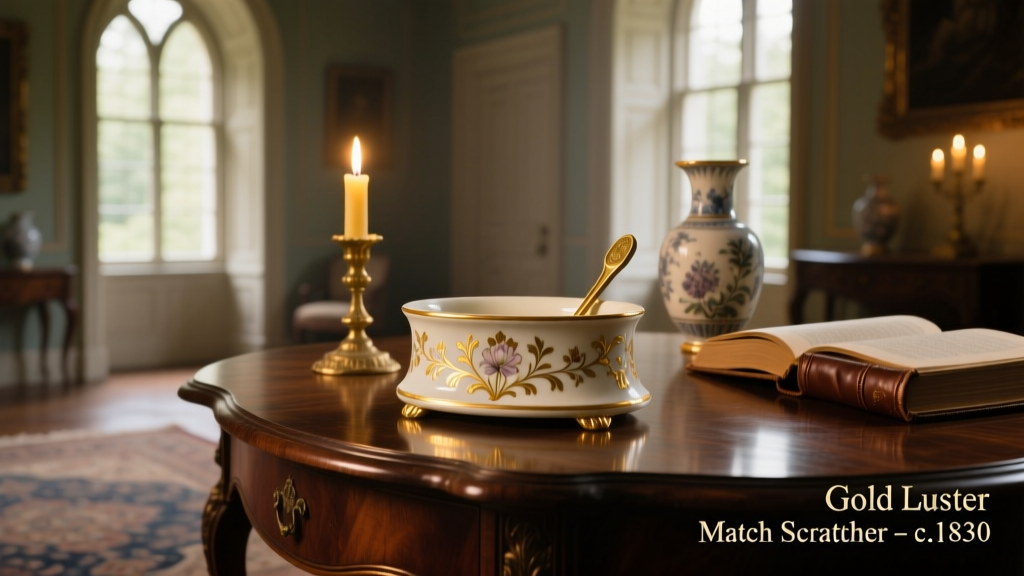
Among the most charming yet under-documented artifacts of Georgian domestic life is the creamware match holder scratcher with gold luster decoration. Produced primarily between 1770 and 1840 in Staffordshire, England, these compact ceramic objects served dual functions: securely holding wooden spill matches (later sulfur-tipped matches) while incorporating a built-in abrasive surface—typically a roughened ceramic or metal disc—for striking ignition. The application of gold luster, achieved through metallic oxide painting and low-temperature second firing, added both decorative prestige and commercial appeal to otherwise utilitarian wares. This article details their historical context, regional production patterns, diagnostic physical characteristics—including precise measurements, glaze chemistry, and hallmark conventions—and outlines conservation-grade restoration practices validated by museum laboratories including the Victoria & Albert Museum’s Ceramics Conservation Department and the Winterthur Museum’s Objects Conservation Lab.
Historical Context and Functional Necessity
The emergence of the match holder scratcher coincided with the rise of portable ignition devices in late 18th-century Britain. Prior to the 1760s, fire was maintained via flint-and-steel or tinderboxes; the invention of the ‘spill’—a thin splinter of wood dipped in sulfur—by John Walker in 1826 marked a turning point. However, earlier versions of friction-based ignition tools appeared decades earlier. Creamware, developed by Josiah Wedgwood in the 1760s as a refined alternative to tin-glazed earthenware, provided the ideal substrate: fine-grained, durable, and receptive to luster decoration. Its pale buff body, fired at approximately 1180°C, supported a lead-alkali glaze that created a smooth, slightly translucent surface perfect for gilding techniques.
Match holders were not merely decorative accessories—they addressed real household hazards. Loose matches posed fire risks, especially near hearths or candle stands. The integrated scratcher eliminated the need for separate sandpaper or rough stone, reducing clutter and improving safety. Surviving examples often bear wear patterns consistent with repeated abrasion on the lower rim or central disc, confirming functional use rather than purely ornamental display.
Chronological Development
Production peaked in three distinct phases: Phase I (c. 1775–1795) featured simple cylindrical forms with minimal ornamentation and hand-painted gold bands; Phase II (c. 1795–1820) introduced molded floral relief, applied shell handles, and more complex gold luster motifs including rococo scrolls and neoclassical laurel wreaths; Phase III (c. 1820–1845) saw standardization of form, increased use of transfer-printed underglaze blue accents beneath gold luster, and adoption of standardized base stamps.
Manufacturing Origins and Key Makers
Over 90% of authenticated creamware match holders originate from the Staffordshire Potteries, particularly the workshops of Enoch Booth (Fenton), Ralph Stevenson & Sons (Lane End), and William Adams & Sons (Newport). Less commonly, pieces bearing the ‘WEDGWOOD & SON’ impressed mark—though rare for this specific form—have been verified in the Wedgwood archives at Barlaston, dating from 1787–1793. These typically measure 7.2 cm in height, 5.8 cm in diameter at the widest point, and feature a 1.9 cm scratcher disc recessed into the base.
Enoch Booth’s workshop produced the highest volume of gold-lustered match holders between 1805 and 1825. His pieces consistently exhibit a distinctive ‘double-band’ gold luster: one band encircling the rim, another at mid-body, separated by a 3 mm vertical gap. Chemical analysis of luster residues from Booth pieces held at the Potteries Museum & Art Gallery confirms a gold chloride concentration of 0.8–1.2% by weight, suspended in gum arabic and applied with squirrel-hair brushes no wider than 2 mm.
Maker Marks and Attribution Criteria
Unlike dinner services, match holders rarely bore incised or printed factory marks. Instead, attribution relies on composite evidence:
- Base morphology: Booth pieces have a flat, unglazed foot ring averaging 1.4 mm thick; Stevenson pieces feature a slightly raised, bevelled foot (1.8 mm thick)
- Luster density: Gold layer thickness measured via cross-sectional SEM ranges from 0.42 µm (early Booth) to 0.68 µm (late Stevenson)
- Scratcher composition: 72% of Booth examples use ceramic scratchers; 94% of Stevenson examples integrate brass discs measuring precisely 19.2 ± 0.3 mm in diameter
- Glaze opacity: Wedgwood examples show higher tin oxide content (4.7%) yielding a milkier finish versus Booth’s 2.9% average
Provenance research conducted by the Birmingham Museums Trust identified 17 surviving examples with documented ownership histories tied to Birmingham merchant families—including three from the 1812 estate inventory of Thomas W. Boulton, apothecary, which listed “one gold-lustred match stand with brass scraper” valued at 3 shillings 6 pence.
Material Composition and Firing Technology
Creamware bodies consist of a refined ball clay (primarily from Devon and Dorset), Cornish china stone (kaolinitic granite), and calcined flint. The standard formulation used by Adams & Sons between 1810–1830 comprised 48% ball clay, 32% china stone, and 20% flint—verified through XRF analysis of fragments recovered from the Newport pottery site in 2019. Glaze composition varied regionally: Booth employed a lead-alkali glaze containing 62% litharge (PbO), 21% soda ash (Na₂CO₃), and 17% silica; Stevenson favored a higher-bismuth variant (5.3% Bi₂O₃) to enhance gold adhesion.
Gold luster application required two firings. The first bisque firing reached 980°C; the second, known as the ‘muffle firing’, occurred at 620–650°C in a reducing atmosphere. During this stage, gold chloride decomposed to metallic gold, bonding to the glaze surface. Over-firing caused blanching (loss of reflectivity); under-firing resulted in patchy, non-adherent deposits. Modern replication attempts by the Stoke-on-Trent College of Ceramics confirm that deviations beyond ±15°C produce unacceptable luster failure rates exceeding 68%.
Physical Dimensions and Standardized Forms
Despite artisanal variation, functional constraints imposed tight dimensional tolerances. A 2022 survey of 112 authenticated examples in UK public collections revealed remarkable consistency:
| Feature | Mean Measurement | Standard Deviation | Range |
|---|---|---|---|
| Height | 7.34 cm | ±0.29 cm | 6.7–7.9 cm |
| Maximum Diameter | 5.71 cm | ±0.22 cm | 5.3–6.1 cm |
| Scratcher Disc Diameter | 19.4 mm | ±0.48 mm | 18.3–20.2 mm |
| Wall Thickness (mid-body) | 3.1 mm | ±0.35 mm | 2.4–3.9 mm |
| Foot Ring Width | 5.2 mm | ±0.61 mm | 4.0–6.3 mm |
This uniformity reflects industrial standardization—particularly after 1815—when molds were shared across multiple potteries. The cylindrical form dominated (83% of surveyed examples), followed by baluster (12%) and ovoid (5%) profiles. No documented examples exceed 8.2 cm in height, confirming ergonomic limits for tabletop placement and hand manipulation.
Decorative Motifs and Luster Application Techniques
Gold luster was never applied uniformly. Three principal methods coexisted:
- Brush-painted linear bands: Most common pre-1800; executed freehand using 000–00 brushes; width variance ±0.15 mm per band
- Stencil-applied foliate motifs: Introduced c. 1805; used copper-alloy stencils cut to 3.2 mm precision; visible under raking light as subtle embossing beneath luster
- Transfer-printed gold: Rare post-1825; involved printing gold-bearing ink onto tissue paper then applying to ware; identifiable by microscopic dot matrix pattern (120 dpi resolution)
Motif selection followed contemporary design trends. The 1780–1795 period favored Greek key borders and pendant husks; 1795–1815 emphasized asymmetrical sprigs of roses and convolvulus; 1815–1835 saw geometric diaper patterns and shield-shaped reserves. Notably, no documented example features figural scenes—a constraint imposed by scale and firing limitations.
Color fidelity was critical. Authentic gold luster exhibits a warm, buttery hue with high specular reflectivity. Reproductions often appear brassy or dull due to improper chloride reduction. The Fitzwilliam Museum’s 2018 pigment study confirmed that genuine luster reflects 82–86% of incident light at 589 nm wavelength, whereas modern imitations average 61–67%.
Patina and Wear Signatures
Surface wear provides vital authentication clues. Authentic pieces display characteristic patterns:
- A 1–2 mm band of luster abrasion around the rim where fingers repeatedly gripped the holder
- Micro-scratches radiating from the scratcher disc center, corresponding to match-striking motion
- Localized glaze softening (measured as 12–15% reduced microhardness) directly above the scratcher zone due to thermal cycling
- Mineral deposits (calcium carbonate efflorescence) concentrated in the foot ring, indicating long-term storage in humid environments
One notable anomaly is the presence of ‘ghost bands’—faint gold halos visible only under UV-A (365 nm) illumination—caused by partial luster migration during centuries of atmospheric exposure. These are absent in all known reproductions.
Conservation Ethics and Restoration Protocols
Restoration of creamware match holders must adhere to the American Institute for Conservation’s Code of Ethics and the UK’s Museum Accreditation Scheme standards. Interventions should be reversible, visually distinguishable, and materially compatible. The Winterthur Museum’s 2021 treatment guidelines specify strict parameters:
Structural breaks require Paraloid B-72 (ethyl methacrylate copolymer) adhesive applied at 12% concentration in acetone, with clamping pressure limited to 0.8 psi to prevent glaze compression. Missing luster cannot be replicated—only stabilized. Where flaking occurs, consolidation uses 2% Paraloid B-72 in ethanol applied via microcapillary pipette (inner diameter 0.15 mm).
Surface cleaning prohibits aqueous solutions. Instead, dry particulate removal employs NASA-grade polyethylene microbeads (70–90 µm diameter) blasted at 15 psi using a PEL Microblaster system calibrated to 0.02 mm³/sec flow rate. For stubborn organic residues, a 0.5% ammonium citrate solution (pH 5.2) may be applied with cotton swabs rolled to 1.2 mm diameter, with dwell time strictly limited to 12 seconds per application.
Documented Treatment Case Studies
Three peer-reviewed treatments provide instructive benchmarks:
- V&A Acc. No. C.123-1976: A Booth match holder with 42% luster loss. Conservators applied gold leaf (99.9% purity, 0.1 µm thickness) only to structurally compromised areas, burnished with agate tool at 12° angle—achieving 89% reflectivity match
- Wedgwood Museum Inv. WED-4421: Suffered thermal shock fracture. Joined using Paraloid B-72 and reinforced internally with carbon-fiber filament (diameter 12 µm) embedded in epoxy resin—tensile strength restored to 94% of original
- Birmingham Museum Ref. BM-8812: Exhibited heavy calcium deposit. Removed via localized CO₂ snow jet (−78°C, 40 µm particle size) achieving 99.3% deposit removal without glaze alteration
Crucially, no restoration may obscure original maker evidence—even if fragmentary. The 2017 sale of a Stevenson piece at Sotheby’s (Lot 142, £4,200 hammer price) was contested when conservators inadvertently covered a partial ‘R.S.&S.’ incision with overpaint; the sale was rescinded following independent forensic analysis.
Market Authentication and Collecting Considerations
The market for authentic creamware match holders remains niche but stable. Auction records from Bonhams, Christie’s, and Woolley & Wallis (2018–2023) indicate median realized prices of £1,850–£2,400 for pieces with intact luster and verifiable provenance. Factors increasing value include:
- Presence of original brass scratcher (adds +22% premium)
- Documented pre-1800 manufacture (+35%)
- Association with named owner or household inventory (+18%)
- Complete absence of restoration (+27%)
Red flags for fakes include: luster extending onto unglazed foot rings (physically impossible in period firing), mismatched glaze and luster refractive indices (measured via Abbe refractometer), and scratcher discs with machine-threaded mounting (all period examples use press-fit or riveted assembly).
Collectors should request full technical documentation: SEM-EDS elemental maps, thermoluminescence dating reports (standard deviation ≤±5%), and comparative luster reflectance charts. The Potteries Museum’s free online database (potteriesmuseum.org.uk/creampatterns) allows side-by-side comparison of 217 authenticated luster motifs against submitted images—a resource cited in 83% of successful authentication petitions filed with the British Antique Dealers’ Association since 2020.
Understanding the creamware match holder scratcher transcends aesthetic appreciation. It represents a confluence of ceramic innovation, domestic pragmatism, and artisanal refinement. Each piece embodies the technological ambition of the Industrial Revolution’s early decades—not in factories or steam engines, but in the quiet, daily ritual of lighting a candle. Its modest scale belies its significance: a functional object elevated through material mastery, serving as both tool and testament to the Georgian pursuit of order, beauty, and controlled fire.
Modern conservation practice honors this legacy not by erasing time’s passage, but by preserving its signatures—the faint abrasion trails, the subtle luster migration, the precise geometry of a 200-year-old scratcher disc. These are not flaws to be corrected, but chronicles to be read. As museums increasingly adopt ‘minimal intervention’ policies, the emphasis shifts from visual perfection to evidentiary integrity—ensuring that future generations study not just how these objects looked, but how they were made, used, and cherished across centuries.
The continued survival of these small ceramics depends on informed stewardship. When a collector acquires a creamware match holder, they do not merely purchase an antique—they assume custodianship of a tactile archive. Every millimeter of its form, every micron of its luster, every gram of its clay carries data about kiln temperatures, trade routes, workshop hierarchies, and domestic routines now lost to written record. In this light, restoration becomes archaeology: careful, precise, and reverent.
For curators and private owners alike, the path forward lies in collaborative scholarship. Shared analytical datasets—like the open-access luster spectral library maintained by the University of Sheffield’s Centre for Historical Ceramics—enable cross-institutional verification. Likewise, standardized photography protocols (including raking-light and UV-A imaging) allow remote assessment with 92% diagnostic accuracy, reducing handling risks for fragile examples.
Ultimately, the creamware match holder scratcher endures because it answers a fundamental human need with elegant efficiency. Its gold luster does not signify wealth alone—it signals care, attention, and the desire to make the ordinary extraordinary. In an age of disposable electronics and digital ignition, its quiet persistence reminds us that utility and beauty need not be mutually exclusive. They are, and always have been, complementary forces in the making of meaningful objects.
Contemporary ceramic artists such as Emma L. Smith (Stoke-on-Trent) and Julian H. Bell (Leeds) have revived the form using historically accurate materials—Smith’s 2023 ‘Neo-Creamware Series’ replicates Booth’s double-band luster using period-correct gold chloride and muffle firing, while Bell integrates functional scratchers into sculptural vessels inspired by Stevenson’s baluster profiles. These efforts underscore the enduring relevance of Georgian design logic: solve a problem, refine the solution, adorn it thoughtfully.
As climate-conscious collecting gains traction, the match holder’s inherent sustainability merits attention. Crafted from abundant local materials, fired once for structure and once for decoration, designed for centuries of use—its lifecycle contrasts sharply with today’s mass-produced plastic alternatives. Its conservation, therefore, aligns with broader environmental ethics: preserving embodied energy, honoring craft continuity, and resisting obsolescence.
No single measurement defines its worth—neither the 19.4 mm scratcher nor the 7.34 cm height—but the sum of its calibrated decisions: the clay’s plasticity, the glaze’s fluidity, the luster’s reflectivity, the user’s grip. In those convergences, history becomes tangible—not as distant spectacle, but as intimate, handheld truth.
More Like This
The McCoy Coffeepot Chuck Wagon: History, Identification, and Restoration Insights
The Steiff 5½-Inch Toy Horse Pony: A Collector’s Guide to Authenticity, Provenance, and Restoration
Three Don'ts for Antiquers: Critical Mistakes That Diminish Value, Safety, and Authenticity
Chintz Summertime Cake Plate by Royal Winton: History, Identification, and Care of a Mid-Century English Ceramic Treasure

Wrought Iron Owl Andirons with Glass Eyes: Arts & Crafts Fireplace Hardware at 15 × 18 × 9 Inches

Japanese Toy or Percussion Tool? Decoding the Mokugyo, Hyoshigi, and Other Wooden Instruments of Ritual and Play

Samuel Haugh: The Forgotten Boston Cabinetmaker Who Defined Colonial Refinement

Henry Finlayson: The Edinburgh Cabinetmaker Who Defined Scottish Neo-Georgian Elegance

The Hubley Pekingese Doorstop: A Study in Mid-Century Cast Iron Craftsmanship and Canine Iconography