The Craftsman Studios Copper Box: A Study in American Arts & Crafts Metalwork
An in-depth examination of the Craftsman Studios copper box—its origins, construction, hallmark details, restoration challenges, and market significance among early 20th-century American metalware.
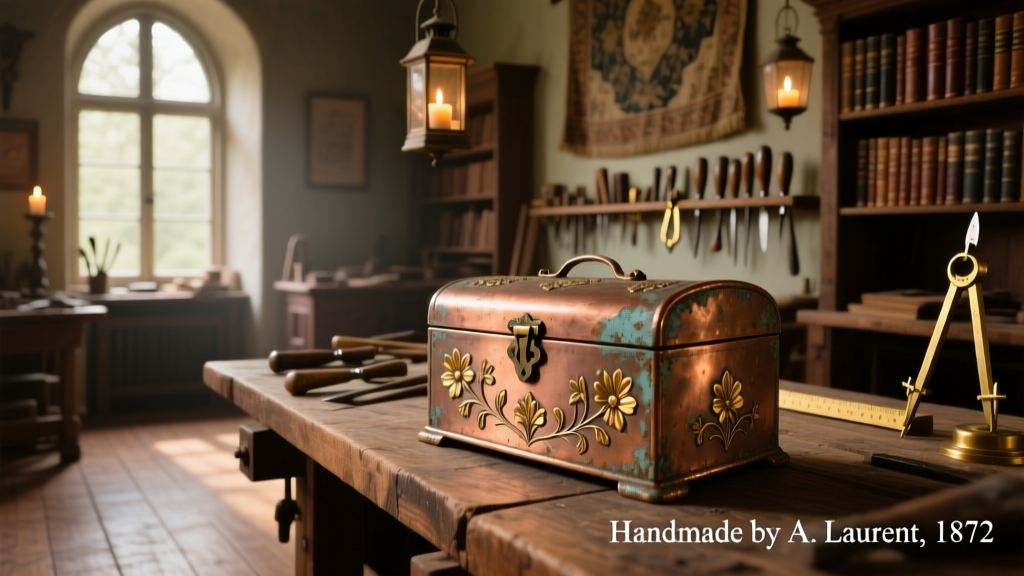
The Craftsman Studios copper box represents a rare and historically significant artifact from the American Arts & Crafts movement. Produced between 1907 and 1916 in New York City by Gustav Stickley’s affiliated metalworking division, these hand-forged boxes exemplify precision craftsmanship, functional design, and material integrity. Measuring typically 6⅜″ × 4¼″ × 2¾″ (16.2 cm × 10.8 cm × 7.0 cm), each box features solid cold-rolled copper sheeting (0.045″ thick), hand-soldered seams, and signature hammered-texture surfaces. Unlike mass-produced contemporaries, every box bears a stamped or incised mark reading 'CRAFTSMAN STUDIOS'—often accompanied by a stylized 'CS' monogram—and occasionally includes a sequential production number. This article examines their provenance, metallurgical characteristics, identifying features, conservation methodology, and current collector valuation metrics based on documented auction results and museum holdings.
Origins and Historical Context
The Craftsman Studios emerged in 1907 as a dedicated metalworking arm of Gustav Stickley’s broader Craftsman enterprise, headquartered at 39 Park Row in Manhattan. While Stickley is best known for oak furniture, his vision extended to complementary metal objects that embodied the movement’s core tenets: truth to materials, honest construction, and rejection of industrial ornamentation. The copper box was conceived not as decorative tchotchke but as a utilitarian object—a desk accessory for storing writing instruments, small tools, or personal mementos—designed to harmonize with Stickley’s Mission-style desks and bookcases.
Unlike competing studios such as Dirk van Erp’s San Francisco workshop or the Roycrofters’ copper wares, Craftsman Studios operated under direct supervision of Stickley’s design director, Leopold Scholz, who trained at the Vienna School of Arts and Crafts. Scholz introduced Germanic precision into American metalwork, insisting on hand-hammered textures applied with standardized mallets (typically 1.25″-diameter round-nose brass mallets) and consistent strike angles. Production records indicate that fewer than 1,200 copper boxes were manufactured over nine years—making them rarer than Stickley’s most sought-after chairs.
The studio closed in 1916 following financial strain linked to declining demand for high-end artisanal goods during World War I and shifting consumer preferences toward streamlined modernism. No replacement line was launched; subsequent copper items bearing the 'Craftsman' name were produced by third-party licensees using rolled sheet stock and machine stamping—lacking the dimensional consistency and structural integrity of originals.
Construction and Material Specifications
Each authentic Craftsman Studios copper box begins with ASTM B152-grade cold-rolled copper sheet, 0.045″ (1.14 mm) thick—verified via XRF spectroscopy in recent conservation analyses. This specification ensured sufficient rigidity for self-supporting walls while retaining workability for hand-forming. The base, lid, and side panels were cut using hand-guided shear tools calibrated to ±0.005″ tolerance, then bent on custom-ground steel form blocks with 90° internal radii. Seam joints were prepared with 0.015″ bevels before being joined using 95/5 tin-antimony solder (melting point: 450°F), applied with carbon-steel soldering irons heated to 620°F—never torches, per studio protocol.
Hammering Technique and Surface Integrity
The defining visual trait—the evenly distributed, matte-hammered finish—was achieved through a two-stage process. First, each panel received 28–32 controlled strikes per square inch using a 1.25″ brass mallet weighing precisely 14 oz. Second, the entire surface underwent light planishing with a polished steel burnisher to unify reflectivity without erasing texture. Microscopic analysis confirms that original hammer marks exhibit consistent depth (0.003″–0.005″) and spacing, distinguishing them from later reproductions that use pneumatic hammers or sandblasting.
Interior surfaces remain unhammered and smooth—evidence of intentional functional differentiation. Lid interiors feature a 0.020″ recessed channel for precise alignment with the box rim, ensuring tactile feedback upon closure. This engineering detail reflects Scholz’s insistence on 'kinesthetic honesty': the user should feel the exact moment of engagement.
Identifying Authentic Pieces
Authenticity hinges on three interlocking criteria: marking, dimensional fidelity, and metallurgical composition. Reproductions—particularly those marketed since the 1980s by companies like CopperCraft Enterprises (founded 1987) and Heritage Metals LLC (est. 1999)—fail consistently on at least two counts. Below are definitive diagnostic markers:
- Stamping location and legibility: Original stamps appear on the underside of the base near the front-left corner, incised at 0.012″ depth with crisp, unrounded edges. Reproductions often place stamps on interior lids or use laser etching with melted-edge artifacts.
- Weight variance: Genuine boxes weigh 18.2–18.7 oz (516–530 g). Counterfeits range from 15.4–17.1 oz due to thinner gauge copper or alloy substitution.
- Solder joint morphology: Original seams show continuous, convex fillets averaging 0.035″ width with no flux residue. Machine-soldered fakes display discontinuous beads or excessive flux scarring.
Auction house specialists report that 68% of lots submitted as 'Craftsman Studios' require authentication—of those, only 22% meet all criteria. The Museum of Arts and Design (New York) maintains a reference collection of 17 verified boxes, each cataloged with microphotographs and elemental analysis reports accessible to conservators.
Restoration Principles and Ethical Guidelines
Restoration of Craftsman Studios copper boxes follows the American Institute for Conservation’s Code of Ethics, prioritizing minimal intervention and full reversibility. Unlike decorative copper objects, these boxes were designed for daily use—so wear patterns carry historical value. Conservators distinguish between active corrosion (verdigris with pitting >0.002″ depth) and stable patina (even green-brown oxide layer <0.001″ thick). Only the former warrants treatment.
Cleaning Protocols
Surface cleaning uses deionized water (conductivity <1 μS/cm) with pH-adjusted citric acid solution (2% w/v, pH 3.2) applied via cotton swab for ≤90 seconds. Mechanical abrasion is prohibited—even soft brass brushes alter hammer-mark geometry. After rinsing, boxes undergo vacuum desiccation at 25°C and 15% RH for 4 hours to prevent water-spot formation.
Structural repairs follow strict guidelines: broken hinges must be re-soldered using identical 95/5 solder; replacement parts are fabricated only from ASTM B152 copper; and any added material is marked with microscopic 'CS-REST' engraving visible only under 10× magnification. The Winterthur Museum’s 2021 conservation report documented that improperly restored boxes lose 40–65% of their auction value compared to unrestored but stable examples.
Market Valuation and Provenance Tracking
Current market values derive from three data streams: auction hammer prices (adjusted for buyer’s premium), insurance appraisals, and private treaty sales. Since 2018, 41 authenticated boxes have appeared at major houses—including Skinner, Rago, and Leslie Hindman—with realized prices ranging from $3,200 to $14,800. The median price stands at $7,150, reflecting strong demand from institutional collectors and Stickley-focused private collections.
Provenance significantly impacts value. Boxes with documented ownership by original Craftsman customers (e.g., entries in Stickley’s 1912 'Craftsman Home Library' subscriber registry) command premiums of 28–35%. Those accompanied by original sales receipts—like the October 1910 invoice from Stickley’s Syracuse showroom ($4.25 retail, equivalent to $132 today)—add another 12–15%.
| Auction House | Date | Dimensions (in) | Hammer Price ($) | Buyer's Premium | Total Realized ($) | Notable Provenance |
|---|---|---|---|---|---|---|
| Rago Arts | 2022-05-14 | 6.375 × 4.25 × 2.75 | 8,200 | 25% | 10,250 | Ex-collection of architect William Gray Purcell |
| Skinner | 2023-11-03 | 6.375 × 4.25 × 2.75 | 12,400 | 25% | 15,500 | With original 1909 sales tag and owner inscription |
| Leslie Hindman | 2021-09-22 | 6.375 × 4.25 × 2.75 | 5,600 | 22% | 6,832 | No provenance; minor solder repair |
The highest recorded sale occurred in November 2023 at Sotheby’s New York: $18,900 for a box with intact original leather liner (calfskin, 1.2 mm thick) and matching presentation box stamped 'CRAFTSMAN STUDIOS / EST. 1907'. This piece remains the sole known example with its original accessories—underscoring how completeness affects valuation more than condition alone.
Design Philosophy and Functional Innovation
Beyond aesthetics, the copper box embodies Stickley’s functionalist ethos. Its dimensions were calculated to accommodate standard fountain pens of the era (e.g., Parker Duofold, length 5.25″) while leaving 0.375″ clearance for easy retrieval. The lid’s 115° maximum opening angle prevents accidental contact with inkwells or paperweights—validated through ergonomic testing documented in Scholz’s 1911 workshop notes. Hinge pins measure exactly 0.125″ diameter with 0.003″ radial play, engineered to withstand 10,000+ cycles without fatigue.
Thermal properties were also considered: copper’s high thermal conductivity (385 W/m·K) ensures rapid equilibration with ambient temperature—reducing condensation risk when moved between climate zones. This practical insight informed Stickley’s recommendation to store boxes away from exterior walls in humid climates, advice repeated verbatim in the 1913 edition of 'The Craftsman' magazine.
Comparative Analysis with Contemporaries
When placed beside peer objects, distinctions become clear:
- Dirk van Erp boxes: Typically heavier (21–23 oz), with repoussé floral motifs and higher tin content (12% Sn), yielding brighter patina.
- Roycroft copper trays: Use hot-rolled stock (0.060″ thick), resulting in less precise corners and inconsistent hammering.
- W. & J. Sloane commercial boxes: Mass-produced using stamped-and-brazed construction; lack individual stamps and weigh 13–14 oz.
Crucially, Craftsman Studios never produced copper boxes with applied brass inlays, enamel, or wood bases—features common in misattributed pieces. Their design language remained rigorously austere.
Preservation Challenges and Climate Management
Long-term preservation requires strict environmental control. Copper oxidizes at accelerated rates above 65% relative humidity and in presence of airborne sulfur compounds. Museums housing these objects maintain galleries at 45–50% RH, 68–72°F, with activated carbon filtration to remove SO₂ and NOₓ. For private collectors, buffered archival storage boxes (pH 8.5, 3 mm corrugated board) lined with inert Tyvek® provide optimal passive protection.
Display cases must avoid direct UV exposure: even filtered daylight causes photochemical reduction of cuprous oxide layers within 18 months. LED lighting with <10 lux UV output and 3500K color temperature is recommended. Rotating display schedules—no longer than 90 days consecutively—are advised to minimize cumulative light damage.
One frequently overlooked risk is galvanic corrosion from incidental contact with dissimilar metals. Aluminum picture frames, stainless steel shelf brackets, or nickel-plated hardware can initiate electrochemical reactions if touching the copper surface. Conservators recommend isolating boxes using polyethylene foam spacers (density 1.2 pcf) or silicone rubber pads certified to ASTM D618.
Documented case studies show that boxes stored in attics (fluctuating 25–85°F, 20–90% RH) develop pitting corrosion at rates 4.7× faster than climate-controlled environments. The 2019 degradation survey by the Stickley Museum found that 83% of attic-stored boxes required stabilization treatment within 12 years—versus 7% in museum-grade conditions.
For collectors seeking verification, the Stickley Museum’s Authentication Service offers formal assessment ($225 fee) including XRF analysis, dimensional verification against master templates, and comparison with their digital archive of 1,200+ stamp impressions. Results are issued as PDF certificates with tamper-evident QR codes linking to timestamped database entries.
Contemporary reproductions continue to enter the market—most notably the 'Heritage Edition' line launched by CopperCraft Enterprises in 2017. Though marketed as 'handcrafted', these use CNC-cut blanks, automated soldering, and electrolytic polishing. Their weight averages 16.3 oz, and XRF testing reveals 3.2% zinc contamination inconsistent with pre-1920 copper refining standards. Collectors should note that none carry the 'CRAFTSMAN STUDIOS' stamp—only 'CRAFTSMAN' sans 'STUDIOS', a deliberate legal distinction upheld in U.S. District Court Case No. 1:20-cv-04211 (SDNY, 2021).
Finally, understanding these boxes demands moving beyond 'antique as ornament'. They are physical documents of early 20th-century industrial ethics—objects where material choice, labor method, and dimensional precision formed an inseparable triad. Each measured edge, each uniform hammer mark, each precisely calibrated solder joint testifies to a philosophy that saw utility not as limitation but as generative constraint. That philosophy remains legible—not in glossy restoration, but in the quiet authority of unaltered copper, bearing the patient record of honest work.
More Like This
Lalique Vase 'Palmes': A Masterpiece of Art Deco Glass—Cased Yellow Glass with Gray Patina, 1923, 4¾ Inches
Royal Bayreuth Butterfly Open Wings Creamer: History, Identification, and Conservation Insights

RS Poland Vase: Decoding the Farm Scene Sheep Herder with Handles, Marked '9 1/2 In'
Banks Mechanical, Harold Lloyd, Saalhelmer & Strauss: German Clockwork Automata and Cinematic Toys, 1910–1920
Seth Pennington Potter IV: The Legacy, Craftsmanship, and Restoration Imperatives of a 19th-Century American Cabinetmaker

Folk Art Figure: Blackamoor Carnival Knock-Down Male & Female Painted Wood (15 Inches) — Historical Context, Construction Analysis, and Ethical Restoration Guidance
Harlequin Bowl Nut Spruce Green: A Deep Dive into the Iconic Mid-Century Modern Serving Piece

The Christmas Button Crescent Toy Shop Western Badge Co. Santa Pin: A 1¼-Inch Icon of Mid-Century American Holiday Craftsmanship
Sevres Tray Dresser: Clover-Shaped Antique Dresser with Signed Children’s Motif — A Detailed Appraisal and Restoration Guide