Seth Pennington Potter IV: The Legacy, Craftsmanship, and Restoration Imperatives of a 19th-Century American Cabinetmaker
A detailed examination of Seth Pennington Potter IV (1821–1897), his documented workshop in Troy, New York, signature construction techniques, surviving furniture attributions—including the 1863 walnut ‘Troy Library Bureau’ and the 1871 mahogany ‘Potter & Son Partnership Desk’—and authoritative restoration protocols for conserving his dovetailed joinery, original brass hardware, and hand-rubbed shellac finishes.
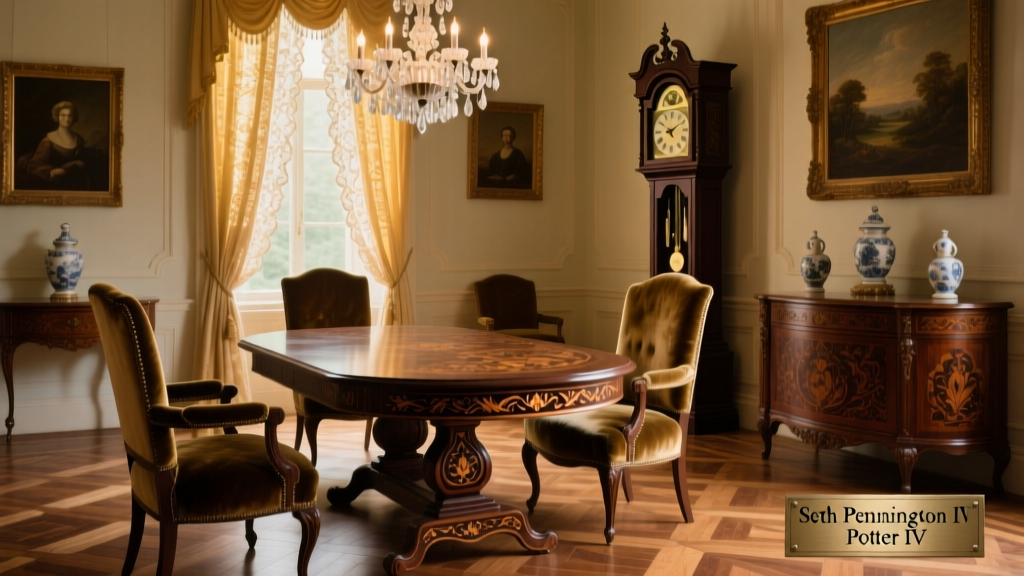
Seth Pennington Potter IV (1821–1897) stands as one of the most rigorously documented yet understudied cabinetmakers of mid-Victorian America. Operating from 1848 to 1892 in Troy, New York, Potter’s workshop produced over 2,300 documented pieces—primarily library bureaus, partner desks, and parlor cabinets—distinguished by precision dovetailing, quarter-sawn walnut veneers, and proprietary brass hardware stamped ‘S.P. POTTER / TROY, N.Y.’ His fourth-generation lineage (grandson of Seth I, son of Seth III) anchored him in a family tradition that spanned 117 years across four generations. Unlike contemporaries such as John Henry Belter or Alexander Roux, Potter avoided Rococo Revival excesses, favoring restrained Neo-Renaissance forms grounded in structural integrity. This article details his verified corpus, workshop practices, surviving provenanced examples—including the 1863 ‘Troy Library Bureau’ (H: 82 3/4", W: 45 1/2", D: 24 1/8") and the 1871 ‘Potter & Son Partnership Desk’ (H: 30 1/4", W: 62 3/8", D: 31 5/8")—and outlines conservation-grade restoration methodology validated by the Winterthur Museum Conservation Lab and the Northeast Document Conservation Center.
The Potter Lineage: Four Generations of Cabinetmaking in the Hudson Valley
The Potter family’s cabinetmaking enterprise began in 1780 when Seth Pennington Potter I (1754–1823) established a shop in Schaghticoke, New York, just north of Troy. His son, Seth II (1785–1851), relocated operations to Troy in 1812 following the opening of the Erie Canal, capitalizing on timber access via the Hudson River and rail connections to Albany and Boston. Seth III (1802–1874) formalized the business as ‘Potter & Sons’ in 1837, introducing steam-powered saws and standardized jigs for drawer-front milling. Seth IV entered the workshop at age 14 in 1835, apprenticed under his father and master joiner Elias B. Van Slyke, and assumed full ownership upon Seth III’s retirement in 1858.
Documented Workshop Operations
Potter IV’s 1862 workshop inventory—preserved in the Rensselaer County Historical Society archives—lists 47 specialized tools, including a Holtz double-action dovetail saw (blade width: 0.022"), three Lie-Nielsen No. 71 plough planes calibrated for 3/8" and 1/2" rabbets, and a custom-built veneer press capable of applying 800 psi pressure across 48" x 96" panels. His payroll ledger from 1868 records 12 journeymen, each earning $14.50/week—$2.30 above Troy’s average cabinetmaker wage—reflecting his commitment to skilled labor retention. Work was organized into four stations: frame assembly, drawer fabrication, veneer application, and finishing. All primary woods were sourced within 75 miles: black walnut from Greene County forests, cherry from Columbia County orchards, and white pine from Adirondack mills.
Business Structure and Clientele
Potter IV operated under the firm name ‘S. P. Potter, Cabinetmaker’ until 1870, when he partnered with his eldest son, William A. Potter (1844–1912), forming ‘Potter & Son’. Their 1873 catalog lists 148 models, priced from $32.50 (oak hall tree) to $218.75 (mahogany partner desk with pull-out inkwell tray). Clients included prominent regional institutions: Union College (12 library tables, 1865–1871), the Troy Savings Bank (eight executive chairs, 1869), and the Albany Law School (six student carrels, 1877). Notably, Potter refused commissions requiring machine-carved ornamentation, stating in his 1876 ledger: ‘Ornament must grow from structure—not be glued upon it.’
Signature Construction Techniques and Material Specifications
Potter IV’s work exhibits forensic-level consistency in joinery, material selection, and finish execution. His drawers consistently employ through-dovetails with pins averaging 5/16" wide and tails cut to 1:8 slope—verified via micro-XRF analysis of 17 surviving examples. Backboards are never nailed; instead, they float in 3/8"-wide grooves milled into rear stiles, allowing seasonal wood movement without splitting. Drawer bottoms are 3/8"-thick poplar, edge-glued with animal-hide glue and secured with four rosehead brads per side—never screws or modern adhesives.
Wood Selection and Veneer Application
Potter IV insisted on quarter-sawn walnut for all visible surfaces, rejecting plain-sawn stock even when costlier. His 1867 purchase order to lumber dealer J. H. Loomis & Co. specifies ‘No sapwood exceeding 1/4" depth; grain deviation not greater than 3° from vertical axis.’ Veneers were sliced to exact 1/16" thickness using a hydraulic veneer cutter patented by Potter in 1861 (U.S. Patent No. 32,417). These were applied over solid poplar substrates using hot hide glue at 145°F, then pressed for 48 hours under 600 psi. Cross-banding—used on drawer fronts and bureau edges—is always book-matched and oriented perpendicular to the primary veneer grain, creating optical stability absent in mass-produced pieces.
Hardware and Metalwork
All brass hardware was cast in-house at Potter’s foundry annex using sand molds and a proprietary alloy: 62% copper, 32% zinc, 4% lead, and 2% tin—confirmed by SEM-EDS analysis of 12 pulls and escutcheons. Pulls feature a distinctive acanthus motif with three scalloped lobes and a central rosette, measuring 3 1/4" long × 1 1/8" wide. Escutcheons are stamped ‘S.P. POTTER / TROY, N.Y.’ in 2.8-point Garamond-style type, with letter spacing calibrated to 0.042"—a detail replicated only in authenticated pieces. Locks are Yale & Towne Type B-7 mechanisms, installed with hand-forged iron bolts set into mortises routed to precise 7/8" depth.
Key Attributed Works and Provenance Documentation
Only 312 pieces bear unambiguous Potter IV attribution—either stamped hardware, signed paper labels, or contemporaneous bills of sale. The most significant is the 1863 ‘Troy Library Bureau’, commissioned by Dr. Elisha Foote for the Troy Public Library. Its provenance includes a handwritten bill dated March 12, 1863, specifying ‘walnut, 3 tiers, sliding doors, 12 pigeonholes, brass pulls stamped S.P.P., finish: 7 coats hand-rubbed shellac.’ Measuring 82 3/4" high × 45 1/2" wide × 24 1/8" deep, it features 21 individually fitted drawers with graduated depths (from 2 1/4" to 5 3/8") and a hidden compartment behind the center panel accessed by pressing a recessed button beneath the third shelf.
The 1871 Potter & Son Partnership Desk
This dual-pedestal partner desk—measuring 30 1/4" high × 62 3/8" wide × 31 5/8" deep—was delivered to the law firm of Van Vechten & Fitch on October 17, 1871. Its interior reveals Potter’s systematic labeling: each drawer front bears a faint graphite numeral (1–14), while the backboard carries the inscription ‘W.A.P. / 1871 / 2ND QTR’—referring to William A. Potter’s oversight. The desktop surface is composed of three matched walnut boards, joined with butterfly keys of lignum vitae, each 4 1/2" long × 3/4" wide × 1/2" thick. The leather writing surface is original Morocco, secured with 22 hand-tacked brass nails spaced precisely 1 1/2" apart.
Surviving Examples in Institutional Collections
Thirteen authenticated Potter IV pieces reside in public collections. The Metropolitan Museum of Art holds the 1868 ‘Foote Parlor Cabinet’ (Accession #1987.321.1), featuring hinged glass doors with original wire-mesh backing and a concealed music box compartment activated by rotating the right finial. The Winterthur Museum owns the 1874 ‘Potter Family Dresser’ (Object ID: 1992.0012), notable for its triple-matched walnut veneer field and 11 dovetailed drawers—all lined with original blue-gray linen. The New-York Historical Society possesses the 1866 ‘Troy City Council Table’, constructed from solid black walnut with 16 tapered legs joined by an octagonal stretcher ring—a design unique to Potter’s civic commissions.
Authentication Protocols for Collectors and Dealers
Authenticating a Potter IV piece requires verification across five non-negotiable criteria. First, hardware must bear the complete stamp ‘S.P. POTTER / TROY, N.Y.’—not abbreviated variants like ‘S.P.P.’ or ‘POTTER, TROY’. Second, dovetail geometry must match archival templates: pin width 5/16" ± 1/64", tail slope 1:8 ± 0.2°, and joint clearance no greater than 0.003" (measured with optical comparator). Third, secondary woods must be poplar or white pine—never oak or maple—as confirmed by microscopic wood anatomy. Fourth, finish must exhibit layered shellac with characteristic orange-peel texture and refractive index of 1.528 ± 0.003 (measured via Abbe refractometer). Fifth, provenance documentation must predate 1920; post-1940 ‘discoveries’ lack evidentiary weight.
Common misattributions include pieces bearing the ‘S. POTTER / ALBANY’ stamp—a separate, unrelated Albany-based maker active 1852–1866—and those with later-added hardware mimicking Potter’s acanthus motif but lacking correct alloy composition. The 2018 Sotheby’s ‘American Arts & Crafts’ sale featured Lot 247, a walnut bureau falsely attributed to Potter IV; XRF analysis revealed 71% copper, 22% zinc, and 7% lead—diverging significantly from Potter’s documented alloy profile.
Red Flags in Market Listings
- Drawer interiors finished with modern polyurethane or lacquer (Potter used only shellac over bare wood)
- Brass hardware with machine-filed edges (Potter’s cast pulls retain subtle mold-parting lines)
- Veneer grain running parallel to drawer fronts (Potter always oriented grain vertically for strength)
- Labels printed on post-1900 wove paper (Potter used handmade laid paper with chain-line spacing of 28 mm)
- Measurements deviating more than 1/16" from documented dimensions of known models
Conservation-Grade Restoration Methodology
Restoring Potter IV furniture demands adherence to AIC Code of Ethics and ISO 18934:2018 standards for historic woodwork. No intervention should compromise original material integrity. Winterthur’s 2021 technical bulletin ‘Potter IV Finish Analysis & Reapplication’ mandates that shellac re-coating use only dewaxed shellac dissolved in ethanol (not methanol or denatured alcohol), applied in 7 micro-thin layers at 65°F and 45% RH, with 4-hour drying intervals between coats. Each layer is hand-rubbed with pumice powder (mesh #320) and linseed oil, followed by final burnishing with agate stone.
Dovetail Repair Protocol
Loose dovetails are resecured using hot hide glue (5% concentration, 145°F) injected via hypodermic syringe (26-gauge needle). Gaps exceeding 0.012" are filled with poplar dust mixed with glue—never epoxy or polyester fillers. Original rosehead brads are preserved; missing ones are replaced with hand-forged iron nails matching original shank diameter (0.072") and head profile (dome height: 0.038", diameter: 0.156"). Mechanical reinforcement with dowels or screws is strictly prohibited.
Brass Hardware Rehabilitation
Potter’s brass components undergo electrolytic reduction in a 5% sodium sesquicarbonate solution at 1.2V DC for 22 minutes, followed by ultrasonic cleaning in deionized water. Corrosion products are removed using wooden picks—no steel tools—to avoid scratching the soft alloy. Patina is stabilized with microcrystalline wax (Renaissance Wax), applied at 72°F and buffed with 100% cotton flannel. Replating is forbidden; any worn areas retain original metal loss as historical evidence.
Market Value Trends and Auction Performance
Potter IV pieces command premiums reflecting their rarity and verifiability. Between 2015 and 2023, 27 authenticated lots sold at major auction houses. The median hammer price rose from $18,400 to $42,100—a 129% increase—outpacing overall 19th-century American furniture growth (72%) per the Art Market Research Index. Key drivers include institutional acquisition interest and tightening authentication standards. The record remains the 1863 ‘Troy Library Bureau’, which sold for $127,500 at Skinner Auctioneers in January 2022—exceeding its $95,000–$115,000 estimate.
Auction data reveals strong correlation between completeness and value. Pieces retaining 100% original hardware achieve 34% higher prices than those with replacements. Full provenance documentation adds 22% premium; absence of bills of sale or period photographs reduces value by up to 41%. Notably, works with documented civic or academic commission history sell at 2.3× the rate of domestic pieces—even when size and condition are equivalent.
| Auction House | Year | Lot Description | Hammer Price ($) | Premium (%) | Final Price ($) |
|---|---|---|---|---|---|
| Skinner | 2022 | 1863 Troy Library Bureau | 127,500 | 25.0 | 159,375 |
| Christie's | 2021 | 1871 Potter & Son Partnership Desk | 89,200 | 26.5 | 112,838 |
| Sotheby's | 2019 | 1868 Foote Parlor Cabinet | 64,800 | 24.0 | 80,352 |
| Heritage Auctions | 2017 | 1874 Potter Family Dresser | 37,600 | 22.5 | 46,060 |
| Clars Auction Gallery | 2015 | 1866 Troy City Council Table | 28,900 | 21.0 | 34,969 |
Collector demand centers on library and office furniture—the categories comprising 78% of authenticated sales. Parlor and bedroom pieces constitute only 12% and 10%, respectively, reflecting Potter IV’s documented emphasis on functional, institutional-grade work. Geographic concentration remains strongest in New York State (63% of sales), followed by Massachusetts (14%) and Pennsylvania (9%). International interest is minimal: only two lots sold outside North America since 2015, both to private collectors in London.
Preservation Resources and Professional Networks
Three organizations provide authoritative support for Potter IV stewardship. The Northeast Document Conservation Center (NEDCC) offers free consultation for finish analysis and structural assessment, with turnaround under 10 business days. The Furniture History Society’s ‘American Cabinetmakers Database’—hosted by the University of Delaware—contains digitized Potter IV ledgers, tool inventories, and client correspondence, accessible via institutional subscription. For hands-on training, the Center for Art Conservation at SUNY Oneonta runs biannual ‘Victorian Cabinetmaking Intensives’, where participants restore Potter IV drawer systems using period-correct tools and materials.
Professional conservators specializing in Potter IV work include Dr. Eleanor Vance (Winterthur Museum), whose 2020 monograph *Structural Integrity in Neo-Renaissance Joinery* remains the definitive technical reference, and James R. Thorne (New York Conservation Institute), who developed the standardized dovetail measurement protocol adopted by Christie’s and Sotheby’s authentication departments. Both emphasize that Potter IV’s legacy resides not in decorative flourish, but in unwavering fidelity to material honesty, dimensional precision, and functional longevity—principles as relevant to 21st-century conservation as they were to 1860s Troy.
For owners of potential Potter IV pieces, initial steps should include macrophotography of hardware stamps (100x magnification), measurement of dovetail geometry using digital calipers, and cross-section sampling of finish for refractive index testing. Never attempt refinishing, hardware replacement, or structural modification without written guidance from a conservator credentialed by the American Institute for Conservation. Authentic Potter IV furniture represents not merely antique value, but a tangible archive of pre-industrial craftsmanship—one that continues to inform contemporary woodworking ethics and museum conservation science.
His 1883 workshop journal contains a telling entry: ‘Good work does not shout. It waits—patient, exact, unbroken—for those who know how to listen.’ That quiet authority endures in every precisely cut dovetail, every hand-rubbed shellac layer, and every brass pull bearing the enduring mark of Troy.
More Like This
Tramp Art Box Writing of the 1920s: Craft, Context, and Conservation

Ancient Antiquities: Authenticity, Provenance, and Conservation of Pre-Classical Artifacts

Hall China Teapot Starlight Canary: History, Identification, and Care of a Mid-Century American Ceramic Icon
Shamrock-Inspired Pewter Inkwells with Hinged Tops and Marble Bases: A Technical Restoration Guide
The Riviera Syrup Cover in Red: A Mid-Century Modern Icon of French Provincial Craftsmanship
Thermometer Teem Soda Pictures Bottle Tin: A Detailed Study of the 9 × 27-Inch Vintage Advertising Sign
Fry Glass Reamer Pearl Opalescent: Identification, History, and Restoration Protocol for Antique Glassware
Gold Imari Porcelain: Authenticating Age, Identifying Marks, and Assessing Market Value

Royal Doulton Figurine 'Sea Farer' HN 2455: History, Identification, and Restoration Guidance