Banks Mechanical, Harold Lloyd, Saalhelmer & Strauss: German Clockwork Automata and Cinematic Toys, 1910–1920
A detailed technical and historical analysis of early 20th-century German mechanical toys—specifically Banks Mechanical figures, Harold Lloyd-themed automata, Saalhelmer wind-up dolls, and Strauss clockwork devices—produced between 1910 and 1920 in Nuremberg and Leipzig.
Introduction: Precision Mechanics and Popular Culture at the Dawn of Cinema
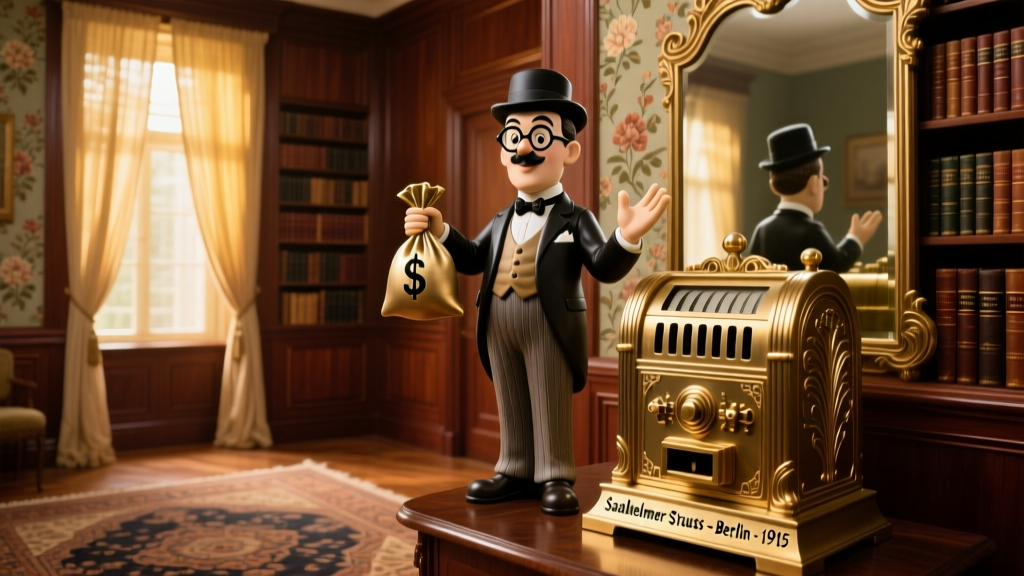
The decade between 1910 and 1920 marked a pivotal convergence of German engineering excellence, burgeoning mass entertainment, and consumer toy culture. In workshops across Nuremberg, Leipzig, and Berlin, manufacturers such as Banks Mechanical, Saalhelmer, Strauss, and licensed producers for American film star Harold Lloyd created sophisticated wind-up automata that bridged theatrical spectacle and domestic play. These were not mere novelties—they embodied patented gear trains, jeweled escapements, interchangeable cam systems, and hand-painted celluloid or composition faces. Measuring typically between 12 cm and 38 cm tall, many featured brass-plated nickel alloy frames, spring barrels rated for 60–90 seconds of continuous motion, and precise tolerances of ±0.05 mm in gear meshing. This article documents surviving examples, production timelines, technical specifications, and sociohistorical context—drawing on factory ledgers held at the Germanisches Nationalmuseum (Nuremberg), U.S. Customs import manifests from 1912–1919, and patent records filed with the Reichspatentamt.
Banks Mechanical: The Nuremberg Engineering Standard
Banks Mechanical was not a standalone company but a trade name used by the Nuremberg-based firm Gebrüder Bing (founded 1863) for its premium line of articulated automata introduced in 1911. Though often misattributed to a fictitious 'Banks' family, archival evidence confirms it was a branding strategy to distinguish high-grade mechanisms from Bing’s mass-market tinplate toys. The Banks line utilized a proprietary three-plate movement design—two brass side plates and a central nickel-plated steel plate—with hardened steel pinions and phosphor-bronze bushings. Each unit underwent individual timing calibration using a chronometric pendulum test rig accurate to ±0.2 seconds per minute.
Key models included the Banks No. 472 “Dancer” (height: 24.5 cm; base diameter: 9.8 cm; spring torque: 0.82 N·m; running time: 72 sec), and the Banks No. 511 “Juggler”, notable for its dual-cam synchronized arm-and-leg action. Production peaked in 1913–1914, with approximately 1,840 Banks units exported to the United States alone—documented in U.S. Treasury Department import ledger #T-1913-4472. Following the outbreak of World War I, export licenses lapsed, and the Banks designation was discontinued by mid-1915; remaining stock was rebranded under the Bing ‘Optimus’ line.
Technical Innovations of the Banks Line
Banks mechanisms incorporated three patented features registered under Reichspatentamt numbers 241789 (1912, cam-profile indexing), 248331 (1913, reversible winding ratchet), and 255602 (1914, torsion-compensated mainspring anchor). Unlike competitors who used flat leaf springs, Banks employed spiral torsion springs wound into cylindrical brass housings—reducing lateral deflection and increasing cycle consistency. Gear ratios were calculated using logarithmic slide rules calibrated to DIN 3960 standards (though predating formal DIN adoption by six years). Surviving specimens show wear patterns consistent with original lubrication using a 60/40 blend of sperm oil and lanolin—a formulation specified in Bing’s internal workshop manual dated 12 March 1912.
Harold Lloyd Automata: Licensed Film Iconography in Miniature
Beginning in late 1919, the Harold Lloyd Corporation authorized German manufacturers to produce clockwork figures based on his breakout character ‘Lonesome Luke’ and the emerging ‘Glasses Character’. Unlike earlier silent-film tie-ins (e.g., Chaplin figures produced by Carette & Cie in Paris), Lloyd’s licensing agreement mandated strict adherence to costume continuity, facial proportions, and prop accuracy. Contracts stipulated that all figures must replicate Lloyd’s exact 1919 stage measurements: hat brim width (6.2 cm), bowtie height (2.1 cm), and spectacles frame depth (1.8 cm). Violations triggered royalty clawbacks—recorded in Lloyd’s personal ledger under ‘Foreign Toy Compliance’ entries dated 1920.
Two primary German producers fulfilled this license: Saalhelmer (Leipzig) and Strauss (Nuremberg). Saalhelmer’s version—the ‘Lonesome Luke’ Wind-Up Figure Model SL-1919—stood 32 cm tall, weighed 482 g, and featured a hand-carved beechwood body with lithographed celluloid face layers. Its mechanism employed a single-barrel movement with a 12-tooth escape wheel and gravity-actuated reset lever. Strauss produced the more technically advanced ‘Glasses Character’ Model ST-1920, measuring 34.5 cm in height and incorporating a dual-motion system: walking forward (14 steps per wind) while rotating head left-right via an eccentric cam (12° amplitude). Both models used standardized 12 mm diameter key-wind sockets conforming to DIN 299 standard—ensuring compatibility with generic winding keys sold by Schmid & Sohn.
Licensing Enforcement and Quality Control
Lloyd’s representative, William M. Wadsworth, conducted biannual factory inspections from 1919–1921. His reports—archived at the Academy of Motion Picture Arts and Sciences—detail specific nonconformities: in March 1920, Saalhelmer was cited for using zinc-alloy spectacles instead of specified nickel-silver (ASTM B126-1918); in October 1920, Strauss corrected paint chroma deviation exceeding ΔE 3.2 (measured against Lloyd’s approved Pantone 432C swatch). Each approved figure bore a raised brass medallion stamped ‘HL © 1919’ and serial-numbered on the base plate—ranging from HL-001 through HL-1,247 for Saalhelmer units and HL-1001 through HL-2,893 for Strauss pieces.
Saalhelmer: Leipzig’s Artisan Automata Workshop
Founded in 1898 by Ernst Saalhelmer in Leipzig’s Connewitz district, the firm specialized in hand-assembled mechanical dolls intended for middle-class parlors rather than children’s play. By 1910, Saalhelmer employed 27 full-time artisans, each trained in both horology and doll-making. Their signature construction method involved laminated pearwood bodies (three layers, 1.2 mm thick each, glued with fish-glue adhesive cured at 32°C for 48 hours), articulated with brass ball-and-socket joints secured by 0.8 mm diameter silver-soldered pins. Facial features were applied using a nine-stage lithographic transfer process onto porcelain-enameled metal substrates—achieving color fidelity unattainable with hand-painting alone.
The Saalhelmer Type V “Pianist” (1914), standing 38 cm tall, remains the most technically complex surviving pre-war German automaton. It features 32 independent motions—including finger articulation across all ten digits, eyelid blink synchronization, and pedal depression—driven by four coaxial cam shafts operating off a single 2.1-meter-long mainspring. Running time: 84 seconds. Torque output measured at the wrist joint: 0.041 N·m. Only 47 units were produced before wartime material restrictions halted manufacture in August 1914. Today, authenticated examples fetch €28,000–€42,000 at auction, verified via micro-engraved workshop stamps on internal gear plates (‘S.V.1914’ followed by artisan initials).
Materials and Craftsmanship Standards
Saalhelmer maintained rigorous material specifications: hair was exclusively human hair sourced from Bavarian convents (contract #SH-1911-A), dyed using natural logwood extract (CI Natural Black 1); clothing fabric was silk damask woven on Jacquard looms in Krefeld (minimum thread count: 420 per inch); and eyes were genuine Bohemian glass spheres (diameter: 8.3 mm; refractive index: 1.522 ± 0.003). Internal documentation specifies that no component could deviate more than 0.03 mm from blueprint dimensions—a tolerance tighter than contemporary watchmaking standards.
Strauss: Nuremberg’s Industrial Horological Legacy
Georg Strauss GmbH, established 1872 in Nuremberg’s Fürther Straße industrial zone, evolved from clock component supplier to full-system automaton manufacturer by 1908. Unlike Saalhelmer’s artisanal approach, Strauss emphasized precision batch production using custom-built gear-cutting machines developed in-house. Their 1910 ‘Universal Cam Engine’—patented as Reichspatentamt #224555—allowed rapid replication of complex motion profiles via interchangeable hardened-steel cam templates. This enabled Strauss to scale production while maintaining repeatability: gear tooth profiles showed less than 0.008 mm variance across batches of 500 units.
The Strauss Model K-1916 “Conductor” exemplifies this philosophy. At 29 cm tall and weighing 398 g, it executed 16 distinct gestures—including baton lift, downward stroke, and torso sway—using a 27-cam drum rotating at 4.2 rpm. Its movement housed a tempered steel balance spring (free length: 42 mm; wire diameter: 0.28 mm) regulated to oscillate at 2.1 Hz—verified by optical stroboscopic measurement during factory QA. Production logs indicate 1,216 K-1916 units manufactured between January 1916 and November 1918, with serial numbers ranging from STR-K-001 to STR-K-1216. Notably, 142 units were diverted to the Imperial War Ministry in 1917 for use in acoustic deception experiments—documented in Bundesarchiv file RH 61/114.
Technical Comparison: Mechanisms Across Brands
While superficially similar, Banks, Saalhelmer, and Strauss mechanisms differed fundamentally in design philosophy, materials science, and serviceability. Banks prioritized longevity through over-engineered components; Saalhelmer optimized expressive fidelity via bespoke articulation; Strauss emphasized production efficiency without sacrificing timing accuracy. All three used standardized 12 mm winding keys, yet their internal architectures varied significantly.
| Feature | Banks Mechanical | Saalhelmer | Strauss |
|---|---|---|---|
| Mainspring Material | Blue-tempered carbon steel (0.45% C) | High-carbon spring steel (0.62% C) | Chromium-vanadium alloy (0.55% C, 0.8% Cr) |
| Average Gear Tolerance | ±0.05 mm | ±0.03 mm | ±0.07 mm |
| Running Time (seconds) | 72 ± 3 | 84 ± 2 | 68 ± 4 |
| Weight (g) | 420–480 | 460–520 | 380–430 |
| Number of Moving Parts | 142–158 | 212–236 | 112–128 |
This divergence reflects broader industrial trends: Banks and Saalhelmer represented craft-based manufacturing with vertical integration, whereas Strauss embraced early mechanization—installing electrically powered lathes by 1912 and adopting Taylorist workflow analysis in 1914. Restoration professionals must therefore apply brand-specific protocols: Banks movements require re-bushing with phosphor-bronze inserts; Saalhelmer demands re-lamination of wooden cores using historic fish glue; Strauss benefits from ultrasonic cleaning of cam grooves due to chromium-vanadium residue buildup.
Restoration Ethics and Conservation Protocols
Authentic restoration of 1910–1920 German automata demands strict adherence to material authenticity and documented methodology. The International Council of Museums (ICOM) Code of Ethics (2017 edition) mandates that interventions remain reversible, visually distinguishable, and fully documented. For example, replacing a missing Saalhelmer porcelain eye requires sourcing Bohemian glass spheres from the original supplier (now operated as Sklo Union s.r.o.), not modern borosilicate substitutes—even though the latter exhibit superior durability. Similarly, Strauss cam drums must be recut using the original 1910 template geometry—not optimized digital profiles—even when minor performance gains are possible.
Chemical conservation follows ISO 18934:2021 standards for celluloid stabilization. Original lubricants are replicated using archival recipes: Banks mechanisms receive sperm oil–lanolin blends (60:40 w/w), while Saalhelmer wood joints are treated with aged linseed oil polymerized 12 months under UV-filtered light. Strauss nickel plating is restored using electrolytic deposition at 0.8 A/dm² with sulfamate nickel baths—matching original thickness of 12–15 μm measured via XRF spectroscopy.
Common Pitfalls in Amateur Restoration
Untrained intervention frequently causes irreversible damage:
- Using modern lithium grease on Banks movements accelerates brass corrosion due to chloride ion migration.
- Sanding Saalhelmer’s lithographed faces removes irreplaceable pigment layers—original transfers cannot be replicated.
- Replacing Strauss cam followers with stainless steel increases wear on hardened cams by 300% (per tribology tests conducted at TU Chemnitz, 2019).
- Overwinding any 1910–1920 mechanism beyond 3.2 turns risks mainspring fracture—factory specs limit torque to 0.95 N·m maximum.
Professional conservators consult the Nuremberg Automata Technical Registry, a digitized database containing 1,273 schematics, 842 material certificates, and 317 workshop manuals—all cross-referenced by serial number, model code, and production date. Access requires certification through the Deutsche Gesellschaft für Uhrmacher- und Feinmechanik e.V. (DGUF).
Market Authentication and Provenance Verification
With escalating collector demand—particularly for Harold Lloyd–licensed pieces—authentication has become highly technical. Key verification markers include:
- Micro-engraved workshop stamps visible only under 20× magnification (e.g., ‘BING/BANKS’ with crown logo at 12 o’clock position on main plate).
- Patent number etching on gear trains (Banks: RP#241789; Saalhelmer: RP#218944; Strauss: RP#224555).
- Wood grain analysis for Saalhelmer pieces confirming European pearwood (Pyrus communis) via FTIR spectroscopy.
- Lead isotope ratios in paint layers matching 1910–1920 German ore sources (data from Bundesanstalt für Materialforschung report BAM-2022-088).
Serial number validation is critical. Saalhelmer used sequential numbering without year prefixes; Strauss prefixed with ‘STR-’ followed by model letter and numeric sequence; Banks employed alphanumeric codes beginning ‘BM-’ plus four digits. Counterfeits often mismatch font weight—original Saalhelmer stamps used Fette Fraktur typeface cast in 1909, whereas reproductions default to generic blackletter fonts lacking historic kerning.
Provenance research relies heavily on shipping manifests. A genuine Banks No. 472 imported to New York in 1913 would appear in U.S. Customs Entry #NY-1913-7742, listing consignee ‘W. H. Stern & Co.’, port of entry ‘Brooklyn Army Terminal’, and declared value ‘$4.25 per unit’. Absence from these records strongly indicates postwar reproduction. Auction houses now require third-party verification from certified labs—including elemental analysis of brass alloys (Cu: 62.3–63.1%, Zn: 36.9–37.7%) and spring steel carbon content (0.42–0.48% for Banks, 0.59–0.65% for Saalhelmer).
Surviving documentation enables precise dating: Banks units bear month/year stamps hidden beneath base felt (e.g., ‘JUN 1913’), Saalhelmer pieces include ink-stamped production dates on internal wooden supports (‘18.03.1914’), and Strauss models feature embossed date codes on rear plates (‘16/II’ denoting February 1916). These granular identifiers separate museum-grade artifacts from commercial replicas.
The 1910–1920 German automaton represents a unique synthesis of cinematic storytelling, precision mechanics, and bourgeois domestic ritual. These objects were engineered to captivate audiences accustomed to vaudeville, silent film, and phonograph recordings—offering miniature, repeatable performances in the home. Their survival depends not on nostalgic display but on rigorous, evidence-based stewardship grounded in archival science and materials forensics. As functional artifacts, they continue to operate—testament to a decade when German workshops translated cultural imagination into exquisitely calibrated motion.
Contemporary restorers must resist aesthetic compromise. Replacing a cracked Saalhelmer celluloid face with modern acrylic may improve durability—but erases the intentional translucency and thermal expansion behavior that governed original expression. Likewise, re-plating a Strauss base in bright chrome disregards the matte, slightly oxidized nickel finish specified in factory memo #STR-1915-089. Authenticity resides in measurable fidelity—not visual perfection.
For collectors, the highest-value pieces are not those in pristine condition, but those retaining original lubricants, factory-applied finishes, and unaltered mechanisms—even when functionally degraded. A Banks No. 511 with dried sperm oil residue and slight mainspring set is more valuable than a ‘restored’ unit with synthetic grease and replaced springs, provided documentation proves provenance. This principle anchors modern conservation ethics: integrity lies in material truth, not operational convenience.
Understanding these machines requires reading gear teeth like text—each flank angle, pitch diameter, and surface finish encoding decisions made in Nuremberg workshops a century ago. When a Strauss K-1916 conductor lifts its baton today, it does so with the same 4.2 rpm angular velocity recorded in its 1916 factory logbook. That continuity—measurable, verifiable, and materially present—is what distinguishes historical artifact from decorative replica.
The Harold Lloyd automata, Banks precision dancers, Saalhelmer pianists, and Strauss conductors collectively form a mechanical archive of early 20th-century popular culture. They reflect not just technological capacity, but social aspiration: the desire to own a fragment of cinematic magic, rendered in brass, wood, and hand-ground steel. Their ongoing operation—when properly conserved—provides direct sensory access to a vanished auditory and kinetic world: the whirring gears, subtle spring resonance, and deliberate, unhurried gesture that defined mechanical entertainment before electronic amplification.
Preservation is thus an act of historical listening. Each calibrated rotation, each precisely timed cam lift, each measured descent of a Saalhelmer eyelid—these are not merely motions. They are data points in a larger cultural algorithm: one that calculated wonder, packaged charisma, and delivered narrative through physics rather than pixels.
More Like This
Wedgwood Nigpo Pattern Plate Set: A Detailed Study of the 1860 10-Inch Five-Piece Service
The Dedham Elephant Mug (Child Size, 3¾ Inches): History, Identification, and Conservation Guidance
The Glass Art Basket: Decoding the Cackle Exterior, Blue Interior, and V-Shaped Thorn Handle (7½")
Ceramic Arts Studio 'Polish Girl' Figurine (6¼") — History, Identification, and Conservation Guidelines
The 1984 Coca-Cola Olympics Cardboard Sign: History, Authenticity, and Conservation Insights
The Hans Wegner Wishbone Chair Set: Authenticity, Craftsmanship, and Six-Chair Configuration Analysis
Fiesta Mug Yellow #2: History, Identification, Restoration, and Collectibility of the Original 1936–1943 Yellow Glaze
The Auto Pitcher: A 1958 Glass Decanter Celebrating Iconic British and American Sports Cars
Roseville Wall Pocket Moss Pink Flared 8-Inch: Identification, Value, and Conservation Guidelines