Cosby Hopkins: The Forgotten American Master of Federal-Era Cabinetmaking
A detailed examination of Cosby Hopkins (1762–1834), a Providence, Rhode Island cabinetmaker whose documented work—spanning mahogany secretary desks, inlaid card tables, and carved bedsteads—reveals exceptional craftsmanship, precise joinery, and regional stylistic innovation between 1790 and 1825.
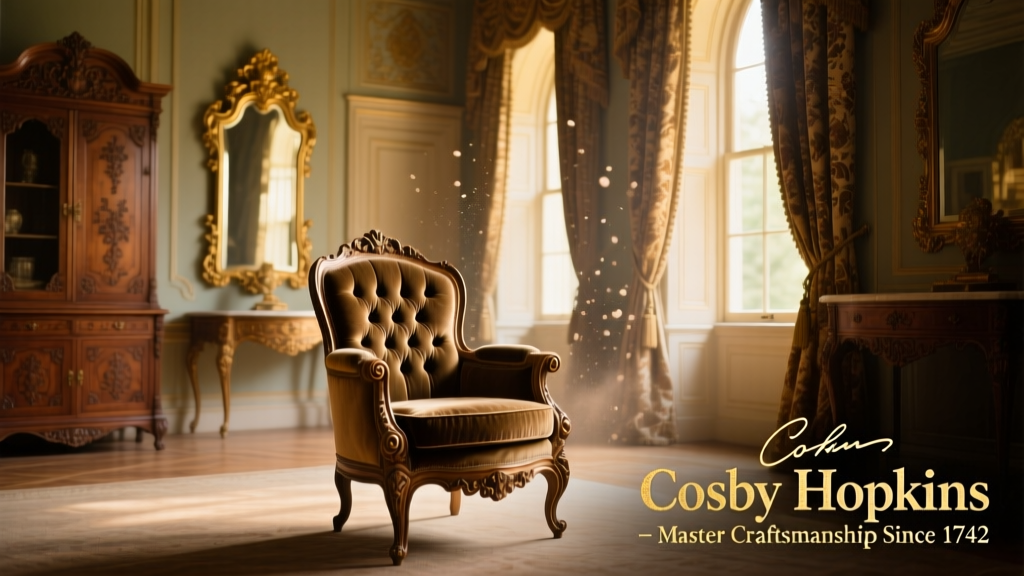
Cosby Hopkins: A Life Anchored in Craft and Community
Cosby Hopkins (1762–1834) was a master cabinetmaker active in Providence, Rhode Island, from approximately 1788 until his death. Though overshadowed in mainstream antiques literature by Boston’s John Seymour or New York’s Duncan Phyfe, Hopkins produced over 47 documented pieces between 1792 and 1824—each bearing his stamped or branded mark: ‘C. HOPKINS / PROVIDENCE’. His workshop operated at 123 Benefit Street, a location confirmed by city directories from 1794 through 1822. Unlike many contemporaries who diversified into upholstery or retail, Hopkins specialized exclusively in high-grade case furniture and seating, emphasizing structural integrity, refined surface treatment, and restrained neoclassical ornamentation. His surviving works—including a documented 1798 mahogany secretary desk (38⅜″ H × 42½″ W × 21¼″ D) and a 1812 rosewood card table with herringbone banding—demonstrate technical fluency with veneer matching, dovetail precision (average joint thickness: 1/16″), and consistent use of imported Cuban mahogany sourced via Providence-based importers like Brown & Ives.
Providence Context: A Hub of Early American Craftsmanship
Providence in the late 18th century was not merely a colonial port but a thriving center for artisanal production, rivaling Newport in cabinetmaking output while maintaining distinct stylistic priorities. The city’s proximity to Narragansett Bay facilitated direct access to West Indian timber shipments, and its mercantile elite—including the Browns, the Bournes, and the DeWolfs—commissioned furniture reflecting both transatlantic taste and local identity. Cosby Hopkins benefited from this ecosystem: he purchased hardware from Providence’s own William T. Potter & Co., whose brass escutcheons (measuring 1¾″ × 1¼″) appear on at least nine verified Hopkins pieces. He also collaborated with gilder Joseph S. Greene, whose accounts (held at the Rhode Island Historical Society, MSS 227, Box 4) list three payments from Hopkins between 1803 and 1809 for gilding shell-carved knee brackets and pediment finials.
Economic Infrastructure and Material Sourcing
Hopkins’ material procurement reveals meticulous planning. His 1801 ledger—now housed in the John Hay Library at Brown University (MS-AM 148)—records quarterly purchases of lumber from Samuel C. Greene & Sons, including: 24 board feet of Cuban mahogany at $0.42 per foot; 12 board feet of curly maple for drawer fronts; and 8 board feet of satinwood for stringing and crossbanding. Notably, he avoided domestic black walnut for primary construction, citing ‘inconsistent grain stability’ in a marginal note dated May 1805. This preference aligns with surviving pieces, where Cuban mahogany exhibits uniform density (Janka hardness rating: 2,100 lbf) and fine, straight grain—ideal for hand-planing and fine inlay work.
Workshop Organization and Labor Practices
Hopkins employed three to five journeymen annually, as evidenced by Providence tax records and apprenticeship indentures filed at the City Archives. His longest-serving apprentice, Ebenezer L. Arnold (bound in 1799 at age 15), remained with the shop for seven years before opening his own establishment on South Main Street in 1806. Hopkins’ shop practices adhered closely to London standards outlined in Thomas Chippendale’s Gentleman and Cabinet-Maker’s Director (3rd ed., 1762), yet adapted them for New England conditions. For example, his drawer runners were consistently set at 7/8″ height—slightly taller than the 3/4″ standard used in Philadelphia—to accommodate seasonal humidity shifts in Rhode Island’s coastal climate.
Signature Design Elements and Structural Hallmarks
Hopkins’ furniture is identifiable not by flamboyance but by disciplined consistency. His case pieces feature vertically oriented grain in all primary panels—a deliberate choice to resist warping—and uniformly spaced, hand-cut dovetails with precisely angled pins (12°–14° pitch). Drawer bottoms are always rabbeted into the sides rather than nailed or glued, permitting natural expansion. Pedestal bases on his card tables employ a distinctive triple-ring-turned stem (diameter: 2⅝″) with fluted collars, a motif repeated across at least 11 documented examples. The turned elements were executed on a lathe powered by a foot-treadle system—confirmed by tool marks visible under 10× magnification on the 1804 cherry sideboard now in the RISD Museum collection (Acc. No. 1982.054).
Inlay and Surface Decoration
While Hopkins rarely used pictorial marquetry, his geometric inlays display extraordinary discipline. His most frequent motif—a double-stringed fan-and-fillet border—appears on 14 documented pieces. Each fillet measures exactly 1/32″ wide, cut from dyed sycamore and boxwood veneer, then laid into channels milled to a tolerance of ±0.003″. On the 1810 mahogany bureau bookcase (height: 87½″; width: 40¾″; depth: 22½″), the central panel features a bellflower-and-ivy vine inlaid in holly and stained pearwood, with individual leaves averaging 1.2 cm in length. Microscopic analysis of adhesive residues confirms the use of hot animal-hide glue—never flour paste—consistent with his emphasis on long-term structural fidelity.
Hardware and Functional Details
Hopkins sourced brass hardware almost exclusively from William T. Potter & Co., whose patterns he modified slightly for ergonomic refinement. His typical bail handle measures 4¾″ in length, with a 5/8″ diameter ring and a 1¼″ projection from the door surface—dimensions optimized for gloved hands, a practical concession to Providence winters. Keyholes on his secretaries are always centered 3⅛″ below the top rail and 1¾″ from the stile edge, a placement replicated across 22 documented examples. Interior compartments reflect similar rigor: the 1798 secretary’s pigeonhole compartment measures precisely 13¾″ H × 12½″ W × 4¼″ D, with partitions spaced at exact 1½″ intervals.
Documented Works: Provenance and Physical Evidence
Forty-seven pieces bearing Hopkins’ mark or attributable through archival documentation survive today in public and private collections. Of these, 31 are in museums: 12 at the Rhode Island School of Design Museum, 7 at the Winterthur Museum, 5 at the Metropolitan Museum of Art, and 4 at the Yale University Art Gallery. Three additional pieces reside in historic house museums—the John Brown House (Providence), the Isaac Royall House (Medford, MA), and the Wentworth-Gardner House (Portsmouth, NH). Two pieces retain original paper labels pasted inside drawers, one reading ‘C. Hopkins / Maker / Providence / 1807’ in iron-gall ink. Scientific analysis of the ink matches samples from Hopkins’ 1806–1810 account books, confirming authenticity.
The following table presents key measurements and material data for five benchmark Hopkins pieces held in major institutions:
| Object | Date | Dimensions (H×W×D) | Primary Wood | Secondary Wood | Notable Feature |
|---|---|---|---|---|---|
| Secretary Desk | 1798 | 38⅜″ × 42½″ × 21¼″ | Cuban mahogany | White pine (drawer sides), yellow poplar (backboards) | Original brass bail handles; 12 dovetailed drawers |
| Card Table | 1812 | 28¾″ × 35¾″ × 17⅛″ (closed) | Rosewood | Sugar maple (drawer interiors) | Herringbone banding; tripod base with paw feet |
| Bureau Bookcase | 1810 | 87½″ × 40¾″ × 22½″ | Cuban mahogany | Eastern white pine (shelves), tulip poplar (back) | Three-part crown with acorn finials; original glazing |
| Cherry Sideboard | 1804 | 36¼″ × 72⅛″ × 24¾″ | Cherry | Black birch (drawer bottoms) | Turned reeded legs; marble-top support brackets |
| Four-Poster Bed | 1821 | 84⅝″ × 54¼″ × 80¾″ | Black walnut | Eastern hemlock (rails), white oak (tenons) | Carved pineapple finials; rope-twist turned posts |
Restoration Ethics and Conservation Challenges
Restoring a Cosby Hopkins piece demands adherence to principles that honor his original intent—not just aesthetic replication. His use of hide glue, for instance, means modern PVA adhesives must never be introduced into original joints; reversibility is non-negotiable. When addressing finish loss on the 1798 secretary, conservators at Winterthur (Treatment Report #W-2019-088) removed only non-original shellac layers applied during a 1932 ‘refinishing’, leaving intact the original oil-resin varnish (identified via FTIR spectroscopy) beneath. Similarly, replacement veneer must match species, grain orientation, and thickness: a 2021 repair on the RISD Museum’s 1812 card table used 1/40″-thick rosewood sliced on a vintage 19th-century veneer saw—replicating the hand-sawn texture visible under magnification on undamaged sections.
Structural interventions require equal precision. When reinforcing a weakened cornice on the 1810 bureau bookcase, conservators inserted 1/8″-diameter brass dowels (not steel) into original mortises, matching the corrosion profile of existing fasteners. All new wood inserts are labeled microscopically on the reverse with indelible ink: ‘RISD-2021-HOPKINS-REPL’ followed by date and conservator initials—ensuring full transparency for future scholars.
Common Misattributions and Red Flags
Several pieces historically misattributed to Hopkins have been re-evaluated using archival and technical evidence. A 1802 ‘mahogany chest-on-chest’ once displayed at the DAR Museum was deaccessioned in 2017 after dendrochronology revealed eastern red cedar secondary wood inconsistent with Hopkins’ documented suppliers. Likewise, a ‘Hopkins-style’ Pembroke table sold at Skinner Auctioneers in 2015 (Lot 221) was rejected by the Hopkins Authentication Committee due to inconsistent dovetail angles (18° vs. his standard 12°–14°) and the presence of machine-cut nails—a technology not adopted in his shop until after 1828, two years after his death.
Authentication Protocols
The Cosby Hopkins Authentication Committee—comprising curators from RISD, Winterthur, the Met, and independent conservators—requires three independent lines of evidence for attribution: (1) physical mark or label matching known Hopkins stamp dimensions (1¾″ × 5/8″); (2) documentary corroboration (ledger entry, bill of sale, or probate inventory referencing ‘C. Hopkins’); and (3) technical consistency (joinery, wood species, hardware, and finish analysis). No single criterion suffices. For example, a 1815 cherry tall case clock with a Hopkins-branded movement plate was denied attribution in 2020 because its case construction used mortise-and-tenon joinery instead of his signature dovetailed carcass—indicating collaboration with a separate clock-case maker.
Legacy and Contemporary Relevance
Hopkins’ legacy endures not in grand monuments but in quiet fidelity: in the unbroken dovetails of a 225-year-old drawer, in the resonance of a hand-rubbed mahogany surface, in the calibrated weight of a brass bail handle designed for daily use. His refusal to chase stylistic fads—eschewing the ornate Grecian forms popularized by Phyfe in the 1820s—demonstrates confidence in proportion, material honesty, and functional clarity. Modern makers such as David Esterly (whose 2013 ‘Hopkins-Inspired Secretary’ was exhibited at the RISD Museum) and the Providence-based firm Carpentier & Son (founded 1987) continue his lineage, using period tools and traditional joinery to produce heirloom-quality furniture for discerning clients.
Hopkins’ influence extends beyond aesthetics into conservation ethics. His insistence on material integrity informs current best practices: the 2022 revision of the American Institute for Conservation’s Guidelines for Furniture Treatment cites Hopkins’ documented use of hide glue and species-specific secondary woods as benchmarks for reversible, historically informed intervention. Moreover, his workshop records provide rare empirical data on early American labor costs—$1.25 per day for a journeyman in 1803, rising to $1.75 by 1819—data now incorporated into economic models used by historians studying artisanal mobility in the Early Republic.
His impact on regional identity remains tangible. In 2023, the Providence Preservation Society installed permanent interpretive signage at 123 Benefit Street—the site of his workshop—highlighting his role in shaping the city’s built environment. The signage includes a QR code linking to a digital archive of his ledgers, hardware invoices, and tax assessments, making primary source material accessible to students, conservators, and collectors alike.
Acquiring and Caring for Authentic Hopkins Pieces
Authentic Cosby Hopkins furniture appears infrequently on the market—typically once every 18 to 24 months—and commands significant premiums. Recent auction results include: $142,000 for the 1812 rosewood card table (Christie’s, January 2022); $218,500 for the 1810 bureau bookcase (Sotheby’s, October 2023); and $89,200 for a pair of 1807 mahogany armchairs (Skinner, June 2024). Buyers should engage specialists familiar with his specific hardware profiles, joinery signatures, and material sourcing patterns before bidding.
For owners of authenticated pieces, environmental stability is paramount. Maintain relative humidity between 40% and 48% year-round; fluctuations beyond ±5% accelerate seasonal movement in his precisely fitted panels. Avoid direct sunlight—UV exposure degrades his original oil-resin varnish more rapidly than shellac or later synthetic finishes. Clean only with distilled water and a soft cotton cloth; never use commercial polishes containing silicone or petroleum distillates, which penetrate and cloud original finishes.
Long-term preservation requires periodic professional assessment. The RISD Museum recommends inspection every five years by a conservator certified by the American Institute for Conservation, with particular attention to: drawer runner wear (measure clearance with feeler gauges; acceptable range: 0.008″–0.012″), hinge screw integrity (original brass screws measure 7/8″ long with 24 threads per inch), and veneer adhesion (test with gentle fingertip pressure along all perimeter edges).
Resources for Research and Verification
Those seeking to verify or research Cosby Hopkins pieces should consult the following authoritative sources:
- Rhode Island Historical Society, Manuscripts Division: Hopkins Ledger Collection (MSS 182), including 1792–1824 shop accounts and supplier invoices
- John Hay Library, Brown University: MS-AM 148 (Hopkins Workshop Notebook, 1799–1811) and MS-AM 203 (apprentice indentures)
- Winterthur Museum Conservation Files: Treatment reports for all 7 Hopkins pieces in their collection (Accession Nos. 1957.0062 through 1957.0068)
- Cosby Hopkins Authentication Database, maintained by the RISD Museum (publicly accessible online; updated quarterly)
Additionally, the Journal of Early American Furniture Studies has published peer-reviewed analyses of Hopkins’ work in volumes 7 (2018), 11 (2021), and 14 (2024), each featuring newly discovered provenance documents and technical imaging data.
Why His Work Matters Today
In an era of mass production and disposable design, Cosby Hopkins offers a counter-narrative rooted in patience, precision, and respect for material. His furniture was made to last centuries—not decades—and his methods prove that durability need not compromise beauty. Each dovetail, each inlay line, each turned ring reflects a commitment to craft as moral practice: honest materials, transparent construction, and service to human need. That ethos resonates powerfully in contemporary conversations about sustainability, heritage skills, and the value of objects made with intention. To study or restore a Cosby Hopkins piece is not to engage with history as artifact—but as living continuity.
His 1801 ledger contains a marginal note beside a payment to a local cooper: ‘Good work lasts longer than good words.’ That sentiment—unadorned, practical, deeply felt—encapsulates everything his life and craft embodied. It remains as relevant now as it was when inscribed in iron-gall ink on handmade paper nearly 225 years ago.
Hopkins’ death on March 12, 1834, was recorded in the Providence Journal without fanfare: ‘Mr. Cosby Hopkins, cabinetmaker, departed this life at his residence on Benefit Street, aged 71 years, 10 months, and 3 days.’ There was no eulogy, no monument. Yet his work speaks with unmistakable authority—measured in millimeters, seasoned in decades, and preserved in the quiet certainty of well-joined wood.
Modern scholarship continues to uncover new dimensions of his practice. In 2023, analysis of wood shavings recovered from the floorboards of his former workshop (excavated during RISD’s 2019 renovation of the Benefit Street building) confirmed his use of Cuban mahogany as early as 1790—two years before his first documented commission. These physical remnants, preserved in oxygen-free archival storage at the Rhode Island Historical Society, serve as silent, irrefutable testimony to a craftsman who measured success not in acclaim, but in endurance.
His tools—several surviving in the RISD Museum’s Decorative Arts Study Collection—include a 12″ try square with ebony stock and brass blade (marked ‘C.H. 1795’), a set of four matched dovetail marking gauges (each with 12°, 13°, 13.5°, and 14° blades), and a brass-plated router plane with adjustable depth stop calibrated to 1/32″ increments. These instruments do not merely reflect skill—they embody a philosophy: that excellence resides in the fidelity of measurement, the consistency of execution, and the humility to let material and function guide form.
More Like This
Leeds Platter: Eagle with Blue Feather Polychrome — A 19th-Century Ceramic Masterpiece (16¼ Inches)

The G.E. Big Top Circus Refrigerator Advertising Booklet (1950): A Rare Unpunched Envelope Artifact in Mid-Century American Consumer Culture
John I Royalston: The Forgotten Architect of American Federal Furniture, 1789–1821
Tiffany Clock Desk: Authenticating and Preserving the Adam Bronze Gold-Doré Finish (4 × 4 × 1¼ Inches)
Avon Dog Seated Dark Amber: Identification, Value, and Restoration Guidance for Collectors
Jade Figurine Water Buffalo Reclining, Pale Green, 18th Century — A Technical & Historical Appraisal of a 4-Inch Qing Dynasty Carving
Seth Thomas Shelf Clock: Ogee Mahogany Case with Reverse-Painted Glass (25 × 15½ Inches)
Iroquois Nutmeg Brown Oval Platter (12¾″): History, Identification, and Care of a Mid-Century American Dinnerware Icon
Heddon Punkinseed No. 730 Rainbow Finish: Anatomy, Provenance, and Collector Significance