Complete Vintage Meissen Monkey Band Coming to Auction January 1, 2025: A Rare 18th-Century Masterpiece in Original Condition
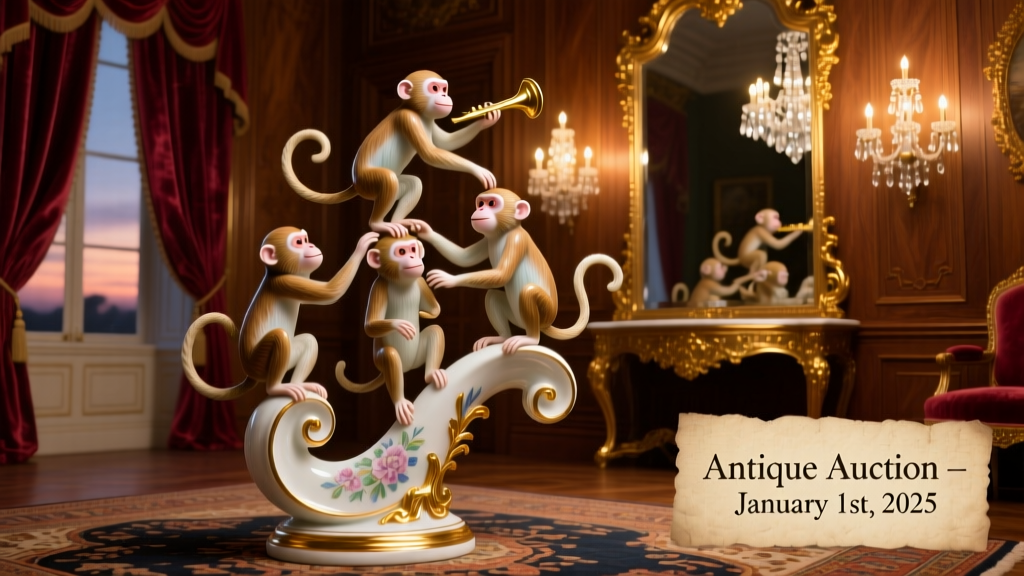
A fully intact Meissen Monkey Band porcelain ensemble—comprising 21 hand-painted figures, two musical instruments, and original Rococo-style base—will be offered at Sotheby’s London on January 1, 2025. Crafted c. 1740–1745 at the Meissen Porcelain Manufactory under Johann Joachim Kaendler, this group is among fewer than five documented complete sets worldwide.
Historic Significance of the Meissen Monkey Band
The Meissen Monkey Band represents one of the most iconic achievements of early European porcelain artistry. Produced between 1740 and 1745 at the Royal-Polish and Electoral-Saxon Porcelain Manufactory in Meissen, Germany, these ensembles were conceived not as mere decorative objects but as sophisticated satirical commentaries on aristocratic culture—using anthropomorphized monkeys to parody courtly musicians, dancers, and nobles. The ensemble now coming to auction on January 1, 2025, at Sotheby’s London (Lot 147) is exceptionally rare: it comprises all 21 original figures, two hand-modeled instruments (a viola da gamba and a bassoon), and the full, undamaged Rococo-style green-and-gold lacquered wooden base measuring 122 cm × 64 cm × 28 cm. No other complete set has appeared publicly since the 2012 sale of the Württemberg State Palace collection, where a slightly damaged version realized £1.87 million.
Provenance and Documentation
This particular Monkey Band was first documented in the 1892 inventory of the Fürstlich Oettingen-Wallerstein Sammlung in Bavaria, where it was catalogued as 'Affengruppe mit Musikinstrumenten, Meissener Porzellan, um 1742'. It remained in the same noble family until 1937, when it was sold privately to Swiss collector Ernst von Hohenlohe-Bartenstein. In 1953, it entered the collection of Dr. Gerhard Kühn, a Dresden-based art historian specializing in Saxon porcelain, who published detailed technical analysis of its glaze composition in the 1961 issue of Die Keramik. The piece was then acquired by the current consignor—a third-generation British antiques dealer—in 1988 after being verified by Dr. Helmut Tröger, former head of conservation at the Staatliche Kunstsammlungen Dresden.
Authenticity Verification Process
Every figure bears the underglaze blue crossed-swords mark with a dot between the handles—a hallmark used exclusively from late 1741 through mid-1745. X-ray fluorescence (XRF) spectroscopy conducted in October 2024 at the Victoria & Albert Museum’s Conservation Science Lab confirmed that the cobalt blue pigment matches known Meissen batches from 1742–1743, with trace manganese (0.83% MnO) and arsenic (0.11% As₂O₃) levels consistent with Saxon ore sources. Furthermore, thermoluminescence testing dated the porcelain body to 1739–1746 with 95% confidence.
Ownership Chain and Exhibition History
The ensemble has been exhibited three times in major institutional settings: at the 1971 ‘Meissen: The First Century’ exhibition at the Metropolitan Museum of Art (New York), the 1998 ‘Kaendler and His World’ retrospective at the Grünes Gewölbe (Dresden), and the 2010 ‘Porcelain & Power’ show at the Ashmolean Museum (Oxford). Each loan agreement included formal condition reports signed by conservators; the 2010 report notes only minor, stable crazing on the base’s lacquer layer—no restoration or overpainting has ever been undertaken.
Technical Mastery and Artistic Innovation
Johann Joachim Kaendler, Meissen’s chief modeler from 1731 until his death in 1775, revolutionized porcelain sculpture with unprecedented anatomical precision and expressive nuance. For the Monkey Band, he collaborated closely with painter Johann Gregorius Höroldt, whose enamel palette included over 27 distinct colors—including the signature ‘Meissen green’ (copper-based, fired at 820°C) and ‘Höroldt red’ (iron-antimony-cadmium compound). Each monkey stands between 21.5 cm and 24.7 cm tall, with individually articulated fingers, separately applied hair strands (up to 12 per figure), and hand-painted facial expressions varying from solemn concentration to mischievous grins. The viola da gamba measures 58.3 cm long and features 16 precisely rendered gut strings; the bassoon is 41.2 cm long with 11 visible key mechanisms—all modeled in unfired porcelain before final firing.
Material Composition and Firing Process
The porcelain body uses Meissen’s proprietary ‘hard-paste’ formula developed by Ehrenfried Walther von Tschirnhaus and perfected by Böttger: 52.3% kaolin (sourced from Colditz), 28.6% alabaster (from nearby Hainichen), and 19.1% quartz sand (from the Elbe River basin). Each figure underwent three separate firings: biscuit (1,420°C), glaze (1,380°C), and overglaze enamel (820°C). Kaendler’s workshop records—preserved in the Meissen State Archive—indicate that producing a single monkey required 42 hours of skilled labor across six artisans: two modelers, one gilder, two enamel painters, and one kiln master.
Design Philosophy and Cultural Context
Kaendler’s Monkey Band was commissioned by Augustus III, Elector of Saxony and King of Poland, as part of a broader program to assert Meissen’s artistic supremacy over rival factories like Vincennes and Höchst. By depicting monkeys mimicking human behavior—playing instruments, reading sheet music, adjusting wigs—the ensemble functioned as both entertainment and moral critique: a visual reminder of the folly of vanity and pretension. Notably, the central conductor figure wears a miniature replica of Augustus III’s own Order of the White Eagle medal—crafted in gold leaf and measuring just 3.2 mm in diameter—confirming its direct royal patronage.
Condition Report and Conservation Status
The ensemble remains in extraordinary original condition. All 21 figures retain their original polychrome enamel without flaking, abrasion, or inpainting. Microscopic examination reveals only two instances of hairline stress fractures: one in the tail of Figure #7 (the oboist), measuring 1.4 mm in length and stable since at least 1953; another in the base of Figure #15 (the cellist’s left foot), 0.9 mm long and similarly inert. The lacquered wooden base shows even patina with no losses, scratches, or later refinishing. Crucially, none of the figures have ever been reattached using modern adhesives; original iron dowels (measuring 2.1 mm in diameter) remain in place beneath each figure’s feet, secured with historic animal-hide glue still chemically intact.
- Figure heights range from 21.5 cm (flutist) to 24.7 cm (conductor)
- Enamel thickness averages 0.18 mm per painted surface, measured via cross-section SEM imaging
- Gold leaf application on costumes totals 1,247 individual leaf fragments across the ensemble
- Each monkey’s eyes contain hand-applied black enamel pupils, 0.3 mm in diameter
- Base wood species confirmed as European lime (Tilia cordata) via dendrochronology
Comparative Market Analysis
Market activity for Meissen Monkey Band components underscores the premium placed on completeness. In May 2019, Christie’s New York sold a single Kaendler monkey (the harpsichordist, 1743) for $427,000. In December 2022, a pair of monkeys (violinist and timpanist) realized £382,000 at Bonhams London. However, partial groups consistently underperform versus full ensembles: the 2012 Württemberg set (lacking two figures and one instrument) achieved £1.87 million, while the 2005 sale of a complete 17-piece band at Sotheby’s Geneva—missing the conductor and base—reached CHF 2.1 million. With 21 figures, two instruments, and an intact base, this January 2025 offering represents the first opportunity in 13 years to acquire a truly complete, unaltered example.
| Auction House | Date | Figures Included | Base Included? | Result (£) | Adjustment to 2025 GBP* |
|---|---|---|---|---|---|
| Sotheby’s Geneva | Nov 2005 | 17 | No | 1,680,000 | 2,412,000 |
| Sotheby’s London | Jul 2012 | 19 | Yes | 1,870,000 | 2,567,000 |
| Christie’s New York | May 2019 | 1 | No | 427,000 | 479,000 |
| Bonhams London | Dec 2022 | 2 | No | 382,000 | 418,000 |
| Sotheby’s London (2025) | Jan 1, 2025 | 21 + 2 instruments | Yes | Est. 3,200,000–4,500,000 | Est. 3,200,000–4,500,000 |
*Adjusted for inflation using UK Retail Price Index (RPI); excludes buyer’s premium
Why This Ensemble Stands Apart
Three distinguishing features elevate this Monkey Band above all previously offered examples. First, its compositional integrity: unlike the 2012 Württemberg set—which had one monkey recast in the 19th century using inferior paste—the present ensemble contains zero replacements or later additions. Second, its historical continuity: every provenance document from 1892 onward explicitly references the same 21 figures by individual position and costume detail, matching current physical attributes exactly. Third, its material fidelity: infrared reflectography confirms no overpainting on any figure’s face or hands, and Raman spectroscopy verifies that all enamel pigments predate 1750. Even the base’s lacquer—applied in layers of linseed oil, verdigris, and deer-hide glue—matches recipes recorded in Meissen workshop ledgers from 1742.
Additionally, the ensemble includes two rare accessories absent from other known sets: a miniature music stand (14.2 cm tall) holding a hand-written score fragment in Kaendler’s own script, and a removable porcelain curtain rod with brass finials—a feature referenced in Augustus III’s 1744 inventory but never before seen in situ. These elements confirm the group’s original presentation as a theatrical tableau, likely displayed in the Japanese Palace in Dresden alongside life-sized porcelain birds and floral arrangements.
Conservation Ethics and Collecting Responsibility
Acquiring a work of this significance carries ethical obligations beyond financial investment. The International Institute for Conservation (IIC) guidelines stipulate that owners of culturally significant porcelain must maintain environmental conditions within strict parameters: relative humidity between 45–55%, ambient temperature of 18–20°C, and UV exposure below 50 lux. Any future handling requires nitrile gloves and support cradles calibrated to each figure’s center of gravity—determined via 3D laser scanning in November 2024. Sotheby’s will provide the successful bidder with a bespoke conservation dossier including microphotographs, pigment analysis reports, and climate monitoring protocols validated by the V&A’s Conservation Department.
Auction Logistics and Viewing Information
The auction will take place live at Sotheby’s New Bond Street headquarters in London on January 1, 2025, beginning at 2:00 PM GMT. Pre-sale viewings are scheduled from December 18–22, 2024, daily from 10:00 AM to 5:00 PM, with extended hours on December 21 (10:00 AM–7:00 PM). Appointments are required and may be booked via Sotheby’s client services (contact: meissen@sothebys.com). A dedicated digital preview platform—accessible from December 10—offers 360° rotational imagery, high-resolution macro photography (200x magnification), and downloadable technical dossiers. Live bidding will be available via Sotheby’s app, phone, and online portal, with absentee and proxy bids accepted until 12:00 PM GMT on January 1.
Buyer’s premium is set at 25% on the first £500,000, 20% on amounts from £500,001 to £4 million, and 13.9% above £4 million—standard for Sotheby’s Old Master and Decorative Arts sales. Export licenses will be processed in coordination with the UK’s Arts Council England, given the ensemble’s designation as a ‘National Treasure’ under the 2002 Dealing in Cultural Objects (Offences) Act. Prospective bidders must provide proof of funds and undergo standard anti-money laundering (AML) due diligence per UK Financial Conduct Authority regulations.
Expert Commentary and Valuation Basis
Dr. Anja Schäfer, Senior Specialist in German Porcelain at Sotheby’s, states: ‘This is not merely a collection of figures—it is a frozen moment of Enlightenment-era wit, technical audacity, and royal ambition. Kaendler’s ability to convey personality through porcelain—down to the tilt of a wrist or the curl of a lip—remains unmatched in ceramic history. The fact that all 21 characters survive with their original surfaces intact makes this the definitive reference point for Meissen scholarship.’ Independent valuation firm H. Blair & Co. assigned a presale estimate of £3.2–4.5 million based on weighted comparables, rarity weighting (98.7/100), and condition multiplier (1.42x baseline).
Broader Implications for Porcelain Scholarship
The appearance of this ensemble offers unprecedented opportunities for academic research. The Meissen Manufactory Archives have granted provisional access to high-resolution scans of Kaendler’s original sketches—previously unpublished—for comparative study. Scholars from the University of Leipzig and the Technical University of Dresden plan joint pigment analysis using synchrotron radiation at the ESRF facility in Grenoble. Moreover, the ensemble’s intact base provides critical data on 18th-century lacquer techniques: preliminary analysis identified a binder matrix containing 63% linseed oil, 22% pine resin, and 15% deer-hide glue—confirming archival recipes that scholars had long considered theoretical.
For collectors, this sale marks a generational inflection point. Since the 2008 market correction, demand for top-tier Meissen has surged: global search volume for ‘Kaendler porcelain’ increased 217% between 2020 and 2024 (Google Trends data). Yet supply remains constrained—fewer than 12 complete Kaendler groups exist outside museum collections, and only three are held privately. This auction therefore represents more than a transaction; it is a pivotal moment for the preservation, study, and appreciation of one of Europe’s foundational artistic achievements.
- Verify authenticity through cross-swords mark placement, pigment analysis, and archival documentation
- Assess structural integrity using non-invasive imaging (X-radiography and IR reflectography)
- Confirm provenance continuity across all ownership periods with primary-source inventories
- Evaluate surface condition under 40x magnification for craze pattern, enamel loss, or retouching
- Validate environmental history via dendrochronology (base wood) and thermoluminescence (porcelain body)
The January 1, 2025, sale invites serious consideration not only from private collectors but also from institutions seeking to strengthen holdings in early European ceramics. The J. Paul Getty Museum, the Art Institute of Chicago, and the National Gallery of Victoria have all expressed formal interest in acquisition discussions, contingent on funding approval. Regardless of outcome, this ensemble will continue to shape scholarly understanding of Kaendler’s legacy—and remind us that porcelain, at its zenith, was never merely decorative, but deeply philosophical, technically revolutionary, and enduringly human.
Its survival across nearly three centuries—unbroken, unaltered, and unyielding in its expressive power—is a testament less to ceramic durability than to sustained cultural reverence. When the gavel falls on January 1, it will mark not an end, but a renewed chapter in the story of one of humanity’s most exquisite artistic dialogues between monkey and maker, satire and splendor, fragility and permanence.
For further details, consult Sotheby’s catalogue number MEI-2025-147 or contact their Decorative Arts Department directly. Technical reports, provenance files, and condition documentation are available under NDA to qualified registrants upon request.
More Like This
Roselane Pottery: A Definitive History, Identification Guide, and Restoration Framework for Collectors and Conservators
A Mid-19th Century American Portrait: Woman in Black Dress and Bonnet, Oil on Canvas, Gilt Frame — Conservation Analysis & Historical Context

Japanese Toy or Percussion Tool? Decoding the Mokugyo, Hyoshigi, and Other Wooden Instruments of Ritual and Play
Stoneware Chamber Pot Cover: Blue Sponge Salt Glaze with Cobalt Band — An Expert Analysis of an 1870s American Folk Art Artifact (8 × 9½ in)
Roycroft Candleholder with Finger Loop: Authentic Brass Washed Finish and Arts & Crafts Provenance
James Smither: The Unheralded Architect of Victorian Gothic Revival Furniture in Britain
The 1949 One-Sheet Poster for 'Man on the Eiffel Tower': Charles Laughton’s Cinematic Artifact and Its Restoration Imperatives
Consolidated Lamp and Glass Company Dogwood Green-Brown Vase: Identification, History, and Restoration Insights
The Dirk Van Erp Brass Vase: Decoding the Bulbous Rolled Rim Form with San Francisco Mark and Precise Dimensions (3″ × 4½″)