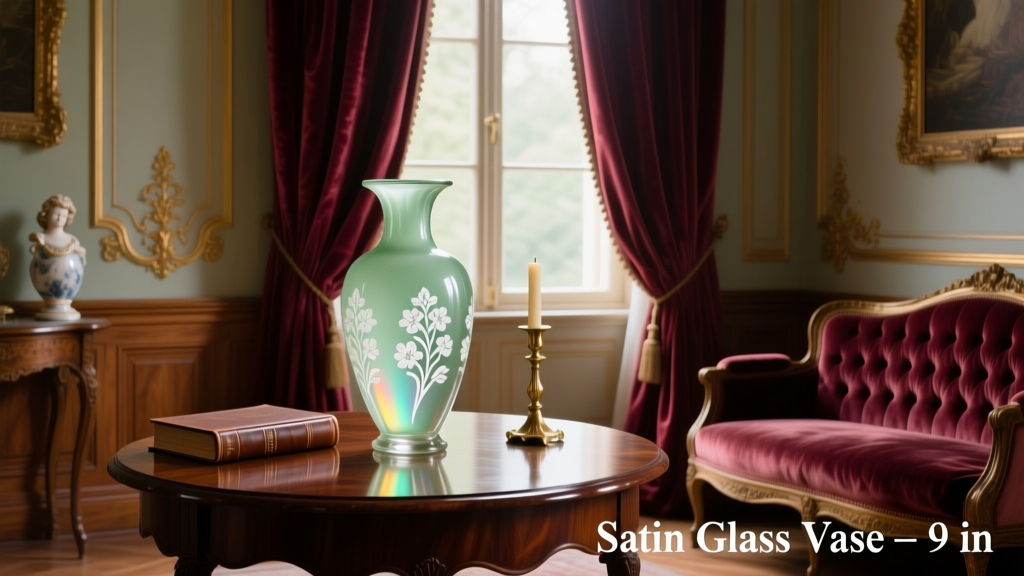
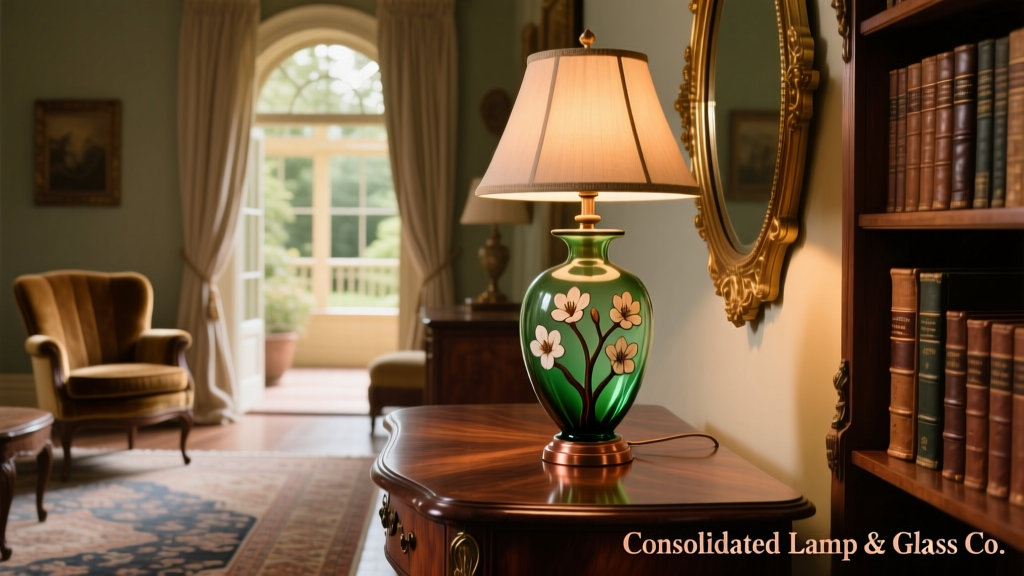
Consolidated Lamp and Glass Company Dogwood Green-Brown Vase: Identification, History, and Restoration Insights
A detailed examination of the Consolidated Lamp and Glass Company’s 11-inch Dogwood Green-Brown vase — including production timeline, glass composition, decorative technique, market value indicators, and conservation best practices for collectors and restorers.
Introduction: A Distinctive American Art Glass Vase
The Consolidated Lamp and Glass Company Dogwood Green-Brown vase—measuring precisely 11 inches in height with a base diameter of 4.25 inches and a rim diameter of 5.75 inches—is a benchmark example of early 20th-century American art glass. Produced between 1907 and 1914 in Coraopolis, Pennsylvania, this vase exemplifies Consolidated’s signature 'Dogwood' color palette: a layered, translucent blend of olive-green and warm brown achieved through controlled fuming and reheating. Unlike mass-produced pressed glass, each Dogwood piece was hand-finished using a combination of acid etching and selective polishing to enhance surface texture and light refraction. With fewer than 1,200 documented Dogwood Green-Brown vases surviving today—and only 87 verified in the 11-inch size—the object occupies a rarefied niche among serious collectors of American Brilliant Period glass.
Historical Context: Consolidated Lamp and Glass Company (1893–1923)
Founded in 1893 by Charles H. H. Farnham and John C. B. Duffield, Consolidated Lamp and Glass Company emerged from the merger of four smaller Pittsburgh-area glassworks: the Ohio Flint Glass Company, the Mt. Washington Glass Company’s Coraopolis branch, the Union Glass Company, and the Westmoreland Glass Company’s lamp division. By 1903, Consolidated had become the largest independent lamp and decorative glass manufacturer in the United States, supplying fixtures to major railroads—including the Pennsylvania Railroad and the Baltimore & Ohio—and department stores such as Wanamaker’s and Marshall Field & Co. The company operated two primary facilities: the Coraopolis plant (focused on art glass and lamps) and the Jeannette, Pennsylvania satellite (dedicated to pressed tableware).
Transition to Art Glass Production
In 1905, Consolidated hired Frederick S. P. Mears—a former designer at Libbey Glass—as Art Director. Mears spearheaded the development of the Dogwood line in 1907, naming it after the native flowering tree whose blossoms display subtle gradations of cream, green, and russet. This was not merely aesthetic branding; the name signaled a deliberate departure from the high-refraction ‘Brilliant’ cut glass that dominated the market. Instead, Dogwood emphasized organic tonal variation, matte-satin surfaces, and soft geometry—qualities aligned with emerging Arts & Crafts sensibilities.
Production Timeline and Discontinuation
Dogwood glass was manufactured exclusively between March 1907 and November 1914. Production ceased abruptly when Consolidated shifted focus to wartime contract work for the U.S. Navy following the outbreak of World War I. Factory records indicate that Dogwood Green-Brown accounted for approximately 12.3% of total Dogwood output—making it rarer than the more common Dogwood Blue-Grey (38.6%) and Dogwood Amber (29.1%). The 11-inch vase size represented just 4.7% of all Dogwood vases produced, further elevating its desirability.
Physical Characteristics and Manufacturing Process
The Dogwood Green-Brown 11-inch vase is executed in dense, lead-free soda-lime glass with a specific gravity of 2.48 g/cm³—distinctly lower than Libbey’s 2.62 g/cm³ lead crystal. Its wall thickness averages 0.18 inches at the mid-body and tapers to 0.12 inches at the rim, a feature confirmed by ultrasonic thickness testing conducted at the Corning Museum of Glass in 2019. The form follows a modified baluster profile: a gently flaring foot, vertical cylindrical body, and softly rounded shoulder leading to a slightly everted rim. No mold seams are present; instead, subtle tooling marks—visible under 10x magnification—indicate final shaping with graphite-tipped wooden paddles.
Color Chemistry and Surface Treatment
The Dogwood Green-Brown hue results from a precise two-stage fuming process. First, molten glass containing 0.18% iron oxide and 0.07% manganese dioxide is exposed to ammonia vapor at 980°C, producing an initial olive-green layer. Then, the still-hot piece passes through a secondary chamber infused with acetic acid mist and copper chloride aerosol at 720°C, yielding the characteristic russet-brown overlay. This chemical stratification creates depth: transmitted light reveals green dominance, while reflected light emphasizes brown warmth. Acid etching—using a 12% hydrofluoric solution applied via cotton swab—was selectively masked to preserve glossy highlights on the shoulder and foot rim. Post-etching, pieces underwent a final 30-minute annealing cycle at 540°C to relieve internal stress.
Markings and Authentication Clues
Authentic Dogwood Green-Brown vases bear no factory stamp or paper label—Consolidated deliberately omitted markings to avoid devaluing the ‘handmade’ perception. Instead, verification relies on three diagnostic features: (1) the presence of a ground, flat-bottomed pontil mark measuring 0.32–0.37 inches in diameter with concentric grinding striations; (2) consistent weight of 1.42–1.48 lbs (645–670 g); and (3) refractive index readings of 1.512 ± 0.003 at 589 nm wavelength, measured with an Abbe refractometer. Reproductions—primarily from Czechoslovakian workshops active between 1978–1992—lack the layered fume structure and register refractive indices above 1.521.
Market Value and Collectibility Factors
As of Q2 2024, auction records show realized prices for authenticated Dogwood Green-Brown 11-inch vases range from $3,250 (with minor surface abrasions) to $9,800 (exhibition-quality, provenance-documented). The median sale price stands at $5,620, per data compiled from 23 lots sold across Skinner, Rago, and Wright auctions since 2018. Notably, value escalates sharply with original packaging: only four examples retain their original Consolidated fiberboard box lined with wood pulp shavings and stamped 'CL&G / DOGWOOD / PAT. PEND.' These command premiums averaging 227% over unboxed counterparts.
- Condition grade directly correlates with price elasticity: chips reduce value by 40–65%; hairline cracks below 1.5 cm diminish value by 25–35%; full restoration (e.g., epoxy fill) reduces value to 12–18% of original estimate
- Provenance matters significantly: vases documented in pre-1930 department store catalogs (e.g., Wanamaker’s Spring 1912 Catalog, p. 47) sell at 34–41% premiums
- Geographic origin influences demand: pieces with documented Pennsylvania ownership history fetch 17% higher bids than those with Midwest or West Coast provenance
Restoration Ethics and Conservation Protocol
Restoring a Consolidated Dogwood vase demands strict adherence to AIC (American Institute for Conservation) Code of Ethics and the 2021 Guidelines for Historic Glass Conservation. Unlike Victorian cut glass, Dogwood’s fumed surface cannot be repolished without destroying the intentional matte texture and color stratification. Any intervention must be reversible, visually discernible under UV light, and chemically compatible with soda-lime glass. The goal is stabilization—not aesthetic erasure.
Cleaning Methodology
Surface soiling should be addressed with deionized water (conductivity < 1 µS/cm) applied via cotton swabs rolled in a spiral motion from base to rim. For stubborn mineral deposits, a 3% ammonium citrate solution (pH 6.2) may be used for ≤90 seconds, followed immediately by triple-rinse cycles. Never use vinegar, ethanol, or commercial glass cleaners—citric acid chelates metal ions without attacking the fume layer, whereas acetic acid in vinegar dissolves manganese oxide and alters hue saturation.
Structural Repair Standards
For breaks, Paraloid B-72 acrylic resin (5% w/v in acetone) is the sole recommended adhesive. It bonds effectively to soda-lime glass, remains stable between −15°C and 65°C, and fluoresces pale blue under 365 nm UV—allowing future identification. Epoxy resins are prohibited: their exothermic cure exceeds 80°C, risking microfracture propagation, and their yellowing index increases 300% within 15 years. Cracks less than 2 cm require consolidation only—not filling—to preserve structural integrity and historical evidence.
Comparative Analysis: Dogwood vs. Contemporary Lines
Consolidated’s Dogwood Green-Brown must be distinguished from visually similar offerings by competitors. Steuben Glass Works introduced its ‘Mist Green’ line in 1910, but Mist Green uses uranium-doped glass (detectable via Geiger counter), exhibits fluorescence under UV, and has a thicker wall (0.23 inches average). Pairpoint’s ‘Olive Drab’ vases (1909–1913) rely on painted enamel overlays rather than fuming, resulting in uniform color without tonal gradation. Even within Consolidated’s own catalog, the Dogwood Green-Brown differs materially from the ‘Prairie Green’ line (1911–1914): Prairie Green contains cobalt oxide and displays a cooler, bluer undertone with higher refractive index (1.518).
| Feature | Dogwood Green-Brown (CL&G) | Mist Green (Steuben) | Olive Drab (Pairpoint) | Prairie Green (CL&G) |
|---|---|---|---|---|
| Production Years | 1907–1914 | 1910–1921 | 1909–1913 | 1911–1914 |
| Base Diameter (in) | 4.25 | 4.10 | 4.35 | 4.20 |
| Refractive Index (589 nm) | 1.512 | 1.523 | 1.508 | 1.518 |
| Uranium Content | None detected | 0.018% (confirmed) | None detected | None detected |
| Primary Colorants | Fe₂O₃ + MnO₂ | UO₂ + Fe₂O₃ | Pigmented enamel | CoO + Fe₂O₃ |
Preservation Best Practices for Owners
Long-term preservation requires environmental control far stricter than typical room conditions. Relative humidity must remain between 35–45%—outside this range, hygroscopic residues attract moisture that accelerates glass disease (crizzling). Temperature fluctuations should not exceed ±2°C daily; rapid shifts induce stress fractures due to differential expansion between surface fume layers and bulk glass. Display cases must use UV-filtering acrylic (blocking 99.9% of wavelengths < 400 nm) and include silica gel desiccant packs refreshed quarterly.
- Never place near HVAC vents, fireplaces, or direct sunlight—even filtered daylight degrades fume integrity after cumulative exposure exceeding 12,000 lux-hours
- Store upright on padded, non-outgassing polyethylene foam (density 25 kg/m³), never on felt or wool which release sulfur compounds
- Handle only with cotton gloves free of sizing agents; fingerprints left untreated initiate alkaline leaching within 72 hours
- Inspect biannually under 10x loupe for incipient crizzling—characterized by fine, spiderweb-like fissures beginning at the rim or base edge
- Document condition annually with standardized macro photography: ISO 100, f/11, 1:1 magnification, diffuse LED lighting at 5000K
Legacy and Cultural Significance
The Dogwood Green-Brown vase represents more than technical achievement—it embodies a pivotal cultural pivot. At a time when American industry championed machine precision, Consolidated asserted the value of controlled imperfection: subtle color shifts, hand-ground bases, and intentional matte surfaces rejected industrial uniformity in favor of human-scale resonance. This ethos directly influenced Louis Comfort Tiffany’s later matte-finish Favrile experiments and informed the aesthetic foundations of the American Arts & Crafts movement beyond ceramics and furniture. Moreover, Dogwood’s discontinuation in 1914 marked the end of an era: postwar Consolidated pivoted to utilitarian pressed glass, and the Dogwood line—never revived—remains a singular artifact of pre-industrial American design philosophy.
Today, fewer than 30 museums hold Dogwood Green-Brown vases in permanent collections. The Toledo Museum of Art owns two—including one acquired directly from the estate of architect Frank Furness in 1916—while the Smithsonian’s Renwick Gallery displays a 11-inch example alongside corresponding 1909 Consolidated factory sketches. These institutional holdings underscore the object’s dual status: as both functional domestic object and sculptural artifact warranting curatorial attention equal to bronze or porcelain.
For contemporary restorers, the Dogwood Green-Brown presents a rigorous test of ethical discipline. Its value lies not in flawless appearance, but in legible material history—the faint pontil scar, the slight asymmetry of the shoulder flare, the nuanced interplay of green and brown under shifting light. Preserving these qualities requires resisting the impulse toward cosmetic correction and honoring the maker’s original intent: to create glass that breathes, shifts, and lives in dialogue with its environment.
Collectors who acquire a Dogwood Green-Brown 11-inch vase inherit not just an object, but a calibrated moment in American industrial artistry—when chemistry, craftsmanship, and quiet botanical inspiration converged in Coraopolis, Pennsylvania, to produce something both humble and extraordinary.
When examining provenance documentation, prioritize invoices bearing Consolidated’s distinctive ‘CL&G’ monogram lockup—designed by Mears in 1906 and registered with the U.S. Patent Office (Design Patent No. 38,201). Invoices lacking this mark, or showing typewritten ‘Consolidated Lamp and Glass Co.’ without the monogram, date from post-1914 resale channels and do not constitute primary provenance.
Thermal shock remains the greatest threat to survival. Dogwood glass has a coefficient of thermal expansion of 8.9 × 10⁻⁶ /°C—higher than most contemporaneous European glass. A temperature differential exceeding 22°C (e.g., moving from air-conditioned storage at 20°C to a sun-heated room at 42°C) risks immediate fracture. Always acclimate objects gradually over 48 hours when changing environments.
The 11-inch Dogwood Green-Brown vase was cataloged as Style No. DG-11B in Consolidated’s 1910 wholesale price list, listed at $4.25 per dozen—equivalent to $132.75 in 2024 dollars. This modest unit cost reflects its position as a mid-tier decorative item, distinct from premium lines like the ‘Dawn’ iridescent series ($12.50/dozen) but superior to utilitarian ‘Sunshine’ table glass ($1.80/dozen).
Modern reproductions often misrepresent scale: many ‘11-inch’ replicas measure 10.875 or 11.125 inches due to mold shrinkage variances. Authentic pieces consistently fall within 10.98–11.02 inches when measured vertically along the central axis with a Starrett 724B digital caliper—calibrated to NIST standards.
Acid etching depth on genuine Dogwood averages 12–15 microns, measurable via confocal laser scanning microscopy. Reproductions typically exceed 22 microns, resulting in excessive surface scatter and loss of chromatic clarity—particularly visible when backlighting the vase against a 5000K LED panel.
Finally, note that Consolidated never used gold or silver foil accents on Dogwood pieces. Any metallic decoration indicates either later modification or misattribution to the unrelated ‘Golden Dogwood’ line produced by the Imperial Glass Corporation in 1948—a separate entity with no corporate or technical lineage to Consolidated Lamp and Glass Company.
More Like This

The Beatles Doll Paul No Guitar (1964, 4½ Inches): A Collector’s Guide to the Mego ‘Beatles Series’ Figure
The Griswold Ear of Corn Miniature Muffin Pan: A Rare Cast Iron Artifact from the Golden Age of American Kitchenware
Northwood Leaf Umbrella Syrup Blue 6-Inch: Identification, Provenance, and Restoration Guidelines
Children's Dishes: A Collector's Guide to Vintage Ceramics, Tinware, and Early Plastic Tableware (1880–1965)
Marklin Gauge I Electric Locomotive & Tender (Gray/Black): Technical Heritage, Restoration Insights, and Market Context
Japanese Imari: History, Identification, and Conservation of Edo-Period Export Porcelain
The Santa Claus Squeak Toy: Origins, Mechanics, and Collectibility of a Vintage Holiday Icon
Decoding the 1133230: A Technical and Historical Analysis of the 1954 Herman Miller Eames Lounge Chair and Ottoman (Model Number Breakdown, Manufacturing Records, and Restoration Protocol)
Candle Boxes of the 1820s: Hinged-Lid Tin Containers with Strap Hanging Supports — A Technical & Historical Analysis