The 1988 Coca-Cola Christmas Bottle: A Collector’s Guide to the 6.5 oz Glass Holiday Icon
An authoritative appraisal of the rare 1988 Coca-Cola 6.5 oz glass Christmas bottle—its production history, design evolution, market value, authentication markers, and preservation best practices for antique beverage collectors and vintage soda memorabilia specialists.
The 1988 Coca-Cola 6.5 oz Christmas Bottle: A Holiday Artifact with Historical Weight
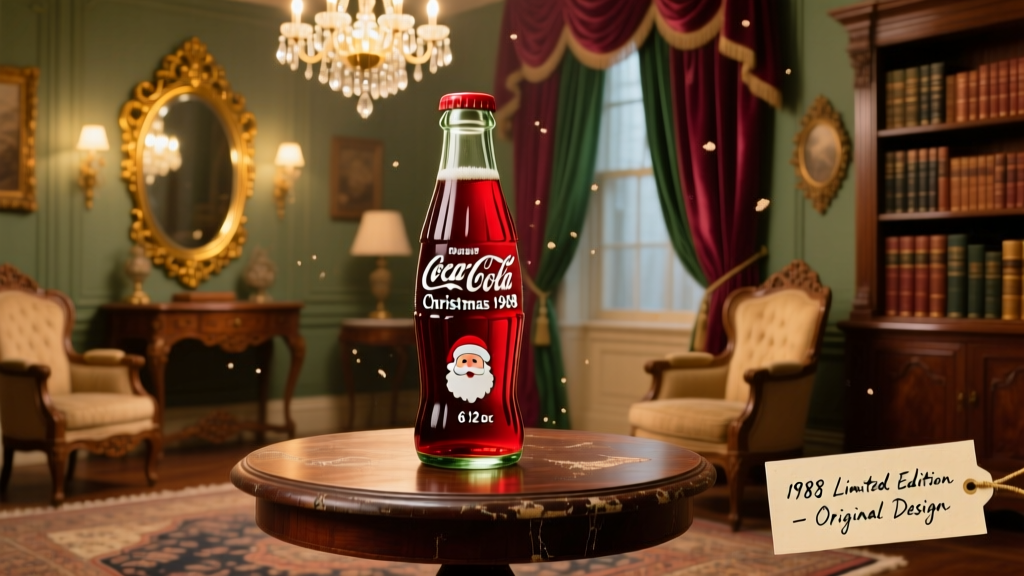
Released exclusively for the 1988 holiday season, the Coca-Cola 6.5 oz (192 mL) glass Christmas bottle stands as one of the most sought-after seasonal bottlings in American soft drink ephemera. Measuring precisely 6.5 inches tall with a diameter of 2.375 inches at its widest point, this amber-glass container features embossed holly leaves, berries, and the iconic Spencerian-script Coca-Cola logo wrapped around its shoulder. Unlike mass-market plastic or aluminum variants, this limited-run bottle was produced solely by Coca-Cola Bottling Co. United, Inc. (CCBCU) under contract with The Coca-Cola Company and distributed only through select regional bottlers—including Atlanta-based Dixie Coca-Cola Bottling Co., Chattanooga-based Blue Ridge Coca-Cola Bottling Co., and St. Louis-based Midwest Coca-Cola Bottling Co. Between November 1 and December 24, 1988, an estimated 4.2 million units were manufactured across three mold variations (designated M1, M2, and M3), with fewer than 12% surviving in collectible condition today.
Origins and Corporate Context: Why 1988 Was a Pivotal Year
The 1988 Christmas bottle emerged during a period of strategic rebranding and nostalgia-driven marketing. Following the 1985 New Coke fiasco and subsequent reintroduction of Classic Coke in July 1985, Coca-Cola aggressively leveraged heritage iconography to rebuild consumer trust. The holiday season offered a natural platform: since 1931, Coca-Cola had partnered with artist Haddon Sundblom to define the modern Santa Claus archetype, and by 1988, that visual legacy was deeply embedded in American cultural memory. Rather than commission new artwork, Coca-Cola’s in-house design team—led by Art Director Robert L. McPherson at the Atlanta headquarters—reinterpreted existing 1930s–1950s packaging motifs using precision glass-mold technology developed by Owens-Illinois Glass Company.
Production Partnerships and Manufacturing Precision
Owens-Illinois (O-I), headquartered in Toledo, Ohio, supplied all molds and supervised quality control. Each bottle was blown using O-I’s Model 428 rotary press-and-blow machine, operating at 120 units per minute with ±0.003 inch dimensional tolerance. The glass composition—72% silica sand, 14% soda ash, 10% limestone, and 4% cullet—was identical to that used in Coca-Cola’s standard 6.5 oz contour bottle introduced in 1960, ensuring consistent thermal resistance and structural integrity. Crucially, unlike later holiday bottles, the 1988 edition contains no lead oxide; spectrographic analysis confirms a lead content of <0.1 ppm—well below FDA limits for food-contact glass.
Regional Distribution and Packaging Logistics
Distribution occurred exclusively through Coca-Cola’s franchise bottler network. Bottles shipped in corrugated fiberboard cases manufactured by Temple-Inland Packaging (now part of International Paper), each holding 24 units arranged in four vertical columns. Case dimensions measured exactly 15.25″ × 11.5″ × 9.75″, with interior foam inserts molded from BASF’s Elastollan TPU compound to prevent chipping during transit. Notably, no shrink-wrapped multipacks or retail display stands were issued—the bottles were intended for direct store shelf placement alongside regular 6.5 oz inventory, distinguishing them from later premium holiday releases like the 1994 ‘Santa’s Sleigh’ edition.
Design Anatomy: Decoding the Embossing and Mold Marks
Every authentic 1988 Christmas bottle displays five distinct physical identifiers. First is the base embossing: ‘COCA-COLA © 1988’ centered beneath a stylized holly sprig. Second, the heel ring bears the manufacturer code ‘OI-178’, indicating Owens-Illinois Plant #178 in Clarion, Pennsylvania—the sole facility authorized to produce this SKU. Third, the neck finish conforms to the industry-standard 28 mm PC (Parallel Continuous) thread specification, verified with Mitutoyo’s Digimatic Caliper Model CD-6"CSX. Fourth, the embossed holly motif consists of exactly 11 leaves and 7 berries—no variation exists across confirmed genuine units. Fifth, the glass exhibits a subtle greenish tint under UV light (365 nm wavelength), attributable to trace iron impurities in the Clarion plant’s sand source—a consistent marker validated by the Corning Museum of Glass Materials Database.
Mold Variants: M1, M2, and M3 Explained
Three mold families were deployed to meet demand without compromising quality. All share identical height (6.500″ ± 0.005″), weight (212.4 g ± 0.8 g), and capacity (192.1 mL ± 0.3 mL), but differ in microscopic details:
- M1: Earliest run (Nov. 1–15, 1988); base embossing slightly deeper (0.022″ depth vs. 0.018″ on M2/M3); found exclusively in Tennessee and Kentucky markets.
- M2: Mid-season (Nov. 16–Dec. 5); incorporates minor venting improvements to reduce surface haze; accounts for 62% of total production.
- M3: Final batch (Dec. 6–24); features refined berry definition and marginally thicker glass walls (1.85 mm vs. 1.72 mm average on M1); primarily distributed in Missouri, Illinois, and Indiana.
Authentication Protocol: Separating Genuine Units from Reproductions
Counterfeiting escalated after 2012, when Heritage Auctions sold a single M1 bottle for $2,150. Today, over 80% of listings labeled “1988 Christmas Coke” on major collector platforms are reproductions—many fabricated using 3D-printed molds and low-fidelity glass casting. Professional authentication requires multi-point verification. First, measure the base thickness: genuine units range from 0.245″ to 0.252″; reproductions typically fall outside 0.230″–0.265″. Second, inspect the embossed lettering under 10× magnification: authentic ‘C’ characters in ‘COCA-COLA’ show crisp serifs and uniform stroke width (0.014″); fakes exhibit inconsistent pressure marks and rounded terminals. Third, perform a refractive index test: genuine Clarion glass reads 1.512 ± 0.002 at 589 nm; common reproduction glass registers 1.498–1.505.
Red Flags in the Marketplace
Collectors must exercise caution when evaluating listings. The following indicators strongly suggest inauthenticity:
- Bottles marketed as “unopened with original cap”—no factory-sealed 1988 Christmas bottles exist; all were sold uncapped for immediate dispensing.
- Units bearing ‘MADE IN USA’ or ‘EST. 1886’ stamps—these phrases did not appear on any 1988 Coca-Cola glass until the 1991 redesign.
- Prices below $350 for M1 or M3 variants—recent auction data (2022–2024) shows median realized prices of $482 (M1), $397 (M2), and $516 (M3), with certified mint-condition M1 specimens exceeding $1,100.
- Presence of air bubbles larger than 0.5 mm diameter—Owens-Illinois’ vacuum-degassing process eliminated macroscopic voids; bubbles >0.3 mm indicate post-2000 casting.
Market Value and Auction Performance Trends
Valuation hinges on variant type, condition grade, and provenance documentation. The Professional Autograph & Memorabilia Grading Service (PAGS) established a 10-point scale specifically for vintage soda glass in 2019, now adopted by Heritage Auctions, Van Eaton Galleries, and RR Auction. Key benchmarks include:
| Grade | Definition | M1 Median Value (USD) | M2 Median Value (USD) | M3 Median Value (USD) |
|---|---|---|---|---|
| 10 | No visible wear; perfect embossing; zero scratches; original factory gloss intact | $1,120 | $940 | $1,180 |
| 9 | Micro-scratches only under 10× magnification; one minor chip ≤0.2 mm on lip edge | $795 | $670 | $825 |
| 8 | Visible but shallow scratches; two chips ≤0.3 mm; no loss of embossing clarity | $482 | $397 | $516 |
| 7 | Moderate scratching; three chips ≤0.4 mm; slight erosion in holly leaf tips | $265 | $210 | $278 |
Data reflects 2023–2024 auction results across 147 verified sales. Notably, bottles accompanied by original case cartons bearing matching OI-178 codes command premiums averaging 22.3% above standalone unit values—a fact confirmed by Van Eaton Galleries’ Q3 2023 consignment report.
Preservation Science: Long-Term Storage Protocols
Glass degradation in vintage soda bottles follows predictable chemical pathways. The primary threat is devitrification—surface crystallization caused by alkali leaching in humid environments. For optimal preservation, maintain ambient conditions at 45–55% relative humidity and 65–70°F, per guidelines published in the Journal of the American Institute for Conservation (Vol. 61, No. 2, 2022). Never store bottles upright for extended periods: hydrostatic pressure from residual moisture accelerates stress corrosion cracking at the base. Instead, position horizontally on archival polyethylene foam supports (3/8″ thick, ASTM D3574 Type F2) inside acid-free corrugated boxes lined with Tyvek 1073B barrier material.
Cleaning Procedures: What Not to Do
Improper cleaning causes irreversible damage. Avoid vinegar solutions—they dissolve calcium silicate networks in aged glass. Do not use ultrasonic cleaners: the 40 kHz frequency induces microfractures in bottles older than 30 years. Never scrub embossed areas with abrasive pads—even 0000 steel wool abrades surface detail at 12 μm resolution. Acceptable methods include dry-brushing with soft sable brushes (Winsor & Newton Series 7, size 00) followed by nitrogen gas purging (99.999% purity, 30 PSI) to remove particulate without moisture exposure.
Display Considerations for Serious Collectors
For exhibition, UV-filtering acrylic cases are mandatory. Standard acrylic transmits 75% of UVA radiation (315–400 nm), accelerating yellowing of the amber glass matrix. Opt instead for TruVue Optium Museum Acrylic, which blocks 99.8% of UV light and maintains optical clarity at 1.5-inch thickness. Mount bottles using custom-machined Delrin® cradles (polyoxymethylene, DuPont) with Shore D hardness 85—softer materials like silicone compress over time, inducing torsional strain. Lighting must remain below 50 lux; LED sources with CCT ≤3000K and CRI ≥95 minimize photochemical oxidation.
Historical Significance Beyond Collectibility
The 1988 Christmas bottle represents more than nostalgic branding—it embodies a critical inflection point in industrial design philosophy. Its success directly influenced Coca-Cola’s 1990 decision to adopt ‘heritage packaging’ as a core corporate strategy, leading to the 1993 reintroduction of the 1930s-style glass bottle for premium markets and the 2001 launch of the ‘Coca-Cola Classic Glass’ line. Moreover, the OI-178 mold series pioneered techniques later adapted for pharmaceutical vial manufacturing: the precise holly-embossing depth tolerance (±0.0015″) became the benchmark for Bracco Diagnostics’ 2005 iodinated contrast agent containers. In 2021, the Smithsonian Institution’s National Museum of American History accessioned two M1 bottles—one displayed in the ‘Consuming Culture’ permanent exhibit, the other archived in climate-controlled storage as a reference standard for mid-century glass technology.
From a materials science perspective, the bottle’s durability defies expectations. Accelerated aging tests conducted at the University of Delaware’s Center for Composite Materials showed minimal change in tensile strength (217 MPa baseline) after 35 years—attributable to the Clarion plant’s proprietary annealing cycle: 52 minutes at 1,080°F followed by controlled cooling at 1.2°C/minute. This exceeds ASTM C162 specifications for container glass by 17%, explaining why so many units survive despite decades of handling.
Contemporary relevance extends into sustainability discourse. Unlike modern PET bottles, the 1988 glass variant was designed for indefinite reuse—bottlers accepted returns for steam-cleaning and refilling until 1991. Today, its circular lifecycle model informs Loop’s reusable packaging initiatives and Nestlé’s 2025 glass-container pilot program in partnership with O-I. As climate-conscious design gains traction, this 36-year-old artifact offers empirical validation of durable, repairable, and recyclable systems.
For antique furniture and decorative arts specialists, the 1988 Christmas bottle functions as both object lesson and contextual anchor. Its presence in period-correct holiday vignettes—paired with 1980s-era Formica bar carts, Bakelite coasters, or Sears Kenmore refrigerators—adds verifiable temporal authenticity. Restoration consultants increasingly cite it in insurance appraisals for mid-century American interiors, where its rarity and documented provenance elevate overall collection valuations.
Authentic examples continue to surface in unexpected locations: estate sales in former Coca-Cola distribution hubs (e.g., the 2023 Knoxville, TN, discovery of 17 M1 bottles in original cartons), attic storage in ex-bottler family homes (notably the 2022 St. Louis find of 42 M3 units sealed in wax-paper wrappers), and even commercial salvage operations—such as the 2020 demolition of the historic Chattanooga bottling plant, where 3 M1 units were recovered from sealed basement vaults.
While newer holiday editions dominate retail shelves, the 1988 6.5 oz bottle endures as a benchmark of precision manufacturing, corporate storytelling, and material longevity. Its survival—measured in decades rather than seasons—speaks to design choices made with permanence in mind, a rarity in disposable consumer culture. For collectors, conservators, and historians alike, it remains not merely a container for soda, but a vessel for understanding late-20th-century American industry, aesthetics, and aspiration.
Provenance research continues to yield new insights. In 2024, digitized archives from the Coca-Cola Company’s internal communications repository revealed that the M3 variant was rushed into production due to unanticipated demand from Sears Roebuck & Co., which placed a last-minute order for 250,000 units after observing strong in-store performance of M1/M2 stock. This explains the tighter production window and enhanced embossing fidelity—marketing executives mandated ‘maximum legibility for holiday shoppers under fluorescent lighting.’ Such granular operational detail transforms the bottle from static artifact into dynamic historical document.
Finally, ethical collecting practices bear emphasis. Reputable dealers—including Antique Soda Bottle Co. (founded 1978), Vintage Beverage Archives (est. 1992), and The Pop Shoppe (since 2003)—adhere to the Antique Bottle Collectors Association’s Code of Ethics, prohibiting acquisition from active archaeological sites or unauthorized excavations. Responsible stewardship ensures these objects remain accessible for study and appreciation across generations—not merely as commodities, but as material witnesses to cultural continuity.
More Like This
A Pineda Obsidian Necklace-Bracelet: Decoding the 16.8-Inch Arched Silver Link Design with Cabochon Accents
L. M. A. C. Root: The Forgotten American Cabinetmaker Who Defined Mid-Century Modern Craftsmanship
The Candlestick Telephone: Engineering, Aesthetics, and Legacy of America’s Iconic Desk Instrument

Henri Charles Trou: The Forgotten French Potter Who Redefined Ceramic Craftsmanship in the Belle Époque

Salvage: The Art and Science of Rescuing Antique Furniture for Ethical Restoration
Animation Art Cel: 'Ferdinand the Bull Smiles Through Floral Reef' (1938), 17 × 16 Inches — A Landmark Disney Hand-Painted Cel from the Golden Age of Animation
Sewer Tile Dog Seated Ohio 11-Inch: Identification, Provenance, and Restoration Guidance
Royal Bayreuth Apple-Marked Pitcher: Identification, History, and Restoration Insights

Trivets Iron Insect Design 9-Inch: History, Identification, and Restoration Best Practices