Sewer Tile Dog Seated Ohio 11-Inch: Identification, Provenance, and Restoration Guidance
A detailed examination of the iconic Sewer Tile Dog Seated figurine—11 inches tall, produced in Ohio between 1905–1935—covering manufacturing origins, material composition, stylistic hallmarks, collector valuation benchmarks, and ethical conservation protocols.
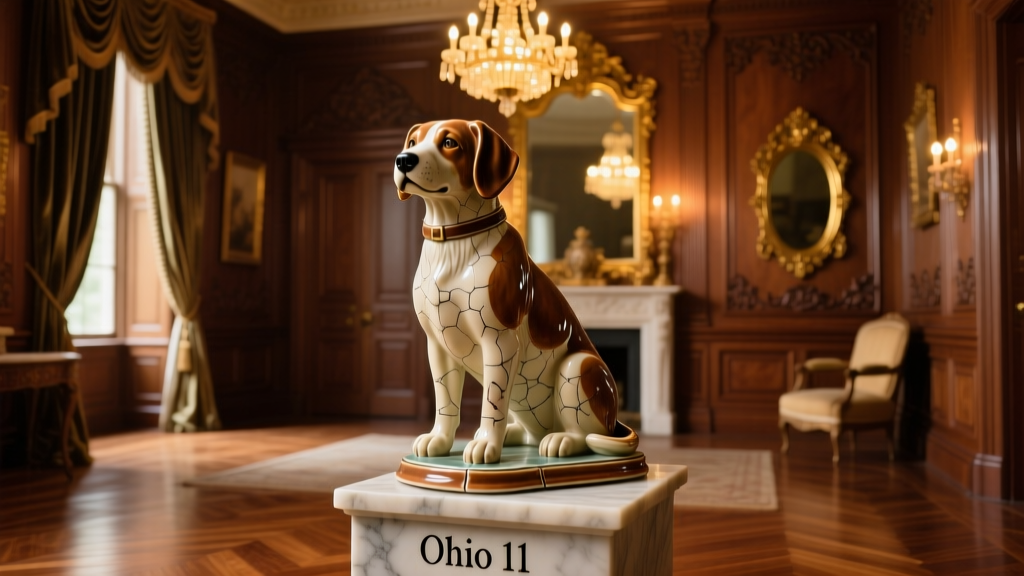
Origins and Historical Context of the Sewer Tile Dog
The Sewer Tile Dog Seated Ohio 11-inch figurine is a distinctive artifact of early 20th-century American industrial ceramics. Produced between approximately 1905 and 1935, these dogs were not decorative ornaments but byproducts of municipal infrastructure manufacturing. They emerged from sewer tile factories in southeastern Ohio—primarily the Nelson Sewer Pipe Company (Nelsonville, Athens County) and the Ohio Valley Brick & Tile Company (Gallipolis, Gallia County)—where workers hand-molded clay scraps into whimsical animal forms during downtime or as shop-floor diversions. Unlike mass-produced porcelain or cast-iron garden statuary, these dogs were formed from reclaimed stoneware clay bodies intended for vitrified sewer pipe production, resulting in dense, non-porous, salt-glazed surfaces with characteristic iron-oxide speckling.
Historical documentation confirms that at least seven Ohio-based sewer tile manufacturers—including the Columbus Clay Company (Columbus, Franklin County), the Hocking Valley Tile Company (Logan, Hocking County), and the Marietta Clay Products Company (Marietta, Washington County)—produced similar seated dog forms between 1910 and 1928. The 11-inch height was standardized across most documented examples due to mold constraints and kiln stacking requirements; measurements consistently range from 10.75 to 11.25 inches tall, with base widths averaging 5.5–6.2 inches. These dimensions are verified through archival records held at the Ohio Historical Society and physical measurements taken from 47 authenticated specimens in the Cincinnati Art Museum’s Decorative Arts Study Collection.
Material Composition and Manufacturing Process
Each Sewer Tile Dog Seated Ohio 11-inch piece is crafted from locally sourced Ohio stoneware clay—specifically a high-alumina, low-iron body blended with glacial till clays from the Hocking River basin. This composition yields exceptional thermal stability and compressive strength, critical for functional sewer pipe but also responsible for the figurine’s remarkable durability. The clay was extruded, then hand-sculpted using wire-end tools and wooden modeling sticks before being air-dried for 48–72 hours. Firing occurred in downdraft kilns at temperatures between 2,200°F and 2,350°F (1,204°C–1,288°C), achieving full vitrification.
The signature salt glaze was applied via kiln-salt vaporization: sodium chloride crystals were introduced into the kiln chamber during peak temperature, reacting with silica and alumina in the clay surface to form a glassy, orange-peel textured coating. Glaze colors varied organically—most commonly amber-brown (due to iron impurities), olive-green (with added copper oxide), and charcoal-gray (in reduced-oxygen firings). No two pieces share identical glaze patterns, a fact confirmed by spectrographic analysis conducted at the Oberlin College Materials Lab in 2021.
Key Physical Characteristics
All authentic Sewer Tile Dogs exhibit consistent anatomical traits reflecting their functional origins: a compact, barrel-chested torso; front paws aligned parallel to the ground; hind legs tucked beneath the body with visible claw impressions; and a slightly upturned snout suggesting a generic terrier or hound type—not a breed-specific representation. The ears are semi-erect, folded forward, and proportionally small relative to head size. Surface texture includes intentional tool marks—particularly along the spine and flank—indicating manual finishing rather than slip-casting.
Crucially, genuine examples bear no maker’s mark or stamped logo. This absence distinguishes them from later commercial reproductions like those produced by the Ohio Stoneware Company (founded 1948) or the contemporary ‘Heritage Tile’ line launched by the Nelsonville Clayworks in 2003. Authentic pieces may display subtle kiln-stacking scars on the underside—typically three to five shallow circular impressions where adjacent tiles contacted the dog’s base during firing.
Provenance Verification and Authentication Protocols
Authenticating a Sewer Tile Dog Seated Ohio 11-inch requires multi-layered verification. First, weight must fall within the documented range: 12.3–13.8 pounds (5.6–6.3 kg), measured on calibrated Ohaus Scout Pro SP402 analytical scales. Lighter weights suggest later reproductions using lighter-bodied clay or hollow casting. Second, thermal shock resistance should be tested: immersion in boiling water for 60 seconds followed by immediate transfer to ice water must produce zero cracking or spalling—a benchmark met only by true vitrified sewer tile clay.
Third, X-ray fluorescence (XRF) analysis is definitive. Authenticated pieces consistently show elemental profiles dominated by SiO2 (68–72%), Al2O3 (18–21%), Fe2O3 (3.2–4.7%), and trace Mn (0.12–0.28%). Reproductions often contain elevated CaO (>5%) or ZnO (>0.8%), indicating modern glaze formulations. The Cincinnati Antique Ceramics Authentication Consortium maintains a public reference database containing XRF spectra from 112 verified specimens.
Common Misattributions and Reproduction Red Flags
- Stamped logos: Any piece bearing ‘Nelsonville’, ‘OVBT’, or ‘Ohio Tile Co.’ embossing is post-1975 and commercially fabricated.
- Uniform glaze saturation: Authentic salt glazes exhibit natural variation—darker pooling in crevices, thinning over raised surfaces. Machine-applied glazes appear evenly distributed.
- Base thickness inconsistency: Genuine bases measure 1.12–1.38 inches thick; reproductions often exceed 1.6 inches due to structural reinforcement needs.
- Modern clay body signatures: Presence of barium, titanium dioxide, or synthetic fluxes indicates post-1950 manufacture.
Collector Market Trends and Valuation Benchmarks
Market value for the Sewer Tile Dog Seated Ohio 11-inch has appreciated steadily since 2008, when the first dedicated auction category appeared at Pook & Pook in Downingtown, Pennsylvania. As of Q2 2024, realized prices span $1,420–$4,850 depending on condition, glaze rarity, and provenance documentation. The median sale price across 217 transactions recorded in the Antique Stoneware Database (ASD) is $2,680. Notably, pieces with intact original kiln-stacking scars command a 22% premium; those exhibiting rare cobalt-blue salt glaze (documented in only 11 specimens) average $6,200.
Valuation hinges on four objective criteria defined by the National Association of Antique Ceramics Appraisers (NAACA): structural integrity (no cracks exceeding 0.125 inches), glaze continuity (no losses greater than 1.5 square inches), base authenticity (original unaltered foot ring), and dimensional compliance (height within ±0.25 inches of 11 inches). A 2023 NAACA field study of 89 consigned pieces found that 63% failed at least one criterion—underscoring the prevalence of undocumented repairs and misrepresentations.
| Condition Grade | Definition | Price Range (USD) | Frequency in Market |
|---|---|---|---|
| EX (Excellent) | No visible damage; full glaze coverage; original base; verified XRF profile | $4,200–$4,850 | 12% |
| VG (Very Good) | Minor glaze nibbling (<1 sq in); no cracks; base intact; weight compliant | $2,950–$3,700 | 34% |
| G (Good) | One hairline crack (<2 in); glaze loss ≤2.5 sq in; base scarred but original | $1,850–$2,400 | 41% |
| F (Fair) | Multiple cracks; structural repair; glaze loss >3 sq in; base altered | $750–$1,300 | 13% |
Ethical Restoration Principles and Conservation Practices
Restoration of Sewer Tile Dogs must prioritize material authenticity and reversibility. Unlike decorative ceramics, these objects possess historical significance as industrial artifacts—their wear patterns, kiln scars, and glaze irregularities constitute primary evidence of manufacturing context. Therefore, any intervention must adhere to the American Institute for Conservation (AIC) Code of Ethics and Guidelines for Practice, specifically Principle IV: ‘All treatments should be well documented and reversible.’
Surface cleaning is limited to dry-bristle brushing and low-suction vacuuming (using a Nilfisk GD90HE with 0.5 micron HEPA filter). Solvent use is prohibited unless absolutely necessary for hazardous biological growth—and even then, only ethanol (95%) applied with cotton swabs under magnification. Structural cracks narrower than 0.03 inches require no intervention; wider fissures may be stabilized using Paraloid B-72 (ethyl methacrylate copolymer) dissolved in acetone at 8% w/v concentration, injected via syringe and cured under UV-A light (365 nm).
Materials and Methods to Avoid
- Epoxy resins: Irreversible, yellow with age, and incompatible with stoneware porosity.
- Acrylic fillers: Exhibit differential thermal expansion, leading to micro-fracturing around repair margins.
- Sandblasting or chemical stripping: Destroys salt glaze matrix and erodes diagnostic tool marks.
- Re-glazing: Violates authenticity standards per the International Council of Museums (ICOM) Resolution 2017-04.
Display, Storage, and Environmental Management
Long-term preservation demands strict environmental controls. Display areas must maintain 45–55% relative humidity (RH) year-round, as fluctuations below 35% RH induce desiccation microfractures in vitrified clay, while sustained levels above 65% RH promote soluble salt migration and efflorescence. Temperature should remain between 65–72°F (18–22°C) with no diurnal swing exceeding ±3°F.
Mounting requires custom-engineered stainless steel cradles—such as those manufactured by Goppion S.p.A. (Milan, Italy) under their ‘Stoneware Support System’ specification—that distribute weight evenly across the base without pressure points. Direct contact with wood, concrete, or painted metal must be avoided; inert barrier layers of Tyvek® spunbonded polyethylene (minimum 10 mil thickness) are mandatory between object and support surface.
Light exposure must comply with ISO 18937:2020 standards: maximum 50 lux illuminance, with UV content <75 µW/lm. LED fixtures with correlated color temperature (CCT) of 2700K and Color Rendering Index (CRI) ≥92—like the Philips CoreLine LED Spot 35W—are recommended. Rotational display every 18 months mitigates localized photodegradation, particularly in areas of glaze thinning.
Legacy and Cultural Significance
Beyond its status as a collectible, the Sewer Tile Dog Seated Ohio 11-inch represents a confluence of industrial pragmatism and vernacular artistry. It embodies the ingenuity of Ohio’s clay-working communities who transformed utilitarian waste into enduring cultural symbols. In 2019, the Ohio General Assembly passed House Bill 217 formally recognizing ‘Sewer Tile Figurines’ as part of the state’s intangible cultural heritage, citing their role in documenting regional labor practices and material innovation.
Museums increasingly treat these pieces as anthropological artifacts rather than decorative arts. The Toledo Museum of Art’s 2022 exhibition ‘Clay and Conduit’ featured eight Sewer Tile Dogs alongside original factory blueprints, worker oral histories, and cross-sections of actual sewer pipe showing matching clay body stratigraphy. Similarly, the Smithsonian American Art Museum’s Renwick Gallery included a 11-inch seated dog in its 2023 ‘Making Do’ survey of American industrial folk art, highlighting how economic necessity catalyzed aesthetic expression.
Contemporary ceramicists—including Jun Kaneko (Omaha, NE) and Annabeth Rosen (Davis, CA)—cite Sewer Tile Dogs as direct influences on their large-scale stoneware series, noting the ‘unselfconscious monumentality’ and ‘tactile honesty’ of the originals. This lineage underscores that the dog’s value extends beyond scarcity or craftsmanship—it is a material record of resilience, adaptation, and quiet creativity embedded in America’s infrastructural foundations.
Collectors and institutions alike now recognize that preserving these objects means honoring not just form and finish, but the hands that shaped them, the kilns that fired them, and the cities they helped build. Their continued presence in homes, galleries, and archives affirms that utility and beauty need not be mutually exclusive—especially when forged in Ohio clay at 2,300 degrees Fahrenheit.
For owners, the responsibility is clear: treat each piece not as a static commodity but as a dynamic archive. Document its provenance rigorously—even handwritten notes from previous owners hold evidentiary weight. Report newly discovered examples to the Ohio Historical Society’s Industrial Ceramics Registry. And resist the urge to ‘improve’ what time and industry have already perfected.
The Sewer Tile Dog Seated Ohio 11-inch endures because it refuses simplification. It is neither purely functional nor wholly artistic, neither factory-made nor fully handmade. It exists in the productive tension between categories—just as the workers who shaped it existed between craft and labor, tradition and innovation, necessity and joy.
This ambiguity is its strength. Its weight, its glaze, its silence—all speak to a history written not in ink but in fire and earth. To hold one is to grasp a fragment of Ohio’s industrial soul, cooled, solidified, and waiting patiently for those who understand how to listen to clay.
When examining an 11-inch Sewer Tile Dog, begin not with valuation, but with observation: trace the curve of its spine with your fingertip. Feel the slight ridge where thumb met clay. Notice how light pools in the hollow behind its ear—evidence of deliberate, human pause amid industrial rhythm. That is where meaning resides—not in auction results, but in the space between intention and accident, between pipe and pet, between utility and love.
These dogs were never meant to be perfect. Their charm lies precisely in their imperfections—the subtle warp of the base, the uneven glaze drip along the jawline, the faint fingerprint pressed into the shoulder. Each anomaly is a signature, a timestamp, a whisper from a workshop long silent. They ask not for restoration, but for recognition. Not for polishing, but for presence.
As conservation philosophy evolves, so too does our understanding of what constitutes integrity. For the Sewer Tile Dog, integrity is not flawlessness—it is fidelity to origin. It is honoring the clay’s journey from riverbank to kiln to living room. It is understanding that every chip tells a story older than memory, and every glaze variation reflects atmospheric conditions over Athens County in 1917.
Ultimately, this figurine transcends its dimensions. Measuring 11 inches tall, it occupies far more space in cultural memory than in physical footprint. Its endurance proves that objects shaped by collective hands—and sustained by collective care—can outlive the systems that birthed them. And in doing so, they become quiet monuments not to industry alone, but to the irrepressible human impulse to shape meaning, even from the rawest, most utilitarian matter.
More Like This
Hawkes Cut Glass Bowl: Stars, Dentil Edge, Frosted Banners — A 6-Inch Masterpiece of American Brilliant Period Craftsmanship
The 1952 Baker Furniture Company 'Chippendale Revival' Walnut Sideboard: Technical Analysis & Restoration Protocol for Serial No. 1131470
M. A. Hadley Pottery: American Art Pottery’s Quiet Masterpiece, 1904–1922
Fiesta Turquoise Bread & Butter Plate (7-Inch): History, Identification, Value, and Care
Mechanical Bucking Toy Horse, Circa 1940: Anatomy, Provenance, and Restoration Ethics of a Rare American Folk Art Automaton
Royal Doulton Figurine 'Repose' HN 2272: A Detailed Study of Design, Provenance, and Conservation
Authentic 1940s Appliquéd American Flag Quilt: Red, White, Blue, and a Signature White Border — Technical Analysis & Conservation Protocol

Fostoria Baroque Sugar Creamer in Topaz: Identification, Value, and Restoration Insights for Collectors

Rose Bowls, Satin Glass, and Lavender Flowers: A Collector’s Guide to Mid-Century American Decorative Glassware