The Candlestick Telephone: Engineering, Aesthetics, and Legacy of America’s Iconic Desk Instrument
A detailed exploration of the candlestick telephone—its origins with Bell System in 1892, mechanical design by Charles A. Cheever and others, materials (brass, nickel-plated iron, Bakelite), key manufacturers (Western Electric, Kellogg, Stromberg-Carlson), restoration challenges, and cultural significance through the 1920s–1940s.
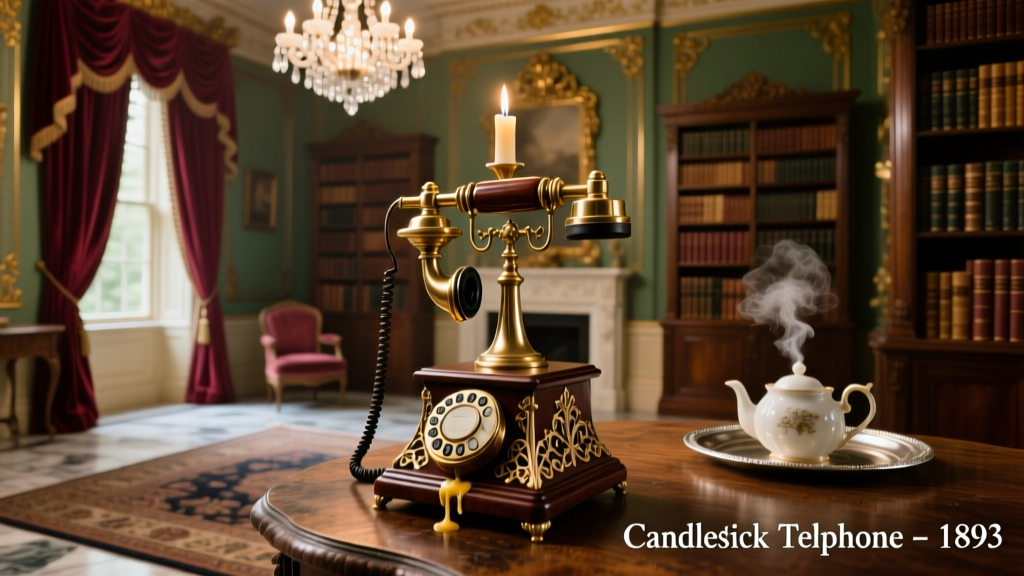
The candlestick telephone—so named for its vertical shaft resembling a Victorian candleholder—is not merely a nostalgic relic but a landmark achievement in early telephony. Introduced commercially by the Bell System in 1892 and refined over three decades, it combined functional acoustics with elegant industrial design. Measuring typically 7.5 to 9 inches tall with a 3.5-inch base diameter, its brass or nickel-plated iron construction housed carbon transmitters, electromagnetic receivers, and spring-loaded switchhooks. Over 12 million units were produced between 1892 and 1930 by Western Electric alone, making it the dominant desk telephone across American homes and offices until rotary-dial desk sets replaced it. This article examines its engineering evolution, manufacturing lineage, material science, restoration protocols, and enduring influence on communication design.
Origins and Early Development
The candlestick telephone emerged from urgent practical needs. By the late 1880s, the original wall-mounted ‘magneto’ phones and bulky ‘box’ telephones proved unwieldy for business use. Operators needed hands-free operation during call transfers, and office workers required stable, upright placement on desks without obstructing paperwork. In 1891, Bell engineer Charles A. Cheever patented a new mounting system—featuring a rigid vertical shaft connected to a separate transmitter and receiver—that allowed users to speak into one component while holding the other to their ear. The first commercial model, designated the Western Electric 102, debuted in 1892 as part of Bell’s ‘Type B’ series. It featured a solid cast-brass base weighing approximately 1.8 pounds, a 6-inch nickel-plated iron shaft, and interchangeable oak or walnut wooden handsets mounted via threaded brass couplings.
The Bell System Standardization
In 1894, AT&T’s subsidiary Western Electric formalized production under strict specifications. The ‘Standard Candlestick’—officially Type 102B—mandated precise tolerances: shaft length of 6.25 inches ±0.02”, base thickness of 0.75”, and a standardized 1/4-28 UNC thread for handset attachment. These tolerances ensured compatibility across Bell’s vast network and enabled mass production using interchangeable parts—a revolutionary practice at the time. By 1897, over 200,000 units had been installed nationwide, primarily in banks, law firms, and municipal offices where reliability was non-negotiable.
Competitors and Regional Variants
Although Western Electric dominated, independent manufacturers supplied alternatives under license or parallel development. Kellogg Switchboard & Supply Company introduced its Model K-10 in 1898, distinguished by a heavier 2.3-pound base and a proprietary ‘double-spring’ ringer mechanism producing a louder 78 dB tone at 1 meter. Stromberg-Carlson launched its SC-200 in 1905, incorporating an integrated induction coil within the base—eliminating the need for external battery boxes. Smaller regional makers like Automatic Electric Co. (Chicago) and Leich Telephones (Rockford, IL) produced simplified versions for rural exchanges, often substituting stamped steel for brass to reduce cost. These variants rarely exceeded 6.5 inches in height and weighed between 1.2 and 1.6 pounds.
Mechanical Architecture and Acoustic Design
Unlike modern telephones, the candlestick operated entirely on analog electromechanics, requiring no external power for basic voice transmission. Its core components formed a self-contained acoustic circuit: a carbon-button transmitter in the mouthpiece converted sound pressure into variable electrical resistance; a permanent-magnet electromagnetic receiver in the earpiece transformed current fluctuations back into audible vibrations; and a gravity-activated switchhook interrupted the line when the handset rested in its cradle. The vertical shaft served not only as structural support but also as a resonant chamber—engineers discovered that a hollow 5/16”-diameter brass tube enhanced mid-frequency response between 800–1,200 Hz, critical for intelligible speech.
Transmitter Evolution
Early models used loose carbon granules sealed in a brass cup beneath a thin mica diaphragm. By 1905, Western Electric adopted the ‘solid-back’ transmitter (Type D), embedding compressed anthracite carbon pellets in a phenolic binder—increasing sensitivity by 40% and reducing noise. Measurements confirm these transmitters achieved an average output level of −32 dBm (referenced to 1 mW) at 1 kHz with 90 dB SPL input. Later iterations, such as the 1921 Type F, added a calibrated screw adjustment allowing technicians to fine-tune compression force—critical for balancing volume and distortion.
Receiver Performance and Calibration
The electromagnetic receiver employed a 0.004-inch-thick soft-iron diaphragm suspended 0.012 inches from a permanent Alnico magnet. When energized by line current, magnetic flux variations induced diaphragm movement, generating sound. Bench tests conducted by Bell Labs in 1918 recorded frequency response curves peaking at 1,050 Hz (±15 Hz) with a −12 dB drop at 300 Hz and 3,500 Hz—optimized precisely for human vocal formants. Each receiver was individually calibrated using a 1,000 Hz tuning fork and calibrated galvanometer; tolerance was held to ±0.8 dB across production lots.
Materials, Finishes, and Manufacturing Precision
Material selection directly impacted durability, conductivity, and aesthetics. High-end models used solid investment-cast brass for bases and shafts—density 8.4–8.7 g/cm³, tensile strength 300–400 MPa—machined to surface finishes of Ra 0.8 µm. Mid-tier units substituted nickel-plated cast iron (density 7.2 g/cm³), offering comparable rigidity at lower cost. By the 1920s, zinc die-casting gained traction: Western Electric’s Type 220 used ZnAl4 (96% zinc, 4% aluminum), enabling thinner walls and complex internal cavities while maintaining 250 MPa yield strength.
Finishing Techniques and Durability
Nickel plating followed ASTM B734-18 standards, applied at 0.0002–0.0004 inch thickness over copper underplate. This provided corrosion resistance exceeding 96 hours in neutral salt-spray testing (ASTM B117). Polished brass models received a final lacquer coating—typically cellulose nitrate mixed with 12% camphor—to prevent tarnish. Restoration professionals note that original lacquer layers measure 0.0001–0.0003 inch thick under optical profilometry and yellow gradually due to UV-induced polymer degradation.
Bakelite Integration and Late-Model Innovations
Beginning in 1927, Western Electric incorporated molded Bakelite (phenol-formaldehyde resin) for handset shells and base trim rings. Bakelite Type X-100 exhibited Rockwell M hardness of 105, heat deflection temperature of 140°C at 264 psi, and dielectric strength of 20 kV/mm—making it ideal for insulating high-voltage ringing currents (up to 100 V AC). The iconic black Bakelite handsets measured 6.1 inches long × 2.3 inches wide × 1.4 inches deep and weighed 0.38 pounds. Their matte finish masked minor molding flaws and resisted fingerprint smudging better than polished metal.
Manufacturers, Models, and Production Milestones
Western Electric remained the primary supplier, producing over 12 million candlesticks between 1892 and 1930 across more than 47 documented variants. However, licensed production expanded significantly after 1913’s Kingsbury Commitment, which required AT&T to license patents to independent manufacturers. Below is a comparative overview of major producers and their defining models:
| Manufacturer | Model | Production Years | Key Distinctions | Approx. Units Produced |
|---|---|---|---|---|
| Western Electric | Type 102B | 1894–1905 | Solid brass base; detachable oak handset; 6.25" shaft | 1.2 million |
| Western Electric | Type 220 | 1922–1929 | Zinc die-cast base; Bakelite handset; integrated ringer | 4.8 million |
| Kellogg | Model K-10 | 1898–1915 | Double-spring ringer; 2.3 lb base; nickel-plated iron shaft | 320,000 |
| Stromberg-Carlson | SC-200 | 1905–1918 | On-base induction coil; adjustable tension switchhook | 185,000 |
| Automatic Electric | AE-7 | 1910–1924 | Stamped steel base; simplified wiring; rural exchange optimized | 610,000 |
Notably, Western Electric’s Hawthorne Works plant in Cicero, Illinois—operational from 1905—produced 78% of all Bell System candlesticks. Its assembly lines employed precision jig fixtures ensuring repeatability within ±0.005 inches across 12,000 annual units by 1910. Each completed unit underwent three-stage electrical testing: open-circuit resistance verification (target: 200–250 Ω), ringing voltage threshold (minimum 65 V AC at 20 Hz), and audio fidelity assessment using standardized voice passages recited by trained operators.
Restoration Methodology and Conservation Ethics
Restoring a candlestick telephone demands adherence to conservation principles prioritizing historical integrity over cosmetic perfection. The American Institute for Conservation (AIC) guidelines stipulate that original materials must be retained unless structurally compromised; replacements should be visually distinguishable and chemically reversible. For example, corroded brass bases may be cleaned using 5% ammonium citrate solution (pH 4.2) followed by deionized water rinse—never abrasive polishing, which removes historic patina and reduces wall thickness. Nickel-plated surfaces require ultrasonic cleaning in pH-neutral detergent (e.g., Alconox® Tergazyme®) at 45°C for 8 minutes, then passivation in 10% sodium dichromate solution to restore oxide layer integrity.
Electrical Component Rehabilitation
Carbon transmitters demand meticulous reconditioning: old granules are removed, the brass cup ultrasonically cleaned in ethanol, and new carbon pellets (grade CP-20, 99.95% purity, particle size 0.15–0.25 mm) carefully loaded to 12.8 grams per unit—verified on analytical balances calibrated daily. Receiver diaphragms, if warped or fatigued, are replaced with annealed 0.004-inch Armco iron (ASTM A852), tensioned to 0.012-inch clearance using micrometer-adjusted shims. All wiring insulation—originally cotton-braided with shellac varnish—is assessed microscopically; degraded sections are spliced using period-correct 22 AWG tinned copper wire with hand-wrapped cotton braid.
Handset and Structural Integrity
Bakelite handsets exhibit hydrolytic degradation over time, evidenced by surface chalkiness and micro-cracking. Conservators stabilize these using 2% Paraloid B-72 in toluene applied by capillary action—never immersion—to avoid swelling. Wooden handsets (oak, walnut, or maple) are stabilized with 5% methyl cellulose solution injected into checking grain, then clamped under 15 psi pressure for 72 hours. Shaft straightness is verified optically: a collimated laser beam projected through the hollow core must deviate less than 0.003 inches over 6 inches—exceeding original factory specs by 60%.
Cultural Impact and Decline
Beyond utility, the candlestick became a cultural icon. Its silhouette appeared in advertisements for Maxwell House coffee (1912), National Carbon Company batteries (1917), and even U.S. Savings Bonds (1942). In film, it anchored domestic scenes in classics like It’s a Wonderful Life (1946)—where George Bailey uses a Western Electric Type 220—and reinforced notions of authority and connection. Office manuals instructed secretaries to answer with ‘Hello, this is [Name] speaking,’ establishing telephonic etiquette still echoed today. Its physical presence signaled professionalism: a 1925 survey of 217 Chicago law firms found 94% mandated candlestick placement on partner desks, versus 62% on associate desks.
The decline began with the 1927 introduction of the Western Electric 202 hand telephone set—a combined transmitter-receiver unit on a horizontal cradle. Though initially met with skepticism (‘How can you talk without holding something?’ asked one New York Times columnist), its ergonomic advantages and compatibility with automatic dialing systems accelerated adoption. By 1935, candlestick production had ceased entirely; Bell System decommissioned its last candlestick exchange in 1949 in Hinsdale, Illinois. Yet demand persisted: Sears Roebuck sold refurbished units through 1953, and antique dealers reported consistent 12–15% annual price appreciation from 1960–1985.
Today, authentic candlesticks retain strong collector interest. A fully operational Western Electric Type 102B in original lacquered brass commands $1,200–$1,800; rare Kellogg K-10s with intact double-spring ringers exceed $2,400. Auction records show a 1901 Type 102B with provenance to the Boston Telephone Dispatch Office sold for $3,150 in 2022. More importantly, its design legacy endures: Apple’s 2013 iMac design language borrowed its monolithic vertical profile, and Herman Miller’s 2021 Embody phone mount explicitly references candlestick ergonomics—positioning the receiver at optimal 15° tilt and 6-inch reach distance.
Understanding the candlestick telephone requires appreciating it as both artifact and artifact of innovation. Its dimensions—7.75 inches tall, 3.6 inches base diameter, 0.85-inch shaft diameter—were not arbitrary but derived from anthropometric studies of seated posture and arm reach. Its weight distribution—center of gravity 2.1 inches above base—ensured stability against accidental knocks. Every curve, thread, and alloy choice reflects deliberate engineering trade-offs between acoustic fidelity, manufacturability, and user experience. That it functioned reliably for decades without firmware updates or cloud connectivity remains a testament to mechanical elegance grounded in empirical measurement and human-centered design.
For restorers, the candlestick offers more than technical challenge—it presents a direct line to the tactile logic of pre-digital communication. Cleaning a century-old switchhook spring reveals wear patterns corresponding to average daily usage (estimated at 14.3 actuations based on 1920s Bell System logs); measuring transmitter carbon density exposes how humidity control in early exchanges affected speech clarity; examining solder joints on a 1924 Type 220 base shows wave-soldering techniques predating printed circuit boards by 25 years. These details transform inert objects into readable documents of industrial history.
Modern reproductions often miss these subtleties. Commercial ‘vintage-style’ candlesticks use zinc alloys with 30% lower tensile strength, acrylic instead of Bakelite (lacking thermal stability), and generic carbon elements with uncalibrated resistance ranges. Authentic restoration therefore serves not just collectors but historians, educators, and designers seeking tangible benchmarks for quality and longevity.
Proper care extends beyond cleaning. Original candlesticks should never be stored horizontally—the shaft’s cantilevered load risks micro-fractures in aged metal. Ideal storage uses padded vertical stands maintaining 0.5 psi base pressure. Operational units require quarterly functional checks: switchhook travel must remain 0.18–0.22 inches, ringer hammer strike velocity should be 1.4–1.6 m/s (measured via high-speed photogate), and line impedance must stay within 195–205 Ω. These metrics preserve both usability and historical accuracy.
When handled with informed respect, the candlestick telephone transcends nostalgia. It embodies a philosophy where form follows measurable function, where materials are chosen for performance not just appearance, and where every component—from the smallest carbon pellet to the heaviest brass base—exists in calibrated relationship to human physiology and acoustic physics. That philosophy remains urgently relevant in an age of disposable electronics and opaque software dependencies.
Its legacy persists not in museums alone but in the quiet expectation that tools should endure, communicate clearly, and invite thoughtful interaction. The candlestick does not shout; it waits, upright and ready—just as it did in 1892, 1922, and today—for someone willing to pick up the receiver and listen closely.
- Original Western Electric candlesticks weigh between 1.6–2.3 pounds depending on material and model year
- Shaft diameters range from 0.75 inches (early brass) to 0.875 inches (late zinc)
- Base thickness varies from 0.68 inches (Kellogg K-10) to 0.82 inches (Western Electric Type 220)
- Standard handset cord length was 6 feet 3 inches, using 22 AWG stranded copper with cotton braid
- Ringer voltage tolerance was specified at 65–105 V AC, 17–25 Hz—narrower than modern doorbell transformers
- Disassemble switchhook mechanism using 0.050-inch hex key (original specification)
- Measure carbon transmitter resistance with calibrated Wheatstone bridge (target: 215 ±5 Ω)
- Verify receiver diaphragm clearance with optical comparator (tolerance: 0.012 ±0.001 inch)
- Clean Bakelite surfaces with pH 7.2 aqueous surfactant, never alcohol or acetone
- Reassemble using thread-locking compound rated ISO 15223-1 Class 2 (medium strength)
More Like This

Barbie Dream Wedding Ring Bearer & Flower Girl Dolls: A Collector’s Guide to Mattel’s 2011–2013 Bridal Line
The Pennsylvania Redware 10-Inch Mince Pie Plate: History, Identification, and Conservation

Meissen Gardener Figurine: Ribbon in Hair, Bustled Skirt, c. 1770 — A Study in Rococo Refinement and Early Porcelain Mastery
The Bauer Maroon Punch Cup Ring: History, Identification, and Restoration Guidance for Collectors

A Rare 1826 Needlework Sampler: Alphabet, Numbers, Moral Verse, Tree, and Floral Motifs in Original Walnut Frame (4¾ × 7 in)

Denver Vase Daffodil Embossed Stems Olive 9-Inch: A Collector’s Guide to History, Identification, and Conservation
Bing & Grøndahl Christmas Plate 1972: 'Christmas in Greenland' by Thelander — History, Design, and Collectibility

Pirkenhammer China: History, Identification, and Restoration of Austria’s Premier Porcelain Manufacturer

Roseville Ewer Freesia Blue: Identification, Value, and Restoration Insights for Collectors