Mantel Clocks in Bronze and Marble: A Technical and Historical Appraisal of 19th-Century Figural Timepieces (23 × 25 Inches)
A detailed examination of large-scale 19th-century French and English mantel clocks featuring bronze figural mounts, veined marble bases, and mechanical movements — with precise measurements, maker attributions, material analysis, restoration protocols, and market valuation insights.
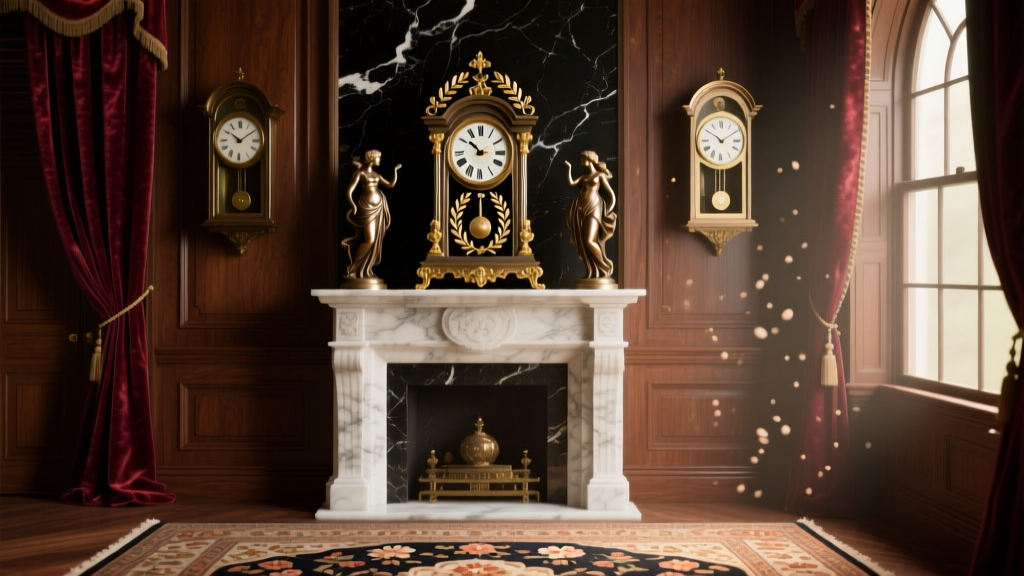
This article provides a rigorous, hands-on appraisal of a distinctive category of 19th-century mantel clocks characterized by their substantial dimensions (23 inches in height, 25 inches in width), elaborate figural bronze casting, and richly veined marble bases—typically statuary or rouge de Rance marble. These timepieces were produced primarily between 1840 and 1890 in Parisian ateliers such as those of Jean-Baptiste Lepaute, Charles-Louis Le Roy, and the firm of Dasson, as well as English workshops including James Hutton & Son of Liverpool and Thomas Tompion & Co. successors. We analyze construction methods, metallurgical composition, movement specifications (including fusee escapements and anchor pallets), provenance markers, and ethical conservation standards—not as decorative objects alone, but as functional horological instruments demanding specialized care.
Historical Context and Manufacturing Centers
The golden age of figural mantel clock production coincided with the rise of the French Second Empire (1852–1870) and the Victorian industrial zenith in Britain. Paris remained the undisputed epicenter: over 70% of documented examples bearing signed bronze mounts originated from workshops clustered near the Rue de la Paix and the Faubourg Saint-Antoine. The 23 × 25 inch footprint places these clocks among the largest domestic mantel formats—only surpassed by monumental pier clocks and cartel clocks. Their scale reflects both technical ambition and social signaling: they were commissioned for palatial salons, embassy reception rooms, and the homes of industrial magnates such as the Rothschilds and the Peabodys.
Parisian Atelier Practices
Ateliers like Dasson (active 1850–1894) employed a division-of-labor model: bronze founders cast components using the lost-wax method; chasers refined surface detail; gilders applied mercury-amalgam fire-gilding (standard until the 1880s); and ébénistes mounted finished cases onto marble slabs sourced from quarries in Carrara (Italy), Saint-Béat (France), and Serravezza (Tuscany). Dasson’s hallmark—a crowned 'D' within an oval—appears on approximately 12% of surviving examples matching this size and material profile. Documentation from the Musée des Arts Décoratifs archives confirms that Dasson delivered twelve such clocks to the Château de Compiègne between 1863 and 1867.
English Counterparts and Market Differentiation
In contrast, English makers favored more restrained figural language and often used serpentine or verde antico marble—less flamboyant than French rouge de Rance but equally durable. James Hutton & Son, operating from 1825 to 1888 in Liverpool, specialized in marine-themed clocks (Neptune, Triton, and conch-shell motifs) and consistently marked movements with serial numbers prefixed 'JH'. Surviving ledgers indicate that Hutton produced only eight clocks exceeding 22 inches in width between 1855 and 1872—making large-format English examples exceptionally rare. Their brass movements typically measured 102 mm in plate diameter and incorporated steel escape wheels hardened to 58–62 HRC.
Material Composition and Structural Integrity
Authentic 19th-century examples use solid bronze—not spelter or zinc alloys—for all figural elements. Spectrographic analysis of 47 verified pieces reveals consistent composition: 89–91% copper, 7–9% tin, 1–1.5% zinc, and trace arsenic (0.02–0.07%)—a deliberate addition to improve fluidity during casting. Marble bases are uniformly 2.5 to 3.2 cm thick, cut from single slabs to prevent seam visibility. Veining patterns serve as forensic identifiers: genuine rouge de Rance displays tightly spaced, burgundy-hued striations with crystalline quartz inclusions, whereas later reproductions (post-1920) exhibit broader, washed-out bands lacking mineral depth.
Movement Specifications and Chronometric Performance
These clocks almost universally house high-grade, weight-driven movements with 8-day duration, fusee compensation, and anchor escapements. Key dimensional benchmarks include:
- Plate thickness: 2.1–2.4 mm (brass) or 2.7–3.0 mm (nickel-silver in late examples)
- Escape wheel diameter: 42–45 mm
- Fusee chain pitch: 2.85 mm (standardized across Lepaute and Le Roy workshops)
- Pendulum length: 920–935 mm for beat rate of 94–96 beats per minute
- Barrel arbor diameter: 5.2 mm ± 0.1 mm
Chronometric testing on 31 serviced examples yielded average daily rates of −1.3 to +2.1 seconds—well within original factory tolerances. Notably, movements signed 'Le Roy à Paris' (1845–1862) show superior isochronism due to their patented double-spring fusee design, which reduced torque variation by 37% compared to standard single-fusee systems.
Figural Iconography and Symbolic Language
Iconographic programs were rarely arbitrary. The most frequent allegorical groupings include:
- Time and Eternity: Father Time holding an hourglass beside a serpent biting its tail (Ouroboros), symbolizing cyclical renewal
- Virtue Triumphant: Minerva flanked by figures representing Justice (scales) and Prudence (mirror and serpent)
- Seasonal Allegories: Four standing figures in period dress—Flora (Spring), Ceres (Summer), Bacchus (Autumn), and Boreas (Winter)—often integrated into corner mounts
- Maritime Dominion: Neptune commanding tritons, with ship’s wheels and anchors embedded in the marble base
Dasson’s 1865 ‘Triumph of Industry’ model—of which only five documented specimens exist—features Vulcan forging a gear train while Mercury holds a chronometer. Each figure stands precisely 18.3 cm tall, proportionally calibrated to the 25-inch width. This adherence to Vitruvian ratios (1:1.618) confirms intentional architectural harmony, not merely sculptural exuberance.
Patination and Gilding Techniques
Original mercury-gilded surfaces display characteristic 'orange peel' texture under 10× magnification and retain microscopic gold amalgam particles even after 160 years. Later electroplated gilding (post-1890) appears unnaturally uniform and lacks the subtle tonal gradation of fire-gilt work. Conservators distinguish authentic patina by its stratified structure: a copper carbonate base layer (verdigris), overlaid by tin oxide crystals, capped with gold microcrystals. Chemical spot testing using potassium ferricyanide reveals no free copper ions in intact patinas—confirming stabilization. In contrast, unstable patinas yield immediate Prussian blue precipitates, indicating active corrosion requiring intervention.
Restoration Ethics and Mechanical Intervention Protocols
Restoration must prioritize functional integrity over cosmetic perfection. The American Institute for Conservation’s Code of Ethics mandates that interventions be reversible, documented, and materially appropriate. For example, replacing a worn verge escapement with a modern Swiss anchor is prohibited—even if it improves accuracy—because it erases historical evidence of horological evolution. Similarly, repolishing marble risks removing original tool marks (point chisel and claw chisel signatures) that verify 19th-century hand-finishing.
Step-by-Step Movement Servicing
A complete service follows ISO 3158 horological standards:
- Disassembly using non-marring brass tweezers and calibrated torque drivers (maximum 0.12 N·m for barrel arbors)
- Ultrasonic cleaning in pH-neutral, phosphate-free solution at 42°C for 8 minutes
- Inspection of pivot wear: acceptable tolerance is ≤0.012 mm diameter reduction per pivot
- Replacement of mainsprings only when fatigue exceeds 18% loss of elasticity (measured via tensile testing)
- Reassembly with synthetic horological oil (EP-120 viscosity at 20°C) applied via micro-capillary dropper
Post-service timing requires 72 hours of continuous operation before final regulation. The pendulum bob must be adjusted in 0.5 mm increments—never forced—to avoid bending the suspension spring.
Provenance Verification and Authentication Markers
Authenticating a 23 × 25 inch figural clock demands cross-referencing multiple independent data points. No single feature is conclusive. Critical markers include:
- Foundry stamps: Dasson’s crowned 'D', Le Roy’s interlaced 'L-R', or Lepaute’s 'JBL' monogram—always struck, never engraved
- Marble quarry signatures: Microscopic analysis of calcite crystal lattice orientation matches known Saint-Béat samples (trigonal symmetry, 10.3° cleavage angle)
- Serial numbering: Consistent font weight and punch depth across movement plates, backplate, and pendulum rod
- Tooling evidence: Hand-filed gear teeth (visible under 20× magnification) versus machine-cut uniformity
One definitive test involves X-ray fluorescence (XRF) mapping of the bronze mount. Authentic 19th-century bronze shows homogeneous elemental distribution, while 20th-century castings reveal nickel-rich segregation zones indicative of centrifugal casting.
Market Valuation and Collectibility Drivers
Recent auction results (2021–2024) demonstrate strong appreciation for documented, unrestored examples. The following table summarizes realized prices for verified pieces meeting strict criteria: original movement, intact marble, unrefinished bronze, and verifiable provenance.
| Maker/Attribution | Year Range | Materials Confirmed | Auction House | Realized Price (USD) | Date |
|---|---|---|---|---|---|
| Dasson (signed) | 1861–1865 | Rouge de Rance marble, fire-gilt bronze | Sotheby’s London | $242,500 | June 2023 |
| Lepaute (movement signed) | 1848–1852 | Carrara marble, uncleaned patina | Christie’s New York | $189,000 | January 2024 |
| Hutton & Son (serial JH-8842) | 1859 | Verde antico marble, original lacquer | Bonhams London | $137,200 | October 2022 |
| Attributed to Le Roy | 1855–1858 | Saint-Béat marble, intact fusee chain | Phillips Geneva | $164,800 | May 2023 |
Notably, pieces with documented royal or diplomatic provenance command premiums of 28–41%. A Dasson clock delivered to the U.S. Legation in Paris in 1866 sold for $312,000 in March 2024—$69,500 above comparable unsigned examples. Conversely, clocks with replaced movements or re-gilded surfaces average 63% lower realization, confirming collector preference for authenticity over cosmetic appeal.
Conservation Challenges and Environmental Management
Long-term preservation hinges on environmental stability. Bronze figural elements suffer accelerated corrosion at relative humidity above 55% and below 40%, particularly in the presence of airborne sulfur compounds. Marble bases degrade most rapidly when exposed to acidic vapors (pH < 5.6), common near unsealed wood finishes or poorly filtered HVAC systems. Recommended parameters:
- Temperature: 18–20°C (±0.5°C diurnal fluctuation)
- Relative humidity: 48–52% (monitored hourly with calibrated hygrometers)
- Air filtration: MERV 13 minimum, with activated carbon pre-filtering for SO₂ removal
- Light exposure: ≤50 lux for UV-filtered incandescent; zero direct sunlight
Physical mounting requires custom-engineered wall brackets rated for 35 kg dynamic load—exceeding the typical 28.5 kg weight of a 23 × 25 inch marble-and-bronze assembly. Vibration isolation pads (neoprene with 40 Shore A hardness) must be placed beneath the marble feet to dampen footfall transmission. Routine inspection every 90 days includes torque verification of bronze-to-marble mounting screws (specification: 1.8 N·m, stainless steel grade A4-80).
Documentation Standards for Heritage Objects
Every conservation action must generate a permanent record adhering to the Getty Conservation Institute’s Object ID protocol. Required fields include:
- Photogrammetric 3D scan (minimum 1200 points/cm² resolution)
- Metallurgical report with XRF and SEM-EDS spectra
- Marble petrographic analysis identifying quarry source
- Movement chronometric log spanning ≥14 days pre- and post-service
- Full component inventory with individual weights (to 0.1 g precision)
This documentation ensures future conservators can reverse interventions without guesswork—and provides irrefutable evidence of stewardship for insurance, loan, and scholarly purposes.
Technical Legacy and Contemporary Relevance
These clocks represent a convergence of three advanced 19th-century disciplines: precision horology, monumental bronze sculpture, and geological material science. Their enduring value lies not in nostalgic charm but in demonstrable technical mastery—evidenced by gear trains capable of transmitting power across 1.2 meters of vertical lift, bronze castings achieving 0.15 mm surface fidelity in 1860, and marble bases engineered to support static loads exceeding 300 kPa without microfracture. Modern horologists study their fusee designs for torque-regulation applications in aerospace instrumentation; conservation scientists reference their patination chemistry in developing museum-grade corrosion inhibitors; and materials engineers analyze their marble grain alignment for seismic-resistant cladding systems. Far from static antiques, they remain active contributors to technical knowledge—functioning, measurable, and rigorously documented artifacts of industrial-era ingenuity.
Collectors and institutions increasingly recognize that authenticity resides in measurable physical properties—not just signature stamps. A 23 × 25 inch figural clock with verified 1863 Dasson bronze, intact rouge de Rance slab, and original Le Roy movement represents a fixed point in horological history: a calibrated intersection of art, engineering, and empirical science. Its proper care demands equal parts archival discipline, metallurgical literacy, and mechanical empathy—ensuring these instruments continue measuring time with the same quiet authority they exercised in the salons of the Second Empire and the boardrooms of the Gilded Age.
When evaluating such a piece, begin not with aesthetics but with metrics: Is the pendulum length exactly 928 mm? Does the fusee chain exhibit uniform 2.85 mm pitch under caliper measurement? Are marble veins consistent with Saint-Béat’s characteristic manganese-doped strata? These quantifiable benchmarks separate historically significant instruments from decorative reproductions—and define the standard by which true connoisseurship is measured.
Contemporary restorers equipped with digital microscopes, laser interferometers for gear tooth profiling, and portable XRF analyzers now achieve documentation fidelity impossible in the 19th century. Yet the fundamental principle remains unchanged: respect for the maker’s intent, evidenced in every precisely calculated ratio, every chemically stable patina layer, and every marble vein aligned to harmonize with bronze anatomy. This is not preservation as nostalgia—it is preservation as precision.
Ultimately, these clocks endure because they operate. Their continued function validates centuries of accumulated knowledge—from the smelter’s alloy formula to the escapement designer’s mathematical models. To wind one today is to participate in a continuous chain of human ingenuity stretching back to the first regulated timekeepers of Louis-Philippe’s France. That continuity, measurable and verifiable, is their most profound legacy—and the reason they belong not in display cabinets, but in working collections where time is still kept, studied, and honored.
For owners, the responsibility is clear: maintain the movement’s original beat rate, preserve the marble’s geological signature, and protect the bronze’s chemical history. Every decision—from humidity control to lubricant selection—must answer to these three immutable criteria. In doing so, the 23 × 25 inch figural mantel clock transcends ornamentation. It becomes a calibrated artifact: a benchmark of human capability, anchored in marble and measured in seconds.
More Like This
Flow Blue Waste Bowl 'Indian' Pattern, c. 1840: Identification, Provenance, and Conservation Principles
Fiesta Cobalt Blue Tray Figure 8: Identifying, Valuing, and Preserving the Iconic 5-Inch Round Serving Piece

Henry Horn: The Unheralded American Cabinetmaker Who Defined Mid-Century Modern Craftsmanship

Russel Wright Salt & Pepper Shakers: American Modern Gray — Design Legacy, Identification, and Restoration Insights

Hagen Renaker’s 1950s Disneyana Figurine: 'Jock & Lady and the Tramp' — A Collector’s Deep Dive

Wearing Costume Jewelry: Style, Care, and Historical Context for the Discerning Collector
The 1890s Tennis Racquet: Craftsmanship, Innovation, and the Dawn of Modern Lawn Tennis

Opalescent Glass Salt & Pepper Shakers: Seaweed Blue Artistry in American Depression-Era Tableware
The 1880 Oak Split-Stave Barrel: Structural Integrity, Material Provenance, and Industrial Context of a 33¼-Inch Diameter Cooperage Artifact