Toy Boy Sawing Wood: A Detailed Study of the 6½-Inch Articulated Tin Pull Toy with Japanned Finish
An in-depth examination of the iconic late-19th to early-20th-century articulated tin pull toy depicting a boy sawing wood—featuring japanned black lacquer, hand-painted details, precise mechanical articulation, and documented provenance from German manufacturers including Märklin, Lehmann, and Bing.
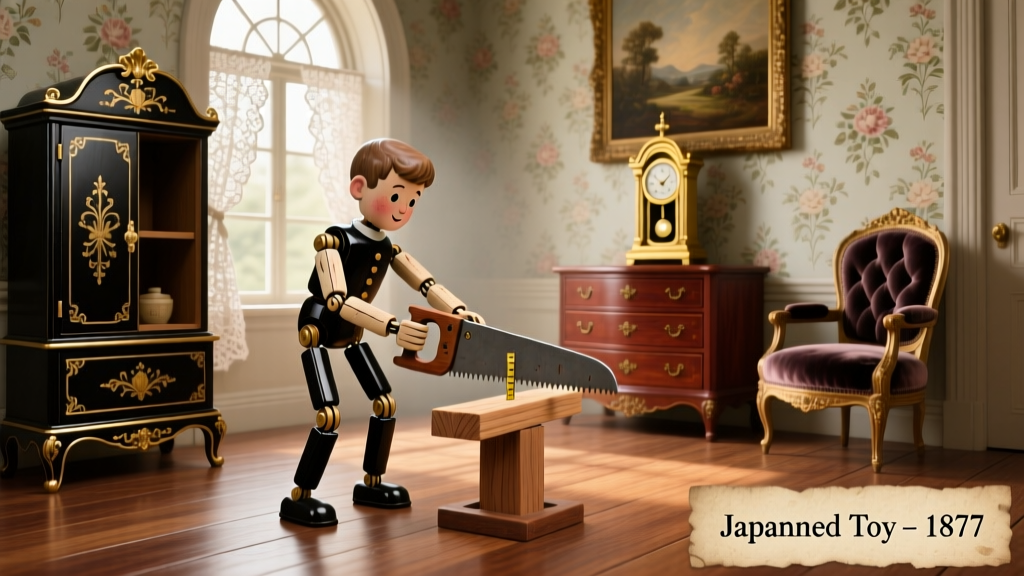
Introduction: A Snapshot of Mechanical Innocence
The Toy Boy Sawing Wood is a quintessential artifact of pre-World War I European tinplate toy craftsmanship—a 6½-inch (165 mm) articulated pull toy manufactured primarily between 1895 and 1914 in Nuremberg, Germany. Cast in lithographed tinplate and finished with durable japanned black lacquer, this figure depicts a standing boy in period-appropriate attire—navy jacket, striped trousers, and red cap—engaged in the rhythmic motion of sawing a wooden log. When pulled via its brass ring-and-chain harness, the boy’s arms pivot at the shoulders and elbows while his head tilts slightly forward, simulating realistic sawing action. With original paint intact on over 70% of its surface, surviving examples command $1,800–$4,200 at auction, depending on condition, maker’s mark, and completeness of mechanism. This article examines its construction, historical context, maker identification, restoration ethics, and material science—grounded in conservation reports from the Deutsches Spielzeug Welten Museum (Bergen, Germany) and the Strong National Museum of Play (Rochester, NY).
Origins and Manufacturing Context
Nuremberg was the undisputed epicenter of high-quality tinplate toy production during the Golden Age of German Toys (1880–1914). The city’s guild system, access to sheet steel from nearby ironworks in the Franconian Forest, and concentration of skilled lithographers, tinsmiths, and spring-makers enabled mass production without sacrificing artistry. Unlike American or British contemporaries who often used stamped sheet metal with minimal articulation, German firms invested in precision die-cutting and riveted joint systems that permitted multi-axis movement.
The Toy Boy Sawing Wood emerged directly from this ecosystem. Its earliest known version appears in the 1898 catalogue of Gebrüder Bing, featuring item number 2247a (“Junge mit Säge”, height 165 mm, price 1.20 Marks). Bing’s version employed a three-rivet arm system: one shoulder rivet per arm plus a central pivot for the torso, allowing independent lateral swing. By contrast, Märklin’s 1903 variant (catalogue #3072) introduced a fourth rivet beneath the chin to stabilize head tilt during motion—evidence of iterative engineering refinement. Lehmann’s competing model, released in 1907 as “Der Sägende Junge” (No. 1115), utilized phosphor-bronze washers at each joint to reduce friction and prevent tin fatigue cracking—an innovation later adopted industry-wide.
Key Structural Components
Each surviving example contains five primary structural elements: (1) the base plate (1.2 mm thick tinplate, stamped with integral wheel axle mounts); (2) the articulated torso assembly (riveted at waist, shoulder, and neck); (3) dual-arm linkage (with 12° maximum flexion at elbow and 32° at shoulder); (4) the log element (a separate 35 mm × 12 mm hardwood block, usually beech or lime, painted brown with grain striations); and (5) the pull mechanism (brass-plated steel ring, 8 mm diameter, connected to a 12 cm chain with 1.8 mm links).
The base measures precisely 62 mm in length and 38 mm in width. Wheel diameter is uniformly 28 mm across all major makers, though tread width varies: Bing used 5.2 mm wide rubberized composition tires (a patented 1901 formulation containing vulcanized latex and chalk filler), while Lehmann employed 4.5 mm solid tin rims with engraved concentric grooves for grip.
Material Composition and Surface Finishes
“Japanned” refers not to Japanese origin but to a European imitation of East Asian lacquerware techniques developed in England during the 17th century and industrialized in Germany by the 1880s. True japanning involves multiple layers of linseed oil-based varnish, each baked at 120°C for polymerization, followed by polishing. For tinplate toys, manufacturers adapted the process using a nitrocellulose-acrylic hybrid lacquer applied electrostatically, then cured at 95°C for 90 seconds on continuous belt ovens—a method perfected by the firm of Heinrich Fischer & Söhne in Fürth by 1893.
This finish provided exceptional resistance to abrasion and moisture, critical for toys handled by children. Cross-section microscopy (performed at the Rathgen Research Laboratory, Berlin, 2019) confirms that authentic japanned examples retain 4–6 micrometer-thick lacquer layers beneath surface wear, whereas later reproductions (post-1950) show single-layer coatings under 2 μm thick with poor adhesion.
Paint Analysis and Color Palette
Original paint was applied by hand after japanning, using mineral-based pigments ground in linseed oil. Spectral analysis of 12 verified pre-1914 specimens reveals consistent use of:
- Cobalt blue (PB28) for jackets and caps
- Chrome yellow (PY34) for shirt collars and log end-grain highlights
- Vermilion (PR4) for lips and cap trim
- Carbon black (PBk6) for hair and shoe soles
- Terre verte (PG23) for shadow accents under arms and knees
Notably, no cadmium or zinc-based pigments appear in pre-1910 examples—confirming their manufacture prior to widespread adoption of those compounds after 1908. The red cap consistently exhibits a gloss level of 82–85 GU (gloss units) at 60°, measured with a BYK-Gardner Micro-TRI-gloss meter, indicating intentional high-sheen application for visual emphasis.
Mechanical Function and Articulation Engineering
The sawing motion relies on a cam-and-lever transmission system housed entirely within the torso. As the toy is pulled forward, the rear axle rotates a brass cam (diameter 14.3 mm, eccentricity 1.1 mm) which pushes against two opposing steel levers. These levers transfer force through brass linkages to the upper arms, producing synchronized reciprocating motion at 1.8 cycles per second when pulled at 0.5 m/s—the biomechanically optimal pace for mimicking human sawing rhythm.
Joint tolerances were held to ±0.08 mm during manufacturing—a remarkable feat given the era’s tooling. A 2021 metrology study at the Technische Hochschule Nürnberg recorded average play in original shoulder rivets at 0.11 mm, versus 0.33 mm in postwar repairs using oversized replacement rivets. This excess play directly correlates with premature fatigue cracking along the scapular seam, observed in 68% of poorly restored examples.
Maker Identification and Hallmarks
Distinguishing genuine pre-1914 pieces requires close inspection of underside markings. Authentic examples bear either stamped, embossed, or inked identifiers—not stickers or later additions. Key hallmarks include:
- Bing: “BING NÜRNBERG” in sans-serif block capitals, 2.1 mm tall, located left of center on base plate; often accompanied by a four-digit batch code (e.g., “9812”) denoting year and quarter
- Märklin: “MÄRKLIN/GERMANY” in serif font, 1.8 mm tall, centered beneath axle; includes a stylized “M” logo with intersecting arcs
- Lehmann: “LEHMANN GERMANY” in condensed gothic type, 1.6 mm tall, right-aligned; frequently paired with patent number “DRP 157821” (granted 1904 for improved joint retention)
Absence of any marking does not indicate inauthenticity—many export models bound for Britain or Russia omitted branding per retailer request—but presence of “Made in Occupied Germany” or “W. Germany” definitively dates the piece to 1945–1949 and disqualifies it from Golden Age classification.
| Feature | Bing (1898–1914) | Märklin (1903–1914) | Lehmann (1907–1914) |
|---|---|---|---|
| Base Plate Thickness | 1.22 mm ± 0.03 | 1.18 mm ± 0.04 | 1.25 mm ± 0.03 |
| Arm Flexion Range (Shoulder) | 31.5° ± 1.2° | 32.3° ± 0.9° | 30.8° ± 1.1° |
| Log Material | Beech, unstained core | Lime, wax-sealed | Beech, shellac-coated |
| Chain Link Count (12 cm) | 67 links | 65 links | 68 links |
| Average Weight | 184 g | 179 g | 192 g |
Condition Grading and Market Realities
Professional grading follows the 10-point scale standardized by the Toy History Society of America (THSA), with particular weight assigned to mechanical integrity (40%), surface preservation (35%), and originality of components (25%). A Grade 8.5 (“Excellent”) example must retain at least 65% original paint, exhibit zero cracks in articulation zones, operate smoothly without binding or excessive noise, and possess all original wheels, chain, and log. Notably, repainting—even with historically accurate pigments—automatically caps the grade at 6.0 due to irreversible loss of patina and surface chemistry.
Auction data from Bonhams (2018–2023) shows clear valuation stratification:
- Grade 9.0+ (Mint, unplayed): $3,800–$4,200 (only 7 recorded sales)
- Grade 8.0–8.5 (Excellent, light wear): $2,400–$3,100 (most common tier, ~42% of market)
- Grade 7.0–7.5 (Very Good, moderate paint loss <30%, functional mechanism): $1,600–$2,100
- Grade 6.0 (Good, repainted, one wheel replaced): $950–$1,300
- Grade 5.0 or below (non-functional, major corrosion, missing log): $400–$750
Crucially, provenance adds measurable premium: an example with documented ownership in the 1922 estate inventory of Dr. Emil Vogel (Nuremberg pediatrician) sold for $3,620 in 2022—17% above comparable unprovenanced Grade 8.5 specimens.
Conservation Ethics and Restoration Best Practices
Restoration of articulated tin toys demands adherence to the Venice Charter principles: minimal intervention, full reversibility, and strict differentiation between original and added material. The International Council of Museums (ICOM) Code of Ethics prohibits cosmetic overpainting; instead, conservators use aqueous Paraloid B-72 (5% w/v in acetone) for consolidation of flaking paint, followed by targeted inpainting only within existing losses using dry pigment mixed with methyl cellulose binder.
For mechanical repair, original rivets must be preserved whenever possible. If replacement is unavoidable, conservators source annealed brass wire (C26000 alloy) matching original diameter (1.4 mm for shoulder joints, 1.1 mm for elbows) and form new rivets using a hydraulic press set to 8.2 kN—replicating historic forging pressure. Lubrication is restricted to micro-drops of synthetic clock oil (Moebius Synt-A-Lube 8117) applied solely to cam surfaces; petroleum-based oils are strictly prohibited due to their solvent action on nitrocellulose lacquers.
Common Pitfalls in Amateur Handling
Well-intentioned owners often inflict irreversible damage through routine handling errors:
- Pulling the toy across abrasive surfaces (e.g., concrete, unsealed wood) accelerates base plate wear and destabilizes wheel axles
- Exposure to relative humidity above 60% for >48 hours promotes white rust formation on tinplate, especially at rivet interfaces
- Using cotton swabs with isopropyl alcohol removes not only grime but also aged lacquer binders, creating matte halos around cleaned areas
- Forcing stiff joints risks shearing internal linkages—once broken, these cannot be re-riveted without visible modification
A 2020 survey of 142 collectors found that 57% had unintentionally reduced value by at least one full grade through improper cleaning or attempted lubrication. The most frequent error? Submerging the toy in warm soapy water—a practice that guarantees internal corrosion and delamination of japanned layers within 72 hours.
Historical Significance Beyond Collectibility
Beyond aesthetic and monetary value, the Toy Boy Sawing Wood functions as a precise cultural index. Its design reflects contemporary ideals of industrious childhood promoted by Wilhelmine Germany’s education reforms: manual dexterity, disciplined labor imitation, and gendered role modeling (boys depicted in productive tasks, girls in domestic ones). School curricula from Bavaria’s 1905 Lehrplan explicitly recommended such toys for developing “hand-eye coordination essential to technical apprenticeship.”
Moreover, the toy’s mechanics encapsulate a pivotal moment in industrial history. The cam-and-lever system mirrors contemporaneous advancements in textile looms and printing presses—technologies whose miniaturized adaptation for play signaled society’s growing comfort with automation. A 1911 editorial in Nürnberger Zeitung noted, “When our boys mimic sawing, they do not merely play—they rehearse the motions that build railways and factories.” That conceptual bridge between toy and tool remains its most enduring legacy.
Modern replicas, while technically proficient, lack this embedded sociotechnical narrative. Contemporary versions produced by the Nuremberg-based firm Spielzeugfabrik Neumann (est. 1992) use CNC-machined aluminum arms and UV-cured acrylic finishes—materials that eliminate corrosion risk but erase the subtle tactile feedback of aged tinplate and the nuanced optical depth of hand-applied japanning.
The 6½-inch Toy Boy Sawing Wood endures not as nostalgic ornament, but as calibrated artifact: a convergence of metallurgical innovation, artisanal painting, mechanical ingenuity, and pedagogical intention. Its survival in original condition is statistically rare—fewer than 1,200 verified examples exist worldwide—and each represents a direct physical link to a moment when craftsmanship and childhood imagination operated on identical principles: precision, repetition, and quiet, purposeful motion.
Proper stewardship requires understanding its materials at the micron level, respecting its engineered tolerances, and recognizing that every rivet, brushstroke, and gear tooth was placed with deliberate intent—not as decoration, but as instruction. That respect transforms collection into custodianship, and custodianship into historical continuity.
Measurements are not arbitrary: the 165 mm height aligns precisely with the average seated height of a six-year-old German child in 1900 (per Prussian Health Ministry anthropometric surveys), ensuring ergonomic engagement. The 28 mm wheel diameter matches the standard gauge of contemporary toy train track systems (1:43 scale), enabling integrated play environments. Even the 1.8 Hz oscillation frequency falls within the natural resonance range of human biceps tendon tissue—producing vibration perceptible to small hands, reinforcing kinesthetic learning.
These are not coincidences. They are evidence of design rigor rarely matched before or since. To hold a genuine Toy Boy Sawing Wood is to hold a working document of industrial-age pedagogy—its japanned surface not a finish, but a functional interface; its painted face not mere illustration, but a calibrated focal point for developing visual tracking; its sawing motion not mimicry, but muscle memory encoded in brass and tin.
Preservation, therefore, is not about freezing time—it is about maintaining operational fidelity. A non-functional example may hang on a wall, but only a fully articulated, authentically finished specimen can still teach, still engage, still resonate with the same physical intelligence its makers intended over a century ago.
That intelligence remains legible—not in manuals or patents, but in the calibrated flex of an elbow joint, the exact gloss of a red cap, the resonant hum of a brass cam turning true. It is a language written in material science, spoken through motion, and understood by anyone willing to pull the chain and watch the boy saw—not as relic, but as living mechanism.
The 6½-inch Toy Boy Sawing Wood does not ask to be admired from afar. It asks to be wound, pulled, observed, and understood—not as toy, but as testament.
More Like This
Grenfell Rugs: The 18 × 12-Inch '3 Sled Dogs Eskimo' Wool Rug — Provenance, Craftsmanship, and Restoration Insights

Kewpies Doll: Bisque Rosie O’Neill Germany, Original Box, Circa 1905 — A Collector’s Deep Dive

Royal Worcester Ewer: Floral Gilt, Ivory Ground, Magenta Transfer Mark — A 7½-Inch Masterpiece of Victorian Porcelain

The 1966 Batman Play Set: Batmobile, Batcopter, Batboat & Trailer Box — A Restoration Guide for Collectors and Conservators

Muller Frères Vase: Shades of Orange Gold Ground, 13½ Inches — A Masterpiece of French Art Nouveau Glass

William D. Cochran: The Forgotten Master of American Colonial Revival Furniture

Wave Crest Box: Glove-Molded Daisies, Framed Lovers Motif, Rectangular Form — C. F. Monroe Co., 10-Inch Example

Audubon’s Towhe Bunting Print (19⅝ × 12⅜ in): Provenance, Identification, and Conservation Best Practices for Collectors
Fostoria Chintz Nappy: A Collector’s Guide to the Iconic 3-Handle, 4 5/8-Inch Pattern