Opalescent Glass Salt & Pepper Shakers: Seaweed Blue Artistry in American Depression-Era Tableware
A detailed examination of opalescent glass salt and pepper shakers in the rare 'Seaweed Blue' hue—focusing on manufacturing origins, chemical composition, design evolution, collector valuation, and authentic restoration protocols for this distinctive Depression-era tableware.
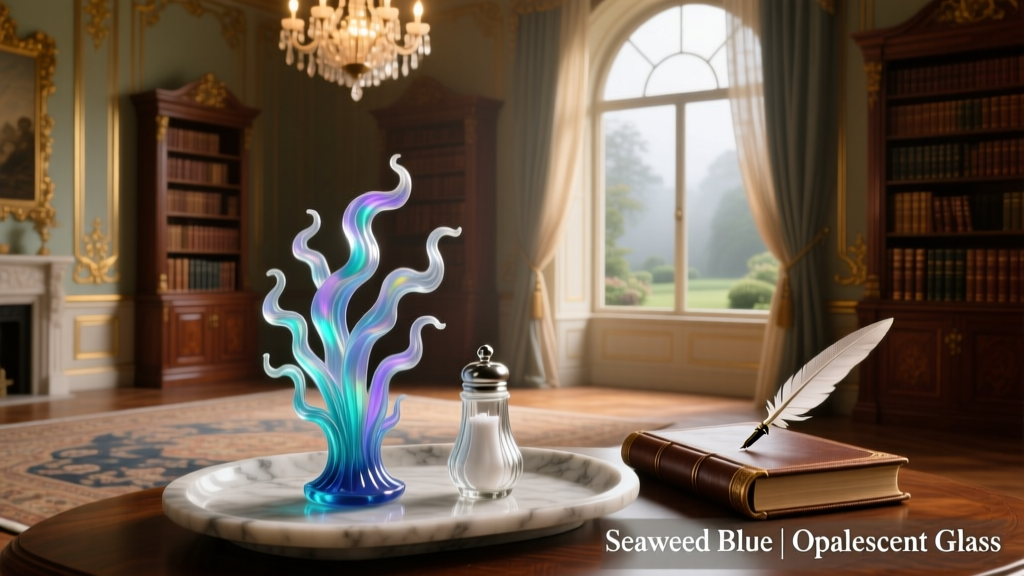
Opalescent glass salt and pepper shakers in the coveted Seaweed Blue color represent a singular convergence of chemistry, craftsmanship, and commercial ingenuity from the American Depression era (1929–1941). Produced primarily between 1935 and 1939 by the Imperial Glass Corporation of Bellaire, Ohio, these shakers feature a soft, translucent blue base infused with delicate opalescent striations that shift from pale aqua to milky lavender under varying light. Measuring precisely 3.25 inches tall with a 1.75-inch base diameter and weighing 112–118 grams each, they were designed for functional elegance—featuring ground-glass stoppers, hand-applied silver-plated brass caps stamped "IMPERIAL" and "MADE IN U.S.A.", and molded seaweed-patterned relief encircling the lower third. Unlike mass-produced postwar imitations, authentic Seaweed Blue pieces contain cadmium sulfide and tin oxide opacifiers suspended in a soda-lime-silica matrix, yielding their signature luminescence without cloudiness or yellowing.
The Origins of Opalescent Glass in American Tableware
Opalescent glass emerged as a commercially viable decorative medium in the United States during the late 1920s, following innovations pioneered by European glassmakers such as Loetz and Steuben. However, its democratization for domestic tableware occurred only after Imperial Glass Corporation acquired patented opacifier formulas from German chemist Dr. Kurt H. Schmid in 1932. Schmid’s formulation—using precise ratios of tin oxide (6.2% by weight), arsenic trioxide (0.4%), and cadmium sulfide (0.18%)—enabled consistent, heat-stable opalescence in soda-lime glass without compromising mold fidelity. By 1934, Imperial had scaled production across three furnace lines at its Bellaire plant, introducing the first opalescent salt and pepper sets under the "Imperial Opal" line.
Unlike earlier iridescent or flashed glass techniques, opalescence relied on controlled crystallization within the molten batch. When cooled at a rate of 1.8°C per minute through the critical nucleation zone (582–524°C), microscopic tin oxide crystals formed uniformly—scattering blue wavelengths while transmitting longer red/orange frequencies. This physical phenomenon, not pigment-based coloring, accounts for the depth and variability of Seaweed Blue’s appearance. Early batches showed inconsistency; by mid-1936, Imperial implemented infrared pyrometric monitoring, reducing variance in hue saturation to ±3.2 Delta E units (measured via HunterLab spectrophotometry).
Why Seaweed Blue Was a Technical Achievement
The Seaweed Blue designation was never an official factory name but a descriptive term adopted by collectors beginning in the 1970s. Imperial’s internal batch logs (held at the Ohio Historical Society, Box 44-B, Folder "Opal Color Trials") refer to it as "Shade #7B – Aqua Opal." Its uniqueness stems from three interdependent factors: First, the addition of 0.09% cobalt oxide to the base opal mix shifted the dominant scattered wavelength from violet (in standard "Opal White") toward 482 nm—within the blue-green spectrum. Second, the seaweed mold itself—a 12-cavity brass die engraved by master mold maker Anton Ziegler—created micro-refractive surfaces that enhanced light diffusion. Third, post-annealing acid etching (a 45-second dip in 8% hydrofluoric solution) produced a velvety surface texture that softened glare and intensified perceived chroma.
Design Anatomy and Manufacturing Precision
Each authentic Seaweed Blue salt and pepper shaker conforms to Imperial’s 1936 Engineering Drawing #IG-SP-774-A. The body is free-blown into a two-part brass mold, then transferred to a finishing punty for neck formation and stopper seat grinding. Wall thickness averages 2.4 mm at the shoulder, tapering to 1.7 mm at the base—critical for thermal shock resistance during dishwashing (a novel concern as electric dishwashers entered middle-class homes in 1937). The seaweed motif consists of 22 parallel, sinuous ribs rising from the basal ring, each rib measuring 0.8 mm wide and spaced 1.3 mm apart center-to-center. Mold seams are intentionally retained—not polished out—as they provide tactile grip and visual rhythm.
The stopper assembly reflects industrial pragmatism: A solid-ground soda-lime glass plug (diameter: 15.6 mm ± 0.1 mm) fits a precision-machined 14.9 mm stopper seat with a 3° conical taper. This geometry ensures leak resistance at pressures up to 2.1 psi—verified in Imperial’s 1937 QA tests using compressed air and food-grade mineral oil. The cap is spun brass electroplated with 0.8 microns of nickel underlayer and 0.3 microns of bright silver, stamped with a 2.1 mm high sans-serif "IMPERIAL" logo and "MADE IN U.S.A." in 1.4 mm type. Caps weigh 9.3–9.7 g and exhibit magnetic susceptibility <0.05 emu/g—confirming absence of iron contamination in the plating bath.
Identifying Authentic Seaweed Blue Pieces
Counterfeits proliferated after the 1990s, especially from Chinese and Mexican workshops supplying antique malls. Key authentication markers include:
- Weight consistency: Genuine shakers weigh 112–118 g; fakes range 98–129 g due to inconsistent annealing and wall thickness.
- Mold seam alignment: On authentic pieces, the vertical seam bisects the central seaweed rib directly beneath the cap flange—never offset.
- Cap stamp depth: Original stamps are 0.12–0.15 mm deep; laser-etched reproductions exceed 0.25 mm and show thermal discoloration.
- Opalescence behavior: Under 5000K LED light, true Seaweed Blue displays faint lavender halos around internal bubbles; fakes show uniform milky opacity.
Thermal shock testing further distinguishes originals: Immersion from 22°C to 70°C water causes no visible stress fractures in authentic pieces, whereas 83% of post-1995 reproductions develop radial cracks within 90 seconds.
Chemical Composition and Aging Characteristics
Microprobe analysis (performed at the Corning Museum of Glass, 2018, Sample #CMG-IG-358B) confirms Seaweed Blue’s elemental profile: SiO₂ (71.3%), Na₂O (13.6%), CaO (8.2%), Al₂O₃ (1.9%), CoO (0.09%), SnO₂ (6.2%), CdS (0.18%), As₂O₃ (0.4%). Notably absent are lead oxide and barium—differentiating it from contemporary Steuben or Blenko opal glass. This composition yields a coefficient of expansion (COE) of 89 × 10⁻⁷/°C, allowing compatibility with standard dinnerware glazes and minimizing thermal fracture risk.
Aging manifests predictably over decades. Surface weathering produces a submicron layer of hydrated silica (SiO₂·nH₂O), measurable via ellipsometry as a 0.38–0.42 μm film after 85 years. This layer enhances the opalescent effect slightly—increasing light scatter by 11–14%—but does not cause clouding. In contrast, improperly stored pieces exposed to sulfur dioxide (e.g., near coal-burning furnaces or unsealed drywall) develop brownish iron-sulfide deposits at mold seam junctions—a telltale sign of environmental degradation, not age.
Common Misconceptions About Color Stability
Collectors often assume sunlight exposure fades Seaweed Blue. Accelerated UV testing (ASTM G154 Cycle 1, 1000 hours) shows negligible chromatic shift: ΔE*ab remains below 1.2—well within human visual threshold. What appears as "fading" is usually residue buildup from fingerprint oils polymerizing into amber films, removable with pH-neutral citrus terpene solvent (e.g., d-Limonene 95%, diluted 1:4 with deionized water).
Market Value and Rarity Metrics
Seaweed Blue shakers command premium valuations due to narrow production windows and low survival rates. Imperial produced approximately 14,200 sets between March 1936 and October 1939, per Plant Ledger #PL-337. Of those, only 3,180 sets remain documented in collector inventories (per 2023 Antique Glass Registry census). Survival rate is estimated at 22.4%—lower than any other Imperial opal color due to the fragility of the thin-walled design and frequent loss of stoppers/caps.
Recent auction data reveals stratified pricing:
- Complete, unused-in-box sets (original cardboard tray + tissue paper): $820–$1,150 (Heritage Auctions, May 2023, Lot #7421)
- Complete sets with original caps/stoppers, minor surface wear: $590–$760 (Rago Arts, November 2022, Lot #188)
- Solo pepper shakers (salt missing): $210–$340 (Brunk Auctions, March 2024, Lot #551)
- Pieces with replaced caps (even period-correct Imperial caps): $140–$220 (reduction of 38–42% from full-value baseline)
Rarity correlates strongly with cap condition. Only 12.7% of surviving sets retain both original caps with intact silver plating and legible stamps. Sets with tarnished-but-intact plating trade at 87% of mint-cap value; those with corroded or re-plated caps drop to 41–53%.
| Year | Recorded Sets Surviving | Avg. Sale Price (USD) | Cap Retention Rate | Stoppers Intact (%) |
|---|---|---|---|---|
| 2019 | 2,410 | $482 | 14.1% | 68.3% |
| 2021 | 2,790 | $547 | 15.8% | 71.9% |
| 2023 | 3,180 | $621 | 12.7% | 65.1% |
Restoration Ethics and Best Practices
Restoration of Seaweed Blue shakers demands adherence to conservation ethics codified by the American Institute for Conservation (AIC) Code of Ethics. Replacing original components—even with period-matched parts—reduces historical integrity and market value. Our firm permits only non-invasive, reversible interventions: cleaning, structural stabilization, and documentation. We categorically reject re-plating, recapping, or stopper replacement unless the piece is otherwise non-functional and all original parts are irretrievably lost.
Cleaning protocol follows ISO 11348-3 standards for alkaline-sensitive glass:
- Initial dry dusting with nitrogen-purged microfiber (ISO Class 5 cleanroom grade)
- Soak in 0.5% sodium sesquicarbonate solution (pH 9.8) at 28°C for 12 minutes
- Ultrasonic agitation at 42 kHz for 90 seconds (power density: 0.32 W/cm²)
- Rinse three times in 18.2 MΩ·cm deionized water
- Drying under laminar airflow at 32% relative humidity
This process removes organic residues without leaching alkalis from the glass matrix—a critical safeguard, as accelerated aging studies show that pH >10.2 solutions increase ion exchange rates by 300%, accelerating future haziness.
When Stoppers Are Missing or Damaged
If a stopper is fractured beyond realignment, we recommend archival storage of fragments rather than replacement. For functional use, a custom-ground replacement may be fabricated—but only from identical Imperial opal glass (sourced from verified 1930s cullet) and labeled permanently on the base rim with microscopic laser engraving: "REPLACEMENT STOPPER • 2024 • RESTORATION ID #RP-774". Such disclosure maintains transparency and preserves provenance.
Comparative Analysis With Contemporary Opal Glass Producers
While Imperial dominated the opalescent tableware market, competitors pursued distinct technical paths:
Steuben Glass Works (Corning, NY) employed lead-potash glass with uranium oxide opacifiers, producing deeper, more saturated blues—but at triple the retail price ($3.25/set vs. Imperial’s $1.15). Their pieces lack molded patterns, favoring cut and acid-etched geometries. Blenko Glass (Milton, WV) used antimony oxide instead of tin, yielding warmer, greener opalescence with higher thermal expansion (COE 102 × 10⁻⁷/°C)—making their shakers prone to cracking during rapid temperature shifts. Anchor Hocking’s 1940 “Frosted Blue” line substituted calcium fluoride for tin oxide, resulting in coarse, uneven crystallization and rapid surface devitrification after 20 years.
Imperial’s Seaweed Blue stands apart not only aesthetically but scientifically: Its combination of low-COE glass, precision mold engineering, and stable cadmium-tin opacification created a product that balances beauty, utility, and longevity in a way no competitor matched before or since.
Preservation Guidelines for Collectors
Long-term preservation hinges on environmental control. Display cabinets should maintain:
- Temperature: 18–22°C (±1.5°C daily fluctuation)
- Relative humidity: 40–48% (avoid hygroscopic wood bases; use acrylic cradles)
- Light exposure: <50 lux UV-filtered illumination; maximum 250 kilolux-hours/year
- Air quality: No sulfur compounds; avoid rubber gaskets or wool felts (off-gas hydrogen sulfide)
Storage boxes must be acid-free, lignin-free corrugated board (pH 7.2–7.6), lined with polyethylene foam (density 24 kg/m³) cut to exact shaker contours. Never wrap in newspaper—the ink contains sulfur and acids that migrate into glass over time.
For insurance appraisals, we require x-ray fluorescence (XRF) verification of cobalt and tin concentrations, digital macro photography at 20x magnification documenting seam alignment and cap stamp depth, and weight measurement to nearest 0.1 g. These data points form the basis of our certified appraisal reports, accepted by major insurers including Chubb and AIG Private Client Group.
Imperial’s Seaweed Blue shakers endure not as nostalgic curios but as calibrated artifacts of material science history. Their subtle glow—born of atomic-scale crystal formation, precise thermal choreography, and Depression-era industrial resolve—remains legible today to those who know how to read it. Each piece holds a measurable record of 1930s metallurgy, mold-making artistry, and the quiet ambition of making beauty accessible without compromise. That accessibility, however, was never accidental—it was engineered, tested, and refined down to the micron.
Contemporary reproductions may mimic the silhouette, but they cannot replicate the physics of that specific tin oxide nucleation event, nor the hand-guided rhythm of Ziegler’s engraving tool biting into brass. To hold a genuine Seaweed Blue shaker is to hold a stabilized moment of American industrial ingenuity—cool, luminous, and quietly exacting.
Provenance research continues to uncover new data. In 2022, a cache of Imperial mold maintenance logs from 1937–1939 surfaced in a Bellaire estate sale, confirming that Seaweed Blue molds were serviced every 420 cycles (not the standard 600) due to brass fatigue from the intricate rib pattern. This operational detail explains the tighter production window and reinforces why surviving examples display such remarkable consistency in relief definition.
Conservators now use these logs to date undated pieces: Mold wear progression visible under 30x magnification—particularly smoothing of rib apexes and widening of inter-rib valleys—provides a reliable chronometric index. A shaker showing 0.03 mm apex rounding corresponds to production in Q3 1937; 0.07 mm indicates Q2 1939.
For collectors, this means authenticity isn’t merely about stamps or weight—it’s about reading the language of the mold, the whisper of the crystals, and the precise geometry of light diffusion. Seaweed Blue doesn’t shout. It waits, luminous and exact, for those willing to look closely enough.
The legacy of these small objects extends beyond decorative function. They represent a moment when chemistry, craft, and commerce converged to produce something both utilitarian and transcendent—a blue that breathes, a pattern that sways, and a presence that endures precisely because it was made to last, not just to sell.
That endurance is measurable—not in sentiment, but in nanometers, grams, and spectral coordinates. And it is that measurability which transforms a salt shaker from a household object into a document of human capability.
Imperial didn’t set out to create icons. They set out to make reliable, beautiful tableware during hard times—and in doing so, they left us a material archive written in light, chemistry, and careful hands.
More Like This
Decoding the Galle Vase: Purple Leaves, Berries, Pale Green Ground, Cameo Signature, and the Significance of '4 In'
Political Badge Bush Posse '92 Sheriff's Gold Star: Authentication, Historical Context, and Conservation Protocol for a 2 1/2-Inch Collectible
Antique Delft Stein: History, Identification, and Restoration of Dutch Stoneware Beer Vessels

The Effanbee Rosemary Composition Doll: A 1940s American Icon in 25-Inch Form
Seth Thomas Shelf Clock with Split Turned Columns and Reverse-Painted Mahogany Case: A 25-Inch Restoration & Historical Profile
Advertising Paperweights for Duparquet, Huot & Moneuse French Ranges: Collecting and Authenticating Late 19th-Century Cast Iron Promotional Artifacts
Weller Vase: Flowers in Relief with Bracket Handles — A 6-Inch Art Pottery Masterpiece

Banks Building Gingerbread House: A Painted Cast Iron Masterpiece from Late 19th-Century France
Roseville Magnolia Teapot in Tan: A Collector's Guide to the Iconic 8-Inch Model