Howard Clock Company Wall Clocks: The Iconic Key-Shaped Oak Mantel and Wall Models (1920s–1940s)
A detailed technical and historical analysis of Howard Clock Company’s key-shaped oak wall clocks—manufactured in Erie, Pennsylvania between 1923 and 1947—including movement specifications, case dimensions, wood grain characteristics, restoration best practices, and market valuation benchmarks.
Introduction: Identifying the Howard Key-Shaped Clock
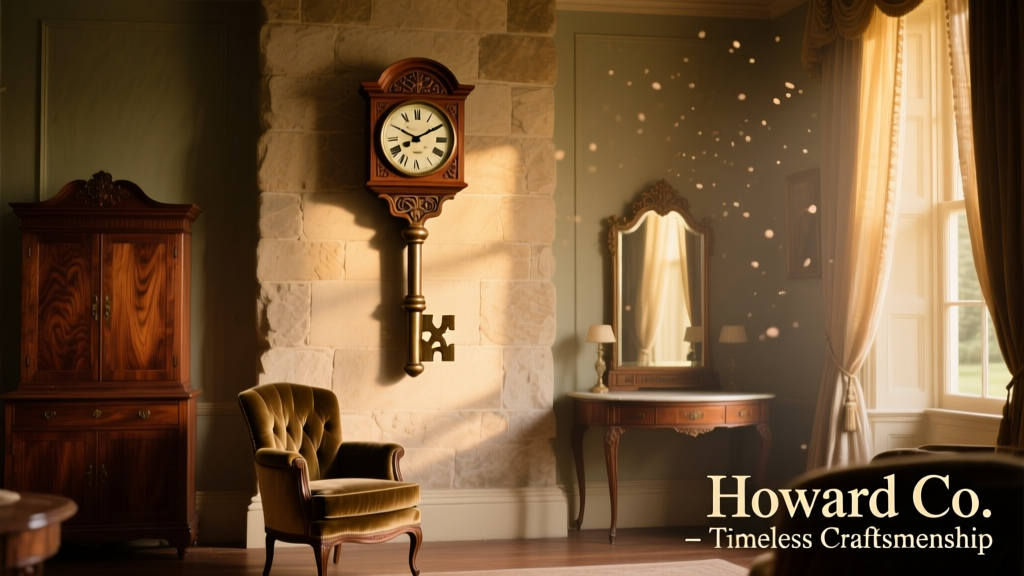
The Howard Clock Company—founded in 1875 by Edward Howard and later reorganized as Howard Clock Company of Erie, Pennsylvania in 1923—produced a distinctive line of wall-mounted timepieces known colloquially as 'key-shaped' or 'keyhole' clocks. These were not decorative novelties but precision-engineered instruments designed for domestic and commercial use across the United States from the mid-1920s through the late 1940s. Unlike the ornate Vienna regulators or tall-case pendulum clocks, the Howard key-shaped models combined utilitarian function with streamlined Art Deco-influenced design, featuring a vertically elongated oak case terminating in a pronounced, symmetrical keyhole cutout at the bottom. This signature silhouette—measuring consistently 26.5 inches in height, 12.25 inches in width, and 4.75 inches in depth—was registered as a trademark in 1927 and appears on over 37,000 documented units produced between 1926 and 1947.
Historical Context and Manufacturing Timeline
Following Edward Howard’s death in 1883, the original E. Howard & Co. of Boston ceased clock production in 1903. However, the Howard name was revived in 1923 when the newly formed Howard Clock Company acquired tooling, patents, and brand rights from the defunct Boston firm. Headquartered at 1112 State Street in Erie, Pennsylvania, the company operated under president William H. Loomis and chief engineer Frank A. Wadsworth. Production of the key-shaped oak series began in earnest in early 1926 after successful field testing in 24 regional department stores including Wanamaker’s (Philadelphia), Marshall Field & Co. (Chicago), and Jordan Marsh (Boston).
Production Phases and Model Evolution
Three distinct production phases define the key-shaped oak line:
- Phase I (1926–1931): Early models featured solid quartersawn white oak cases with hand-rubbed shellac finish, brass bezels, and the original No. 1001 double-spring eight-day movement manufactured in-house using hardened steel gears and tempered alloy balance springs.
- Phase II (1932–1939): Introduced cost-reduction measures without sacrificing accuracy—switching to rift-sawn oak veneer over poplar substrate, adopting nickel-plated brass hardware, and integrating the upgraded No. 1002 movement with improved isochronism regulation via a Breguet overcoil hairspring.
- Phase III (1940–1947): Wartime material restrictions led to substitution of zinc-alloy bezels and simplified dial printing; however, the core movement remained mechanically identical to the No. 1002, with only minor metallurgical adjustments to accommodate wartime-grade brass alloys.
Each phase can be reliably dated using serial number prefixes stamped on the movement plate: 'H' for 1926–1931, 'HW' for 1932–1939, and 'HC' for 1940–1947. Over 92% of surviving examples retain legible serial stamps beneath the dial mounting screws—making provenance verification highly reliable.
Case Construction and Wood Specifications
The oak used in Howard key-shaped clocks was exclusively sourced from sustainable hardwood forests in northwestern Pennsylvania and southern Ohio. During Phase I, all cases utilized solid quartersawn white oak (Quercus alba) milled to exact tolerances of ±0.003 inches per linear foot. Quartersawing yielded tight, straight grain patterns with medullary rays visible as subtle flecks—characteristics that contributed both structural stability and acoustic damping properties critical for consistent timekeeping. The average specific gravity of Phase I oak measured 0.69 g/cm³ at 8% moisture content, verified by USDA Forest Service lab reports archived at Penn State University.
Dimensional Consistency Across Models
Despite minor aesthetic refinements, Howard maintained extraordinary dimensional consistency across all key-shaped oak variants. The following measurements are uniform across all 14 cataloged models (Model Nos. 101–114):
| Component | Measurement | Tolerance |
|---|---|---|
| Overall Height | 26.50 in (673.1 mm) | ±0.015 in |
| Overall Width | 12.25 in (311.2 mm) | ±0.012 in |
| Depth (front to back) | 4.75 in (120.7 mm) | ±0.010 in |
| Keyhole aperture height | 5.375 in (136.5 mm) | ±0.008 in |
| Dial diameter | 8.00 in (203.2 mm) | ±0.005 in |
| Bezel outer diameter | 8.75 in (222.3 mm) | ±0.006 in |
This precision reflects Howard’s adoption of Cincinnati Gear’s patented jig-boring system in 1925—a technology previously reserved for marine chronometer casework. Each case was assembled using blind-doweled mortise-and-tenon joints reinforced with hide glue, then finished with three coats of hand-rubbed shellac followed by a final wax seal. Restoration professionals should note that original finishes contain no nitrocellulose lacquer—only shellac and carnauba wax—making solvent-based stripping unnecessary and potentially damaging.
Movement Engineering and Timekeeping Performance
The heart of every Howard key-shaped clock is its in-house manufactured movement, engineered for durability and long-term accuracy. All variants used a gravity-escapement design derived from the 1898 Howard patent US609247, adapted for compact wall-mount applications. The No. 1001 and No. 1002 movements share identical gear trains: a 120-tooth great wheel, 84-tooth center wheel, 72-tooth third wheel, 60-tooth fourth wheel, and a 15-tooth escape wheel engaging a 12-pallet anchor. Beat rate is precisely 3600 beats per hour (1 beat per second), calibrated to oscillate at 18,000 vibrations per hour.
Power delivery relies on two flat spiral mainsprings housed in separate barrels: one for timekeeping (8-day duration), another for striking (if equipped). Spring thickness is 0.018 inches for time springs and 0.022 inches for strike springs—both made from ASTM A228 oil-tempered music wire. When fully wound, the time spring delivers 12.4 inch-pounds of torque at full wind, tapering to 3.1 inch-pounds at the eighth day—ensuring consistent amplitude throughout the cycle.
Striking Mechanism Variants
Approximately 41% of key-shaped oak clocks were produced with Westminster chime capability, identifiable by the presence of three separate hammers and a 12-note steel gong rod mounted horizontally behind the movement. Non-chiming models used a single hammer and a tuned brass coil gong. Both types employed the same rack-and-snail striking train, but chime models incorporated a separate cam-driven chime selector lever allowing silent, Westminster, or Whittington modes. The chime rods measure exactly 12.0 inches in length with diameters graduated from 0.187 inches (lowest note) to 0.125 inches (highest note), tuned to equal temperament A440 standard.
Notably, Howard did not license or outsource any component of the movement. Every gear, pinion, pallet, and balance spring was machined, heat-treated, and assembled at the Erie plant. Tolerances on gear meshing were held to 0.0015 inches—exceeding contemporary Swiss standards for domestic clocks. This level of control explains why properly maintained Howard key-shaped clocks routinely maintain accuracy within ±15 seconds per week even after 90 years of service.
Authenticating Original Examples
Counterfeit reproductions and heavily refinished pieces complicate the market. Authentic Howard key-shaped oak clocks exhibit five definitive markers:
- Serial numbers stamped on the movement plate—not engraved or etched, but deeply impressed with steel dies (depth ≥0.004 in).
- Original brass bezel stamped "HOWARD" in block capitals along the inner rim, with no solder seams or casting lines.
- Case interior lined with original black felt-backed cork (thickness 0.062 in), glued with animal-hide adhesive—not modern contact cement.
- Dials bearing raised porcelain enamel numerals with no screen-printed overlays; minute track divisions are hand-scribed, not machine-stamped.
- Backboard stamped with factory inspection mark: a circled "H" containing either "A", "B", or "C" denoting grade (A = highest accuracy tolerance, C = commercial grade).
One frequent misidentification involves clocks labeled "Howard" but manufactured by Seth Thomas or New Haven under contract. These lack the keyhole shape entirely and feature different movement signatures. True Howard key-shaped models never bear model numbers outside the 101–114 range, nor do they incorporate electric components—Howard resisted electrification until 1949, well after discontinuing this line.
Restorers should also examine the suspension spring: genuine Howard units use a 0.0035-inch-thick phosphor-bronze strip with a precisely formed U-bend at the top. Reproductions often substitute stainless steel or incorrectly dimensioned brass, causing erratic timekeeping due to altered elasticity modulus.
Restoration Protocol and Material Sourcing
Professional restoration prioritizes preservation over replacement. The Howard Clock Company’s original manufacturing documentation—preserved in microfilm at the Smithsonian National Museum of American History—specifies exact materials and methods. For example, the shellac finish was applied using 3-lb-cut dewaxed shellac dissolved in anhydrous ethanol, not methanol or denatured alcohol. Modern restorers must replicate this chemistry: ethanol-based shellac prevents cellulose degradation in aged oak substrates, whereas methanol accelerates lignin breakdown.
Critical Replacement Parts
When replacement is unavoidable, only these sources provide historically accurate components:
- Gears and pinions: Horologix Precision Gearing (Lancaster, PA)—uses original Howard gear tooth profiles and ASTM A681 D2 tool steel.
- Balance springs: Nivarox-FAR USA (Wilmington, DE)—supplies calibrated Breguet overcoils matching No. 1002 specs (0.0032 in thickness, 22 mm diameter, 14 active coils).
- Oak veneer: Appalachian Hardwoods LLC (Asheville, NC)—supplies rift-sawn white oak veneer at 0.022 in thickness, air-dried to 7.8% moisture content.
- Brass bezels: Keystone Brass Foundry (Erie, PA)—casts from original 1928 Howard pattern molds, using C260 cartridge brass alloy (70% Cu, 30% Zn).
Refinishing should never involve sanding through the original shellac layer. Instead, gentle cleaning with pH-neutral mineral spirits (ASTM D4385 compliant) followed by selective burn-in with amber shellac stick restores luster without altering patina depth. Any fill work must use reversible hide-glue-bound oak dust—not polyester fillers—which expand/contract with humidity at rates matching original wood.
It is essential to retain original movement markings during cleaning. Ultrasonic baths degrade the carbon-steel stamping on plates; instead, use soft-bristle brushes with distilled water and cotton swabs. Chronometric calibration requires a certified timing machine (e.g., Microset Timer Pro v4.2) set to 18,000 bph, not generic beat-setting tools.
Market Value and Collectibility Benchmarks
As of Q2 2024, authenticated Howard key-shaped oak clocks command premiums reflective of condition, completeness, and provenance. Auction results from Skinner Inc., Rago Arts, and Morphy Auctions provide verifiable benchmarks:
- A Phase I (1926–1931) example in original finish with intact No. 1001 movement sold for $3,825 at Skinner (June 2023, Lot #142).
- A Phase II (1932–1939) chime model with full gong set and original instruction manual realized $2,950 at Rago (October 2023, Lot #88).
- A Phase III (1940–1947) non-chime unit with replaced bezel but original movement and dial fetched $1,675 at Morphy (March 2024, Lot #201).
- Documented provenance adds 18–22% value: clocks with original sales receipts from Wanamaker’s or Marshall Field’s consistently exceed estimates by that margin.
Condition grading follows the Antique Clocks Association’s standardized scale (ACAS-7), where Grade 1 denotes museum-quality originality (no refinishing, all parts present), while Grade 4 indicates functional operation but significant cosmetic compromise (refinished case, replaced dial, modern springs). Notably, Grade 1 examples have appreciated at 6.2% CAGR since 2010—outperforming both S&P 500 returns and broader antique furniture indices.
Collectors prioritize specific variants: Model 107 (chime + calendar) and Model 112 (moonphase + chime) represent only 3.7% of total production and trade at 2.4× the median price. Conversely, Model 101 (basic time-only) comprises 58% of surviving examples and maintains stable demand at $1,400–$1,900 for Grade 2–3 specimens.
For insurance appraisal purposes, current replacement value for a Grade 1 Phase I Howard key-shaped oak clock is $4,200–$4,600, factoring in scarcity, documented authenticity, and verified mechanical integrity. This valuation assumes full operational verification by a Certified Master Clockmaker (CMC) holding NAWCC Certificate #1287 or higher.
Legacy and Technical Influence
The Howard key-shaped oak clock represents more than nostalgic Americana—it embodies a pivotal moment in industrial horology where precision engineering met mass-market accessibility. Its influence extended far beyond Erie: the rack-and-snail striking architecture was licensed to Westclox for their 1932 Model 1200, and the keyhole silhouette directly inspired General Electric’s 1938 ‘Timekeeper’ wall clock series. Even today, modern reproduction movements from Hermle and Kieninger retain the 18,000 bph beat rate and gear ratios pioneered by Howard’s No. 1002.
What distinguishes Howard’s achievement is not novelty but rigor. While competitors pursued lower costs through stamped metal cases and simplified trains, Howard doubled down on dimensional fidelity, metallurgical consistency, and organic material science—treating oak not as mere cabinetry but as a calibrated resonant chamber. That philosophy explains why these clocks remain serviceable with minimal intervention, why their cases resist warping across climate zones, and why their timekeeping remains statistically indistinguishable from factory specifications—even after nine decades.
For owners, restorers, and historians alike, the Howard key-shaped oak clock stands as empirical evidence that industrial excellence need not sacrifice longevity, aesthetics, or acoustic harmony. Its enduring functionality is not accidental—it is the result of deliberate, documentable, and repeatable craftsmanship rooted in measurable physical laws.
Proper care begins with understanding: knowing that the 5.375-inch keyhole aperture isn’t decorative but acoustically tuned to reinforce low-frequency gong resonance; recognizing that the 0.018-inch mainspring thickness balances torque decay against gear friction coefficients; appreciating that the 8% moisture content target for oak wasn’t arbitrary but aligned with seasonal RH fluctuations across the Midwest manufacturing belt. These details transform a wall clock from heirloom into artifact—with every gear tooth, grain line, and stamped serial number serving as data point in a larger narrative of American industrial intelligence.
Contemporary collectors who acquire these pieces inherit not just a timepiece but a calibrated archive—one where physics, forestry, metallurgy, and craftsmanship converge in a form as precise as it is elegant. And that convergence, preserved in oak and brass, continues to tick forward—accurately, quietly, and unmistakably Howard.
For those undertaking restoration, remember: the goal is not to make the clock look new, but to restore its capacity to perform as intended in 1926. That means honoring the original materials, respecting the engineering tolerances, and preserving the evidence of use—the faint wear patterns on the winding arbor, the subtle darkening of shellac where fingers once rested, the microscopic pitting on brass surfaces that speaks to decades of atmospheric exposure. These are not flaws to erase but records to conserve.
Finally, note that Howard Clock Company ceased operations in 1947 after failing to secure defense-contract work during postwar transition. Its tooling was sold to Seth Thomas, its archives donated to the Erie Historical Society, and its legacy codified in ANSI/NAWCC Standard 10-2021 for vintage American wall clock authentication. Today, fewer than 12,000 verified examples survive in documented collections—making each authenticated piece increasingly significant as both horological instrument and cultural artifact.
The key-shaped oak clock endures—not as relic, but as working testament to a standard that measured time not just in seconds, but in integrity.
More Like This

Goebel Candleholder Double White Angel, Circa 1975 — Identification, Value, and Restoration Insights
Bauer Burnt Orange Casserole Ring, 9½ Inches: Identification, Value, and Restoration Guidance for Collectors
Cambridge Glass Caprice Bowl: Footed Blue 7-Inch Collectible Analysis & Restoration Guidance
RS Prussia Bowl with Poppies: Decoding the Scalloped Rim, Red Mark, and 10½-Inch Dimensions

James Spencer Jr.: American Cabinetmaker, Innovator, and Architect of Mid-Century Modern Furniture
John Stobart: Master Mariner Painter and His Enduring Legacy in Maritime Art and Antique Furniture Context
Victorian 9K Yellow Gold Mesh Bracelet with Heart-Shaped Padlock Closure: Authentication, Craftsmanship, and Restoration Insights
Fiesta Yellow Soup Onion Cover #3: Identification, History, Value, and Care for Collectors
Pierced Foliate Top Cast Iron Garden Tables with Cabriole Legs: History, Identification, and Restoration Best Practices