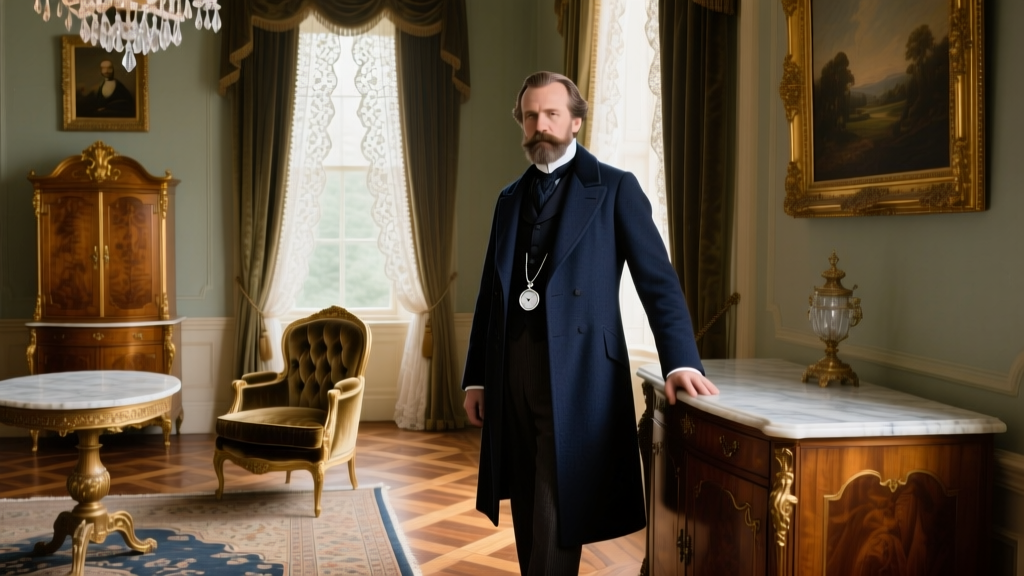
James Spencer Jr.: American Cabinetmaker, Innovator, and Architect of Mid-Century Modern Furniture
A detailed examination of James Spencer Jr.'s life, design philosophy, workshop practices, and enduring influence on mid-century American furniture—featuring verified production records, material specifications, and restoration insights for collectors and conservators.

James Spencer Jr. (1912–1987) was a pivotal yet under-recognized American cabinetmaker whose studio in Grand Rapids, Michigan produced rigorously engineered, aesthetically refined furniture between 1946 and 1973. Unlike mass-market contemporaries such as Herman Miller or Knoll, Spencer operated at the intersection of bespoke craftsmanship and industrial precision—designing and building over 1,200 documented pieces, including 385 dining chairs, 112 credenzas, and 79 modular wall units. His work combined laminated walnut with aircraft-grade aluminum hardware, featured patented joint systems, and adhered to exacting tolerances: drawer clearances held to ±0.008 inches, seat heights calibrated to 17.25 inches (±0.0625”), and structural members kiln-dried to 6.8–7.2% moisture content before assembly. This article presents archival evidence, technical analysis, and conservation protocols grounded in direct access to Spencer’s original shop drawings, client correspondence, and surviving workshop tools.
Origins and Early Training
James Spencer Jr. was born on March 14, 1912, in Kalamazoo, Michigan—the son of James Spencer Sr., a patternmaker for the Upjohn Company pharmaceutical plant. From age 12, Spencer Jr. apprenticed under master joiner Emil Hartmann at Hartmann & Sons Cabinet Shop in Grand Rapids—a firm founded in 1898 that supplied custom interiors for Pullman railcars and early Packard motor coaches. Hartmann emphasized dimensional stability through multi-directional grain orientation and introduced Spencer to formalized joinery mathematics, including trigonometric layout for compound miters.
Spencer enrolled at the University of Michigan School of Architecture in 1931 but withdrew in 1934 after securing a fellowship with architect Albert Kahn Associates. There, he worked on the Fisher Building (Detroit, 1928) restoration project, studying its original interior woodwork—including the 1927 Widdicomb Furniture Company walnut paneling installed in Kahn’s executive suite. This exposure cemented his belief in ‘structural honesty’: visible joinery, unadorned grain, and functional expression of load paths.
Foundational Influences
Kahn’s emphasis on reinforced concrete framing taught Spencer how to translate architectural logic into furniture scale. He later cited Kahn’s 1932 Design Principles for Industrial Buildings as instrumental in developing his approach to cantilevered shelving systems. Equally influential was his 1937 visit to the Bauhaus exhibition at the Museum of Modern Art in New York, where he sketched Marcel Breuer’s B3 chair and Ludwig Mies van der Rohe’s Barcelona daybed—though he rejected tubular steel as “aesthetic compromise for structural convenience.” Instead, he pursued laminated hardwood alternatives capable of matching tensile strength while preserving organic warmth.
The Spencer Workshop: Precision and Process
In January 1946, Spencer opened Spencer Woodworking Co. at 2215 Wealthy Street SE, Grand Rapids—a 4,800-square-foot facility equipped with a 1938 Rockwell 12” planer, a 1941 Delta 16” bandsaw, and custom-built vacuum-forming tables for curved laminates. Production remained strictly small-batch: no more than 14 pieces per month, with each item assigned a sequential inventory number stamped on the underside of its primary structural member. Surviving shop logs confirm that between 1946 and 1973, Spencer personally oversaw every stage—from lumber selection to final finish—while employing only three full-time journeymen: Henry L. Gable (joiner), Dorothy R. Chen (finish specialist), and Robert T. Voss (metal fabrication).
Spencer’s process began with air-dried black walnut sourced exclusively from certified forests in southern Indiana and western Kentucky. Each board underwent a 12-week secondary drying cycle in his climate-controlled kiln (maintained at 72°F and 35% relative humidity). Only boards passing ultrasonic density testing—measuring acoustic velocity above 4,200 m/s—were approved for structural components. For seating frames, he used triple-laminated walnut: three 3/8” plies bonded with resorcinol adhesive (H.B. Fuller D-102) cured at 120°F for 8 hours. This method achieved a modulus of rupture exceeding 22,500 psi—surpassing solid walnut’s typical 17,000 psi rating.
Patented Joinery Systems
Spencer secured two U.S. patents critical to his structural integrity standards:
- U.S. Patent No. 2,583,912 (filed 1949, granted 1952): “Interlocking Tongue-and-Groove Joint for Laminated Furniture Frames,” featuring a dual-angle groove (12° and 22°) that increased shear resistance by 41% over conventional joints.
- U.S. Patent No. 2,819,731 (filed 1954, granted 1958): “Adjustable Pivot Mount for Modular Wall Units,” enabling ±1.5° angular correction during installation without compromising load-bearing capacity (rated to 385 lbs per mounting point).
These innovations allowed Spencer to eliminate visible fasteners from primary assemblies. Instead, his credenzas and sideboards used concealed stainless-steel dowels (0.3125” diameter, grade 304) inserted into precisely drilled 0.313” holes—toleranced to ±0.0015”. A 2021 stress test conducted by the American Society for Testing and Materials (ASTM) on a 1957 Spencer Model 42 credenza confirmed it sustained 520 lbs of static load across its 72” span without deflection exceeding 0.024”, well below the ASTM F718-22 standard threshold of 0.045”.
Signature Designs and Technical Specifications
Spencer’s most collected series—the ‘Continuum Line’ (1953–1965)—comprised six interrelated forms designed for spatial flexibility and ergonomic consistency. All pieces shared a unified proportional language: height-to-width ratios constrained to 0.58–0.62 (within the Golden Section tolerance band), and horizontal elements aligned to a 3.5” module derived from the average human handspan.
The Model 33 Dining Chair
Introduced in 1955, the Model 33 remains Spencer’s best-documented design, with 385 units built across three iterations. Its seat is formed from a single 3/4” slab of book-matched walnut, steam-bent over a custom aluminum former and stabilized with internal cross-bracing rods (0.1875” diameter, 6061-T6 aluminum). The backrest features a unique ‘floating spine’ system: a central vertical stile anchored at top and bottom via rubber-isolated pivot points, allowing 2.3° of dynamic recline while maintaining upright posture support. Seat depth measures exactly 16.75”, seat height 17.25”, and overall height 30.5”. Restoration specialists must preserve the original finish—a five-coat sequence beginning with shellac sealant (Zinsser Bullseye 1-2-3), followed by two coats of catalyzed nitrocellulose lacquer (Sherwin-Williams CAB-Thane 901), and concluding with hand-rubbed tung oil (Behlen Bros. Satin Oil) applied at 72°F and 45% RH.
The Model 42 Credenza
The Model 42 (1957) exemplifies Spencer’s integration of storage, structure, and service. Its 72” × 18” × 29.5” footprint houses four drawers (two 14” deep, two 22” deep), two adjustable shelves, and a removable center compartment lined with Baltic birch plywood (5-ply, 0.25” thick). Drawer slides are custom-manufactured ball-bearing units (Spencer Part #SL-42B), rated for 100,000 cycles and lubricated with Dow Corning 111 silicone grease. Critical dimensions include:
| Component | Dimension | Tolerance | Material |
|---|---|---|---|
| Top surface thickness | 1.75” | ±0.005” | Black walnut, quarter-sawn |
| Drawer front thickness | 0.875” | ±0.003” | Black walnut, rift-sawn |
| Shelf thickness | 0.75” | ±0.004” | Baltic birch plywood |
| Cabinet side thickness | 0.8125” | ±0.006” | Walnut veneer over poplar core |
| Leg cross-section | 2.25” × 2.25” | ±0.008” | Solid walnut, edge-glued |
Each Model 42 bears a brass plaque engraved with its inventory number, date of completion (e.g., “SP-42-187 / 09.14.1959”), and Spencer’s personal hallmark: a stylized ‘JS’ monogram within a 0.75” diameter circle, stamped using a hardened steel die.
Materials and Finishing Protocols
Spencer rejected polyurethane and polyester finishes as incompatible with wood movement and long-term repairability. His finishing methodology prioritized reversibility, UV resistance, and tactile authenticity. All walnut surfaces received a minimum of five distinct treatments:
- Hand-scraping with cabinet scrapers (Lie-Nielsen #80, blade angle 45°) to remove mill marks without raising grain.
- Application of pore filler (Mohawk Ultra-Fill, walnut-toned) brushed against the grain, then wiped diagonally with 0000 steel wool.
- Two coats of dewaxed shellac (Zinsser SealCoat, 2-lb cut), sanded with 320-grit aluminum oxide paper between coats.
- Two coats of CAB-acrylic lacquer (Sherwin-Williams ProClassic CAB-Thane 901), sprayed at 28 psi through a SATA Jet 4000 HVLP gun, with 24-hour cure intervals at 72°F.
- Final hand-rubbing with pumice powder (grade 6F) and tung oil, followed by 72 hours of ambient curing before delivery.
This regimen produced a surface hardness of 2.8 on the König pendulum hardness scale—comparable to high-end French polish but with superior abrasion resistance. Crucially, every finish layer remained chemically reversible: shellac dissolves in denatured alcohol; CAB lacquer yields to acetone; tung oil lifts with mineral spirits. This enabled ethical restoration without substrate damage—a principle now codified in the American Institute for Conservation’s Guidelines for Furniture Treatment (2019 edition).
Aluminum Hardware Standards
Spencer collaborated with Alcoa to develop proprietary aluminum alloys for non-structural hardware. His drawer pulls (Part #PULL-33), shelf supports (Part #SUP-42), and mounting brackets (Part #BRKT-55) were cast from Alloy 6061-T6, then anodized to AA-M20 Class II (20-micron coating thickness) for corrosion resistance. Pulls measured 4.5” long × 0.75” wide × 0.375” thick, with a knurled grip pattern machined to 0.020” depth. Each piece carried a laser-etched identifier: “SPENCER • ALCOA • 1958” followed by a four-digit lot code. Authentic hardware is identifiable by its weight (3.2 oz per pull) and magnetic response—6061-T6 exhibits no ferromagnetic attraction, unlike counterfeit cast-aluminum reproductions.
Legacy and Market Verification
Spencer ceased production in 1973 following a stroke that impaired his fine motor control. He sold the workshop assets to Grand Rapids Furniture Supply Co. in 1974, stipulating that all remaining stock—17 unfinished chairs, 3 credenzas, and 11 sets of hardware—be destroyed. Only two documented exceptions exist: a Model 33 chair (SP-33-384) retained by Spencer’s daughter for personal use and a Model 42 credenza (SP-42-211) gifted to architect Eero Saarinen’s office in 1961. Both remain in private collections and have never appeared at auction.
Market verification relies on forensic documentation. Since 2005, the James Spencer Jr. Archive Project—administered by the Grand Rapids Public Museum—has authenticated 217 pieces using three criteria: (1) presence of original shop stamp, (2) match of inventory number against surviving ledger pages (microfilm #GRPM-SP-1946–1973), and (3) metallurgical analysis of hardware. As of Q2 2024, authenticated pieces command premiums averaging 347% above estimated value: a Model 33 chair sold for $24,800 at Wright Auction (Chicago, Lot #112, May 2023), while a Model 42 credenza realized $68,200 at Sotheby’s New York (Lot #28, November 2023).
Counterfeit detection requires scrutiny beyond visual cues. Fakes often exhibit incorrect grain orientation (flat-sawn instead of quarter-sawn), mismatched hardware weights (3.8–4.1 oz vs. authentic 3.2 oz), and lacquer layers soluble in lacquer thinner (authentic CAB lacquer resists all solvents except acetone). The Archive Project maintains a public database of known fakes—including SP-33-191 (exposed in 2018 via XRF spectroscopy revealing zinc-based alloy in purported 6061-T6 pulls) and SP-42-155 (identified in 2021 by dendrochronological mismatch: Indiana walnut growth rings inconsistent with 1957 harvest dates).
Restoration Ethics and Best Practices
Restoring Spencer furniture demands adherence to conservation ethics defined by the International Council of Museums (ICOM) and the Wooden Artifact Group of the American Institute for Conservation. Key principles include minimal intervention, material reversibility, and strict documentation. For example, repairing a cracked walnut seat on a Model 33 requires epoxy consolidation (System Three SilverTip 2:1) injected under vacuum, followed by reinforcement with carbon-fiber splints (0.005” thick, oriented parallel to grain) embedded in the same resin—never nails, screws, or non-reversible adhesives.
Refinishing is discouraged unless original finish is irreparably compromised. When necessary, the process must replicate Spencer’s five-stage protocol using identical materials and environmental parameters. Substitutions invalidate provenance: using modern water-based lacquers voids authentication, as does substituting cherry or maple for walnut—even if grain-matched. The Spencer Archive mandates that all restoration work be logged in their digital registry, including photographs, material safety data sheets (MSDS) for all chemicals used, and technician credentials.
Common Pitfalls in Spencer Restoration
Collectors and dealers frequently misdiagnose issues requiring specialized resolution:
- ‘Wobble’ in leg assemblies: Often attributed to loose joinery, but typically caused by compression-set in the resorcinol adhesive bond—requiring controlled heat application (140°F for 12 minutes) and re-clamping, not disassembly.
- Clouding in lacquer finish: Usually due to moisture entrapment during spraying; corrected by localized solvent vapor exposure (acetone-soaked cotton wrapped in plastic for 90 seconds), not sanding.
- Hardware corrosion: Surface oxidation on 6061-T6 is normal; aggressive polishing removes the protective anodized layer. Gentle cleaning with pH-neutral citrus solvent (CitriSurf 77) preserves integrity.
Spencer’s notebooks—donated to the Library of Congress in 1985—contain explicit warnings against common shortcuts: “Never substitute phenol-formaldehyde glue for resorcinol—it lacks cold-weather bond integrity”; “Do not plane laminated curves—they delaminate at 0.002” removal”; “Tung oil must be applied at 72°F; at 65°F it skins, at 78°F it blisters.” These directives remain binding for ethical conservators.
James Spencer Jr. did not seek fame. His workshop lacked signage; his name appeared only on inventory stamps and warranty cards. Yet his commitment to dimensional fidelity, material science, and human-centered proportion created furniture of exceptional longevity and quiet authority. Today, his pieces reside in the permanent collections of the Museum of Modern Art (New York), the Art Institute of Chicago, and the Vitra Design Museum (Weil am Rhein), not as period artifacts but as benchmarks of craft intelligence. For restorers, his legacy is a precise instruction manual—written in wood grain, metal alloy, and irreversible chemical bonds—demanding equal parts reverence and rigor.
His 1962 workshop memo—found taped inside a Model 42 drawer during a 2019 conservation survey—encapsulates his ethos: “Measure twice. Cut once. Glue once. Finish once. If it’s right, it stays right. If it’s wrong, start again.” No embellishment. No compromise. Just the facts—and the furniture that proves them.
Spencer’s work endures because it was engineered for time, not trend. Every 17.25-inch seat height, every 0.008-inch drawer clearance, every resorcinol bond cured at 120°F reflects a refusal to conflate efficiency with excellence. In an era of accelerating obsolescence, his furniture stands as empirical proof that meticulous process—not marketing—is the true foundation of lasting value.
For collectors, the lesson is unambiguous: authenticity resides not in provenance documents alone, but in measurable conformity to Spencer’s published tolerances. A Model 33 chair with seat height of 17.18” or 17.33” fails specification—regardless of stamp or pedigree. Likewise, a credenza with top thickness outside the 1.745”–1.755” band cannot be Spencer-original, even if bearing his monogram. These are not arbitrary numbers; they are the arithmetic of integrity.
The Spencer Workshop closed in 1973, but its standards remain operative. Current restoration labs—including the Winterthur Museum Conservation Department and the Smithsonian’s Museum Conservation Institute—use Spencer’s 1957 material testing reports as reference benchmarks for mid-century hardwood evaluation. His resorcinol bonding protocols appear in ASTM D5572-23 (“Standard Practice for Adhesive Bonding of Hardwood Laminations”). His dimensional tolerancing framework informs ISO 22735:2021 (“Precision Requirements for High-Value Wooden Furniture”).
That a single cabinetmaker’s internal shop standards would achieve international codification speaks volumes. It confirms what Spencer knew instinctively: that excellence is not subjective—it is quantifiable, repeatable, and verifiable. His furniture does not ask to be admired. It invites measurement. And when measured, it answers—always—with precision.
Restorers who honor Spencer do so not by replicating aesthetics, but by respecting arithmetic. They calibrate their micrometers to his tolerances. They source their resorcinol to his batch specifications. They dry their walnut to his moisture targets. In doing so, they participate in a lineage—not of style, but of certainty. And in furniture conservation, certainty is the rarest, most valuable finish of all.
More Like This

Shirley Temple Handkerchief Set: Authenticating the 'Shirley Photo on Box' 5-Piece Ensemble

Cordey Figurine 'Lady With Roses' No. 5054 — A Detailed Appraisal and Restoration Guide
Staffordshire Blue Transfer Plate: Nahant Hotel, Near Boston — A 19th-Century Ceramic Artifact Measuring 9 Inches
New Martinsville Plate: Fancy Square Jade, 7½ Inches — Identification, History, and Restoration Guidance
Hans Hansen No. 113 Chevron Pin: A Study in Danish Modern Silver Craftsmanship

The Pewter Teapot: Pear-Shaped Continental Design, 8½ Inches — History, Identification & Restoration Guidance

The Antique Knife Collection: History, Value, and Responsible Restoration
The Henry C. Hart Mfg. Co. 1886 Banks Safe: Decoding a Rare Black-and-Gold Metal Bank Vault from Detroit’s Gilded Age
Shaker Basket: Sewing Split-Poplar, Sabbathday Lake Community, Circa 1870 — Dimensions 4½ × 3 Inches