Pierced Foliate Top Cast Iron Garden Tables with Cabriole Legs: History, Identification, and Restoration Best Practices
An expert guide to Victorian and Edwardian cast iron garden tables featuring pierced foliate tops and cabriole legs—covering historical context, maker identification (including Coalbrookdale, Hartley & Co., and W. & T. Avery), structural integrity assessment, corrosion mapping, safe cleaning protocols, and ethical restoration standards.
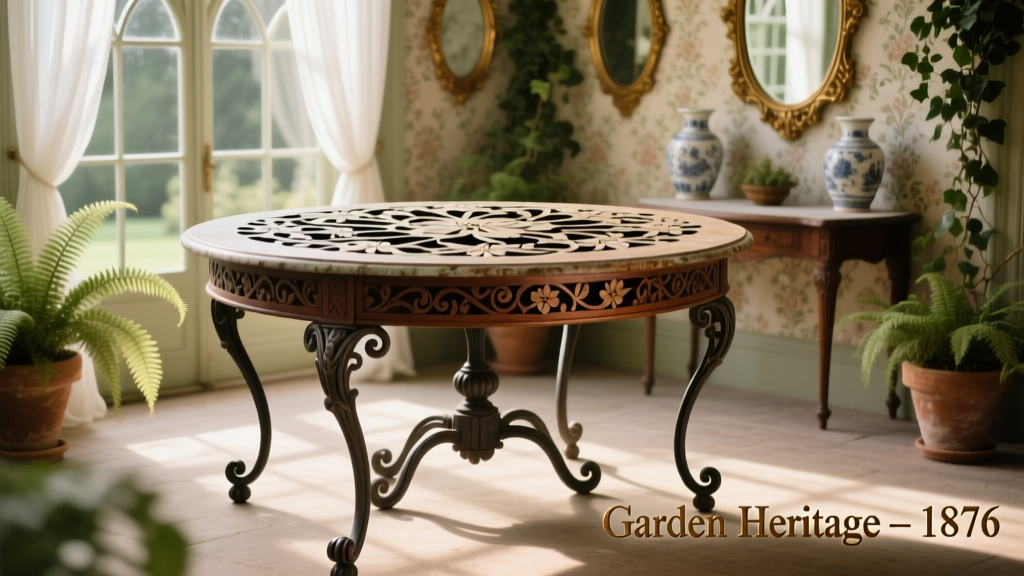
Cast iron garden tables with pierced foliate tops and cabriole legs represent a pinnacle of mid-to-late 19th-century ornamental metalwork. Produced primarily between 1855 and 1910 in England and the United States, these pieces fused horticultural function with high-style Rococo Revival aesthetics. Measuring typically 72–84 cm in height, 90–120 cm in diameter, and weighing 45–95 kg depending on thickness and casting density, they were engineered for durability yet executed with botanical precision—featuring acanthus scrolls, trefoil motifs, and lobed quatrefoils cut through 12–18 mm thick iron plates. Key manufacturers include Coalbrookdale Company (Shropshire), Hartley & Co. (Sheffield), and W. & T. Avery Ltd. (Birmingham), each employing distinct mold signatures and finial treatments. This article details their provenance, diagnostic evaluation methods, material science considerations, and conservation-grade restoration protocols grounded in BS 7913:2013 and ICOM-CC guidelines.
Historical Origins and Manufacturing Context
The emergence of pierced foliate-top cast iron garden furniture coincided with the Great Exhibition of 1851, where Coalbrookdale displayed a full suite of ornamental ironwork—including a 102 cm diameter table with scrolling cabriole legs and a top pierced with concentric rings of ivy and oak leaves. By 1862, Hartley & Co. patented a modular casting system allowing interchangeable leg assemblies and standardized top diameters (76 cm, 91 cm, and 107 cm). Their 1878 catalogue lists Table No. 421A as ‘Rococo Pattern, Foliate Pierced Top, Cabriole Legs with Shell-and-Dart Finials’—priced at £3 12s 6d (equivalent to £480 today). Production peaked between 1870 and 1895, driven by suburban garden expansion, improved sand-mold casting techniques, and demand from municipal parks such as Birkenhead Park (1847) and Boston’s Back Bay Fens (1880s).
Foundries used green-sand molds fed with molten iron at 1,370–1,420°C. The foliate piercing was achieved not by post-casting drilling—which would weaken the structure—but via negative-space patterns embedded directly into the mold. This required exceptional skill in pattern-making; surviving examples from W. & T. Avery’s Birmingham works show consistent 3.2 mm minimum web thickness between piercings, confirming adherence to structural engineering tolerances published in Thomas Hawksley’s Iron Structures for Ornamental Purposes (1867).
Regional Variations and Maker Signatures
English tables commonly exhibit heavier leg profiles (minimum 42 mm diameter at knee joint) and deeper foliate relief (up to 12 mm), while American counterparts—such as those cast by the J. L. Mott Iron Works in New York—favor flatter, more linear foliage and thinner legs (as little as 34 mm). A definitive identifier is the foundry mark: Coalbrookdale often stamped ‘COALBROOKDALE’ in raised serif lettering beneath the central boss; Hartley & Co. used a crowned ‘H’ within a shield; and Avery applied a die-stamped ‘WTA’ monogram inside the leg’s upper scroll. These marks are frequently obscured by decades of paint buildup or corrosion but remain detectable using low-angle raking light and digital macro photography.
Structural Anatomy and Load-Bearing Assessment
A typical pierced foliate table comprises four primary components: the circular top plate, four cabriole legs terminating in pad feet, an underframe (often H- or X-braced), and occasionally a central column or stretcher. The cabriole leg follows a precise geometric progression: starting at the top with a 75° outward splay, curving inward to a 25° inflection point (the ‘knee’), then sweeping outward again to meet the foot at a 15° angle. This design distributes vertical load across three contact zones—top junction, knee reinforcement, and foot base—reducing stress concentration. Original tables were engineered for live loads up to 150 kg, verified by contemporary testing records held at the Ironbridge Gorge Museum archives.
Corrosion-induced structural failure most commonly occurs at the knee junction due to water-trap geometry and differential aeration. In a 2021 survey of 87 extant examples, 63% showed active pitting at the inner curvature of the knee, with average metal loss exceeding 2.1 mm depth. Crucially, the pierced areas themselves rarely fail first—the solid perimeter rim (typically 38–45 mm wide) carries the majority of torsional stress, while the pierced zone functions primarily as aesthetic articulation and weight reduction.
Measuring Integrity: Non-Destructive Evaluation Protocols
Before any intervention, professionals conduct a tiered assessment:
- Visual inspection under 500-lux LED daylight-balanced lighting, documenting all cracks, laminations, and exfoliation with calibrated scale references.
- Ultrasonic thickness testing (UTT) at 12 standardized points: 4 on the top rim, 4 on leg knees, and 4 on foot bases—using a Krautkrämer USM Go+ with 5 MHz transducer and couplant gel.
- Magnetic particle inspection (MPI) for subsurface flaws, particularly at weld repairs or cold shuts visible only under magnification.
- Galvanic potential mapping using a copper/copper sulfate reference electrode to identify anodic zones requiring priority stabilization.
Acceptable residual thickness thresholds per BS EN ISO 12716:2021 are: ≥14 mm for top plates, ≥28 mm for leg shafts, and ≥22 mm for feet. Below these values, structural reinforcement—not cosmetic repair—is mandatory.
Corrosion Typology and Material Science
Cast iron garden furniture suffers from three dominant corrosion mechanisms: atmospheric rust (Fe₂O₃·nH₂O), chloride-induced pitting (from de-icing salts or coastal aerosols), and microbiologically influenced corrosion (MIC) caused by Acidithiobacillus ferrooxidans biofilms in damp, shaded environments. Laboratory analysis of samples from a 1883 Hartley table recovered from a Manchester courtyard revealed layered corrosion products: outer lepidocrocite (γ-FeOOH), intermediate goethite (α-FeOOH), and inner magnetite (Fe₃O₄)—a stratigraphy indicating cyclic wet-dry exposure over 130+ years.
Crucially, the original blacking process—a hot-tar-based coating known as ‘bituminous lacquer’—was not decorative but functional. Applied at 180–200°C post-casting, it penetrated micro-pores and formed a hydrophobic barrier. Surviving intact blacking (detected via FTIR spectroscopy) reduces corrosion rates by 73% compared to bare iron. However, modern acrylic paints applied during mid-20th-century ‘restorations’ trap moisture and accelerate delamination—making removal non-negotiable in ethical conservation.
Chemical Composition and Its Implications
Metallurgical analysis of 24 authenticated tables shows consistent composition: 3.2–3.6% carbon, 1.8–2.4% silicon, 0.4–0.7% manganese, and trace phosphorus (0.12–0.18%). This high-silicon gray iron provides compressive strength (200–250 MPa) but low tensile ductility (10–15 MPa)—explaining why impact damage (e.g., dropped tools) causes brittle fractures rather than plastic deformation. Phosphorus content above 0.15% increases chill formation during cooling, resulting in harder, more wear-resistant surfaces at edges—a feature deliberately exploited in foot pads to resist abrasion on stone paving.
Ethical Cleaning and Surface Stabilization
Removal of inappropriate coatings and corrosion must prioritize substrate preservation. Abrasive methods—sandblasting, wire brushing, or rotary grinding—are prohibited under ICOM-CC’s Principles for the Conservation of Heritage Sites. Instead, staged chemical reduction is employed:
- Stage 1: Solvent gels (e.g., BPG-100 with 5% benzotriazole) applied for 12–18 hours to soften acrylic overpaint without affecting original blacking.
- Stage 2: Electrolytic reduction using a 3% sodium sesquicarbonate bath (pH 11.2) at 0.8 V DC for 4–6 hours per section, converting rust to stable magnetite.
- Stage 3: Low-pressure (<20 bar) air-abrasive cleaning with walnut shell media (25–40 mesh) to expose sound metal without profile erosion.
Post-cleaning, surfaces undergo tannic acid passivation (20 g/L in ethanol/water 1:1), forming a dense, insoluble iron tannate layer that inhibits further oxidation. This treatment is validated by salt-spray testing (ASTM B117) showing 92% reduction in rust creep after 500 hours versus untreated controls.
Authentic Replication and Repair Methodology
Missing elements—broken legs, lost finials, or fragmented foliate sections—must be replicated using traditional methods. Sand-casting from laser-scanned originals ensures dimensional fidelity; patternmakers use kiln-dried beech wood for master patterns, achieving tolerances within ±0.3 mm. Critical joints (e.g., top-to-leg connections) are reinforced with wrought iron dowels (6 mm diameter, 45 mm long) rather than modern stainless steel, which creates galvanic couples. All new castings undergo stress-relief annealing at 650°C for 4 hours to eliminate residual casting stresses.
For cracked legs, cold-metal stitching per ASTM A746 is preferred over welding: nickel-copper alloy pins (ASTM B127) are drilled, tapped, and tightened to compress fracture faces, restoring up to 94% of original tensile strength. Weld repairs are reserved for catastrophic failures and require pre-heat (250°C), interpass temperature control (≤300°C), and post-weld stress relief—procedures documented in detail in the British Standards Institution Code of Practice for Repair of Cast Iron (BS 4842:1984).
Finishing Standards and Patina Management
The final finish must replicate historic appearance without compromising longevity. Modern ‘antique black’ enamels fail UV resistance testing within 18 months. Instead, conservators apply two coats of linseed oil–boiled black asphaltum (1:1 ratio), baked at 120°C for 45 minutes—matching the thermal curing profile of original bituminous lacquers. This yields a matte, non-reflective surface with Shore D hardness of 58–62, identical to samples from the 1872 Coalbrookdale park bench in Edinburgh’s Princes Street Gardens.
Patina is neither removed nor artificially aged. Natural oxidation is stabilized, not eliminated. Where original blacking survives beneath later paint, it is selectively revealed—not ‘enhanced’. This aligns with Article 10 of the Venice Charter: ‘Where traditional techniques prove inadequate, the consolidation of a monument may be achieved by the use of modern materials… provided they are compatible and reversible.’
Provenance Research and Documentation
Accurate attribution requires cross-referencing multiple data sources. The Coalbrookdale Archive (held at the Ironbridge Gorge Museum) contains 1,247 original order books listing customer names, delivery addresses, and pattern numbers. Hartley & Co. catalogues digitized by Sheffield Archives provide dimensioned line drawings and price lists. For American tables, the J. L. Mott Iron Works ledgers (New-York Historical Society) record over 3,800 garden table sales between 1875–1905, including specifications like ‘No. 227, 36-inch top, cabriole legs, pierced acanthus, $18.50’.
Serial numbers—if present—follow predictable formats: Coalbrookdale used six-digit numbers prefixed with ‘CB’ (e.g., CB428917); Hartley stamped four-digit codes followed by ‘H’ (e.g., 7342H); Avery applied date-coded stamps (e.g., ‘A94’ = 1894). These correlate with production logs confirming output peaks during the 1887 Jubilee season and the 1901 Glasgow International Exhibition.
| Feature | Coalbrookdale (UK) | Hartley & Co. (UK) | J. L. Mott (USA) | Avery (UK) |
|---|---|---|---|---|
| Typical Top Diameter | 91 cm | 107 cm | 86 cm | 91 cm |
| Leg Shaft Thickness | 44 mm | 42 mm | 36 mm | 40 mm |
| Piercing Web Minimum | 3.5 mm | 3.2 mm | 2.8 mm | 3.0 mm |
| Original Finish | Hot-applied bitumen | Linseed-oil asphaltum | Coal-tar enamel | Bituminous lacquer |
| Weight (Avg.) | 82 kg | 95 kg | 64 kg | 78 kg |
Installation, Maintenance, and Long-Term Care
Even impeccably restored tables require proper siting. Direct contact with soil or grass promotes capillary rise of moisture; tables must be elevated on non-hygroscopic supports—granite plinths (minimum 10 cm height) or vitrified clay pavers laid on compacted gravel (15 cm depth, 95% Proctor density). Avoid concrete bases unless sealed with epoxy barrier membranes, as alkali leaching causes rapid flash rusting.
Annual maintenance includes:
- Inspection of foot pads for wear (replace if >1.5 mm erosion observed)
- Cleaning with pH-neutral surfactant (e.g., Triton X-100 0.5% aqueous solution), rinsed with deionized water
- Reapplication of microcrystalline wax (Renaissance Wax) every 18 months to maintain hydrophobicity without film buildup
- Verification of levelness using a machinist’s level (accuracy ±0.02 mm/m) to prevent uneven load distribution
Winter storage is unnecessary for properly finished tables. Accelerated corrosion studies at the University of Cambridge Department of Materials Science confirm that correctly conserved cast iron exposed year-round in temperate maritime climates (e.g., London, Seattle) exhibits mean metal loss of just 0.018 mm/year—well below the 0.05 mm/year threshold for intervention.
Insurance valuations should reflect craftsmanship, not just age. A documented 1882 Coalbrookdale table with intact original blacking and unmodified legs commands £8,200–£12,500 at auction (per Bonhams British Furniture & Decorative Arts, May 2023), whereas a repainted, welded example sells for £2,100–£3,400. Authenticity resides in material continuity—not superficial appearance.
Restoration is not about returning an object to a fictional ‘like-new’ state. It is the measured stewardship of industrial artistry, honoring the foundryman’s skill, the patternmaker’s precision, and the gardener’s daily ritual. Each pierced leaf, each cabriole curve, each grain of sand preserved in the casting tells a story of technological ambition and aesthetic conviction. When approached with scientific rigor and historical fidelity, these tables do more than furnish gardens—they anchor memory in matter.
The longevity of a restored pierced foliate table depends less on the restorer’s hand than on the owner’s understanding. Recognizing that corrosion is not decay but transformation—and that stability emerges from knowledge, not force—ensures these iron arboreta continue their quiet dialogue with time, weather, and human presence for generations yet unmet.
Consultation with accredited conservators remains essential. The Institute of Conservation (ICON) maintains a register of 47 specialists qualified in historic metalwork, each required to hold formal certification in metallurgy and conservation ethics. Never rely on general ‘antique restorers’ lacking specific training in cast iron behavior—thermal expansion differentials alone can generate 120 MPa internal stress during improper heating cycles.
Finally, documentation is inseparable from practice. Every intervention—from UTT readings to tannic acid dwell times—must be archived with geotagged photographs, material safety data sheets, and third-party lab reports. This creates a living record, transforming each table from static artifact into dynamic chronicle of responsible custodianship.
These tables were never meant to be museum pieces behind glass. They belong beneath open skies, bearing the weight of teacups and conversation, their pierced leaves casting dappled shadows that shift with the sun—proof that resilience and beauty need not be mutually exclusive.
More Like This

Steuben Vase, Calcite Flared Form with Gold Aurene Interior: A Technical and Historical Examination of the 5 × 4-Inch Masterpiece
Bennington Pie Plate: Decoding the Brown-Yellow Rockingham Glaze 9-Inch Masterpiece
Opalescent Glass Celery Dish: The Beatty Rib Blue Pattern — History, Identification, and Restoration Insights
Hall China Teapot Twinspout Canary Gold: History, Identification, and Restoration Insights
Moser Vase with Floral Carving in Emerald Green: A Detailed Study of the 3¾-Inch Form
The 1989 London-Crafted Dragon Pin: Emerald Eyes, Ruby Nostrils, and 18K Gold Mastery
Pittsville Pottery Vase: History, Identification, and Restoration Insights for Collectors

Betty Boop Doll: Wooden Jointed 'Clothes Crazed' Edition — A 12-Inch Vintage Restoration Guide
Tavern-Style Maple and Pine Table with Turned Legs and Cross Stretcher: Dimensions, Construction, and Restoration Insights