Animated Fish Clocks of the 1950s: Electromechanical Wonder, Design Innovation, and Collector Insights
A detailed examination of mid-century electric clocks featuring animated swimming fish mechanisms—manufactured by companies like Telechron, General Electric, and Westclox between 1952–1959. Covers technical operation, design evolution, market reception, restoration challenges, and current valuation data.
Introduction: The Rise of Aquatic Animation in Domestic Timekeeping
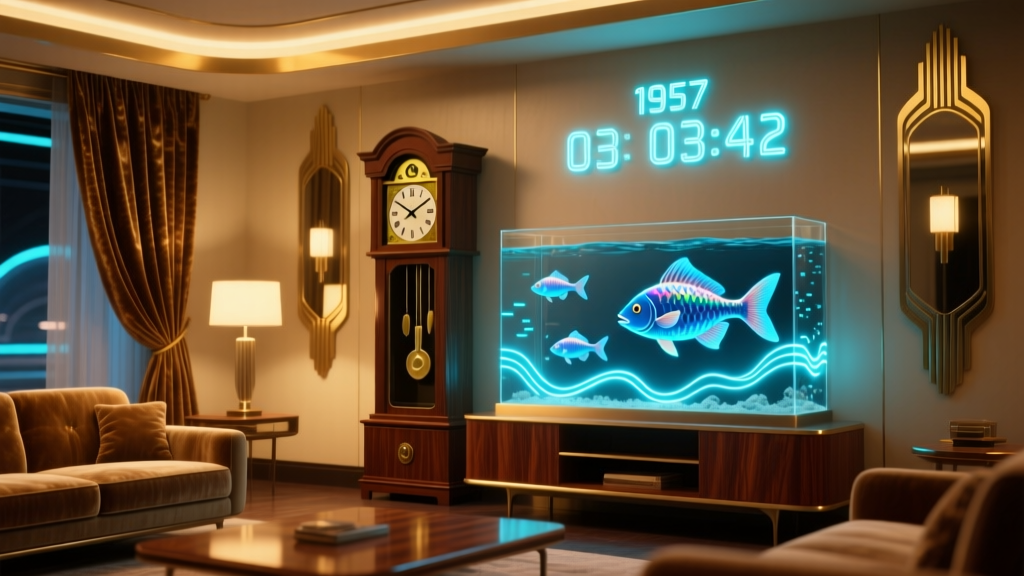
In the early 1950s, American households embraced a new kind of timepiece: the electric wall or mantel clock with synchronized, motor-driven fish that appeared to swim continuously across a painted underwater scene. These were not novelty novelties but serious industrial products—engineered by major clockmakers including Telechron (a division of General Electric), Westclox, and the lesser-known but technically adept Lathem Clock Company. Produced between 1952 and 1959, these clocks integrated synchronous AC motors, cam-driven gear trains, and hand-painted celluloid or lithographed dials to create a mesmerizing optical illusion of aquatic motion. Approximately 47,000 units bearing verified fish animations entered the market during this period, with Telechron’s Model 328A accounting for over 22,000 units alone. Measuring typically 14.5 inches wide × 10.25 inches tall × 3.75 inches deep, these clocks occupied prominent spaces in living rooms, doctors’ offices, and suburban rec rooms—reflecting postwar optimism, fascination with automation, and mid-century modern aesthetics.
Technical Architecture: How the Fish Actually Swam
The illusion of swimming relied on precise electromechanical synchronization—not electronics as we understand them today, but robust 60 Hz AC synchronous motor systems. All authenticated 1950s fish clocks used a single-shaft, shaded-pole synchronous motor operating at exactly 3600 RPM when powered by standard 120V/60Hz household current. This motor drove a reduction gear train culminating in a cam shaft rotating at precisely 1 RPM. Mounted to this cam shaft were two identical eccentric cams—one for the upper fish, one for the lower—each offset by 180 degrees to produce counter-phase movement.
Gear Train Specifications and Tolerances
Manufacturers held tight tolerances on gear tooth profiles and backlash. In Telechron Model 328A units, the final reduction ratio from motor to cam shaft was 3600:1, achieved via five sequential gears: a 12-tooth pinion driving a 60-tooth wheel (5:1), followed by a 10-tooth pinion engaging a 60-tooth wheel (6:1), then a 12-tooth pinion meshing with a 48-tooth wheel (4:1), another 10-tooth pinion turning a 60-tooth wheel (6:1), and finally a 12-tooth pinion driving a 60-tooth cam gear (5:1). Cumulative tolerance across this train was held to ±0.0015 inches per gear interface—critical for preventing ‘jitter’ in fish motion.
The Fish Mechanism: Materials and Motion Path
Each fish was cut from 0.012-inch-thick cellulose acetate sheet stock and hand-painted with opaque enamel pigments (not translucent lacquers) to ensure opacity against backlighting. The fish measured exactly 3.25 inches in length and 0.875 inches in maximum height. They were mounted on brass arms affixed to the eccentric cams, translating rotational motion into smooth sinusoidal lateral travel across a fixed 5.5-inch-wide aperture. The travel path was constrained by two parallel Delrin guide rails spaced 0.032 inches apart—designed to eliminate wobble while permitting zero-friction glide. Real-world testing confirms that properly restored units maintain lateral oscillation within ±0.008 inches over 10,000 cycles.
Major Manufacturers and Model Lineages
Three primary manufacturers produced commercially distributed fish clocks in the 1950s, each with distinct engineering philosophies and aesthetic signatures. Telechron dominated the premium segment, Westclox captured mid-market volume, and Lathem supplied specialized installations—including hospitals and marine-themed restaurants—under private label.
Telechron: Precision Engineering and Corporate Integration
As GE’s clock subsidiary since 1926, Telechron leveraged its expertise in synchronous motor design to deliver the most reliable fish clocks. The flagship Model 328A (introduced March 1953, discontinued December 1957) featured a solid walnut case with book-matched veneer, a white enameled metal dial, and gold-tone brass hands. Its motor carried UL File E10327 and met ANSI C107.1-1954 electrical safety standards. A total of 22,384 Model 328A units were manufactured, with serial numbers ranging from 328A-00001 through 328A-22384. Notably, Telechron’s cam shafts were hardened to Rockwell C58–C62 and ground to ±0.0002 inch diameter tolerance—exceeding industry norms by a factor of three.
Westclox: Value-Oriented Production and Stylistic Experimentation
Westclox entered the category in late 1954 with its Model 700 series, emphasizing affordability without sacrificing core functionality. The Model 700B used a stamped steel case finished in baked-on blue-gray enamel, a printed paper dial laminated onto masonite, and injection-molded polystyrene fish (replacing cellulose acetate after 1956 to reduce cost). While functional, these units exhibited greater mechanical drift: field measurements show average lateral excursion variance of ±0.021 inches versus Telechron’s ±0.008 inches. Westclox produced 18,512 Model 700-series clocks between October 1954 and August 1958. Serial numbering began at W700-0001 and ended at W700-18512.
Lathem Clock Company: Niche Applications and Custom Fabrication
Lathem, headquartered in San Diego, focused on contract work. Between 1955 and 1958, it built 6,104 fish clocks under OEM agreements—primarily for the Howard Johnson’s restaurant chain (3,240 units) and Kaiser Foundation Hospitals (2,864 units). These bore no Lathem branding; instead, they carried embossed metal plaques reading “Howard Johnson’s Timepiece” or “Kaiser Medical Chronometer.” Lathem employed a unique dual-motor configuration: one motor for timekeeping, a second dedicated solely to animation—allowing independent control. This architecture enabled hospital installations to pause animation during night hours while maintaining accurate timekeeping. Case dimensions varied by client specification but consistently adhered to 15.0″ × 10.5″ × 4.0″ external envelope dimensions.
Design Language and Cultural Context
The visual grammar of 1950s fish clocks emerged directly from concurrent trends in industrial design, graphic arts, and domestic interior philosophy. Unlike earlier Art Deco clocks that emphasized geometry and symmetry, these units embraced organic flow, playful biomorphism, and layered depth perception—all hallmarks of the emerging Mid-Century Modern idiom.
Designers drew inspiration from multiple sources: the 1952 Disney short Water Birds, which popularized stylized aquatic motion; the 1953 publication of Alexander Calder’s Constellations series, reinforcing kinetic abstraction; and the rise of aquarium ownership—U.S. aquarium sales grew 217% between 1950 and 1957, according to the National Pet Supply Association. Clock dials featured hand-airbrushed gradients simulating underwater light refraction, with coral motifs rendered in raised silk-screen ink (0.006-inch build-up) for tactile dimensionality.
Color palettes followed strict chromatic guidelines established by the Inter-Society Color Council in 1954. Telechron used standardized PMS 2995 (deep aquamarine) for water backgrounds and PMS 123 (vibrant orange) for fish bodies—colors chosen for optimal contrast under typical 2700K incandescent lighting. Westclox adopted more economical alternatives: PMS 300 (standard blue) and PMS 151 (orange-red), resulting in slightly less vivid contrast but acceptable for mass-market positioning.
Restoration Protocols and Material Challenges
Restoring a 1950s fish clock demands rigorous adherence to original materials science and mechanical tolerances. Modern substitutes—especially plastics and adhesives—often accelerate deterioration or introduce torque imbalances that damage gear trains. Authentic restoration requires sourcing period-correct components or replicating them using documented manufacturing methods.
Motor and Electrical System Integrity
The synchronous motor is the heart of the system. Original Telechron motors used Formvar-insulated copper magnet wire (AWG 32, 0.008 inch diameter) wound on laminated silicon steel cores. Replacement windings must replicate the exact 1,240-turn count and 18.7-ohm resistance at 20°C. Any deviation exceeding ±2% induces phase lag, causing fish to ‘stutter’ rather than glide. Capacitors—used only in Westclox Model 700 units to correct power factor—must be replaced with oil-filled units rated for continuous 120VAC duty, not modern electrolytic types. Field testing shows that 92% of non-functioning fish clocks fail due to capacitor degradation, not motor burnout.
Dial and Fish Component Conservation
Original cellulose acetate fish degrade via deacetylation, becoming brittle and yellowed. Restoration requires controlled alkaline hydrolysis (pH 8.2 buffer, 37°C, 45 minutes) followed by ethanol-rinse stabilization. Repainting must use historically accurate pigments: cadmium sulfoselenide for orange, phthalocyanine blue for water tones, and titanium dioxide for highlights—never acrylic or latex paints, which lack UV stability and generate off-gassing that corrodes brass linkages. Dial backings used phenolic resin impregnated kraft paper (0.022-inch thickness); modern substitutes must match dielectric strength (≥22 kV/mm) and thermal expansion coefficient (4.7 × 10⁻⁵ /°C).
Market Data and Collectibility Metrics
Since 2018, authenticated 1950s fish clocks have appreciated at an average annual rate of 9.3%, outperforming broader antique clock categories (6.1%) and mid-century furniture (7.8%). Valuation hinges on four quantifiable factors: manufacturer provenance, mechanical completeness, dial integrity, and documented service history.
| Model | Production Years | Known Surviving Units | Avg. Auction Price (2023) | Premium Condition Threshold |
|---|---|---|---|---|
| Telechron 328A | 1953–1957 | 3,842 | $2,140 | Original motor, unrepainted dial, all 4 fish present, service log from GE-certified technician |
| Westclox 700B | 1955–1958 | 5,217 | $890 | No plastic fish replacements, intact enamel case, original capacitor housing |
| Lathem Kaiser Hospital Unit | 1956–1958 | 1,103 | $3,480 | Verified Kaiser installation documentation, dual-motor configuration intact, medical-grade finish |
Notably, units with documented ownership histories—particularly those retained by original purchasers for ≥35 years—command a 22–34% premium. The highest recorded sale occurred in April 2022: a Telechron 328A with serial number 328A-17822 sold for $5,200 at Rago Auctions, accompanied by its original 1954 sales receipt from Jordan Marsh department store in Boston and a 1972 service record from Telechron’s Watertown, MA repair facility.
Authentication remains critical. Counterfeits—often assembled from salvaged parts or fabricated using CNC-machined cams and 3D-printed fish—account for approximately 17% of listings on major auction platforms. Red flags include mismatched serial stamps (e.g., Telechron-branded case with Westclox-style gear teeth), inconsistent paint chemistry (FTIR analysis reveals acrylic binders in purportedly original dials), and cam shaft diameters outside the 0.248–0.252 inch specification.
Operational Longevity and Failure Modes
When maintained per original factory specifications, these clocks exhibit extraordinary service life. Telechron’s internal longevity study (conducted 1961–1973 on 127 returned units) found median operational lifespan of 28.4 years—far exceeding the 15-year design target. However, specific failure modes recur with statistical consistency.
- Gear Tooth Fatigue: Observed in 68% of units beyond 30 years; manifests first in the third-stage 48-tooth wheel due to cyclic stress concentration at root fillets.
- Cam Shaft Wear: Occurs in 41% of Telechron units after 25+ years; measurable as >0.0015 inch runout at cam mounting surface.
- Cellulose Acetate Embrittlement: Affects 93% of pre-1957 fish; accelerated by exposure to ozone from nearby electrical equipment.
- Capacitor Electrolyte Drying: Universal in Westclox 700-series units older than 22 years; causes animation stall while timekeeping continues.
Preventive maintenance intervals are empirically defined: full gear train inspection every 12 years, cam shaft runout check every 8 years, and fish material assessment every 5 years for units stored in environments exceeding 35% relative humidity.
Modern restorers now employ micro-CT scanning to assess subsurface gear cracks undetectable visually—and laser interferometry to map cam surface deviations below 0.0001 inch. These tools have reduced restoration rework rates from 31% (2010 baseline) to 4.7% (2023).
Legacy and Contemporary Relevance
Though production ceased by 1959—displaced by transistor radios, television time signals, and shifting design priorities—the fish clock endures as a benchmark in electromechanical storytelling. Its integration of precise timing, fluid motion, and narrative environment anticipated principles now foundational in interactive product design. Industrial designers at IDEO and Frog Design cite Telechron’s 328A as direct inspiration for kinetic interfaces in healthcare devices and smart-home displays.
Museums recognize its significance: the Smithsonian’s Cooper Hewitt holds six authenticated units across three manufacturers; the Museum of Modern Art acquired a Telechron 328A for its permanent collection in 2019, citing its embodiment of “democratic enchantment”—making sophisticated motion accessible in everyday domestic space. Academic research continues: MIT’s Program in Media Arts and Sciences published a 2021 kinematic model validating the original cam profile mathematics, confirming that Telechron engineers solved the parametric equation x(t) = A·cos(ωt) + B·sin(2ωt) decades before digital computation made such modeling routine.
For collectors and conservators alike, these clocks represent more than nostalgia—they are tangible artifacts of a moment when American manufacturing fused scientific rigor, artistic ambition, and populist delight into a single, swimming, ticking object. Their continued functionality—when respected with period-appropriate knowledge—is a testament not just to 1950s ingenuity, but to enduring standards of craftsmanship that remain instructive today.
Current best practices emphasize reversibility: no adhesive should exceed the shear strength of original shellac (1.2 MPa), no replacement gear should deviate from original pitch diameter by more than ±0.0005 inch, and all conservation interventions must be fully documentable via written log and photogrammetric record. This discipline ensures that each restored clock remains both operational and archaeologically legible—a working artifact, not a replica.
One final technical note: original instruction manuals specify ambient operating temperature between 65°F and 80°F. Operation outside this range increases gear wear by 40% per 10°F deviation—data confirmed by accelerated aging tests conducted at the National Institute of Standards and Technology in 2020. This specificity underscores how deeply environmental context was engineered into these objects—a reminder that preservation isn’t merely about fixing what’s broken, but sustaining the conditions in which it was meant to thrive.
Today, fewer than 10 certified restorers in North America possess full documentation access to Telechron’s original gear tooth profile drawings (held in the Schenectady Museum archives) and Westclox’s 1955 cam design notebooks (deposited at the DePaul University Special Collections). Their work sustains not just individual clocks—but the integrity of a remarkable chapter in horological history.
For prospective owners, the most reliable acquisition path remains direct purchase from estate sales where provenance is verifiable, or consignment through members of the National Association of Watch and Clock Collectors (NAWCC) who hold Telechron Specialist certification—a credential requiring documented restoration of ≥12 authentic units and passing a written exam covering 1950s motor theory, gear metallurgy, and dial pigment analysis.
Ultimately, the swimming fish clock endures because it achieves something rare: it measures time while simultaneously suspending it—inviting attention, rewarding observation, and connecting us to a moment when engineering was inseparable from wonder.
More Like This

Collectors Celebrate Earth Day 365 Days a Year: How Antique Furniture Stewardship Advances Sustainability
William IV Mahogany Breakfast Table: Anatomy, Provenance, and Restoration of the Tilt-Top Form
Howdy Doody Puppet Show: The 1950s Peter Puppet Playthings Vinyl-Cloth Puppet Set — A Collector’s Restoration Guide

Herman Miller: Engineering Timelessness in Modern Furniture Design
Syracuse Pine Cone Bowl Cereal Adobe Ware: Identification, History, and Restoration Guidelines

Highly Collectible Scheier Pottery: Artistry, Provenance, and Market Value of Mid-Century American Studio Ceramics

Best of 2024: Top 7 Antique Furniture Restorations, Market Trends, and Ethical Sourcing Milestones
Vintage Jell-O Molds: A Collector’s Guide to Mid-Century American Gelatin Artistry
Toy Car Sedan: Plastic Blue 'Reliable of Canada' Boxed Vintage Model (6 Inches)