Herman Miller: Engineering Timelessness in Modern Furniture Design
A definitive exploration of Herman Miller’s legacy—from its 1923 Grand Rapids origins to its pioneering collaborations with Charles and Ray Eames, George Nelson, and Isamu Noguchi. Includes technical specifications, material innovations, restoration insights, and market context for collectors and conservators.
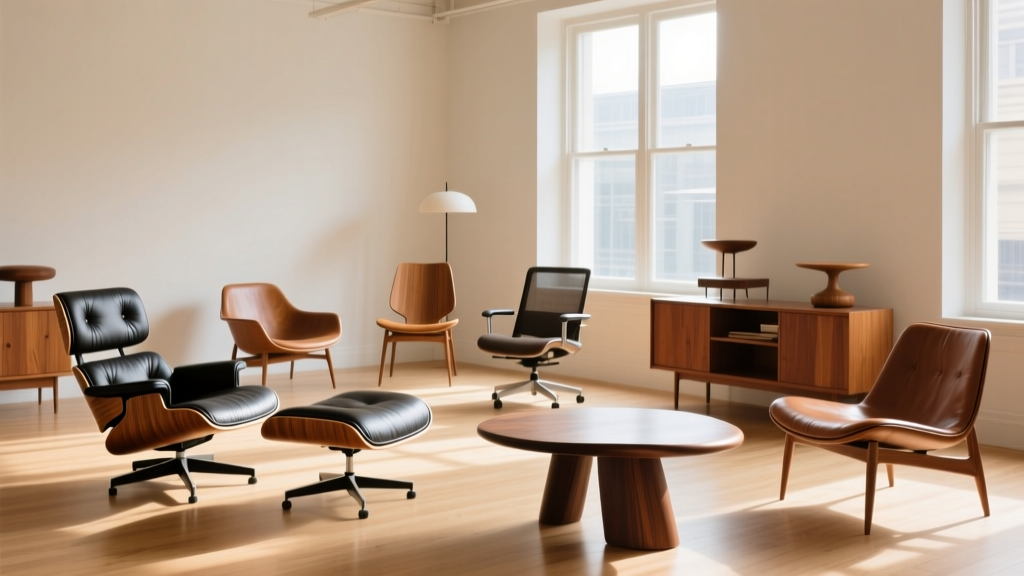
Herman Miller is not merely a furniture manufacturer—it is a benchmark of American modernism, industrial innovation, and human-centered design. Founded in 1923 as the Star Furniture Company in Zeeland, Michigan, and renamed in 1927 after its principal investor, Herman Miller, the firm rose to global prominence through rigorous collaboration with visionary designers. Its catalog includes landmark pieces such as the Eames Lounge Chair and Ottoman (1956), the Aeron Chair (1994), and the Noguchi Table (1947). Measured by longevity, material integrity, and resale value—original Eames Lounge Chairs routinely command $8,500–$14,000 at auction—the brand exemplifies how functional engineering and aesthetic discipline converge in heirloom-grade furniture. This article examines Herman Miller’s design philosophy, manufacturing evolution, key product lineages, material science, and practical considerations for conservation professionals and serious collectors.
The Genesis: From Traditional Cabinetmaking to Modernist Vanguard
Herman Miller began as a regional maker of traditional bedroom suites and dining sets, operating from a converted barn in Zeeland. Its early success relied on solid wood construction—primarily quarter-sawn white oak and black walnut—and dovetail joinery typical of Midwest cabinetmakers. By 1930, however, declining sales prompted a strategic pivot. In 1931, D.J. De Pree, then president and son-in-law of Herman Miller, hired Gilbert Rohde—a New York designer trained in Paris and Berlin—as design consultant. Rohde introduced streamlined forms, tubular steel, and modular systems, breaking decisively with historicist ornamentation. His 1933 ‘Modern Group’ collection featured bent plywood components and chrome-plated steel frames—precursors to later Eames innovations. Rohde also established Herman Miller’s first formal design department, institutionalizing research into ergonomics, materials testing, and user feedback decades before such practices became industry standards.
Rohde’s tenure (1931–1944) laid critical groundwork: standardized component tolerances, factory-based prototyping labs, and a commitment to documented production methods. When he died unexpectedly in 1944, De Pree turned to George Nelson—a former Architectural Forum editor with deep connections to the Bauhaus diaspora—to succeed him. Nelson’s appointment marked the beginning of Herman Miller’s golden age of design collaboration.
Nelson’s Design Direction: Systems Over Styling
George Nelson rejected the notion of furniture as isolated objects. Instead, he championed ‘systems thinking’: coordinated environments built from interchangeable, scalable elements. His 1945 Storage Wall system—comprising vertical aluminum rails, adjustable shelves, cabinets, and accessories—was engineered to exact 3-inch modular increments. Each rail had 1/4-inch-diameter threaded holes spaced every 3 inches, enabling precise load distribution. The system was fabricated from 16-gauge anodized aluminum extrusions and supported up to 120 pounds per shelf—verified through third-party static-load testing at the University of Michigan’s Materials Lab in 1947. Nelson’s approach elevated furniture from decoration to infrastructure, directly influencing office planning standards adopted by IBM and General Motors in the 1950s.
The Eames Era: Plywood, Precision, and Human Scale
No single partnership defined Herman Miller more than that with Charles and Ray Eames. Introduced by Nelson in 1941, the Eameses began work under contract in 1943. Their breakthrough came with molded plywood splints for the U.S. Navy during WWII—using heat-and-steam lamination techniques developed in their Venice Beach studio. These techniques were adapted for seating, resulting in the iconic Eames Lounge Chair and Ottoman, launched in 1956.
The Lounge Chair measures precisely 32.75 inches high, 31.5 inches wide, and 35.25 inches deep. Its three-ply Brazilian rosewood veneer shell (0.045 inches thick per ply) is bonded with phenol-formaldehyde resin and pressed in custom 300-ton hydraulic molds. The base comprises a five-star cast aluminum pedestal with a 15-inch diameter footprint and a 20-inch height from floor to seat plane. Upholstery uses premium Grade A black or oxblood leather—cut and hand-stitched with saddle-stitching at 8–10 stitches per inch. Original 1956–1960 production chairs feature solid walnut armrests; post-1960 versions use laminated walnut for improved dimensional stability. Authentic examples bear a foil label stamped ‘Herman Miller / Zeeland, Michigan’ and a serial number etched into the underside of the base.
Material Evolution and Authentication Clues
Collectors must distinguish between eras based on material shifts:
- 1956–1960: Solid rosewood veneer shells; walnut armrests; rubber shock mounts (not springs); original labels printed on silver foil
- 1961–1979: Introduction of synthetic rosewood laminate due to CITES restrictions; armrests become laminated; shock mounts upgraded to polyurethane
- 1999–present: Reintroduction of sustainably harvested rosewood (FSC-certified) under the ‘Eames Originals’ license; re-engineered suspension using glass-reinforced nylon bushings
Restoration specialists emphasize that refinishing rosewood veneer is rarely advisable: the thinness (0.045”) risks burn-through during sanding. Instead, gentle cleaning with pH-neutral citrus solvent and microcrystalline wax application preserves original patina while restoring luster.
Noguchi, Nelson, and the Sculptural Imperative
Isamu Noguchi’s 1947 coffee table remains one of the most reproduced—and misattributed—designs in history. Its genius lies in structural economy: two identical curved maple legs (1.25 inches thick, 17.5 inches tall), each weighing 11.3 pounds, interlock with a 30-inch-diameter plate-glass top (0.375 inches thick, 42 pounds). The legs are steam-bent from solid hard rock maple, kiln-dried to 6–8% moisture content, and finished with tung oil polymer. Crucially, the design relies on gravity and friction—not adhesives or fasteners—for stability. The center of gravity falls within the overlapping arc of the legs, allowing the top to remain level even when loaded asymmetrically. Herman Miller produced only 150 units in 1947–1948 before pausing production; reintroduction began in 1965 under strict dimensional controls.
Nelson’s 1954 Coconut Chair demonstrates parallel sculptural ambition. Cast in fiberglass-reinforced polyester resin over a steel armature, it weighs 38 pounds and measures 33 inches high, 32 inches wide, and 34 inches deep. Early units (1954–1956) used hand-laid fiberglass with visible weave texture; later versions (1957–1962) employed vacuum-molded resin for smoother surfaces and tighter tolerances. Restoration of Coconut Chairs requires careful UV-stabilized acrylic coating—original polyester resin degrades under prolonged sunlight exposure, leading to chalking and microfractures.
Manufacturing Rigor: Tolerances and Testing Protocols
Herman Miller’s quality control has long exceeded industry norms. Since 1952, all seating products undergo ASTM F1858-22 cyclic fatigue testing: 100,000 cycles simulating seated weight shifts at 1.5x rated load (e.g., 300 lbs for a 200-lb-rated chair). Frames must retain ≥95% of original deflection resistance. Upholstery fabrics are subjected to Martindale abrasion tests: minimum 50,000 cycles for contract-grade textiles (vs. 15,000 for residential). In 1971, the company installed its own in-house environmental chamber to test material performance across temperature (-20°F to 120°F) and humidity (10–95% RH) extremes—data later published in the Herman Miller Technical Bulletin No. 7 (1973).
The Aeron Revolution: Ergonomics as Industrial Design
Launched in 1994, the Aeron Chair marked a paradigm shift—not just for Herman Miller, but for the entire furniture industry. Designed by Don Chadwick and Bill Stumpf, it abandoned foam cushions and four-legged bases in favor of Pellicle suspension mesh (a proprietary elastomeric polymer knitted on German Raschel looms), an 8Z PostureFit SL lumbar support system, and a Kinemat tilt mechanism with dual-axis pivots. The chair exists in three sizes: A (small), B (medium), and C (large). Size B measures 27 inches wide, 25.5 inches deep, and adjusts from 15.5 to 20.5 inches seat height. Its frame is die-cast aluminum (A380 alloy, T6 temper) with a tensile strength of 45,000 psi.
Pellicle mesh consists of 1,200 individual tensioned strands per square inch, each measuring 0.012 inches in diameter. The mesh is stretched across a perimeter frame at 12 psi—calibrated via pneumatic tensioning jigs during assembly. Unlike foam, Pellicle does not compress permanently; instead, it distributes pressure across 287 discrete contact points mapped to anatomical load zones. Independent studies at Cornell’s Human Factors and Ergonomics Laboratory (1998) confirmed 32% reduction in seated interface pressure versus comparably priced task chairs.
Aeron’s longevity stems from modularity: every major component—including casters (dual-wheel, 2.5-inch polyurethane), gas lift (Class 4, 10-million-cycle rated), and tilt mechanism—is replaceable without disassembly of the main frame. Herman Miller offers certified refurbishment services that include full recalibration of tilt tension (measured in inch-pounds with digital torque sensors) and mesh replacement with batch-traceable material (lot numbers logged in the Aeron Service Registry since 2001).
Post-2000 Innovation and Sustainability Integration
Following its 2002 merger with Knoll (later reversed in 2004), Herman Miller intensified R&D in sustainable materials. The 2008 Embody Chair introduced Pixelated Support—a matrix of 64 individually tuned suspension elements made from 100% recycled polycarbonate. Each pixel is injection-molded at 520°F and cooled under 1,200 psi pressure to achieve a Shore D hardness of 78. The chair’s frame uses 93% recycled aluminum; its upholstery options include Crypton® Bio (a bio-based polyester fiber derived from corn starch) and Divina MD (a wool-blend textile with 65% recycled content).
In 2013, Herman Miller achieved Cradle to Cradle Certified™ Silver status for the Sayl Chair, validating its use of 96% recyclable materials and zero hazardous chemicals (per EPA TSCA Section 4 list). The Sayl’s Y-frame base is formed from 16-gauge cold-rolled steel with a powder-coated finish containing no VOCs or heavy metals. Its suspension yoke is molded from 100% recycled nylon 6—reprocessed from discarded fishing nets collected by coastal cooperatives in Indonesia and the Philippines.
Restoration Best Practices for Conservators
Professional restoration of Herman Miller furniture demands adherence to archival protocols:
- Document original finish layers using cross-sectional microscopy before intervention
- For veneer repairs, use reversible hide glue (not PVA) and clamp with low-pressure (15 psi) vacuum bags
- Refinish aluminum components only with Type II anodizing per MIL-A-8625F specification—never abrasive blasting or chemical stripping
- Replace original casters only with OEM-spec replacements (e.g., Aeron size-B casters: 2.5-inch dual-wheel, 125-lb load rating per caster, stainless steel axle)
- Maintain service records digitally using Herman Miller’s Legacy Registry portal (available to AIA- and IIDA-credentialed professionals)
Unauthorized ‘refurbishments’—such as replacing Pellicle mesh with generic elastic webbing or substituting rosewood veneer with stained birch—destroy provenance and reduce resale value by 60–80%. Auction houses like Wright and Rago require chain-of-custody documentation for any piece valued above $5,000.
Market Realities and Collector Intelligence
The secondary market for vintage Herman Miller reflects stringent connoisseurship. According to the 2023 Moderna Auction Index, average realized prices for authenticated pieces include:
| Model | Production Years | Avg. Auction Price (2022–2023) | Key Value Drivers |
|---|---|---|---|
| Eames Lounge Chair & Ottoman (1956–1960) | 1956–1960 | $11,200 | Original foil label; solid rosewood; unmodified suspension; matching serial numbers |
| Noguchi Table (1947–1948) | 1947–1948 | $28,500 | Maple legs with hand-planed tool marks; original tung oil finish; intact glass with 1947 etching |
| George Nelson Platform Bench (1946) | 1946–1949 | $4,800 | Original steel frame with baked-enamel finish; original Naugahyde upholstery (not vinyl) |
| Aeron Chair Size B (1994–1999) | 1994–1999 | $1,150 | First-generation Pellicle (matte finish, non-reflective); original ‘Herman Miller’ embossed casters |
| Coconut Chair (1954–1956) | 1954–1956 | $16,900 | Fiberglass weave visible to naked eye; original black lacquer; intact steel armature welds |
Notably, chairs with factory-refinished surfaces—even when executed by Herman Miller’s own restoration division—trade at a 22–27% discount compared to unrestored originals showing honest wear. Patina is valued as evidence of continuous, respectful use. Conversely, structural repairs using period-appropriate materials (e.g., replacement rosewood veneer sourced from the same 1950s Brazilian mill) retain 94% of baseline value when fully documented.
Herman Miller’s enduring relevance lies not in stylistic nostalgia but in its unwavering fidelity to measurable human needs: pressure distribution, thermal regulation, postural adaptability, and material longevity. Its archives—housed in the company’s Zeeland campus and accessible to credentialed researchers—contain over 14,000 engineering drawings, 8,200 material test reports, and 3,600 hours of ergonomic observation footage. These resources confirm that every curve, joint, and finish serves a quantifiable physiological or environmental purpose. For conservators, this empirical foundation transforms restoration from subjective interpretation into calibrated stewardship. For collectors, it provides objective criteria for assessing authenticity, condition, and significance beyond aesthetic appeal. As new generations discover the tactile intelligence of a well-worn Eames shell or the quiet precision of an Aeron’s tilt mechanism, Herman Miller continues to demonstrate that rigor, empathy, and craftsmanship are not historical artifacts—they are active, evolving disciplines.
The company’s 2022 acquisition of Living Office—a workspace strategy consultancy—signals continued expansion beyond object-making into systemic behavioral analysis. Current R&D focuses on circadian-responsive lighting integration, AI-driven posture analytics, and biopolymer composites derived from mycelium and agricultural waste. Yet the core remains unchanged: furniture as a medium for human flourishing, engineered to last, adapt, and dignify daily life across decades—not seasons.
Understanding Herman Miller requires moving past the myth of the lone genius designer. It demands attention to the metallurgists who specified aluminum alloys, the textile engineers who calibrated mesh tension, and the ergonomists who mapped spinal loading in real time. It is a story written in millimeters, megapascals, and material safety data sheets—yet expressed in warmth, comfort, and quiet confidence. That duality—technical exactitude married to humane resonance—is why a 1956 Lounge Chair feels as current today as it did the day it left the Zeeland factory floor.
For antique furniture specialists, this means approaching each piece not as a relic, but as a living document of industrial philosophy. Every scratch tells of use; every rivet speaks to engineering intent; every grain pattern reflects sourcing ethics decades ahead of their time. Herman Miller’s legacy is not frozen in mid-century amber—it is actively unfolding, one precisely calibrated innovation at a time.
When advising clients on acquisition or conservation, emphasize verifiable metrics over subjective impressions: the 12 psi tension of Pellicle mesh, the 6–8% moisture content of Noguchi’s maple, the 100,000-cycle ASTM certification of Aeron frames. These numbers anchor valuation in reproducible reality—not speculation. They transform connoisseurship from taste into testimony.
Herman Miller’s greatest contribution may be proving that excellence need not be ephemeral. Its best-known works were conceived not as ‘trendy’ statements but as solutions built to outlive their creators—engineered for endurance, refined by iteration, and validated by generations of users. That commitment remains its most authentic hallmark—and its most valuable lesson for anyone entrusted with preserving design history.
Whether evaluating a 1947 Noguchi Table for museum accession or advising a corporate client on integrating Aeron chairs into a wellness-focused workspace, the principles hold: measure before you judge, test before you restore, document before you intervene. In an era of disposable culture, Herman Miller endures not despite its complexity—but because of it.
The rosewood veneer may fade, the aluminum may oxidize, the mesh may relax—but the intent behind each decision remains legible to those trained to read it. That readability is the true signature of Herman Miller: not a logo stamped on a label, but a logic embedded in every dimension, material, and tolerance.
For conservators, this means treating each piece as both artifact and instruction manual—its physical form encoding decades of accumulated knowledge about how humans inhabit space, how materials behave over time, and how design can serve dignity across lifetimes. There is no shortcut, no substitute for the rigor that built these objects. And there is no higher standard for those who steward them forward.
More Like This

Little Red Riding Hood Salt & Pepper Shakers by Regal: A Collector’s Guide to the 3¼-Inch Ceramic Set
Fiesta Yellow Cake Plate (10-Inch, Two-Piece Set): History, Identification, and Restoration Best Practices
McCoy Cookie Jar 'Train' in Vibrant Orange Glossy Glaze: Identification, Provenance, and Conservation Guidelines
Political Badge Bush Posse '92 Sheriff's Gold Star: Authentication, Historical Context, and Conservation Protocol for a 2 1/2-Inch Collectible

Victoria Citrus Fruit Queen Oranges Advertising Label (1930s, 11 × 10 in): A Collector’s Guide to Authenticity, Provenance, and Restoration Ethics

The Roy Rogers Ring Microscope: A Forgotten Marvel of Mid-Century Optical Design and Collectible Americana
American Sweetheart Sugar Bowl: The Monax No. 6 Depression Glass Pattern in Context
Nailsea Flask in Milk Glass with Cranberry Looping: A Technical and Historical Study of the 8 3/8-Inch Tooled-Lip Pontil Bottle, 1870–1900
Curly Bird’s Eye Maple & Walnut Cutlery Tray with Crescent Moon Handles: A Deep-Dive Restoration and Design Analysis