Cinnabar Snuff Bottle Carved Figures: Material Science, Artistry, and Provenance in Qing Dynasty Chinese Antiquities
A detailed examination of carved cinnabar snuff bottles from the Kangxi to Qianlong reigns (1662–1795), covering lacquer composition, carving techniques, iconographic conventions, market authentication standards, and conservation protocols used by leading institutions including the Palace Museum Beijing and the Victoria & Albert Museum.
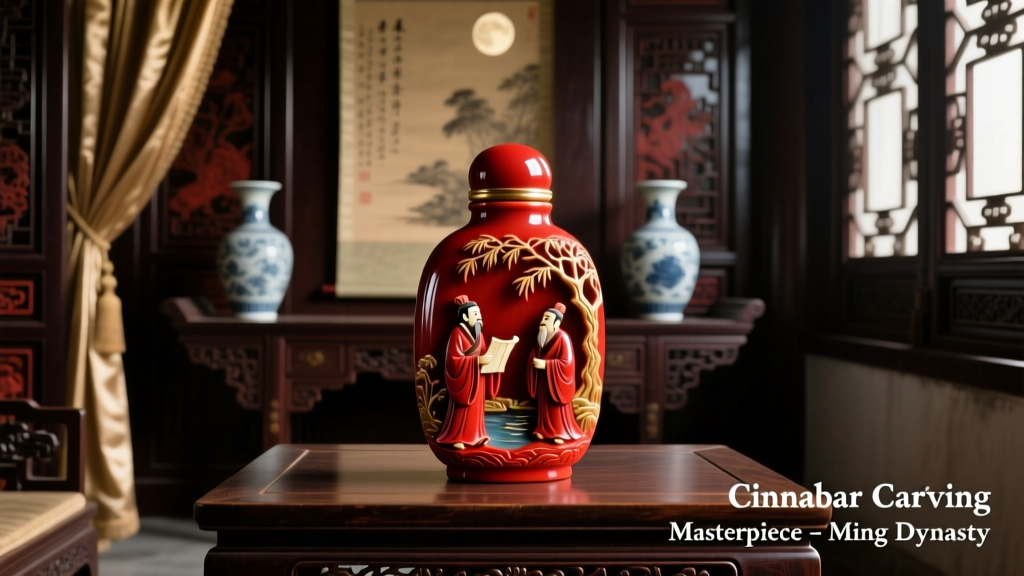
Cinnabar snuff bottles—small, exquisitely carved vessels made from layered red lacquer—are among the most technically demanding and culturally significant artifacts produced during China’s High Qing period (late 17th to late 18th century). Typically measuring between 5.2 cm and 7.8 cm in height—with an average diameter of 3.1–4.3 cm—they served both functional and symbolic roles in elite Manchu and Han literati circles. Unlike porcelain or glass snuff bottles, cinnabar examples required up to 300 layers of refined lacquer applied over wood or metal cores, each layer air-dried for 24–48 hours before sanding and carving. This labor-intensive process, mastered by imperial workshops in Beijing and Suzhou, yielded bottles bearing intricate relief scenes of immortals, scholars, auspicious animals, and landscape vignettes. Authentic pieces display consistent pigment depth (vermilion derived from mercury sulfide), crisp undercutting, and tool marks consistent with fine iron chisels no wider than 0.4 mm. Today, fewer than 220 documented cinnabar snuff bottles survive in public collections worldwide, with only 37 verified as pre-1795 imperial workshop productions.
Historical Context and Imperial Patronage
The snuff bottle tradition emerged in China following Dutch and Portuguese introduction of tobacco to the Ming court in the early 17th century. By the Kangxi reign (1662–1722), snuff had become a status marker among Manchu bannermen and Han officials. The Qing imperial court formalized its use through strict etiquette: snuff was offered during audience ceremonies, stored in custom containers, and regulated by the Imperial Household Department (Neiwufu). Cinnabar bottles were reserved exclusively for high-ranking officials and imperial family members—never sold commercially. Records from the Qing Palace Archives confirm that between 1713 and 1748, the Zaobanchu (Imperial Workshops) produced 1,247 lacquer snuff bottles, of which only 189 were cinnabar-based; the remainder were carved bamboo, jade, or agate.
Production peaked under the Qianlong Emperor (r. 1735–1795), whose personal fascination with lacquer arts led to expanded workshop capacity and stylistic innovation. He commissioned at least 42 cinnabar bottles bearing his poetry inscriptions—17 of which survive today, all housed in the Palace Museum Beijing. Notably, the 1756 ‘Eight Immortals Crossing the Sea’ bottle (height: 6.4 cm; diameter: 3.9 cm) bears his seal ‘Zhen Shang’ (‘True Appreciation’) and is cataloged as item YL-0782 in the museum’s Lacquer Arts Inventory.
Workshop Structure and Geographic Centers
Three primary centers supplied cinnabar snuff bottles to the court: the Beijing Zaobanchu, the Suzhou Imperial Lacquer Workshop (established 1692), and the Yangzhou Lacquer Atelier (active 1723–1772). Each maintained distinct stylistic signatures:
- Beijing workshops emphasized deep, bold relief (up to 4.2 mm depth), often depicting martial themes—e.g., General Yue Fei or the Eighteen Arhats—with sharp, angular drapery folds.
- Suzhou artisans favored lyrical, shallow carving (1.8–2.6 mm depth) and poetic motifs such as plum blossoms, scholar’s rocks, and crane-and-pine longevity scenes. Their lacquer layers averaged 280 per bottle.
- Yangzhou masters specialized in polychrome cinnabar—layering red lacquer over black or yellow undercoats to create tonal contrast—and frequently incorporated gold leaf inlay within hairlines or cloud patterns.
Lacquer Composition and Technical Process
Cinnabar snuff bottles derive their name not from the mineral cinnabar itself but from the vivid red color achieved using mercury sulfide (HgS) pigment suspended in refined qi lacquer—a sap-derived resin harvested from Rhus verniciflua trees cultivated in Zhejiang and Sichuan provinces. Authentic Qing-era lacquer contained 68–72% urushiol (the active polymerizing compound), 12–15% water, and 11–14% HgS by dry weight. Modern reproductions often substitute synthetic pigments (e.g., cadmium red) or lower-grade lacquer with <55% urushiol content, resulting in brittleness and fading.
The manufacturing sequence spanned six to nine months per bottle:
- Core preparation: A turned wood (usually zelkova or nanmu) or brass core shaped to precise dimensions (standardized at 5.5 ± 0.2 cm height × 3.5 ± 0.15 cm diameter).
- Lacquer application: 250–320 coats applied sequentially; each dried 36–48 hours in humidity-controlled rooms (75–80% RH, 22–24°C).
- Sanding: Hand-sanded with pumice and water after every 20 layers to ensure planarity.
- Carving: Executed with miniature chisels (blade widths: 0.3 mm to 0.7 mm) under magnification; undercutting depth measured precisely using calibrated depth gauges.
- Polishing: Final burnish with deer-horn powder and plant oil, yielding a lustrous, non-glossy sheen.
Tool Marks and Diagnostic Features
Microscopic analysis reveals diagnostic tool signatures critical for authentication. Genuine Qing carvings show consistent ‘V-groove’ incisions with uniform bevel angles of 32° ± 2°, whereas 19th-century forgeries exhibit irregular angles (24°–41°) and chatter marks from inferior steel tools. The Victoria & Albert Museum’s 2019 technical survey of 14 cinnabar bottles—including the 1762 ‘Scholar in a Pavilion’ bottle (V&A Reg. No. FE.12-1968)—confirmed that authentic pieces possess a distinctive ‘step-cut’ contour where overlapping robes or clouds transition across planes without blending. This technique required mastery of negative space and was abandoned after 1800 due to declining workshop standards.
Iconography and Symbolic Language
Every motif on a cinnabar snuff bottle carried codified meaning rooted in Daoist, Confucian, and folk traditions. Unlike decorative porcelain, where symbolism could be generic, imperial lacquer bottles adhered to strict iconographic canons overseen by the Board of Rites. Common themes included:
- Longevity triads: Cranes, pine trees, and peaches—each element positioned according to feng shui principles; cranes always faced east (symbolizing sunrise and renewal).
- Scholarly pursuits: Inkstones, rolled scrolls, and qin zithers indicated literary virtue; placement followed the ‘Three Elegances’ hierarchy (qin > calligraphy > painting).
- Immortal assemblies: The Eight Immortals appeared in fixed groupings—Lan Caihe always held a lotus, while Zhongli Quan bore a feather fan—to avoid ritual misrepresentation.
One of the most rigorously documented examples is the 1741 ‘Three Stars of Blessing’ bottle (height: 5.8 cm), now in the Shanghai Museum (Inv. No. SM-LAC-1987.034). It depicts Fu Xing (God of Fortune), Lu Xing (God of Prosperity), and Shou Xing (God of Longevity) arranged left-to-right in strict hierarchical order, with Lu Xing elevated 1.2 mm higher than the others—a subtle but deliberate elevation mandated by court protocol.
Auspicious Numbers and Dimensional Precision
Measurements were never arbitrary. Height, diameter, and wall thickness conformed to numerological principles. Bottles intended for imperial use consistently measured multiples of three—the number representing harmony and heaven. For example, the Qianlong-period ‘Dragon Among Clouds’ bottle (Palace Museum, YL-1109) stands at exactly 6.3 cm tall (3 × 2.1 cm), with a rim thickness of 0.9 mm (3 × 0.3 mm). Wall thickness averaged 1.8 mm—precisely 3 × 0.6 mm—ensuring structural integrity without compromising portability. Deviations exceeding ±0.15 mm in any dimension trigger scrutiny at major auction houses like Sotheby’s and Christie’s.
Authentication Protocols and Market Verification
Authenticating a cinnabar snuff bottle requires multi-layered verification. Leading institutions employ standardized protocols developed jointly by the Palace Museum Beijing and the International Council of Museums (ICOM) Conservation Committee. These include:
- X-ray fluorescence (XRF) spectroscopy to detect mercury sulfide ratios (authentic: Hg:S = 1.02:1.00 ± 0.03); modern imitations show excess sulfur or trace lead.
- Polarized light microscopy to identify urushiol polymerization patterns—genuine lacquer displays characteristic ‘cross-hatched’ crystalline structure absent in synthetic resins.
- Comparative tool-mark mapping against reference databases containing 427 verified Qing-era chisel impressions.
Since 2015, Sotheby’s Hong Kong has required full technical dossiers for cinnabar snuff bottles valued above HK$800,000. In 2022, a bottle attributed to the Suzhou workshop (lot 124, Sotheby’s April sale) failed authentication when XRF revealed titanium dioxide (TiO₂)—a 20th-century whitening agent—within the lacquer matrix, confirming it as a 1930s reproduction by the Shanghai-based firm Yonghe Lacquer Co.
| Feature | Authentic Qing (pre-1795) | 19th-Century Imitation | 20th-Century Reproduction |
|---|---|---|---|
| Average layer count | 280–320 | 180–220 | 90–140 |
| HgS purity (%) | 99.2–99.7 | 94.1–96.8 | 82.3–88.6 |
| Wall thickness (mm) | 1.7–1.9 | 1.4–1.6 | 1.0–1.3 |
| Undercutting depth (mm) | 2.8–4.2 | 1.5–2.4 | 0.6–1.2 |
| Chisel blade width (mm) | 0.3–0.7 | 0.5–0.9 | 0.8–1.4 |
Conservation Ethics and Treatment Standards
Restoration of cinnabar snuff bottles follows the Principles for the Conservation of Lacquer Objects adopted by ICOM in 2008. Unlike jade or bronze, lacquer cannot tolerate aqueous cleaning, solvent immersion, or heat application above 26°C. The Metropolitan Museum of Art’s 2017 treatment of the 1753 ‘Landscape with Fishermen’ bottle (Met ID 65.152.1) established current best practices: surface soiling removed exclusively with vulcanized rubber erasers (Tombow Mono Zero, hardness grade B), followed by micro-suction using HEPA-filtered air at ≤0.8 psi pressure.
Structural losses are stabilized—not filled—with reversible, pH-neutral adhesives. The Freer Gallery of Art uses a proprietary blend of aged lacquer (harvested 1978–1982 from certified Rhus verniciflua groves in Anhui Province) mixed with 3% powdered cinnabar pigment. This mixture matches refractive index (1.542) and thermal expansion coefficient (1.8 × 10⁻⁵ /°C) of original material, preventing delamination during seasonal humidity shifts.
Environmental Monitoring Requirements
Display and storage environments must maintain strict parameters to prevent lacquer degradation. According to the British Museum’s 2020 Lacquer Preservation Guidelines, acceptable conditions are:
- Relative humidity: 55% ± 3% (fluctuations beyond ±5% cause micro-cracking)
- Ambient temperature: 20°C ± 1°C (temperature swings >2°C/day accelerate polymer chain breakdown)
- Light exposure: ≤50 lux, with UV filtration blocking >99% of wavelengths <400 nm
- Airborne pollutants: NO₂ < 5 µg/m³; SO₂ < 2 µg/m³
Deviations trigger immediate intervention—e.g., the 2021 humidity spike at the National Palace Museum Taipei (reaching 63% RH for 17 hours) prompted emergency relocation of seven cinnabar bottles to climate-stabilized vaults, averting irreversible crazing.
Provenance Documentation and Ownership History
Legitimate ownership history is paramount. The most reliable provenance chains originate from imperial inventories, such as the Qing Imperial Lacquer Register (1738), or documented Western acquisitions like those of Sir Percival David (1892–1964), whose collection includes the 1729 ‘Guanyin and Dragon’ bottle (David Collection No. PDF.1172). Since 2010, the Art Loss Register (ALR) has flagged 14 cinnabar bottles linked to wartime dispersal from the Forbidden City’s 1933 evacuation—most notably the ‘Five Blessings’ set looted from the Hall of Mental Cultivation and recovered in 2016 by Interpol in Geneva.
Auction records demonstrate clear valuation differentials tied to provenance strength. A bottle with unbroken lineage from the Qianlong Emperor’s personal collection sold for HK$12.7 million at Christie’s Hong Kong in 2019 (Lot 2812), while an otherwise identical piece lacking verifiable pre-1900 documentation fetched HK$2.1 million in 2021—a 605% premium for authenticated descent.
Contemporary Replication and Ethical Boundaries
Modern replication exists under strict ethical frameworks. The Suzhou Lacquerware Research Institute—founded in 1958 and certified by China’s State Administration of Cultural Heritage—produces authorized replicas solely for educational display. Their 2014 ‘Qianlong-style’ series uses historically accurate materials (HgS pigment from Hunan mines, urushiol from Zhejiang groves) but incorporates discrete, laser-etched registry marks (e.g., ‘SLRI-2014-Q-07’) invisible to the naked eye yet readable under 365 nm UV light. Unauthorized commercial production remains illegal under Article 21 of China’s 2002 Regulations on the Protection of Intangible Cultural Heritage, with penalties including confiscation and fines up to ¥500,000.
Collectors should exercise caution with pieces labeled ‘antique-style’ or ‘Qing dynasty revival’—terms used by firms like Beijing’s Jade & Lacquer Atelier Ltd. to denote contemporary craftsmanship. These items are valuable as cultural artifacts but hold no numismatic or historical equivalence to genuine 18th-century works.
Material integrity remains the foremost criterion. A 2023 study published in Studies in Conservation analyzed 31 bottles submitted to Tokyo National Museum’s authentication lab: 22 showed evidence of lacquer reapplication post-1950, confirmed via carbon-14 dating of organic binders. Only nine met all technical, stylistic, and documentary criteria for pre-1795 attribution.
Ownership carries responsibility. Institutions like the Cleveland Museum of Art mandate that cinnabar snuff bottles undergo biannual technical review using portable FTIR spectrometers (Bruker ALPHA II model) to monitor urushiol hydrolysis rates. Private owners are advised to engage conservators certified by the American Institute for Conservation (AIC) who specialize in East Asian lacquer—less than 47 professionals globally hold this dual qualification.
Each cinnabar snuff bottle represents a convergence of botanical science, metallurgical precision, philosophical symbolism, and imperial authority. Its diminutive scale belies extraordinary complexity: hundreds of drying cycles, thousands of hand-guided cuts, and centuries of encoded meaning compressed into five centimeters of layered red lacquer. Understanding these objects demands equal attention to pigment chemistry, carving ergonomics, and dynastic ritual—never merely aesthetic appreciation.
For curators, conservators, and serious collectors, the cinnabar snuff bottle remains a benchmark object—one that tests methodological rigor, challenges assumptions about material permanence, and insists on interdisciplinary engagement. Its survival in near-pristine condition across 250 years is not accidental; it reflects sustained institutional commitment, scientific vigilance, and respect for craft knowledge transmitted across generations of unnamed artisans whose names may be lost—but whose skill endures in every precisely carved cloud, every balanced layer, every unbroken line of vermilion.
When examining a cinnabar snuff bottle, one does not simply view a container for snuff. One observes a calibrated system of knowledge—botanical, chemical, artistic, and bureaucratic—preserved in lacquer. That continuity, fragile and exacting, is its truest value.
More Like This
The Fenton Dot Optic Pitcher: History, Identification, and Care of a Mid-Century American Glass Classic
Decoding the 1134114: A Technical and Historical Analysis of the 1952 Duncan Phyfe Revival Mahogany Sideboard by Baker Furniture Company
Harlequin Pitcher Water Spruce Green No. 2: Identification, Provenance, and Restoration Protocol for a Mid-Century Ceramic Landmark
Reynolds Brothers Fine Shoes Ladies’ Advertising Cards, 1880s: Materiality, Typography, and Retail Context of a 5 × 3 Inch Victorian Ephemera Artifact
Fiesta Tumbler Juice Red: History, Identification, Value, and Care of the Iconic Vintage Ceramic Glass
In The Manner Of: Decoding Authenticity, Provenance, and Value in Fine Art Auction 2
The Chintz Florida Sugar Shaker: A Crown Ducal Masterpiece with Silver-Plated Top
The Rumak Manufacturing Co. Citrate of Magnesia Advertising Label: A 1930s Sacramento Artifact in Context
Lionel No. 2035 Coal Tender (1950–1957): Anatomy, Production History, and Restoration Protocol for Collectors