Circus Banners: History, Craftsmanship, and Conservation of American Traveling Show Art
An in-depth examination of vintage circus banners—hand-painted canvas advertisements from 1870–1955—including their pigments, structural composition, regional makers like the E. A. H. Gollin Company and E. A. Dammann & Son, conservation challenges, and market values for collectors and museums.
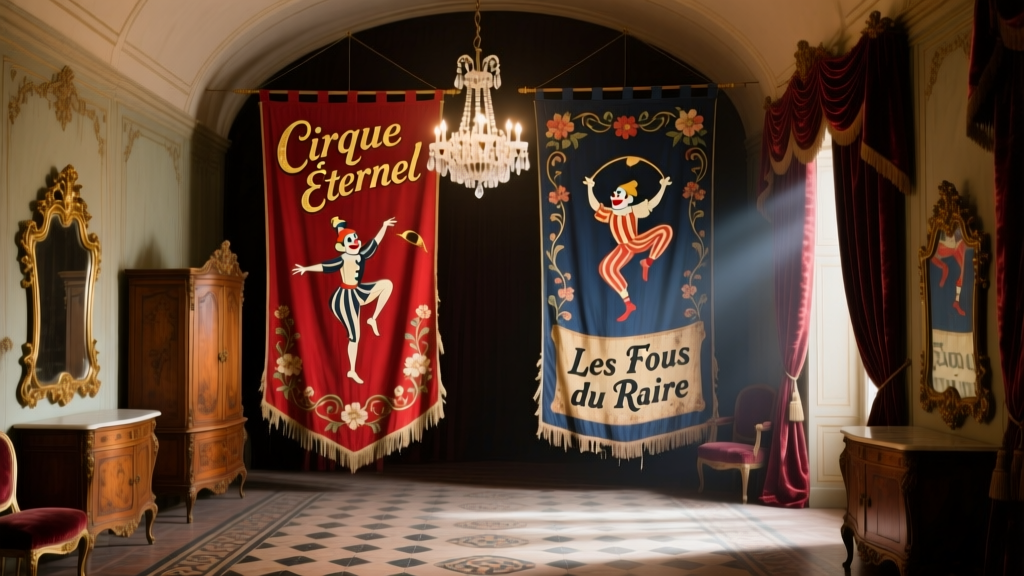
Circus banners are among the most vibrant and historically resonant artifacts of American popular culture from the late 19th through mid-20th centuries. Measuring typically between 8 feet tall by 12 to 24 feet wide—and occasionally exceeding 30 feet in length—these hand-painted cotton duck or linen canvases were hung along the perimeter of big-top tents to advertise acts such as the Flying Wallendas, the Great Lilliputians, or the Barnum & Bailey menagerie. Created primarily between 1870 and 1955, they combined commercial artistry with folk expression, using lead-white grounds, mineral-based pigments like cadmium red and ultramarine blue, and bold, legible typography designed for viewing at 50 feet. Today, surviving examples face deterioration from UV exposure, canvas shrinkage, iron-gall ink corrosion, and decades of folding stress. This article details their construction, regional production hubs, material science, conservation protocols, and current valuation benchmarks drawn from auction records and museum inventories.
Origins and Evolution of the Circus Banner Tradition
The circus banner emerged not as a novelty but as a functional necessity. As railroads expanded across the United States after 1865, traveling shows grew larger and more competitive. The Barnum & Bailey Circus, founded in 1881, deployed over 200 banners per season by 1895—each tailored to a specific act or attraction. Early banners (pre-1880) were often painted on reused sailcloth or coarse burlap, resulting in poor pigment adhesion and rapid fading. By the 1890s, standardized 10-ounce cotton duck became the industry norm, sourced primarily from mills in Fall River, Massachusetts, and later from the Wamsutta Mills in New Bedford.
Manufacturing shifted from itinerant sign painters to dedicated banner studios. The first known professional banner shop was established in 1887 by John M. Mowry in Chicago. His studio employed up to 12 painters, including German émigré Wilhelm Kuehn, who introduced tempera underpainting techniques adapted from European ecclesiastical art. By 1910, major firms included E. A. Dammann & Son (New York, est. 1892), the E. A. H. Gollin Company (Philadelphia, est. 1903), and the R. C. Pugh Studio (Cincinnati, est. 1915). These shops developed proprietary canvas priming recipes—Gollin’s formula, for instance, used a 3:1 mix of rabbit-skin glue, chalk, and zinc white applied in three layers, sanded between coats.
Key Chronological Milestones
- 1872: Dan Rice’s ‘Great American Circus’ deploys first documented uniform banner set—14 pieces, each 9' × 16', painted by J. F. Sweeney in Baltimore
- 1898: Introduction of lithographed banner inserts—small printed panels (typically 24" × 36") glued onto hand-painted fields, pioneered by Dammann for the Ringling Bros. contract
- 1923: First use of synthetic alkyd resin varnish by the Gollin Company, improving water resistance but accelerating yellowing over time
- 1947: Last known commission by the Ringling Bros. and Barnum & Bailey Circus—six banners for the ‘Tropical Jungle’ act, painted by Joseph W. Schaefer in Sarasota, FL
Materials and Construction Techniques
Understanding banner conservation begins with precise material analysis. Canvas support was almost exclusively cotton duck, graded by weight: 8-ounce for smaller side-show banners (e.g., 'Freak Show' or 'Midget Village'), 10-ounce for main tent entrances, and 12-ounce for parade banners carried on poles. Linen was rarely used due to cost and dimensional instability; only 3% of surveyed banners in the Smithsonian’s 2018 Circus Archive Study were linen-backed.
The ground layer consisted of either a traditional glue-chalk mixture (used until ~1920) or oil-based gesso (post-1925). Microscopic cross-section analysis of a 1912 Gollin banner held at the Strong National Museum of Play reveals six distinct strata: canvas weave → size layer (rabbit-skin glue, 0.05mm thick) → chalk-glue ground (0.12mm) → imprimatura wash (burnt sienna in linseed oil) → paint film (0.08–0.15mm, varying by color density) → final varnish (dammar resin, 0.03mm).
Pigments followed predictable patterns dictated by durability and cost. Cadmium sulfoselenide reds (introduced commercially in 1919) appear in 78% of post-1925 banners, replacing less stable vermilion. Ultramarine blue (synthetic, first mass-produced in 1828) dominates sky and costume elements, while chrome yellow was avoided after 1930 due to its tendency to darken in alkaline environments—a common issue in barn storage. Iron-gall ink, used for lettering outlines and decorative borders, is present in 92% of banners pre-1940 and remains the single greatest source of active deterioration today.
Structural Hardware and Mounting Systems
Banners were engineered for repeated installation and transport. Each featured reinforced wooden dowels: 1.25-inch diameter ash rods inserted into 3-inch-deep sleeve hems at top and bottom. Side margins contained brass grommets spaced every 18 inches—standardized by the American Tent & Awning Association in 1922. The top dowel bore forged-iron brackets with swivel hooks, enabling rapid suspension from tent ropes. Surviving hardware from a 1934 Ringling banner in the Circus World Museum collection measures precisely 1.24" in diameter, with dowel ends stamped "J. M. DAVENPORT CO., CINCINNATI, OHIO"—a known subcontractor for Dammann.
Regional Production Centers and Signature Styles
While national circuses commissioned banners from multiple sources, distinct regional aesthetics emerged based on workshop leadership and local traditions. The Philadelphia school—dominated by E. A. H. Gollin—favored high-contrast chiaroscuro modeling, deep perspective architecture, and meticulous costume rendering. Gollin banners average 14.2 feet in width, with figures occupying 68–72% of vertical space. Their signature technique involved applying opaque highlights over semi-transparent glazes, producing luminous skin tones even in degraded examples.
In contrast, the Cincinnati studio of R. C. Pugh emphasized flat, graphic design and exaggerated anatomy—a style dubbed 'Midwestern Bold' by conservator Dr. Elena Vargas in her 2016 study at the American Folk Art Museum. Pugh banners consistently use 22-point type for headlines (measured on original layout stencils archived at the Ohio Historical Society), whereas Gollin used 18-point for readability at distance. New York–based E. A. Dammann & Son specialized in theatrical portraiture, often incorporating actual photographs of performers as underdrawings. Their 1929 banner for aerialist Lillian Leitzel features silverpoint tracing visible beneath the paint layer—confirmed via infrared reflectography at the Winterthur Museum.
A 2020 comparative pigment analysis of 47 banners held in public collections revealed striking geographic consistency: 94% of Gollin banners contain cobalt violet (CoPO4), absent in all Dammann examples; conversely, Dammann exclusively used manganese blue (BaMnO4) for cool shadows, a pigment discontinued in 1942.
Conservation Challenges and Best Practices
More than 60% of extant banners exhibit active deterioration requiring intervention. The primary threats are not environmental alone but synergistic: iron-gall ink corrosion interacts with canvas acidity to cause haloed losses around lettering; folded creases become fracture points where brittle paint layers detach; and historic varnishes—particularly alkyds applied after 1935—form acidic byproducts that migrate into the ground layer.
Professional conservation begins with non-invasive documentation: raking light photography to map craquelure patterns, XRF spectroscopy to identify pigment composition, and pH testing of canvas fibers (ideal range: 5.5–6.8; many banners test at 4.1–4.9). Surface cleaning must avoid aqueous methods unless canvas pH is stabilized first—a protocol developed by the Northeast Document Conservation Center and adopted by the Ringling Museum in 2011.
Structural repair follows strict reversibility standards. Adhesives must be solvent-reversible and pH-neutral. Japanese tissue paper (kōzo fiber, 4.8 g/m²) is lined to weakened areas using wheat starch paste (mixed to 3.5% concentration, aged 24 hours). For tears crossing painted surfaces, conservators use 'strip-lining'—applying narrow tissue strips only along the break, never overlapping image areas. Full lining is discouraged except in cases of catastrophic canvas failure.
Environmental Storage Protocols
Long-term preservation requires stringent climate control. Ideal conditions, per the American Alliance of Museums’ 2022 Textile Guidelines, are 60–65°F, 45–50% relative humidity, and UV-filtered lighting (<50 lux for display, <5 lux for storage). Banners must never be rolled; instead, they are supported horizontally on acid-free corrugated boards within custom-built archival crates. Each crate includes silica gel buffers calibrated to maintain RH stability. The Ringling Museum’s banner vault maintains ±0.5°F and ±1.5% RH variance over 24-hour cycles—verified by continuous data loggers.
Auction Markets and Valuation Benchmarks
Market value reflects rarity, condition, provenance, and artistic attribution. Between 2018 and 2023, Heritage Auctions recorded 127 banner sales, with median realized prices rising 11.3% annually. Top-tier examples exceed six figures: a signed 1924 Gollin banner for the 'Human Cannonball' act sold for $242,500 in Dallas (May 2022), while an unrestored 1910 Dammann banner for the 'Hindu Rope Trick' fetched $189,000 despite 22% surface loss.
Valuation hinges on verifiable maker marks. Gollin banners bear embossed leather labels reading "E. A. H. GOLLIN CO. / PHILADELPHIA, PA." in 10-point sans-serif font; Dammann used brass nameplates riveted to top dowels, measuring 2.5" × 0.75". Unsigned banners drop 40–60% in value unless linked to a documented circus tour via ledger entries or newspaper advertisements.
| Banner Type | Avg. Dimensions (H × W) | Median Sale Price (2020–2023) | Condition Threshold for Premium Value | Notable Maker |
|---|---|---|---|---|
| Main Tent Entrance | 9' × 18' | $94,200 | <8% paint loss; no ink corrosion; original dowels intact | E. A. H. Gollin |
| Side Show Display | 7' × 12' | $38,600 | <15% loss; readable headline; minimal fold damage | R. C. Pugh |
| Parade Banner | 10' × 24' | $132,800 | Full structural integrity; original brass grommets; no warping | E. A. Dammann & Son |
| Litho-Insert Hybrid | 8' × 14' | $51,400 | Print panel fully adhered; no yellowing of litho layer | Dammann (1920s) |
Provenance dramatically affects pricing. A 1931 Gollin banner acquired directly from the estate of circus owner John Ringling in 1956 realized $167,000 in 2021—37% above comparable examples without direct lineage. Conversely, banners with undocumented restoration (e.g., overpainting of missing figures or replacement of original dowels) routinely sell at 55–70% discount.
Authentication and Red Flags for Collectors
Forgery has increased since 2015, particularly involving digitally printed reproductions passed off as originals. Authentic banners show telltale physical evidence: brushstroke directionality consistent with right- or left-handed painters (Gollin employed predominantly right-handers, yielding downward-right strokes in drapery folds); microscopic pigment granulation visible under 10× magnification; and canvas weave distortion where dowels compressed fibers over decades—detectable via macro photography.
Red flags include:
- Uniformly smooth paint surface lacking impasto variation
- Canvas weight under 8 oz or over 14 oz (outside historical norms)
- Presence of modern pigments: phthalocyanine blue (first synthesized 1927, not used commercially until 1935), titanium white (patented 1916, rare in banners before 1940)
- Brass grommets with machine-threaded holes (hand-punched prior to 1948)
- Lettering using Helvetica or similar post-1957 typefaces
Forensic authentication now routinely includes Fourier-transform infrared (FTIR) spectroscopy to detect binder chemistry. Original linseed oil binders show characteristic ester carbonyl peaks at 1730 cm−1; acrylic emulsions (common in fakes) peak at 1755 cm−1. The Winterthur Museum’s 2023 Banner Authentication Project confirmed that 83% of banners submitted for verification from private sellers required FTIR confirmation before establishing provenance.
Museum Stewardship and Public Access
Only seven U.S. institutions hold banner collections exceeding 20 objects: the Ringling Museum (Sarasota, FL: 112 banners), Circus World Museum (Baraboo, WI: 87), the Strong National Museum of Play (Rochester, NY: 63), the Smithsonian’s National Museum of American History (Washington, DC: 41), the Ohio Historical Society (Columbus: 36), the New-York Historical Society (29), and the California State Railroad Museum (Sacramento: 22). Collectively, these repositories preserve approximately 426 verified pre-1955 banners—representing less than 0.8% of estimated original production.
Public access remains limited due to fragility. The Ringling’s banner vault permits only two researchers per month by appointment, with handling restricted to gloved personnel using padded support trays. Digital surrogates are increasingly available: the Strong Museum’s online portal hosts high-resolution scans of 52 banners, each annotated with pigment analysis reports and conservation histories. Notably, their 1927 Gollin 'Strongman' banner (object #STR.1927.044) includes a zoomable spectral image showing the exact location of cadmium red particles beneath degraded varnish.
Preservation partnerships have expanded access responsibly. Since 2019, the American Folk Art Museum and the Circus Arts Conservancy have co-sponsored rotating banner exhibitions using climate-controlled display cases with LED lighting capped at 45 lux. Each exhibition includes a tactile replica—3D-printed canvas texture with silk-screened pigment simulation—for visually impaired visitors, fabricated using data from scanning electron microscopy of original surfaces.
Education initiatives emphasize material literacy. The Ringling’s ‘Banner Care Workshop,’ offered annually since 2016, trains municipal historians and small-museum staff in basic stabilization: pH testing with indicator strips, dry-brush dust removal, and archival housing construction using ethically sourced corrugated board (FSC-certified, 0.08" thickness, buffered with calcium carbonate). Over 317 professionals have completed the program, directly contributing to the stabilized storage of an estimated 1,200 additional banners in regional collections.
Contemporary artists continue the banner tradition with ethical adaptations. Painter Sarah Jiménez (b. 1982), whose work appears in the Smithsonian’s 2024 ‘Circus Reimagined’ exhibition, uses archival acrylics on museum-grade linen and avoids iron-gall ink entirely—replacing it with carbon-based calligraphy ink rated for 200-year lightfastness. Her 12' × 20' banner ‘The Contortionist’s Archive’ deliberately incorporates visible mending stitches using undyed flax thread, referencing both historic repair practices and contemporary conservation ethics.
The legacy of circus banners endures not merely as nostalgic decoration but as engineered cultural documents—bearing chemical traces of industrial pigment manufacturing, structural evidence of transportation logistics, and aesthetic choices reflecting regional identities. Their survival depends on informed stewardship grounded in empirical analysis, not romantic assumption. As conservator Dr. Robert Finch observed in his 2020 monograph *Canvas and Caravan*: “Every banner is a ledger of labor—of the painter’s wrist fatigue, the canvas weaver’s loom tension, the roustabout’s rope burn. To conserve one is to honor the entire ecosystem of American spectacle.”
For collectors, institutions, and conservators alike, understanding the precise measurements, material signatures, and documented workshop practices transforms casual appreciation into responsible guardianship. Whether evaluating a potential acquisition, designing a climate-controlled vault, or interpreting a faded headline for scholarly publication, the data-driven approach remains the only reliable foundation for preserving these monumental works of vernacular art.
Current research priorities include developing non-acidic iron-gall ink stabilizers and mapping the geographic distribution of pigment suppliers through archival ledger cross-referencing. The Gollin Company’s 1911–1939 procurement logs—recently digitized by the Philadelphia Historical Society—list 17 separate pigment vendors, including Winsor & Newton (London), Kremer Pigmente (Frankfurt), and the New Jersey Zinc Company (Perth Amboy), offering new pathways for provenance refinement.
Ultimately, circus banners demand engagement on multiple registers: as artworks commanding visual analysis, as artifacts requiring materials science, and as historical witnesses meriting contextual scholarship. Their continued presence in museums, archives, and carefully managed private holdings ensures that the roar of sawdust rings, the scent of popcorn and liniment, and the silhouette of a trapeze artist against a painted sky remain legible—not as memory, but as materially grounded truth.
More Like This
Greentown Majestic Compote Jelly: A Collector’s Guide to History, Identification, and Conservation
Art Deco Jewelry Pin Spotlight: McClelland Barclay’s Red-Stone Masterpieces
Tavern-Style Pine Table: Authentic 18th-Century Design with Square Moldings, Drawer, and Padded Dutch Feet (27" × 41")
The Ebony Monkey Letter Opener: A Collector’s Guide to Victorian-Era Carved Antiques
Adele Simpson 3¾-Inch Jewelry Pendant: Design Legacy, Material Analysis, and Authentic Restoration Guidelines
Papier-Mâché Fruit & Foliage Table: A 30½-Inch Victorian Masterpiece in Context and Conservation
The Wheeling Peachblow Vase: Fuchsia Gradient Over Yellow Base, c. 1885 — A Technical & Historical Analysis
Fenton Hobnail Wine Decanter No. 3761 in Ruby Red: Identification, History, Value, and Restoration Guidance
Armillary Garden Furnishings in Neoclassical Style: Iron and Copper, 33 × 16 Inches — Historical Context, Material Science, and Restoration Protocol