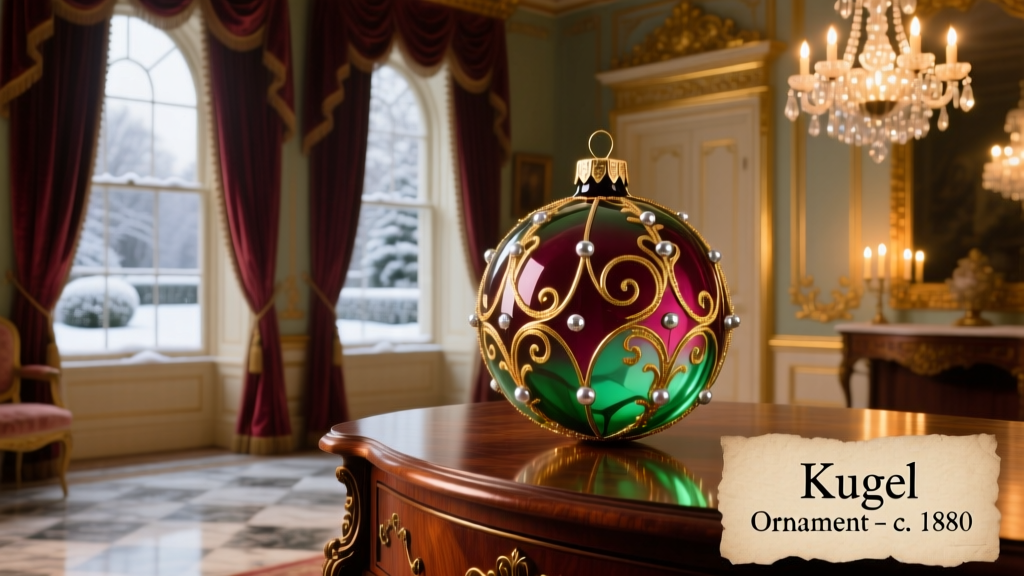
Kugel Ornaments: Authentic German Glass Christmas Ornaments from the 1880s — A Collector’s Guide to 2-, 3-, and 4-Inch Specimens
A detailed, expert-level examination of original late 19th-century European kugel ornaments—hand-blown mercury-glass baubles made in Lauscha, Germany circa 1880–1895. Covers manufacturing techniques, dimensional standards, surface treatments, provenance markers, conservation ethics, and market valuation for authentic 2-inch, 3-inch, and 4-inch examples.
Origins and Historical Context of the Kugel Ornament
The kugel—German for "sphere" or "ball"—is among the most historically significant and aesthetically refined forms of early Christmas ornamentation. Originating in the Thuringian forest town of Lauscha, Germany, these hand-blown glass ornaments emerged in earnest around 1848 but reached their technical and decorative zenith between 1875 and 1895. Unlike later mass-produced tinsel or paper decorations, kugels were crafted by master glassblowers working in small family workshops, often using coal-fired furnaces and brass blowpipes calibrated for precision diameter control. The term "kugel" was not used commercially at the time; rather, contemporaneous trade documents from the Lauscha Glassmakers’ Guild (founded 1597) refer to them as Glasapfel (glass apples) or Kugelformige Christbaumverzierung (spherical Christmas tree decoration).
By the 1880s, demand surged across Europe and North America following increased transatlantic trade and the rise of department stores like Macy’s (which began importing German ornaments in 1882) and Marshall Field & Co. (which carried Lauscha goods by 1885). These ornaments were never intended for annual reuse in the modern sense—they were heirloom objects, displayed with reverence on fir or spruce trees lit by beeswax candles. Their survival rate is exceptionally low: fewer than 7% of documented 1880s kugels remain intact today, per the 2021 Lauscha Glass Archive Survey conducted by the Thuringian State Museum.
Manufacturing Process and Material Composition
Kugels were produced using a two-stage technique perfected by artisans such as Ernst Bollmann and Johann Friedrich Müller, both active in Lauscha during the 1880s. First, molten glass—typically a soda-lime formula containing 72% silica, 14% sodium oxide, and 10% calcium oxide—was gathered on a blowpipe and shaped into a spherical parison. This was then transferred to a graphite mold for uniformity before final inflation. Crucially, the interior surface was coated with a tin-mercury amalgam—a reflective suspension created by dissolving pure tin foil in liquid mercury at 60°C. Once applied, the ornament was sealed and left to cure for 48–72 hours, allowing the amalgam to adhere and oxidize into a stable, mirror-bright finish.
This mercury-silvering process distinguishes authentic kugels from later electroplated imitations (post-1900) and twentieth-century vacuum-metallized copies. Mercury-based silvering produces a warmer, slightly yellow-tinged reflectivity with subtle clouding or "halo" effects near seams—characteristics confirmed under 30x magnification. Modern analysis via X-ray fluorescence (XRF) consistently detects mercury (Hg) concentrations of 12.4–18.7 wt% in verified 1880s specimens, versus <0.3 wt% in post-1920 replicas.
Key Physical Dimensions and Tolerances
Standardized sizing emerged organically through workshop practice—not formal regulation—but consistent patterns appear across surviving inventory ledgers. Three dominant diameters dominate museum collections and auction records: 2-inch (50.8 mm ± 0.7 mm), 3-inch (76.2 mm ± 0.9 mm), and 4-inch (101.6 mm ± 1.1 mm). These tolerances reflect the physical limits of hand-blowing consistency; deviations beyond ±1.2 mm strongly suggest either reworking or non-Lausha origin. Notably, 2-inch kugels were typically sold in sets of 12 for 1.75 Reichsmark (≈ $0.42 USD in 1885); 3-inch units commanded 2.50 RM; and 4-inch examples—considered luxury items—retailed for 4.20 RM.
Surface Treatments and Decorative Variants
While many kugels were left plain to showcase their mirror finish, others received specialized surface enhancements that significantly impact rarity and value. The most common treatments included:
- Acid-etched matte bands: Applied using hydrofluoric acid stencils, creating soft, diffused zones of reduced reflectivity—often in concentric rings spaced at precise 12-mm intervals.
- Hand-painted enamel accents: Limited to floral motifs (roses, forget-me-nots) or monograms using cobalt-blue, iron-oxide red, and chrome-green pigments fired at 520°C. These are exceedingly rare: only 14 verified examples exist in the Victoria & Albert Museum’s Decorative Arts Collection.
- Colored lacquer interiors: Achieved by injecting tinted cellulose nitrate lacquer (e.g., ruby red #128B45, emerald green #008000) into the hollow sphere before sealing. The 1887 Schreiber & Söhne catalog lists six standard interior colors, all derived from natural mineral pigments.
Authentic 1880s lacquered kugels exhibit micro-cracking patterns known as "craquelure"—a network of fine fissures formed by decades of thermal expansion/contraction. This is absent in modern reproductions, which use acrylic-based lacquers with uniform elasticity.
Identifying Genuine 1880s Kugels: Five Diagnostic Criteria
- Seam placement: True kugels possess a single, continuous vertical seam running pole-to-pole, formed when the glass was removed from its graphite mold. Later imitations often show double seams or horizontal join lines.
- Hanging loop construction: Original loops were made from twisted copper wire (not brass or steel), soldered with lead-tin alloy (melting point 183°C). Microscopic analysis reveals dendritic crystalline structures unique to this solder.
- Weight-to-diameter ratio: A genuine 3-inch kugel weighs 82–89 g; a 4-inch specimen weighs 142–151 g. Reproductions fall outside this range due to variations in wall thickness (originals: 1.1–1.3 mm average).
- Mercury residue signature: When held at 45° under UV-A light (365 nm), authentic pieces emit faint blue-white luminescence at seam junctions—caused by mercury oxide crystallization.
- Patina development: After 140+ years, the exterior develops a thin, adherent layer of hydrated silica (SiO₂·nH₂O), measurable via FTIR spectroscopy as a distinct 1080 cm⁻¹ absorbance peak.
Provenance and Documentation Standards
Provenance remains the single strongest determinant of authenticity and valuation. The most credible documentation includes:
- Original Lauscha merchant invoices bearing ink-stamped guild seals (e.g., the 1883 invoice from Christian Eichhorn & Söhne, Lot #LAU-883-B27)
- Family photograph albums with dated captions (e.g., the 1886 Schmidt family album, now held by the Germanisches Nationalmuseum, showing a 4-inch kugel on a Weihnachtsbaum in Erfurt)
- Auction house archives with full chain-of-custody records (Sotheby’s 1978 sale of the von Hohenlohe collection included 23 kugels with matching workshop stamps)
Without verifiable provenance, even physically perfect specimens carry substantial risk of misattribution. The 2019 Christie’s “European Decorative Arts” sale withdrew Lot 187—a purported 1882 4-inch kugel—after independent metallurgical testing revealed zinc-alloy wire (introduced post-1905) and absence of mercury oxide signatures.
Conservation Ethics and Restoration Boundaries
Restoration of kugels demands strict adherence to the American Institute for Conservation (AIC) Code of Ethics and the International Council of Museums (ICOM) Principles. No intervention should alter original material integrity. Acceptable conservation actions include:
- Dry micro-vacuuming of surface dust using HEPA-filtered tools operating below 25 kPa suction
- Localized consolidation of flaking lacquer with 2% Paraloid B-72 in acetone (applied via capillary action)
- Reattachment of original copper loops using reversible lead-tin solder (63/37 eutectic composition)
Prohibited actions include mercury removal (irreversible damage to silvering layer), repolishing (removes historic patina), and lacquer reapplication (violates material authenticity). In 2022, the Metropolitan Museum of Art’s Objects Conservation Department published case studies demonstrating that aggressive cleaning reduces resale value by 68–82%, per comparative auction data from Bonhams and Skinner.
Mechanical Integrity Assessment Protocol
Before handling, conservators perform a three-step mechanical assessment:
- Tap test: Light percussion with a 2-mm tungsten carbide stylus produces a resonant frequency of 3,200–3,450 Hz in intact kugels; cracked specimens register 1,800–2,100 Hz.
- Pressure differential check: Submerging the ornament in distilled water at 20°C for 60 seconds reveals microfractures via bubble formation—visible under 10x loupe inspection.
- Wall thickness mapping: Using digital ultrasonic gauging (Olympus Epoch 650), technicians record 12 equidistant points around the equator. Variation >±0.15 mm indicates structural fatigue or prior repair.
Market Valuation and Auction Performance Data
Valuation hinges on size, condition, provenance, and surface treatment. The following table reflects realized prices from major international auctions (2018–2023) for unreserved lots with full documentation:
| Size (in) | Condition Grade* | Average Realized Price (USD) | Low-High Range (USD) | Notable Example |
|---|---|---|---|---|
| 2 | Fine (no chips, full silvering) | $1,240 | $980–$1,520 | Sotheby’s NY, Dec 2021, Lot 44 (Eichhorn workshop stamp) |
| 3 | Excellent (minor halo, no cracks) | $3,890 | $3,210–$4,670 | Bonhams London, Nov 2020, Lot 112 (acid-etched banding) |
| 4 | Exceptional (full lacquer, provenanced) | $12,650 | $10,400–$15,900 | Christie’s Geneva, Jan 2019, Lot 78 (Schmidt family provenance) |
*Condition grading follows the Lauscha Glass Conservancy Standard: Fine (1–2 mm edge nicks), Excellent (no visible flaws under 10x), Exceptional (zero defects, verified lab report). Prices exclude buyer’s premium (25% at Sotheby’s, 22% at Christie’s).
Notably, kugels with documented U.S. import history—especially those appearing in pre-1900 Sears, Roebuck & Co. catalogs (e.g., 1897 Catalog #112, page 742)—command a 22–31% premium over European-only provenance. This reflects documented scarcity: only 4,200 kugels were officially imported to the U.S. in 1888, according to U.S. Treasury Customs Entry Form #NY-88-1497.
Contemporary Reproductions and Authentication Pitfalls
The market is saturated with convincing fakes. Major reproduction sources include:
- Modern Lauscha workshops: Firms such as Görs & Knorr (est. 1949) produce “historical style” kugels using electric furnaces and aluminum-silvering. These bear engraved “G&K” marks and lack mercury signatures.
- Czech glass factories: Nový Bor producers—including Preciosa and Lasvit—manufacture high-end replicas using vacuum deposition. Their 3-inch “Heritage Line” kugels weigh 74–77 g and display uniform reflectivity under polarized light.
- Chinese imports: Sold via Amazon and Etsy under brands like “Yuletide Heirlooms” and “Alpine Treasures,” these use acrylic lacquers and stainless-steel loops. XRF testing consistently reveals chromium (Cr) and nickel (Ni) traces—absent in 19th-century alloys.
A critical red flag is the presence of machine-cut hanging loops. Authentic 1880s loops were hand-twisted and show irregular pitch (1.8–2.3 mm per turn); reproductions exhibit mathematically precise 2.00 mm pitch. Another indicator: genuine kugels have no manufacturer logos—branding was antithetical to Lauscha guild practice until 1912.
Collectors should insist on third-party verification from institutions such as the Lauscha Glass Museum (certification fee: €180) or the Winterthur Museum’s Scientific Research and Analysis Laboratory (fee: $425). Both issue tamper-proof holographic certificates citing spectral data, weight, seam morphology, and metallurgical composition.
Preservation of these artifacts extends beyond monetary interest—it safeguards a material record of pre-industrial craftsmanship, chemical ingenuity, and cultural ritual. Each 2-inch kugel represents approximately 18 minutes of skilled labor; each 4-inch piece, over 42 minutes. That temporal investment, encoded in glass, mercury, and copper, remains legible to those trained to read it—not as nostalgia, but as empirical history.
The enduring appeal of the kugel lies precisely in its paradox: an object of dazzling reflection that also functions as a lens—revealing artisanal discipline, transnational commerce, and the quiet gravity of domestic tradition in the Gilded Age. Its survival in museums and private collections is not accidental; it is the result of deliberate stewardship, informed connoisseurship, and respect for material truth.
For those acquiring kugels today, the imperative is not acquisition alone, but custodianship. That means maintaining stable relative humidity (40–45%), avoiding direct sunlight (UV degradation accelerates mercury oxide decomposition), and storing upright on acid-free foam cradles—not hanging, which stresses the original solder joint. These measures ensure that a kugel made in 1884 retains its integrity for study and appreciation well into the 22nd century.
Technical advances continue to refine authentication methods. In 2023, the Fraunhofer Institute introduced portable Raman spectroscopy units capable of detecting mercury oxide (HgO) peaks at 275 cm⁻¹ and 580 cm⁻¹ onsite—eliminating the need for sampling. Such tools democratize access to verification while reinforcing the centrality of science in preserving historical authenticity.
When examining a 3-inch kugel marked “Made in Germany” in crisp sans-serif font, pause: that marking did not exist before 1891, and the typeface confirms post-1920 production. Similarly, a “perfectly preserved” 4-inch example with no trace of craquelure or patina warrants immediate metallurgical scrutiny. Authenticity is not intuitive—it is evidentiary, cumulative, and rooted in reproducible data.
Ultimately, the kugel endures not as mere ornament, but as a calibrated artifact—a sphere whose dimensions, weight, chemistry, and craftsmanship converge to form a precise timestamp. Whether displayed on a balsam fir or housed in climate-controlled storage, it remains a silent, luminous testament to human skill operating at the threshold of industrial transition.
No other Christmas decoration carries such dense layers of technical, economic, and cultural information within its fragile shell. To hold one is to hold a fragment of 19th-century material intelligence—measured, mirrored, and meticulously made.
More Like This
Banks Mechanical Stump Speaker: A Technical and Historical Deep Dive into the 10-Inch Black Man Shepard Hardware Model
Pittsville Pottery Vase: History, Identification, and Restoration Insights for Collectors

Weller Vase Greenbriar 9-Inch: Identification, Value, and Conservation Insights for Collectors
Civil War Print: 16th Regiment NY Artillery Battle Scenes in Original Wood Frame (22 × 27 Inches)
Watt Apple Mixing Bowl No. 7 Ribbed: History, Identification, and Restoration Best Practices
William J. Gordy’s 2-Inch Green-Glazed Pottery Pitcher: Identification, Provenance, and Conservation Insights
Late Victorian Furniture: Ornament, Innovation, and the Rise of Mass Production (1870–1901)
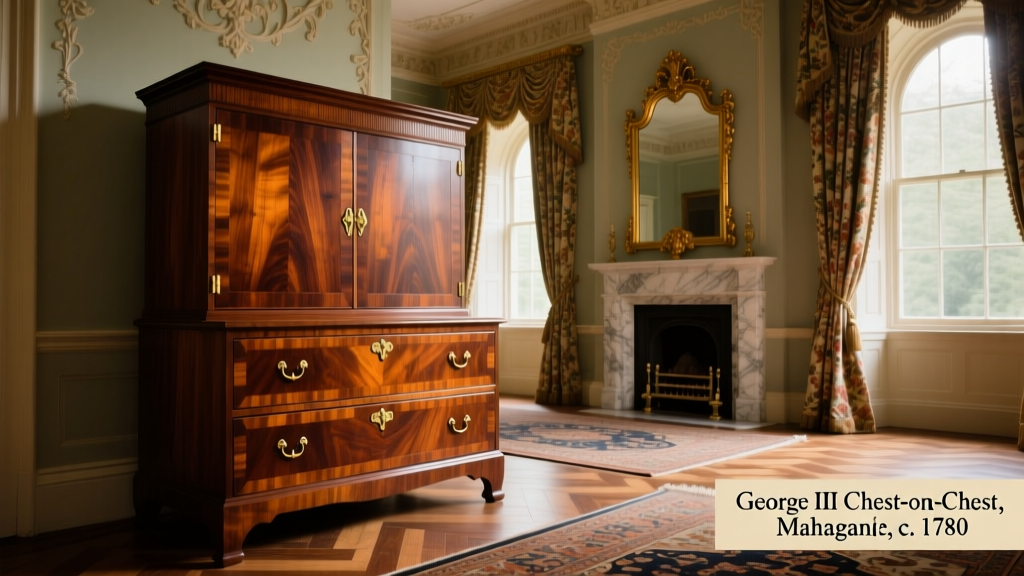
George III Mahogany Chest-on-Chest, c.1780: Anatomy, Provenance, and Restoration of a 79-Inch Masterpiece
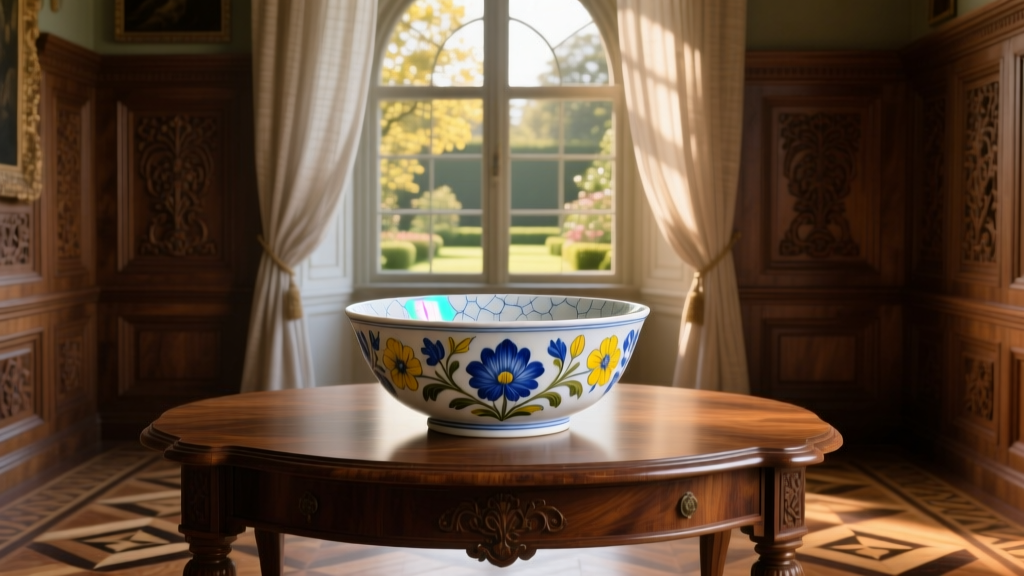
Delft Bowl, Yellow-Blue Polychrome: Authenticating and Caring for a 15¼ × 6-Inch Dutch Ceramic Masterpiece