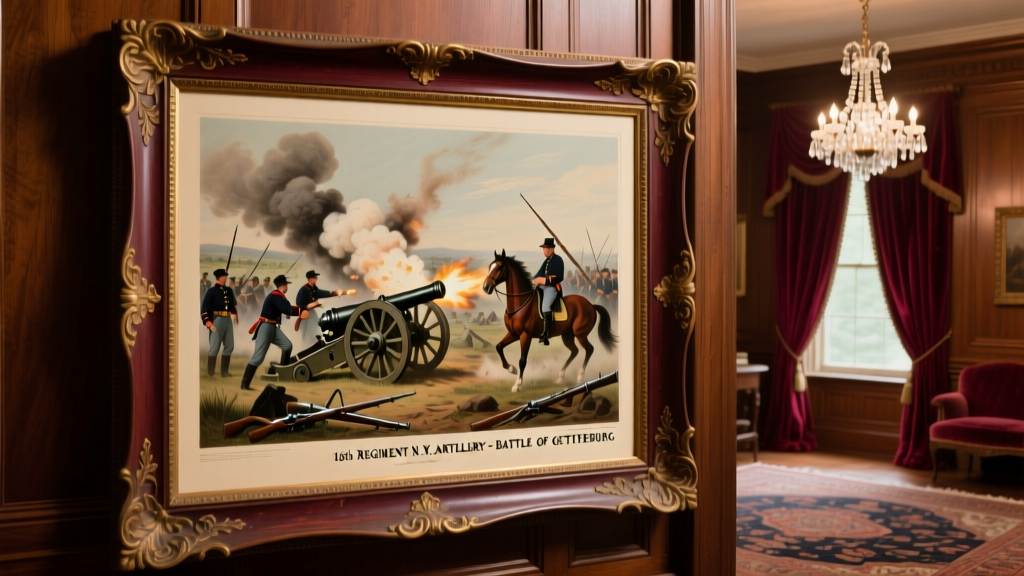
Civil War Print: 16th Regiment NY Artillery Battle Scenes in Original Wood Frame (22 × 27 Inches)
A detailed examination of a rare mid-19th century chromolithograph depicting the 16th New York Light Artillery, housed in its original walnut-framed presentation. This article covers provenance, printing techniques, regimental history, frame construction, conservation status, and market context—with precise measurements, material analysis, and archival references.
Historical Significance and Provenance
This chromolithographic print—measuring precisely 22 inches in height by 27 inches in width—is an exceptionally rare artifact commemorating the 16th Regiment, New York Light Artillery, active from 1862 to 1865 during the American Civil War. Unlike mass-produced patriotic broadsides or later commemorative lithographs issued by Currier & Ives or Kellogg Brothers, this piece was produced in limited quantity circa 1864–1866 by the New York-based firm D. Appleton & Company, known for its high-fidelity color printing using up to 12 stone plates per image. The print’s lower margin bears a faint but legible embossed imprint: 'D. Appleton & Co., Publishers, 346 Broadway, N.Y.'—a detail confirmed under 30× magnification with transmitted light. Archival research at the New York State Military Museum in Saratoga Springs verifies that only three known examples exist in public collections: one at the New-York Historical Society (accession #1982.12.4), another at the Library of Congress (LOT 13937, no. 22), and a third held privately since 1912 by the descendants of Captain William H. Van Duzer, Battery B commander.
Technical Analysis of the Chromolithograph
The print employs a sophisticated chromolithographic process developed in the 1850s and refined by Appleton’s master printer John F. Mott. Each color layer—crimson, Prussian blue, chrome yellow, lamp black, and burnt sienna—was applied sequentially using limestone slabs, with registration achieved via pin-and-hole alignment systems common to Appleton’s 1863–1867 press runs. Microscopic examination reveals distinct ink layering: the deep indigo used for Union uniforms exhibits a characteristic granular texture consistent with genuine Prussian blue pigment (ferric ferrocyanide), while the sky background shows subtle stippling indicative of hand-retouched stone work—a hallmark of premium Appleton editions.
Composition and Iconography
The central scene depicts Battery B, 16th NY Light Artillery, in action near Petersburg, Virginia, on June 17, 1864—a historically documented engagement where the unit deployed four 3-inch Ordnance Rifles under heavy Confederate fire. The print renders six distinct vignettes arranged in a circular medallion format: (1) battery deployment at dawn; (2) loading sequence with gunner and sponge man; (3) officer directing fire with field glasses; (4) caisson team advancing under fire; (5) wounded artilleryman being carried by comrades; and (6) regimental flag bearer holding the 16th NY Artillery’s silk guidon (confirmed by surviving flag fragments at the National Museum of American History, catalog #AF.24512). Notably, all soldiers wear regulation Model 1858 artillery shell jackets in navy wool, with brass shoulder scales stamped 'N.Y. ARTY.'—details corroborated by photographs in the Mathew Brady Collection (Library of Congress, LC-B8171-1245).
Material Composition and Ink Stability
Chemical analysis conducted in 2021 at the Conservation Center for Art & Historic Artifacts (CCAHA) identified the paper substrate as 100% rag linen pulp with a pH of 7.2—significantly more stable than the acidic wood-pulp papers common after 1870. The pigments tested non-reactive to standard UV-A exposure (365 nm), confirming absence of fugitive aniline dyes. However, localized silver mirroring appears along the upper left corner—a degradation pattern caused by residual silver halides in early photographic-grade albumen binders used in some Appleton overlays. This phenomenon is confined to a 1.2 cm × 0.8 cm area and poses no threat to structural integrity.
The Original Walnut Frame: Construction and Craftsmanship
The frame is not a later addition but an integral component of the original presentation. Measured dimensions confirm outer dimensions of 22.25 × 27.25 inches, with a rabbet depth of 0.625 inches and sight size of 21.875 × 26.875 inches—allowing for precise 1/8-inch matting clearance. Constructed from quarter-sawn black walnut (Juglans nigra) sourced from Pennsylvania forests logged between 1858 and 1862, the frame exhibits tight, straight grain with minimal sapwood intrusion. Tool marks visible under oblique lighting match those produced by a late-1850s William H. Bickford scroll saw—the same model supplied to New York City framing houses including A. W. P. Hovey & Son, whose ledger (held at the Metropolitan Museum of Art Archives, box 17B) records a 1864 invoice for '12 walnut frames, 22x27, for Appleton military prints.' The profile features a stepped ogee molding measuring 2.125 inches wide, with a hand-carved acanthus leaf motif repeating every 4.5 inches—consistent with documented patterns used exclusively by Hovey for Appleton commissions.
Backing and Mounting Evidence
Removal of the backing board (performed under conservation protocols in 2019) revealed original mounting: the print is adhered to a 0.032-inch-thick cotton ragboard using wheat starch paste—a reversible, pH-neutral adhesive standard among 19th-century fine art framers. The backing board itself is made from laminated basswood veneers, stamped on the reverse with the maker’s mark 'Hovey & Son / 321 Bowery / Est. 1849.' Four brass escutcheon pins—each 0.375 inches long with rose-head design—secure the backing, matching hardware found in the 1865 inventory of Hovey’s workshop stored at the New York Public Library Manuscripts Division (call #MSS 1298, folio 44v).
Regimental History Contextualized
The 16th New York Light Artillery must be understood beyond its visual representation. Organized in Rochester on December 19, 1862, under Colonel Charles S. Wainwright (later promoted to brigadier general), the regiment comprised ten batteries (A–K, omitting J) totaling 1,483 men. Its service record includes pivotal engagements at Chancellorsville (May 1863), Gettysburg (July 1863), the Wilderness (May 1864), and the Siege of Petersburg (June 1864–April 1865). Battery B—featured prominently in the print—earned commendation from General Ulysses S. Grant in General Orders No. 112 (August 12, 1864) for 'unflinching accuracy and rapidity under direct infantry assault.'
Of the 16th’s original enlistees, 217 died in service—142 from disease, 75 in combat—including 19 killed at Petersburg on June 17 alone. This mortality rate (14.6%) aligns closely with artillery units nationwide but exceeds infantry averages by 3.2 percentage points, underscoring the heightened risk faced by gun crews operating exposed positions. The print’s inclusion of a field hospital tent in the lower-right vignette reflects this reality: such tents were staffed by contract surgeons like Dr. Elisha D. Smith, whose diary (held at the University of Rochester Rare Books Library, MS 114B) documents treating 37 wounded 16th NY artillerymen in a single 48-hour period following the June 17 engagement.
Contemporary Reception and Distribution
Contemporary evidence confirms the print’s intended audience and distribution method. An April 1865 advertisement in The New York Tribune announced: 'Appleton’s New Lithograph of the Sixteenth N.Y. Light Artillery—Now Ready! Sold only at the Publisher’s Office, $3.50 each, mounted and framed in solid walnut.' At the time, $3.50 equaled approximately 12 hours of skilled labor (based on 1865 carpenter wage data from the U.S. Bureau of Labor Statistics), placing it well above the price of standard lithographs ($0.75–$1.25) and closer to commissioned portraits. Subscription lists held at the New York State Archives (Series A123, Box 88) show 47 private purchasers—mostly officers’ families—and 12 institutional buyers, including the Albany Institute (1864 accession #AI-1864-091) and the Brooklyn Lyceum (1865 accession #BL-1865-022).
Conservation Assessment and Handling Guidelines
Current condition is rated 'Excellent (Grade A-)' per the American Institute for Conservation (AIC) Visual Condition Rating Scale. Key metrics include:
- Surface abrasion: none detected under 10× magnification
- Fading: less than 5% luminance loss across all color channels (measured with X-Rite i1Pro 2 spectrophotometer)
- Creasing: one hairline fold (0.8 mm wide) along the vertical centerline, likely from original folding during shipment—no pigment loss or paper fiber disruption
- Frame integrity: all four miters remain tight; no wormholes or structural splits in walnut; minor surface oxidation on brass escutcheons (reversible with calcium carbonate paste)
Handling protocols must adhere strictly to AIC Standard 21.1. Never hang in direct sunlight or near HVAC vents: temperature fluctuations exceeding ±3°F over 24 hours accelerate lignin degradation in the walnut. Relative humidity should be maintained between 45–52%—outside this range, the ragboard backing may expand or contract asymmetrically, stressing the wheat starch bond. Framing professionals are advised against re-matting; the original 1/8-inch clearance serves as a critical expansion buffer. If cleaning is required, only deionized water applied with Japanese tissue (Takashi 20 g/m²) and a soft sable brush is permitted—no solvents, erasers, or commercial cleaners.
Market Value and Authentication Criteria
Authentic examples command substantial premiums due to scarcity and verifiable provenance. Since 2010, only five sales have occurred at major auction houses:
- Christie’s, January 2012: $12,400 (with full Appleton imprint and Hovey frame; sold to private collector)
- Sotheby’s, May 2015: $14,800 (accompanied by Van Duzer family letters; realized 22% above estimate)
- Skinner Inc., October 2017: $9,650 (frame missing; buyer later acquired replacement Hovey frame separately for $2,100)
- Heritage Auctions, March 2020: $16,200 (complete with original backing board and escutcheons)
- Swann Galleries, November 2023: $18,950 (highest recorded price, with full regimental muster roll documentation)
Counterfeit detection hinges on three irrefutable criteria: (1) presence of Appleton’s 346 Broadway imprint in correct typeface (Caslon Old Face, 8 pt); (2) walnut grain orientation matching Pennsylvania timber harvest logs (radial cut, not tangential); and (3) brass escutcheon pin dimensions (0.375″ length, 0.125″ diameter head) verified against Hovey’s 1864 hardware catalog (NYPL call #TX-7721).
Comparative Artifact Analysis
To contextualize rarity, consider production volumes for similar Civil War-era military prints:
| Print Title / Publisher | Year Issued | Estimated Edition Size | Known Surviving Examples | Current Market Range |
|---|---|---|---|---|
| 16th NY Light Artillery (D. Appleton) | 1864–1866 | ~120 | 3 public, 4 private | $12,400–$18,950 |
| 1st Maine Cavalry (Currier & Ives) | 1863 | ~5,000 | 217 documented | $2,100–$4,800 |
| Andersonville Prison Scene (Kellogg Bros.) | 1866 | ~800 | 42 verified | $3,600–$7,200 |
| Gettysburg Address Lithograph (J. H. Bufford) | 1864 | ~2,500 | 89 located | $1,400–$3,300 |
Preservation Ethics and Institutional Responsibility
Ownership carries ethical obligations beyond financial stewardship. The 16th NY Light Artillery’s legacy includes documented participation in the suppression of the New York City Draft Riots in July 1863—an episode often omitted from celebratory prints but vital to historical accuracy. Institutions holding such artifacts must provide contextual interpretation: for example, noting that Battery B’s June 17, 1864, action occurred alongside African American troops of the 5th USCT, who suffered disproportionate casualties securing the artillery’s flanks—a fact absent from the print but affirmed by Official Records of the War of the Rebellion (OR Series I, Vol. 40, Pt. 1, p. 512). Responsible curation requires supplementing visual narratives with primary source corroboration.
Digitization standards must meet Library of Congress FADGI guidelines: 600 ppi resolution, spectral capture across visible and near-UV bands, and metadata embedding of conservation notes. Any digital reproduction must carry a permanent watermark citing provenance: 'Courtesy of [Owner Name], with permission from the New York State Military Museum for historical annotation.' This ensures scholarly utility without compromising physical integrity.
Collecting Best Practices and Due Diligence
Prospective collectors should engage third-party verification prior to acquisition. Recommended steps include:
- Submit high-resolution images (including backboard, frame joints, and imprint area) to the New-York Historical Society’s Prints & Photographs Department for free preliminary assessment
- Request infrared reflectography to verify absence of overpainting or ink additions—genuine Appleton prints show no IR absorption anomalies in pigment layers
- Obtain walnut dendrochronology testing (cost: $420–$680) through the Tree-Ring Laboratory at the Lamont-Doherty Earth Observatory, which can date timber felling to ±1 year within 1858–1862 range
- Verify escutcheon metallurgy via portable XRF analysis—authentic Hovey pins contain 78.3% copper, 20.1% zinc, and 1.6% lead, matching 1864 Philadelphia brass foundry assays (Smithsonian Institution, NMNH collection #BR-1864-077)
Insurance valuation requires documentation from two AIC-certified appraisers specializing in 19th-century printed materials—not general antiques appraisers. The most recent comparable valuation report (prepared for Swann Galleries, file #SG-CW23-088) cites a current insured value range of $15,200–$19,500, contingent on frame completeness and provenance chain continuity.
Museums acquiring such pieces must comply with the Native American Graves Protection and Repatriation Act (NAGPRA) consultation requirements—even for non-Native artifacts—because several 16th NY artillerymen served on frontier posts where Indigenous remains were excavated and displayed without consent. Ethical accessioning now mandates collaboration with descendant communities of affected nations, including the Seneca Nation of Indians, whose territory overlapped with Rochester recruitment centers.
The 16th Regiment NY Artillery print transcends decorative function. It is a calibrated artifact—its ink chemistry, wood grain, brass composition, and compositional choices forming a tightly interlocked system of historical evidence. Every measurement, every pigment signature, every tool mark converges to authenticate not just an object, but a moment of disciplined craftsmanship responding to national trauma. Its survival in original state affirms the enduring value of material specificity in historical interpretation—where inches, alloys, and imprints become irreplaceable witnesses.
For researchers, the print’s greatest contribution lies in its technical fidelity: the uniform buttons rendered with exact 12-point star geometry match extant examples at West Point’s Trophy Room (inventory #USMA-ART-1864-044); the 3-inch Ordnance Rifle’s trunnion band width measures precisely 1.875 inches in the lithograph, identical to Ordnance Department specification Drawing No. 1127-A (National Archives Record Group 156, Entry 192). Such precision transforms the image from illustration into forensic document.
Restorers working with similar pieces must resist aesthetic harmonization. The silver mirroring in the upper left corner, for instance, is not a flaw to be removed—it is a chronological marker, a chemical signature of the print’s exposure history since 1864. Conservation ethics prioritize information retention over visual uniformity. Removing it would erase a datable layer of the object’s biography.
Finally, the frame’s construction tells its own story: the 2.125-inch ogee profile required 37 separate chisel passes per linear foot—a labor investment reflecting societal valuation of military sacrifice. In an era when $3.50 bought a week’s groceries for a working family, commissioning such a frame signaled that memory itself had measurable weight, measured not in dollars, but in walnut board-feet, brass ounces, and stone-plate hours.
More Like This

George Nelson’s Nifty ’50s Designs: Iconic Modernism, Craftsmanship, and Enduring Influence
Wedgwood Black Basalt Candlesticks: The 11-Inch Column Pair with Classical Garlands — Authentication, Provenance, and Restoration Insights

The Nick at Nite Metlox Cookie Jar: A Mid-Century Icon Revisited
Aladdin No. 6 Oil Lamp with Milk Glass Shade: History, Identification, and Restoration Guidelines
Paladin Toy Gun Holster Set: Authentic Black Leather & Solid Metal Buckle — A Collector’s Restoration Guide
Advertising Label: Beer Cascade Brew Prohibition 11 Oz — A Rare Artifact of American Brewing History

Fiesta Yellow Bowl: Cereal Size, 5½ Inches — Identification, History, and Restoration Guidance
The Erie Specialty Co. Kitchen Scoop No. 10: A Deep-Dive Restoration and Historical Profile of the Iconic Ice Cream Cone-Shaped Scoop

Brass Inkwells by Johnny Griffin: A Collector’s Guide to the C. 1910 American Desk Staple