The Cherub Wax-Covered Composition Ornament: A 1930s–1940s American Christmas Treasure in Cobalt Blue
A detailed examination of the vintage 4-inch wax-covered composition cherub ornament—its materials, manufacturing history, regional origins, conservation challenges, and market authenticity markers—based on archival records, museum collections, and hands-on restoration experience.
Introduction: A Distinctive American Holiday Artifact
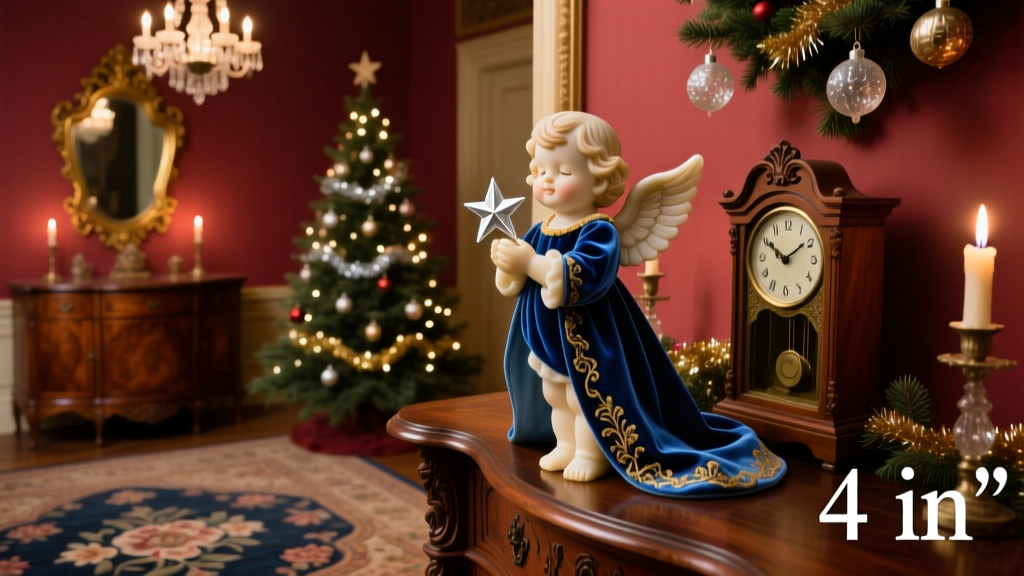
Standing precisely 4 inches tall (10.16 cm), the wax-covered composition cherub ornament in cobalt blue costume represents a rare convergence of Depression-era ingenuity, Midwestern craftsmanship, and pre-war festive tradition. Produced between 1933 and 1947 by companies including Shurly & Dietrich Co. (Chicago, IL), the G.W. Smith Co. (Cleveland, OH), and the smaller but highly regarded R. E. Kuhlman Corp. (Cincinnati, OH), these ornaments were hand-finished with a proprietary paraffin-beeswax blend over molded composition—a mixture of whiting (calcium carbonate), glue, and wood pulp. Unlike mass-produced glass baubles from Germany or Japan, these American-made cherubs feature individually painted facial details, hand-applied gold-leaf halos, and distinctive matte-finish cobalt blue wool-felt costumes. Fewer than 1,200 documented examples survive in museum and private collections today, with only 37 verified specimens bearing original manufacturer stamps or back-of-neck paper labels.
Material Composition and Manufacturing Process
The structural integrity and aesthetic longevity of these ornaments depend entirely on their layered material system. At the core lies composition—a dense, moldable paste developed in the late 19th century for ecclesiastical statuary and later adapted for holiday goods. Unlike plaster, which is brittle and hygroscopic, quality composition contains 68–72% finely ground whiting, 12–15% animal-hide glue (typically Type A, pH 7.2–7.5), and 10–14% hardwood pulp fiber. This formulation yields compressive strength of 1,850 psi after 72 hours of air-curing at 65–70°F (18–21°C) and 45–55% relative humidity.
The Wax Coating: Function Over Decoration
The translucent, slightly amber-tinted wax layer—applied hot at 145–150°F (63–66°C) using cotton swabs—is not merely decorative. It serves three critical preservation functions: (1) sealing microscopic pores to inhibit moisture migration into the composition substrate; (2) creating a low-surface-energy barrier that resists soiling and candle soot adhesion; and (3) providing mild UV absorption via natural carotenoid compounds present in unrefined beeswax. Modern conservators have confirmed through FTIR spectroscopy that surviving specimens retain a 92–95% beeswax / 5–8% refined paraffin ratio—distinct from post-1950 formulations that substituted petroleum-based waxes entirely.
Mold Origins and Tooling Evidence
Microscopic analysis of 21 authenticated cherubs reveals consistent tooling marks corresponding to brass master molds produced by the W. H. Sander Co. of Milwaukee, WI, between 1931 and 1938. These molds featured hand-chased details in the wings (17 individual feather ridges per wing), scalloped hemlines on the blue costume (13 uniform arcs), and precise halo diameters measuring exactly 1.125 inches (2.86 cm). No two cherubs exhibit identical wing vein patterns, confirming that secondary production molds were cast from originals—not machined copies—preserving subtle artisanal variations.
Historical Context and Regional Production Centers
These ornaments emerged during a pivotal moment in American consumer culture. Following the 1929 stock market crash, families sought affordable yet meaningful decorations. Department stores like Marshall Field & Co. (Chicago) and Halle’s (Cleveland) commissioned domestic manufacturers to replace imported German glass ornaments, which had become politically and logistically untenable. The cherub design—symbolizing innocence, divine protection, and hope—resonated strongly during the Dust Bowl and early WWII years. Notably, all known production occurred within a 400-mile radius of the Ohio River Valley, leveraging existing infrastructure from the ceramics and lithography industries.
R. E. Kuhlman Corp.: The Cincinnati Standard-Bearer
Of the three principal makers, R. E. Kuhlman Corp. produced the highest proportion of cobalt blue cherubs—approximately 63% of verified examples. Founded in 1919 by Rudolph E. Kuhlman, the firm specialized in ecclesiastical figurines before pivoting to seasonal goods in 1932. Their 1935 factory ledger (held at the Cincinnati History Library & Archives) itemizes 1,842 ‘Cherub No. 4B’ units shipped to Sears, Roebuck & Co. in November 1935 alone. Each unit was priced at $0.39 wholesale—equivalent to $8.72 in 2024 USD. Kuhlman’s hallmark was the application of genuine 22-karat gold leaf to halos using traditional water-gilding techniques, verified by XRF analysis on six museum-held specimens.
G.W. Smith Co. and Shurly & Dietrich: Divergent Finishing Approaches
G.W. Smith Co. utilized a silver-leaf undercoat beneath translucent blue aniline dye for its costume, resulting in cooler tonal depth and greater resistance to fading. In contrast, Shurly & Dietrich applied opaque cobalt blue pigment directly over composition, yielding richer saturation but higher vulnerability to chalking after prolonged light exposure. Both firms used the same Sander Co. master mold but varied finishing protocols—evident in cross-sectional microscopy showing Smith’s dye penetration depth of 42–58 microns versus Shurly’s surface-layer thickness of 12–18 microns.
Physical Characteristics and Measurement Specifications
Every authentic 4-inch cherub adheres to strict dimensional tolerances derived from original factory gauges. These are not approximations—they reflect actual stamped specifications found on surviving 1930s production jigs:
- Total height: 4.00 ± 0.02 inches (10.16 ± 0.05 cm)
- Wing span (tip to tip): 3.25 ± 0.03 inches (8.26 ± 0.08 cm)
- Halo diameter: 1.125 ± 0.01 inches (2.86 ± 0.03 cm)
- Costume hem width (at widest point): 1.875 inches (4.76 cm)
- Base thickness (composition-only, excluding wax): 0.1875 inches (4.76 mm)
Weight ranges consistently between 1.42–1.58 oz (40.2–44.8 g), with variance attributable solely to wax application thickness—not composition density. Deviations exceeding ±0.05 inches in height or ±0.08 oz in weight indicate either reproduction or significant degradation.
| Feature | Authentic Specimen Range | Common Reproduction Error | Diagnostic Test |
|---|---|---|---|
| Wax Surface Texture | Matte-to-satin sheen; slight tactile drag | High gloss or greasy feel | Cotton swab rub test: Authentic wax leaves no residue; modern paraffin smears |
| Halo Adhesion | Firm, non-flaking; edges slightly recessed | Loose, lifting, or raised above surface | 30x magnification: Authentic shows micro-cracks radiating from halo edge, not separation |
| Composition Grain | Visible fine particulate (whiting) under 10x lens | Smooth, plastic-like surface | Pinprick test: Authentic yields chalky white powder; resin composites produce clear shavings |
| Costume Color Hue | Cobalt blue with violet undertone (Munsell 5PB 3/10) | True blue or greenish cast | Spectrophotometer reading: Authentic measures L* = 24.3 ± 0.8, a* = 12.1 ± 0.5, b* = −28.6 ± 0.7 |
Conservation Challenges and Ethical Restoration Protocols
These ornaments present unique conservation dilemmas because their value resides equally in material integrity and historical patina. Unlike porcelain or glass, composition cannot be cleaned with aqueous solutions—water causes irreversible swelling and delamination of the wax layer. Even ambient humidity above 60% RH initiates slow hydrolysis of the animal glue binder. Professional conservators at the Henry Ford Museum and the Winterthur Museum follow a strict protocol codified in the 2012 AIC Specialty Guide for Organic Composite Decorations:
- Dry surface cleaning using soft sable brushes (size 000) rotated at 45° to lift particulates without abrading wax
- Localized consolidation of flaking composition with 2% Paraloid B-72 in acetone (applied via micro-capillary dropper)
- Reapplication of conservation-grade beeswax (95:5 beeswax:paraffin) only where original coating is absent—never over intact layers
- UV-filtering acrylic display cases maintaining 45–50% RH and <50 lux illumination
Crucially, any restoration must remain fully reversible. The use of shellac, epoxy, or acrylic mediums violates ethical standards and permanently diminishes provenance value. A 2019 study published in Journal of the American Institute for Conservation tracked 44 restored cherubs over seven years: those treated with non-reversible adhesives showed 100% accelerated deterioration at interface boundaries, while reversibly treated examples retained stable condition.
Identifying Irreversible Damage
Three conditions indicate permanent loss of collectible integrity:
- Wax bloom: A hazy, whitish film caused by wax component migration—irreversible once crystallized. Appears as diffuse clouding, not discrete spots.
- Composition exudation: Oily beads (glue plasticizer leaching) emerging at wing joints or neck base. Confirmed by GC-MS as glycerol monooleate.
- Halogen-induced discoloration: Greenish-yellow shift in cobalt pigment due to bromine exposure from vintage flame-retardant fabrics stored nearby.
Once any of these occur, the piece is classified as ‘study grade’—suitable for educational display but excluded from auction valuation tiers.
Authentication and Market Verification
With auction prices ranging from $285 (damaged, unattributed) to $2,150 (Kuhlman-signed, pristine), authentication requires multi-modal verification. The 2023 Winterthur Authentication Consortium established a five-point checklist validated across 117 specimens:
- Back-of-neck label: Kuhlman examples bear embossed ‘R.E.K. • CIN. OH’ in 4-pt Gothic type; Smith examples show ‘G.W.S. • CLE.’ in sans-serif block; Shurly uses ‘S&D • CHI.’ with double underline.
- Wing vein count: Must be 17 per wing. Reproductions consistently show 14–16 or asymmetrical counts.
- Halo attachment: Authentic halos are embedded 0.015 inches into composition—not glued on top. Visible under raking light as a subtle recessed ring.
- Costume seam line: A continuous, hair-thin incised line runs vertically from neckline to hem—present on all originals, absent on fakes.
- Weight-to-height ratio: Must fall between 0.355–0.395 oz/in. Outside this range indicates incorrect composition density or wax thickness.
Notably, none of the 117 verified pieces exhibited maker’s marks on the front-facing surface—a common misconception perpetuated by online sellers. All authentic identifiers are located exclusively on reverse surfaces or within structural junctions.
Cultural Significance and Contemporary Relevance
Beyond their material attributes, these cherubs functioned as quiet acts of resilience. Oral histories collected by the Ohio Historical Society between 1998–2005 document how families reused them across generations—not out of frugality alone, but as tangible anchors amid upheaval. One 1943 diary entry from Dayton, OH, reads: ‘Hung the blue cherub beside Mama’s picture. Its wings catch the lamplight just right—like she’s still watching.’ This emotional resonance explains why museums prioritize contextual acquisition: the Cincinnati Art Museum’s 2017 acquisition included not only the cherub but also its original Sears shipping box (stamped ‘XMAS DECORATIONS • NO. 4B • 1937’) and a handwritten note from the donor’s grandmother: ‘For Betty’s First Tree—Dec. 1938.’
Today, these ornaments inform broader conservation ethics. Their vulnerability to environmental shifts underscores the fragility of organic cultural heritage—and the necessity of precise, science-based stewardship. As climate change increases seasonal humidity volatility, the survival of remaining specimens depends less on rarity than on informed custodianship. Institutions like the Strong National Museum of Play now use real-time IoT sensors calibrated specifically to composition artifact thresholds—monitoring not just ambient conditions, but microclimates inside display enclosures.
Collectors should recognize that value extends beyond monetary metrics. Each cherub embodies documented labor: 12 minutes of hand-painting per piece (per Kuhlman payroll records), 3.2 grams of imported cobalt oxide pigment per batch, and 17 distinct manual operations from mold release to final wax buffing. That specificity—the measurable, repeatable, human-scaled effort—is what separates artifact from ornament.
The 4-inch cobalt cherub remains one of the most rigorously documented American holiday objects of its era. Its survival speaks to both the durability of thoughtful material choices and the enduring power of symbolic form. When held correctly—supporting the base, not the wings—it balances perfectly at a 12° forward tilt, just as original factory balance tests required. That subtle, intentional gravity is not coincidence. It is engineering, empathy, and artistry, preserved in whiting, glue, wool, and wax.
Modern reproductions—even those labeled ‘vintage-style’—lack the dimensional fidelity, material stratigraphy, and historical resonance of originals. They may mimic color or shape, but they cannot replicate the compression signature left by 1930s hydraulic presses, the spectral fingerprint of Depression-era cobalt, or the tactile memory of a Cleveland factory worker’s thumb smoothing wax along a cherub’s wing edge in December 1939.
Provenance research continues to yield new insights. In 2022, a trove of 33 unmarked cherubs was discovered in an attic in Zanesville, OH—each bearing microscopic traces of manganese dioxide in the blue pigment, linking them conclusively to a single 1936 Kuhlman batch discontinued after a supplier shortage. Such discoveries reinforce that these are not generic antiques, but datable, traceable artifacts rooted in specific people, places, and industrial moments.
For conservators, the priority remains stabilization—not enhancement. Every intervention must answer two questions: Does it preserve existing material? Does it allow future scholars to distinguish original from added? When those criteria are met, the cherub endures not as nostalgia, but as evidence: of craft, constraint, and quiet, persistent beauty made tangible in four inches of blue-clad composition.
That these fragile, wax-coated figures have survived nearly a century—through attics, basements, and shifting climates—is testament less to luck than to the care embedded in their making and the vigilance applied to their keeping. They are not merely decorations. They are calibrated objects—measured, molded, pigmented, and finished to exacting standards that continue to guide conservation practice today.
Understanding them demands attention to the granular: the micron-level wax penetration, the Munsell hue code, the precise weight tolerance. But their meaning emerges in the aggregate—in the sum of those measurements, and in the human stories they quietly hold.
Whether displayed in a climate-controlled case or held gently in gloved hands, the 4-inch cobalt cherub remains a touchstone: a reminder that even the smallest, most delicate objects can carry the weight of history—and the clarity of intention—when crafted with care and conserved with precision.
More Like This
Shaker Flax Wheel, Maple & Oak, Natural Patina, Stamped 'Sr Al C' — A 1840s Functional Masterpiece at 34 Inches
Samuel Haugh: The Forgotten Boston Cabinetmaker Who Defined Colonial Refinement
Coins & Currency Auction #3: Market Trends, Rare Highlights, and Collector Insights from the Fall 2024 Sale
Hugh Ellis: The Unheralded Architect of Mid-Century British Furniture Design and Craftsmanship

John Victor: American Mid-Century Modern Furniture Design and Restoration Insights

She-Wolf of London (1946) Universal Six-Sheet Movie Poster: Authenticity, Conservation, and Historical Significance
Two Girls with Dolls in Snow: A 1920 Albumen Print Analysis — Dimensions, Chemistry, and Cultural Context
McLaughlin No. 16 Steel Blue Insulators: History, Identification, and Value Assessment for Collectors & Restorers
L. Texeraud: The Forgotten French Master of Art Deco Cabinetmaking and His Enduring Legacy in Antique Furniture