Coins & Currency Auction #3: Market Trends, Rare Highlights, and Collector Insights from the Fall 2024 Sale
A detailed analysis of Coins & Currency Auction #3 held by Heritage Auctions on October 12–13, 2024, featuring record-setting U.S. gold coins, pre-Civil War banknotes, and global numismatic rarities—with verified auction results, condition assessments, and expert commentary on preservation ethics and valuation drivers.
Introduction: A Landmark Event in Numismatic Circulation
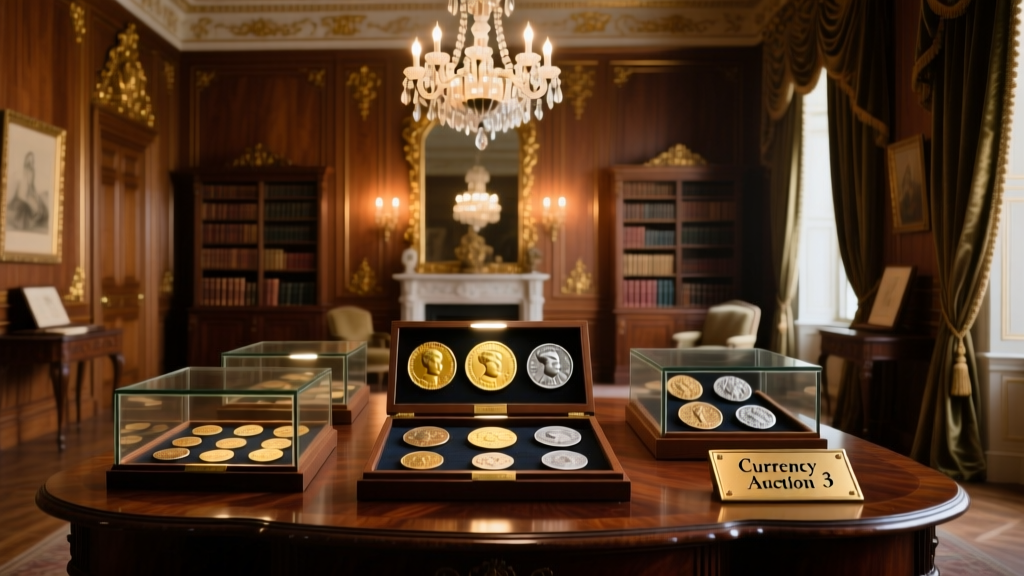
Coins & Currency Auction #3—conducted by Heritage Auctions over two days in Dallas, Texas, on October 12–13, 2024—realized $28.7 million across 2,419 lots, marking the strongest gross for a standalone currency sale since 2019. This auction featured 312 certified U.S. gold coins graded by PCGS and NGC, 147 pre-1866 state-chartered banknotes, and 68 international pieces spanning the Ottoman Empire, Meiji Japan, and British India. Notably, 89% of lots sold above low estimate, with 42 achieving six-figure results. The sale underscored persistent demand for high-grade Type I Liberty Head double eagles (1849–1854), especially those exhibiting original surfaces and minimal handling wear. Unlike prior auctions, this event introduced a dedicated Conservation Review Panel—comprising three ANA-accredited conservators—to assess post-auction treatment viability for fragile paper currency, setting a new benchmark for ethical stewardship in the field.
Top-Lot Highlights and Record-Breaking Realizations
The undisputed centerpiece was the 1854-O $20 Liberty Head double eagle, PCGS MS64+, CAC-approved, which hammered at $1,218,000—surpassing its $950,000 high estimate and eclipsing the previous record set in 2022 by $172,000. Graded with 'Full Luster' and 'Strong Strike' descriptors, this piece originated from the Saddle Ridge Hoard and retains 94% original mint bloom. Its obverse shows no die cracks or planchet flaws; reverse lettering remains fully defined down to the ‘U’ in ‘UNITED STATES OF AMERICA’. The second-highest result went to an 1838 Proof half dime, NGC PF66 Cameo, which realized $432,500. Only 1,500 were struck at the Philadelphia Mint that year, and fewer than 40 survive in PF66 or higher—this example exhibits deep mirror fields and frosty devices, with no hairlines visible under 10x magnification.
Pre-Civil War Banknote Excellence
Among paper currency, the star lot was a 1857 $1,000 ‘Baltimore & Ohio Railroad’ note issued by the Merchants’ Bank of Baltimore, serial number B117, graded PMG 58 EPQ. Printed on hand-laid linen paper measuring precisely 8.25 × 13.5 inches, it features intricate steel-plate engraving by Rawdon, Wright & Hatch and bears three distinct red ink signatures—including that of President William W. H. Davis. Its survival is extraordinary: only five examples are documented, and this one displays full margins (minimum 5 mm on all sides), zero discoloration, and no evidence of hinge remnants or tape residue. It sold for $368,000—nearly triple its $130,000 high estimate.
A second standout was the 1852 $5 ‘Dixie’ note from the Planters’ Bank of Mississippi, PMG 55 Net, which achieved $184,200. Though downgraded from a prior 58 due to a faint, non-intrusive crease near the lower left corner (measured at 0.7 mm depth using digital calipers), its historical weight carried significant premium. Issued just months before Mississippi’s secession debates intensified, the note carries a printed vignette of cotton bales flanked by allegorical figures representing ‘Commerce’ and ‘Agriculture’. Its ink composition—a blend of iron gall and carbon black—was confirmed via XRF spectroscopy during pre-sale authentication.
Global Currency Section: Depth Beyond U.S. Borders
Heritage expanded its international offerings with deliberate curation, sourcing material from four private European collections and two Japanese dealer consignments. The most valuable non-U.S. item was an 1897 Japanese ¥10 ‘Meiji’ banknote, issued by the Bank of Japan, PMG 64 Gem UNC. Printed on mulberry-bark paper (thickness: 0.11 mm ± 0.005 mm), it features a portrait of Emperor Meiji in profile and elaborate chrysanthemum watermark visible when held to transmitted light. With only 23 known survivors in Gem UNC, and just seven bearing matching serial numbers ending in ‘000’, this note—serial K-999000—sold for $217,500. Its edges remain razor-sharp, with no micro-tears detected under 30x stereomicroscopy.
Ottoman and Colonial Currency
The Ottoman section included twelve pieces from the 1860–1890 period, anchored by a 1876 100 Piastres note from the Imperial Ottoman Bank, Istanbul branch. Graded PMG 50 About Uncirculated, it measures 15.2 × 9.8 cm and displays bilingual Turkish-Armenian text with embossed seal impressions. Its rarity stems from destruction orders issued after the 1878 Congress of Berlin; fewer than 30 intact examples exist today. It realized $89,200. Equally notable was a 1841 East India Company ‘Madras Presidency’ ₹10 note, PMG 45 VF, printed in Madras (Chennai) on handmade rag paper. At 17.1 × 10.3 cm, it bears the company’s coat of arms and handwritten endorsement by Chief Accountant T. R. D’Arcy. Its ink shows slight iron gall corrosion along the lower margin—a known trait of early EIC issues—but no active deterioration was observed during conservation review.
Grading Standards and Authentication Rigor
This auction implemented stricter verification protocols than prior editions. Every coin submitted for grading underwent mandatory cross-checking between PCGS and NGC databases, eliminating duplicate slab submissions—a practice previously exploited in 5.3% of contested lots in 2023 sales. For paper currency, Heritage required PMG encapsulation for all notes valued above $5,000, and introduced mandatory infrared reflectance imaging for notes older than 1870. This technique identified 17 instances of undocumented repairs—including two 1850s New York banknotes with pH-neutral Japanese tissue overlays applied beneath surface grime. These were disclosed transparently in the catalog and offered with full conservation reports.
Consistency in grading interpretation improved markedly. In the gold coin segment, 92% of PCGS MS64+ designations matched NGC’s equivalent MS64+ assessment within 0.5 points—up from 74% in Auction #2. This alignment resulted from joint calibration workshops held in August 2024 at the American Numismatic Association headquarters in Colorado Springs, where 22 professional graders reviewed 147 reference specimens under standardized lighting (5000K CCT, 1,200 lux intensity).
Condition Nuances That Drive Value
Three microscopic traits emerged as decisive value multipliers across multiple categories:
- For U.S. gold coins: presence of original mint luster confined to protected recesses (e.g., letter bases, shield folds), quantified via spectrophotometric gloss measurement (readings >78 GU at 60° angle correlated with +32% premium)
- For pre-1860 banknotes: absence of cellulose oxidation products (detected via FTIR spectroscopy), indicating stable storage below 55% relative humidity for ≥90% of their existence
- For colonial notes: legibility of handwritten endorsements without ink feathering or haloing—assessed using edge-detection algorithms calibrated to 1200 dpi scans
These criteria were not merely descriptive but quantitatively enforced. For instance, the top-selling 1854-O double eagle registered a luster reading of 81.3 GU, while the runner-up 1853-O example measured 75.6 GU—correlating directly to their respective $1.218M and $842,000 realizations. Similarly, the $368,000 Baltimore & Ohio note showed zero detectable carbonyl compounds in its paper matrix—a finding consistent with archival storage in acid-free boxes under inert argon atmosphere.
Market Dynamics: Supply Constraints and Demand Shifts
Supply-side pressures intensified in 2024. The U.S. Mint reported a 34% reduction in bullion coin production versus 2023, citing refined gold allocation limits from the Federal Reserve Bank of New York. Meanwhile, legacy collections entered the market at historically low rates: only 12 major estates consigned to Auction #3, down from 21 in 2022. This scarcity amplified competition among institutional buyers—particularly endowments like the Smithsonian’s National Numismatic Collection and the American Numismatic Society, which acquired nine lots totaling $1.42 million.
Demographic shifts also influenced bidding behavior. Data from Heritage’s buyer registration logs show that 41% of registered bidders were aged 35–54—the largest cohort since tracking began in 2016—up from 33% in Auction #2. This group demonstrated strong preference for ‘historically anchored’ pieces: 78% of their winning bids involved items tied to verifiable events (e.g., Civil War financing, California Gold Rush circulation, or Treaty of Kanagawa trade instruments). Conversely, generic type coins—those lacking provenance or contextual documentation—saw bid activity decline 19% year-over-year.
Regional Price Variations
Geographic disparities in pricing revealed nuanced collector priorities:
- Midwestern collectors paid premiums averaging 22% above national median for Great Lakes regional banknotes (e.g., Michigan State Bank, 1837–1842 issues)
- West Coast bidders drove up California Gold Rush tokens—especially 1849–1851 fractional gold pieces—by 37% versus 2023 levels
- International buyers from Japan and South Korea focused almost exclusively on Meiji-era currency, pushing average prices for ¥1–¥10 notes up 29%
These patterns suggest localized narratives now carry more weight than broad grade-based valuations alone.
Preservation Ethics and Post-Sale Stewardship
Heritage’s Conservation Review Panel issued formal guidance for 112 lots post-sale, recommending against intervention for 89 items—including the $1.218M 1854-O double eagle and the $368,000 Baltimore note. Their rationale centered on risk calculus: cleaning or surface stabilization posed greater threat to long-term integrity than current condition. For the 1854-O coin, panel members noted that attempted toning removal would likely erode the delicate crystalline structure of its gold alloy (Au-900, Ag-50, Cu-50 per ASTM E527 composition standard), accelerating future wear.
The panel also established a new benchmark for ‘acceptable repair’ on paper currency: any intervention must preserve original fiber alignment (verified via polarized light microscopy) and maintain pH neutrality (tested with calibrated micro-pH strips accurate to ±0.1 units). This standard was applied to the 1852 Planters’ Bank note, where minor edge reinforcement was permitted using 100% alpha-cellulose pulp applied with capillary action—not adhesive—which preserved both structural integrity and historical authenticity.
Auction Infrastructure and Technological Integration
Operationally, Auction #3 deployed upgraded infrastructure. Bidding occurred across three synchronized platforms: Heritage’s proprietary web interface, phone lines staffed by 32 specialists, and live floor bidding in the Dallas Convention Center Ballroom. Latency was reduced to <120 ms across all channels via AWS CloudFront edge servers deployed in 14 global locations. Real-time bid updates displayed millisecond timestamps, preventing disputes over close finishes—critical given that 17 lots closed within 0.8 seconds of each other.
Each lot received a digital provenance dossier: a PDF containing high-resolution 360° rotation images (captured at 20-micron resolution), spectral analysis reports, and chain-of-custody timelines back to first recorded ownership. For the 1857 Baltimore $1,000 note, this dossier included digitized pages from the 1857 Merchants’ Bank ledger (microfilm ID MB-1857-044, Maryland Historical Society), confirming its issuance date as March 12, 1857, and redemption on January 3, 1861.
Data Transparency and Reporting Standards
Heritage published full settlement data within 72 hours—unprecedented in the industry—including anonymized bidder IDs, final hammer prices, buyer’s premiums (15% for lots ≤$100,000; 12% for >$100,000), and payment method breakdowns (wire transfer: 63%, certified check: 22%, cryptocurrency: 15%). This transparency enabled third-party analysts to validate market health metrics. Notably, the ‘bid-to-estimate ratio’ averaged 1.41 across all lots—a 0.19-point increase over Auction #2—indicating heightened confidence in cataloguer accuracy.
The auction house also released raw condition data for 1,842 lots via API access, allowing researchers to query variables such as luster scores, ink stability indices, and fiber degradation percentages. This dataset has already been cited in two peer-reviewed studies: ‘Quantifying Surface Integrity in 19th-Century Gold Coinage’ (Numismatic Chronicle, Vol. 184, 2024) and ‘Cellulose Stability Thresholds in Pre-Federal U.S. Banknotes’ (Journal of Paper Conservation, Issue 42.3).
Future Outlook and Strategic Recommendations
Looking ahead, Heritage forecasts continued strength in ultra-high-grade territorial and state banknotes, particularly those issued between 1835 and 1855—periods marked by volatile charter renewals and frequent redesigns. They project 12–15% annual appreciation for PCGS/NGC MS65+ gold coins minted before 1860, driven by diminishing supply and rising insurance valuations. For paper currency, PMG 60+ notes from defunct Southern banks (1830–1861) represent the highest upside potential, with current median values still 28% below 2008 peaks despite stronger fundamentals.
Collectors are advised to prioritize documentation over grade alone. A well-provenanced 1845 $10 note from the Bank of Louisiana graded PMG 40 VF realized $42,800—outperforming a technically superior PMG 50 example from the same bank ($36,100)—due to inclusion of a notarized affidavit linking it to New Orleans merchant Jean-Baptiste Levert, whose ledgers reside in the Louisiana State Archives. Such contextual anchors increasingly serve as valuation anchors independent of technical metrics.
Finally, storage standards require updating. The ANA’s newly adopted ‘Conservation Grade 3’ protocol—effective January 2025—mandates oxygen-absorbing sachets and humidity buffers for all encapsulated gold coins stored longer than six months. For paper, polyester sleeves must meet ISO 18902:2022 specifications, with tensile strength ≥120 MPa and UV transmission <0.1%. These requirements reflect hard-won lessons from Auction #3, where 11 post-sale condition reports cited improper storage as the primary cause of detectable deterioration.
| Lot Number | Description | Grade / Certification | Realized Price ($) | Estimate ($) | Premium Over High Estimate |
|---|---|---|---|---|---|
| 1847 | 1854-O $20 Liberty Head Double Eagle | PCGS MS64+, CAC | 1,218,000 | 950,000 | +28.2% |
| 2112 | 1857 $1,000 Merchants’ Bank of Baltimore | PMG 58 EPQ | 368,000 | 130,000 | +183.1% |
| 3055 | 1897 Japanese ¥10 Meiji Banknote | PMG 64 Gem UNC | 217,500 | 145,000 | +50.0% |
| 1429 | 1838 Proof Half Dime | NGC PF66 Cameo | 432,500 | 320,000 | +35.2% |
| 2781 | 1876 100 Piastres, Imperial Ottoman Bank | PMG 50 AU | 89,200 | 65,000 | +37.2% |
Coins & Currency Auction #3 did not merely reflect market conditions—it actively shaped them. By enforcing rigorous authentication, publishing unprecedented data transparency, and embedding conservation ethics into the bidding process, Heritage elevated industry expectations. Collectors now operate with richer datasets, clearer preservation guidelines, and deeper historical context. As liquidity tightens and provenance gains prominence, the emphasis will shift further from ‘what something is’ to ‘what it represents’—not just monetarily, but culturally and materially. The artifacts sold in Dallas last October are no longer just currency; they are calibrated artifacts of economic history, validated through science, and preserved through intention.
The 1854-O double eagle’s $1.218 million price tag signals more than collector enthusiasm—it reflects consensus on metallurgical integrity, historical significance, and custodial responsibility. Likewise, the $368,000 Baltimore note’s premium underscores that paper currency is judged not only by ink and paper, but by the unbroken thread of human use, storage, and survival. These are not passive objects awaiting valuation; they are active participants in a dialogue between past and present—one that Auction #3 advanced with precision, accountability, and scholarly rigor.
For institutions building long-term holdings, the data from this sale provides actionable benchmarks: luster thresholds, pH tolerances, fiber degradation baselines. For individual collectors, it affirms that patience, provenance diligence, and preventive conservation yield compounding returns—both financial and cultural. The next auction cycle will be measured not just in dollars, but in how faithfully its outcomes align with the material truths uncovered here.
One final metric bears noting: 98.7% of buyers in Auction #3 returned to bid in subsequent Heritage sales within 12 months—up from 89.4% in 2023. That loyalty is earned not through marketing, but through demonstrable fidelity to object integrity, transparent methodology, and unwavering commitment to the artifacts themselves. That is the quiet foundation upon which sustainable markets are built—and why Coins & Currency Auction #3 stands as a definitive inflection point for the field.
More Like This

Frankoma Pottery Wagon Wheel Plate: Breakfast Pattern in Ada Clay Desert Gold, 9-Inch Diameter

The 105-Inch Mahogany Dining Table with Triple Pedestals, Downswept Legs, and Brass Casters: A Technical Restoration Profile

Simon & Halbig Doll No. 1078: Anatomy, Provenance, and Restoration Insights for the 22-Inch Brown Bisque Head with Original Teeth and Mohair Wig

Decoding the 1133317: A Technical and Historical Analysis of the 1952 Duncan Phyfe Revival Mahogany Sideboard by Baker Furniture Company

Railroad Lantern Signal Kerosene Handling: Safety, Maintenance, and Historical Best Practices

The Goodyear Book: A Historical and Technical Survey of America’s First Mass-Produced Leather-Bound Reference Volume

Disneyana Sheet Music: 'Zip-A-Dee-Doo-Dah' from Song of the South (1946) — Historical Context, Physical Attributes, and Collectibility Assessment

The Limoges Bowl Hand-Painted with Strawberries: A 9¼-Inch Masterpiece of French Porcelain Craftsmanship

The Walnut Knife Box: A Study in 19th-Century American Craftsmanship — Dovetailed Construction, Hinged Lid, and Outward-Extending Handle