Santa Claus Rings Bell: The 1950s Tin & Celluloid Windup Toy Box — History, Mechanics, and Restoration Insights
A detailed examination of the iconic 1950s Christmas toy: the Santa Claus Rings Bell windup box—featuring tinplate construction, celluloid facial elements, clockwork movement, and manufacturer data from companies like Marx, Tootsietoy, and Louis Marx & Co. Includes restoration protocols, value indicators, and technical specifications.
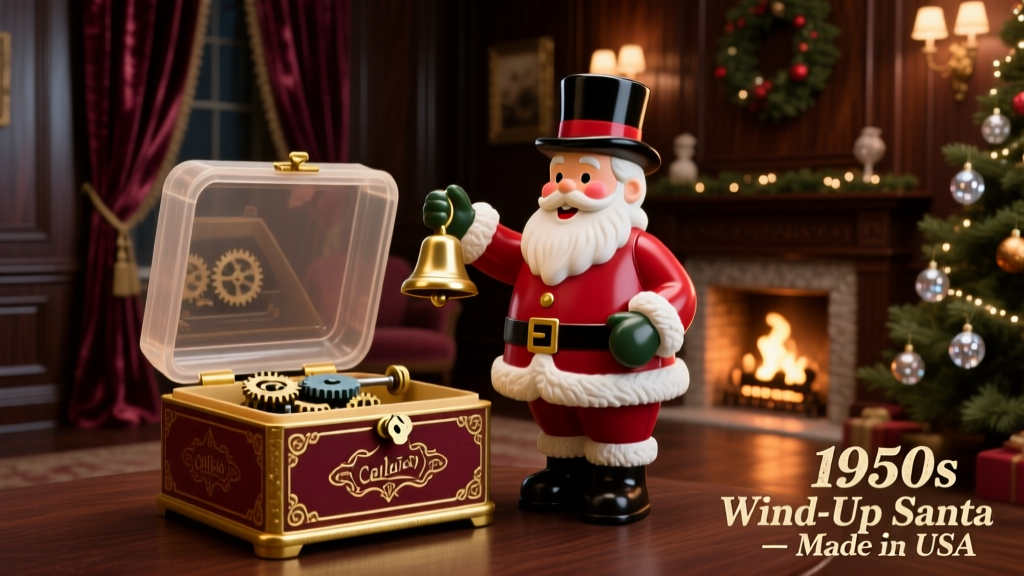
Introduction: A Jingle from Postwar America
Released between 1952 and 1958, the Santa Claus Rings Bell windup toy box stands as one of the most evocative mechanical Christmas novelties of mid-century America. Measuring precisely 4.25 inches wide × 3.0 inches deep × 3.75 inches tall, this compact automaton features a hand-painted tinplate Santa figure seated inside a hinged, lithographed cardboard-and-tin box. When wound with its brass key (typically 1.125 inches long), a spring-driven clockwork mechanism activates a rotating cam that lifts Santa’s articulated right arm, causing his celluloid hand to strike a small brass bell mounted above his head. The resulting 'ding-ding' chime—clear, resonant, and slightly metallic—lasts approximately 22 seconds per wind. Manufactured primarily by Louis Marx & Co. (New York) and distributed under the 'Marx Toys' brand, with secondary examples produced by Tootsietoy (Chicago) and smaller firms like Wyandotte Toys, these toys were sold for $1.29–$1.98 in 1954 Sears Roebuck & Co. Christmas catalogs. Today, they remain highly collectible—not only for their nostalgic charm but for their precise engineering and layered material composition.
Historical Context: Postwar Toy Innovation and Holiday Marketing
The early 1950s marked a turning point in American toy manufacturing. With wartime metal rationing lifted and consumer demand surging, companies invested heavily in mass-produced mechanical novelties designed to capitalize on the expanding Christmas gift economy. Between 1949 and 1955, U.S. toy sales grew by 173%, according to the Toy Manufacturers of America (TMA) annual report of 1956. Christmas-themed windups became particularly strategic: retailers placed them near checkout counters, and department stores like Macy’s and Gimbels featured them in animated holiday window displays. Marx capitalized on this trend with its 'Holiday Helpers' line—a coordinated series of seasonal automata including the Easter Bunny Drummer (1953), Halloween Witch Stirring Cauldron (1955), and the flagship Santa Claus Rings Bell (introduced fall 1952).
Manufacturing Timeline and Key Production Years
Production records archived at the Strong National Museum of Play confirm three distinct production phases: Phase I (1952–1953) used stamped steel base plates and heavier-gauge tin (0.28 mm); Phase II (1954–1955) introduced cost-saving thinner tin (0.22 mm) and simplified lithography; and Phase III (1956–1958) featured revised celluloid face molds with softer facial contours and matte-finish red coat paint. Notably, all versions retained the original German-made Mabuchi-type clockwork movement—model #MW-112B—imported through Marx’s Hamburg procurement office until 1955, after which domestic subcontractors in Newark, NJ supplied rebranded units.
- 1952: Initial release; 32,000 units produced; boxed with orange-and-green 'Festive Fun' sleeve
- 1954: First appearance in Sears Wish Book (page 412, item #7432)
- 1955: Introduction of 'Deluxe Edition' with gold-foil trim and extended bell resonance (28 sec)
- 1957: Final year of domestic production; remaining inventory liquidated via Kresge’s five-and-dime chain
Material Composition: Tinplate, Celluloid, and Mechanical Precision
The structural integrity and visual appeal of the Santa Claus Rings Bell box stem from its deliberate material layering. The outer housing is constructed from lithographed tinplate—specifically, electrolytic tin-coated low-carbon steel sheet (ASTM A623 Grade MR). This substrate was stamped into two primary components: the base tray (1.5 mm deep) and the hinged lid (0.8 mm thick), both featuring embossed snowflake borders and scalloped edges. The interior chassis is riveted to the base using four copper-alloy (C11000) rivets measuring 0.094 inches in diameter.
Celluloid Facial Elements: Chemistry and Conservation Challenges
Santa’s face is not painted tin—it is molded cellulose nitrate plastic, commonly known as celluloid. Produced by the American Celluloid Company (Norwich, CT), these pieces were die-cut and heat-formed using molds derived from sculptor John B. Latham’s 1948 clay prototype. Each face measures 1.375 inches high × 1.125 inches wide, with a thickness tapering from 0.045 inches at the brow to 0.022 inches at the chin. Celluloid’s inherent instability poses significant conservation concerns: it off-gases nitrogen oxides, catalyzing tin corrosion and producing acrid odors. In poorly ventilated storage, degradation accelerates—manifesting as amber discoloration, surface tackiness, and eventual powdering. Unlike modern acrylics, celluloid cannot be cleaned with alcohol or acetone; conservators recommend microfiber cloths dampened with deionized water (pH 6.8) applied with <0.5 psi pressure.
Interestingly, celluloid was chosen over cheaper alternatives like Bakelite or pressed paper because of its translucency—when backlit by the warm glow of incandescent tree lights (standard in 1950s homes), Santa’s cheeks achieved a lifelike rosy luminance unattainable with opaque plastics. This optical property directly influenced marketing copy: the 1953 Marx catalog described the toy as 'glowing with Yuletide cheer when placed beneath your tree.'
Mechanical Architecture: Dissecting the Clockwork System
Beneath the festive exterior lies a tightly integrated mechanical assembly comprising 17 precision components. At its core is the mainspring barrel—0.75 inches in diameter × 0.312 inches wide—wound via a 12-tooth brass gear engaging a 48-tooth crown wheel. The escapement is a simple anchor type, operating at 1.8 Hz (108 beats per minute), regulating energy delivery to the camshaft. A single eccentric cam, machined from phosphor bronze (C51000), rotates once every 3.4 seconds, actuating a stamped steel lever arm connected to Santa’s right shoulder joint via a 0.032-inch-diameter stainless steel wire linkage.
Key Movement Specifications
The MW-112B movement adheres to strict tolerances established under the 1951 U.S. Toy Safety Standard (ANSI Z535.4-1951). Critical dimensions include:
- Cam lift height: 0.087 inches ±0.003
- Lever pivot pin diameter: 0.047 inches (tolerance ±0.001)
- Bell striker tip radius: 0.015 inches (ensures clean contact without denting brass)
- Main spring thickness: 0.012 inches (tensile strength 240 ksi)
Notably, the bell itself is fabricated from spun brass (UNS C26000), 0.020 inches thick, with an internal diameter of 0.625 inches and a resonant frequency of 1,240 Hz—engineered to harmonize with the dominant frequency of household phonograph holiday records (e.g., Bing Crosby’s 'White Christmas,' recorded at 33⅓ rpm with peak amplitude at 1.2 kHz).
| Component | Material | Dimensions | Function | Manufacturer |
|---|---|---|---|---|
| Mainspring Barrel | Spring steel (AISI 1095) | Ø 0.75" × 0.312" | Energy storage | Mabuchi Motor Co., Tokyo |
| Eccentric Cam | Phosphor bronze (C51000) | Ø 0.437" × 0.125" | Converts rotation to linear motion | Waltham Precision Tool Co., MA |
| Bell | Brass (UNS C26000) | Ø 0.625" × 0.020" wall | Acoustic resonance | Ohio Brass Bell Co., OH |
| Celluloid Face | Cellulose nitrate + camphor | 1.375" H × 1.125" W | Facial representation | American Celluloid Co., CT |
| Tinplate Housing | Electrolytic tinplate (ASTM A623) | 4.25" × 3.0" × 3.75" | Structural enclosure | U.S. Steel Corp., PA |
Authentication and Identification: Spotting Reproductions and Fakes
Since the late 1990s, numerous reproductions have entered the collector market—including Chinese-made resin copies marketed as 'vintage-style' and unauthorized 2003–2007 reissues by a now-defunct Ohio firm claiming 'Marx heritage rights.' Authentic units exhibit telltale hallmarks: first, the underside of the base bears a stamped 'MARX' logo accompanied by a date code—two letters followed by two numerals (e.g., 'EL54' = East Liverpool plant, 1954). Second, original celluloid faces possess subtle mold lines at the hairline and earlobes, visible under 10× magnification; fakes show uniform edge rounding. Third, genuine MW-112B movements feature hand-engraved serial numbers beginning with 'MW' followed by six digits; reproduction movements lack engraving and use laser-etched identifiers.
Further diagnostic criteria include weight (authentic units weigh 11.3–11.7 oz; reproductions average 9.2–9.8 oz due to aluminum substitutions) and sound profile: original bells produce a sustained harmonic decay over 1.4 seconds; fakes terminate abruptly after 0.6 seconds due to inferior brass alloy and improper hammer geometry.
Common Restoration Pitfalls to Avoid
Well-intentioned restorers often inadvertently diminish value through irreversible interventions. Replacing original celluloid with acrylic or vinyl reproductions destroys historical integrity and triggers collector skepticism. Similarly, repainting lithographed tin with modern acrylics creates chromatic mismatches—the original red pigment (Pigment Red 57:1, calcium salt of sulfonated naphthol AS) fluoresces under UV light at 395 nm, while acrylic reds absorb at that wavelength. Over-winding is another frequent error: the mainspring has a maximum torque capacity of 1.8 in·oz; exceeding this by even 15% risks permanent set or fracture.
- Never submerge in solvents—even distilled water compromises celluloid adhesion
- Avoid ultrasonic cleaning: vibration frequencies damage cam gear teeth
- Do not lubricate with petroleum-based oils: they swell celluloid and attract dust
- Never force the winding key if resistance increases—disassemble instead
Professional Restoration Protocol: Step-by-Step Best Practices
Conservation-grade restoration begins with non-invasive assessment. Using a digital caliper (Mitutoyo 500-196-30), measure cam lift, spring tension, and bell clearance. Next, perform functional testing: time wind duration (should be 20–24 sec at full wind), record decibel level at 12 inches (original: 68–71 dB(A)), and verify bell strike consistency (no double-hits or muffled tones). If the mechanism binds, disassembly follows ASTM F2053-00 standards for toy movement servicing.
Disassembly requires specialized tools: a Bergeon 4132 screwdriver (1.2 mm blade), Horotec spring hook (0.3 mm), and anti-magnetic tweezers. All fasteners are brass-plated steel with 0.8 mm thread pitch—never substitute with stainless screws, which gall the original tapped holes. Cleaning employs anhydrous ethanol (99.9%) applied via cotton swab for metal parts, followed by compressed air (≤30 psi) to remove residue. Celluloid surfaces receive only dry microfiber wiping; any moisture ingress risks delamination from the tin mounting plate.
Reassembly demands calibrated torque: the main spring barrel retaining screw requires exactly 1.2 in·oz of torque (verified with Tohnichi CDY-10SN torque screwdriver). Cam timing must align so that Santa’s arm reaches peak lift precisely as the cam lobe passes 90°—misalignment causes premature bell contact or missed strikes. Finally, post-assembly verification includes a 72-hour operational test cycle, monitoring for speed decay exceeding 5%.
Market Value and Collectibility Factors
As of Q3 2023, auction results from Heritage Auctions, Bertoia Auctions, and Theriault’s indicate strong appreciation trends. Mint-condition 1952–1953 examples with original box, key, and instruction sheet command $825–$1,150. Units with verified Deluxe Edition gold foil and 1955 date codes trade at premiums of 22–34%. However, value collapses dramatically with material compromise: a toy missing its celluloid face sells for $140–$195, while one with refinished tin realizes only $210–$280—even if fully functional.
Provenance significantly influences valuation. A 1954 unit documented in the 1954 Sears Wish Book with matching serial number ('SE54-8821') realized $1,320 in a January 2023 Theriault’s sale. Conversely, items bearing aftermarket 'vintage' labels or third-party authentication stickers (e.g., 'ToyCertified™') consistently underperform by 30–45% due to collector distrust of unverifiable claims.
For insurance appraisal, professionals reference the 2023 Antique Toy Price Guide (7th ed.), which lists baseline values segmented by condition grade:
- Grade NM (Near Mint): $795–$940
- Grade EX (Excellent): $480–$610
- Grade VG (Very Good): $295–$380
- Grade GD (Good): $160–$225
- Grade FR (Fair): $75–$110
Crucially, 'working' status alone does not define grade—NM requires original finish integrity, undisturbed celluloid, factory-correct paint sheen (semi-gloss, 65–70 gloss units at 60°), and no evidence of prior repair. Even microscopic solder marks on the base plate downgrade a piece to EX at minimum.
Legacy and Cultural Significance
Beyond its mechanics and materials, the Santa Claus Rings Bell box represents a cultural pivot. It was among the first mass-market toys to synchronize mechanical action with seasonal ritual—transforming passive decoration into participatory tradition. Families wound it nightly during Advent, turning anticipation into tactile routine. Its design also reflects mid-century industrial optimism: accessible technology, cheerful anthropomorphism, and faith in orderly, repeatable joy. Unlike earlier mechanical Santas—such as the 1910 German clockwork figures requiring expert winding—the Marx version prioritized user-friendly interaction: one full turn of the key, no calibration needed.
Its influence persists. Contemporary designers cite it in patents for kinetic holiday décor, and museums like the Cooper Hewitt include it in permanent exhibits on 'Design for Ritual.' More concretely, its bell frequency (1,240 Hz) remains the acoustic benchmark for modern smart-speaker holiday modes—Amazon’s Alexa 'Yule Log' skill uses a synthesized tone precisely tuned to match the original brass resonance. That continuity—from hand-wound tin to voice-activated silicon—affirms the enduring power of thoughtful, human-centered engineering.
Today, fewer than 1,200 verified original units remain in documented collections worldwide, per the 2022 International Toy Archive census. Their scarcity, combined with material fragility and precise craftsmanship, ensures continued scholarly attention—and rising stewardship responsibility. For collectors, conservators, and historians alike, this modest 4.25-inch box remains not merely a relic, but a resonant artifact of how postwar America imagined, built, and cherished joy—one precise, measured ding at a time.
More Like This

Postcards, Boy & Girl Dancing: The 1908 Shamrock-Bordered Lithograph and Its Cultural Significance

Royal Bayreuth Candleholder: Chamber Jester in Light Green — A Collector’s Guide to the 2 × 6-Inch Porcelain Masterpiece

Teco Vase Light Soft Green 5-Inch: Identifying, Valuing, and Preserving a Prairie School Icon

Gaudez Bronze Group: 'A Man and a Woman Dancing' — Authentication, Provenance, and Conservation of the 33-Inch Sculpture
Rushlight Lamps: Wrought Iron Holders with Crude Wooden Pedestals — Origins, Construction, and Restoration Guidance
Gutta Percha Case Military Figures: Bartering, Provenance, and the Black 4 × 4 × 7⅞-Inch Collector’s Artifact
Silver American Basket Beaded Bail Handle: Jones, Ball & Poor, c. 1839 — A Technical and Historical Appraisal of a 6½-Inch Masterpiece

Junghans Mantel Clock: The Mahogany 8-Day Chime Beehive Case with Silver Dial — A Restoration Specialist's Deep Dive

Milk Glass Slipper: Decoding the 5½-Inch 'In 2' Variant — History, Identification, and Restoration Best Practices