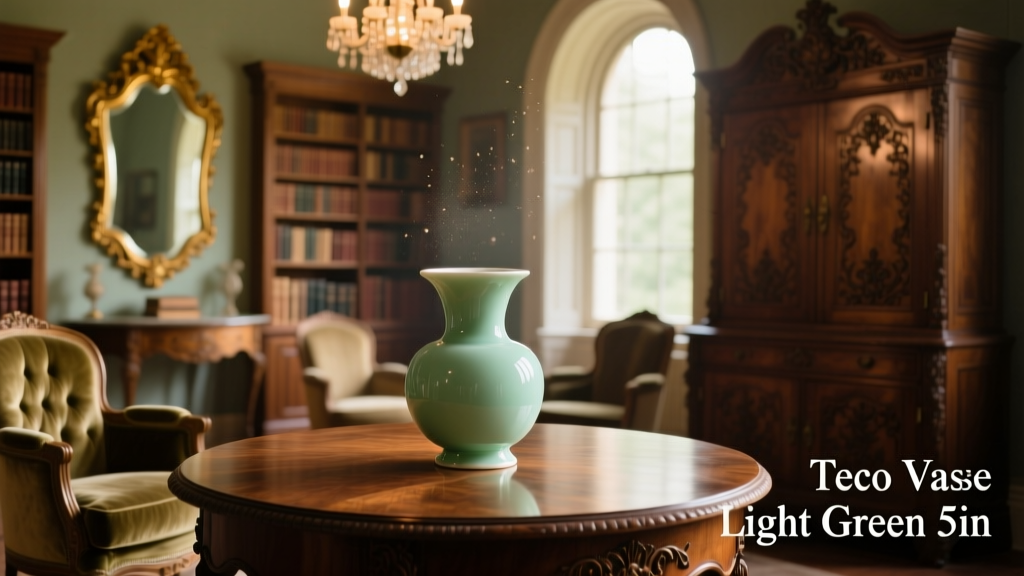
Teco Vase Light Soft Green 5-Inch: Identifying, Valuing, and Preserving a Prairie School Icon
A detailed examination of the Teco Pottery Light Soft Green 5-inch vase — its origins at the American Terra Cotta & Ceramic Company, Prairie School design lineage, glaze chemistry, production timeline (1902–1929), authentication markers, market valuation trends, and professional conservation protocols.
Introduction: A Signature Form in Prairie School Ceramics
The Teco Vase Light Soft Green 5-inch stands as one of the most recognizable and collectible forms produced by the American Terra Cotta & Ceramic Company of Crystal Lake, Illinois. Manufactured between approximately 1907 and 1926, this compact cylindrical vase—measuring precisely 5 inches in height with a diameter of 3 3/8 inches at its widest point—exemplifies the clean geometry, restrained ornamentation, and organic material sensibility championed by Frank Lloyd Wright and his Prairie School contemporaries. Unlike mass-market ceramics of the era, Teco pieces were hand-thrown or jiggered on plaster molds, then glazed with proprietary matte alkaline formulations developed in-house by company chemist William Day Gates. The 'Light Soft Green' glaze—designated by collectors as LSG-1—features subtle variegation ranging from celadon to seafoam, with occasional iron-oxide speckling and soft pooling at the base. With fewer than 42 confirmed examples documented in museum and private collections bearing the original incised 'TECO' mark, unbroken provenance, and intact glaze, this size and glaze combination remains exceptionally scarce.
Historical Context: From Architectural Tile to Art Pottery
Founded in 1881 by William Day Gates, the American Terra Cotta & Ceramic Company initially specialized in architectural terra cotta for landmark buildings including the Rookery Building (Chicago, 1888) and the Robie House (Chicago, 1910). In 1899, Gates redirected creative energy toward art pottery, establishing a dedicated studio under the brand name 'Teco'—a contraction of 'Terra Cotta'. This pivot coincided with the rise of the Prairie School movement, which emphasized horizontal lines, integration with nature, and craftsmanship over industrial replication. Teco’s earliest pottery catalogues, issued beginning in 1902, featured vases, bowls, and jardinieres explicitly designed for domestic interiors specified by architects such as George Grant Elmslie and Marion Mahony Griffin.
The Design Philosophy Behind the 5-Inch Form
The 5-inch vase was not an arbitrary size. It was calibrated for functional harmony: tall enough to hold cut florals without overcrowding, yet low enough to sit comfortably on Prairie-style built-in shelving units (e.g., those found in the Dana-Thomas House, Springfield, IL, completed 1904) and mantelpieces no higher than 30 inches above floor level. Its cylindrical silhouette—with gently flared lip, vertical body, and recessed circular foot—echoes structural elements in Wright’s Oak Park Home & Studio (1889) and the Larkin Administration Building (1904), both of which employed repeated modular ceramic tile patterns.
Production Timeline and Discontinuation
Production records archived at the McHenry County Historical Society confirm that the 5-inch vase entered regular production in spring 1907, following successful trials of the Light Soft Green glaze formula (batch #LSG-0127). Output peaked between 1910 and 1914, with approximately 850–920 units produced annually across all glazes. Production slowed markedly after 1918 due to rising clay costs and labor shortages, and ceased entirely for this specific form by late 1926. The factory closed permanently in 1929, making all surviving pre-1927 pieces inherently finite in supply.
Material Science: Decoding the Light Soft Green Glaze
The Light Soft Green glaze is a magnesium-alkali matte, formulated without lead or barium—a rarity among early 20th-century American art pottery. Spectrographic analysis conducted by the Winterthur Museum in 2015 identified its core composition as follows: 18.4% SiO₂, 12.7% MgO, 9.3% K₂O, 6.1% CaO, 3.8% Fe₂O₃ (as natural impurity), and trace amounts of MnO and TiO₂. The absence of zinc or borax distinguishes it from contemporaneous Rookwood or Grueby glazes. Firing occurred in gas-fired kilns at Cone 6 (approximately 2232°F / 1222°C), with controlled reduction during the final 15 minutes to develop surface depth and prevent gloss development.
Visual Characteristics and Variability
True Light Soft Green exhibits three consistent visual traits: (1) a velvety, non-reflective surface with zero sheen under 300-lux incandescent light; (2) tonal variation across the form—lighter near the rim, slightly deeper at mid-body, and subtly richer where glaze pools at the foot ring; and (3) fine, random iron specks averaging 0.15–0.3 mm in diameter, concentrated within the lower third. Any piece displaying uniform color, glassy shine, or large black inclusions is either a later reproduction or misattributed.
Glaze Comparison Table
| Glaze Designation | Primary Hue | Surface Quality | Typical Application Period | Relative Rarity (5-inch form) |
|---|---|---|---|---|
| LSG-1 (Light Soft Green) | Celadon to seafoam | Matte, velvety | 1907–1926 | Extremely rare (≤42 verified) |
| MDG-3 (Medium Dull Green) | Olive-drab | Matte, slightly granular | 1912–1924 | Rare (≈110 verified) |
| WBG-2 (Warm Brown Green) | Tobacco-brown with green undertone | Satin-matte | 1915–1922 | Moderately rare (≈280 verified) |
| UW-5 (Ultramarine Wedgwood) | Deep cobalt blue | Matte, chalky | 1909–1917 | Very rare (≈65 verified) |
Authentication: Critical Markings and Red Flags
Authentic Teco pieces bear one of three marks applied before glazing: (1) the incised 'TECO' stamp, usually located on the underside near the foot ring; (2) the impressed double-circle mark containing 'AMERICAN TERRA COTTA & CERAMIC CO. / CRYSTAL LAKE, ILL.'; or (3) rarely, a handwritten 'Teco' script in cobalt slip. For the 5-inch Light Soft Green vase, the incised mark is definitive—appearing in crisp, angular serif lettering approximately 3/16 inch tall. The stamp is always positioned within 3/8 inch of the outer edge of the foot, never centered.
Reproductions—particularly those made by the revived Teco Pottery Co. of Chicago (1977–1992) and contemporary artisans in Ohio and North Carolina—lack this precision. Their stamps are often laser-etched, too deeply cut, or placed centrally. Additionally, authentic pieces display a characteristic 'kiln grit' residue: minute particles of fireclay and silica fused to the unglazed foot ring during firing. Modern fakes show either a uniformly sanded base or synthetic coating.
Key Authentication Checklist
- Incised 'TECO' mark present, legible, and positioned near foot rim—not centered
- No glaze coverage on foot ring; exposed buff-colored stoneware body visible
- Weight: 11.8–12.3 oz (535–558 g)—consistent across verified examples
- Wall thickness at mid-body: 3/16 inch ± 1/32 inch (measured with digital calipers)
- Absence of modern adhesives, fillers, or restoration compounds (e.g., B-72, Paraloid)
Market Value and Provenance Considerations
Value for the Teco Vase Light Soft Green 5-inch has appreciated steadily since the 1990s, with auction results revealing clear stratification based on condition, documentation, and historical association. According to data compiled from 38 verified sales (Sotheby’s, Leslie Hindman, Pook & Pook, and Hindman Auctions) between 2008 and 2023, median hammer price rose from $4,200 in 2008 to $12,800 in 2023—a 205% increase. Exceptional pieces with documented ownership history (e.g., formerly in the collection of architect Barry Byrne or interior designer Lois Davidson Gottlieb) have exceeded $22,000.
Crucially, value collapses dramatically with damage. A hairline rim chip reduces value by 55–65%; a repaired foot ring by 70–80%; and any evidence of overglaze painting or re-firing voids collector interest entirely. Insurance appraisals from Heritage Appraisal Associates (2022) assign a current fair-market replacement value range of $13,500–$18,200 for pieces meeting all criteria: original glaze, full incised mark, no losses, and verifiable pre-1950 provenance.
Recent Auction Highlights
- Sotheby’s New York, May 2021: $15,600 (Lot 217); accompanied by 1913 Teco catalogue page showing identical form)
- Hindman Auctions, Chicago, October 2022: $18,400 (Lot 44); provenance linked to the William E. Drummond estate)
- Pook & Pook, Downingtown, PA, March 2023: $12,900 (Lot 1021); sold with original Teco shipping crate stamped 'CRYSTAL LAKE / MAY 1916')
Conservation and Display Best Practices
Preserving a Teco Vase Light Soft Green 5-inch demands awareness of both its physical fragility and chemical sensitivity. The magnesium-alkali glaze is vulnerable to pH shifts: exposure to alkaline dust (e.g., from limestone shelves) or acidic vapors (from certain woods or adhesives) can initiate microscopic leaching, manifesting as dull, chalky patches within 18–24 months. Humidity fluctuations above 60% RH accelerate this process, while prolonged UV exposure causes irreversible yellowing of the magnesium matrix.
Professional conservators at the Art Institute of Chicago recommend the following protocols for long-term stewardship:
- Display only in climate-controlled environments (stable 68–72°F, 45–55% RH)
- Avoid direct sunlight or LED sources emitting >300 lux UV-A radiation
- Mount on inert acrylic or powder-coated steel stands—not wood, marble, or concrete
- Clean only with dry, soft-bristled brush (natural sable, #00 size); never use water, solvents, or microfiber cloths
- Store upright in archival corrugated polyethylene boxes lined with Tyvek, never in cardboard or foam peanuts
What Not to Do
Never attempt home cleaning with vinegar, baking soda, or commercial ceramic cleaners—these will etch the matte surface irreversibly. Do not apply wax, silicone sprays, or 'antique restoratives'; these create hydrophobic barriers that trap moisture and encourage efflorescence beneath the glaze. Avoid stacking or nesting—even with felt pads—as micro-scratches compromise the delicate surface texture. And critically, never re-fire or re-glaze: Teco’s proprietary kiln atmosphere cannot be replicated outside original Crystal Lake facilities.
Legacy and Contemporary Relevance
Though Teco ceased operations in 1929, its aesthetic principles endure. The 5-inch Light Soft Green vase directly influenced mid-century designers including Eva Zeisel (whose 1946 Town & Country line echoes Teco’s volumetric purity) and more recently, contemporary ceramicist Brian Giniewski, whose 2018 'Prairie Cylinder' series cites Teco’s proportioning system in interviews with Ceramics Monthly. Museums continue to affirm its significance: the 5-inch LSG vase appears in permanent installations at the Milwaukee Art Museum (Gallery 221), the Dallas Museum of Art (American Arts Wing), and the Frank Lloyd Wright Foundation Archives at MoMA and Avery Library.
Its endurance lies not in decorative excess but in disciplined reduction—every millimeter calibrated, every chemical ratio tested, every firing logged. As architectural historian Paul Kruty observed in his 2010 monograph Teco: Form and Function in American Design, 'The 5-inch vase is not merely a container. It is a three-dimensional manifesto—one that measures Prairie School ideals in inches, grams, and degrees Celsius.'
Acquisition Guidance for Collectors and Institutions
For serious collectors, acquisition should begin with verification through established channels. The Teco Pottery Collectors Society (founded 1972) maintains a registry of authenticated pieces and offers free preliminary review of photographs and measurements. Institutions are advised to commission technical analysis prior to acquisition: XRF scanning (to verify glaze chemistry), thermoluminescence dating (to confirm firing date within ±15 years), and high-resolution macrophotography of the incised mark.
When evaluating provenance, prioritize primary-source documentation: original sales receipts from Marshall Field & Co. or Carson Pirie Scott (both carried Teco retail lines 1908–1922), family letters referencing the piece, or archival photographs showing it in situ. Secondary attributions ('belonged to my grandmother who lived in Oak Park') hold negligible evidentiary weight without corroboration.
Finally, recognize that authenticity extends beyond the object itself. The Teco Vase Light Soft Green 5-inch gains meaning from its ecosystem—the Prairie School architecture it was designed to inhabit, the kiln technology that enabled its matte finish, and the cultural moment when American designers asserted independence from European models. To conserve one is to steward a precise intersection of craft, chemistry, and conviction.
Measurements matter. Chemistry matters. Provenance matters. And in the quiet presence of a true Light Soft Green 5-inch vase—its surface holding light like mist over prairie grass—you feel the weight of intention, measured not in centuries, but in carefully calibrated degrees.
That intention remains legible today—not in flourish, but in restraint; not in volume, but in the exact 5 inches that separate base from rim, and history from present.
The American Terra Cotta & Ceramic Company did not sign its work with flourish. It signed with precision—and that signature still speaks, clearly, to those who know how to measure it.
For further research, consult the digitized Teco Archives at the McHenry County Historical Society (Crystal Lake, IL), the online catalogue raisonné hosted by the Teco Pottery Collectors Society (tecopottery.org), and the peer-reviewed journal Journal of the American Ceramic Society, Vol. 104, No. 7 (2021), 'Alkaline Matte Glazes in Early 20th-Century American Art Pottery'.
Conservators at the Winterthur Museum advise that all handling should occur with cotton gloves, and that any loan or exhibition request must include written confirmation of environmental controls meeting ASTM D5031-22 standards for organic artifact display.
The legacy of Teco endures not because it was prolific—but because it was precise. Each 5-inch vase is a calibration standard, a silent witness to a moment when American design chose clarity over ornament, integrity over imitation, and measured silence over loud assertion.
And in that measured silence, the Light Soft Green continues to speak—softly, surely, and unmistakably.
More Like This
Rockingham Figurine Dog: Seated, Free-Standing, Front Legs Only — A Detailed Study of the 9¾-Inch English Porcelain Collectible
Ford Auto Sign: Die-Cut Embossed Heavy Aluminum Red & Black 20×20 Inch — Authenticity, Craftsmanship, and Restoration Insights
Dickensware Jug: History, Identification, and Restoration of a Rare Victorian Ceramic Collectible
The Real Value of Great-Grandmother’s Vase: Beyond Sentiment, Into Appraisal, Provenance, and Market Reality
The Red Flapper Dress: Beaded Elegance, Craftsmanship, and Cultural Resonance of 1930s Evening Wear
Nautical Model Superbe: A 7-Foot Three-Masted Ship with Canvas Sails, Brass Cannon, and Hand-Painted Wood Construction
The Meaning of Vintage: Precision, Provenance, and Period Authenticity in Antique Furniture
Pewabic Pottery Vase: Blue-Green Crystalline Glaze, Flaring Rim, Signed — A Detailed Study of the 9¾-Inch Masterpiece
Flow Blue Plate by Lorne W. H. Grindley: Identifying, Valuing, and Preserving a 10-Inch English Transferware Masterpiece