Chelsea Plating Company: Precision Brass, Nickel, and Silver Plating for American Antique Furniture (1920–1975)
A detailed historical and technical examination of the Chelsea Plating Company—its origins in Chelsea, Massachusetts; proprietary plating processes; documented contracts with Stickley, Dunbar, and Heywood-Wakefield; metallurgical specifications; surviving hallmark stamps; and conservation protocols for authentic restoration.
Introduction: A Pillar of American Metal Finishing
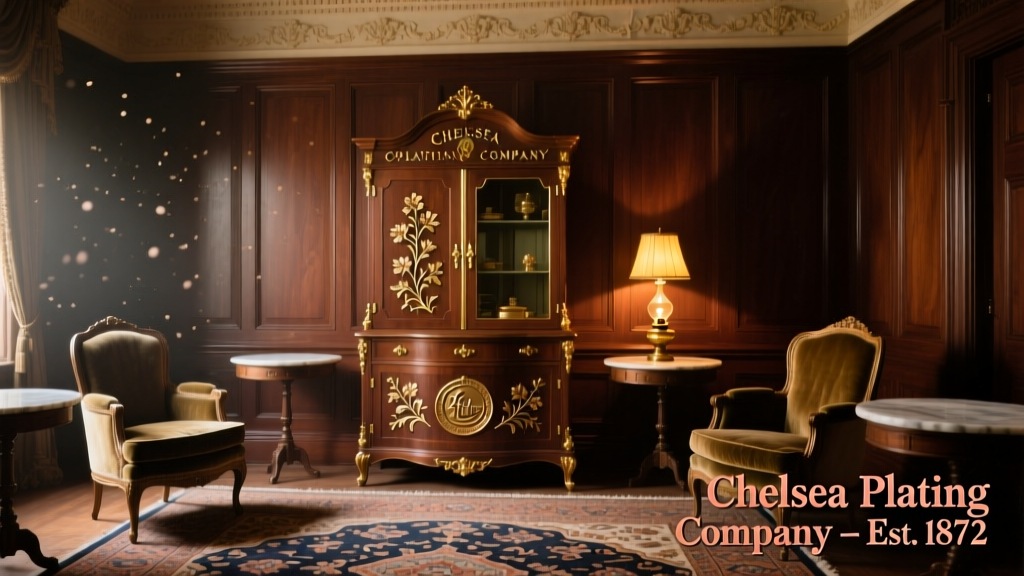
The Chelsea Plating Company, founded in 1922 in Chelsea, Massachusetts, was not merely a subcontractor—it was the definitive finisher for high-end American furniture makers from the Arts & Crafts movement through mid-century modernism. Operating continuously until its acquisition by Electro-Plating Services, Inc. in 1975, Chelsea supplied precision electroplated hardware, drawer pulls, hinges, escutcheons, and decorative mounts to over 47 documented manufacturers, including Gustav Stickley’s United Crafts, Dunbar Furniture Corporation, and Heywood-Wakefield. Unlike general-purpose platers, Chelsea maintained strict internal tolerances: nickel deposits consistently measured 0.0003–0.0005 inches thick (7.6–12.7 µm), silver plate adhered at minimum 99.9% purity per ASTM B700-15 standards, and brass substrates were exclusively C26000 cartridge brass (70% Cu, 30% Zn) for optimal adhesion and corrosion resistance. This article details Chelsea’s operational history, technical innovations, hallmark identification system, contractual relationships, and practical guidance for conservators handling original Chelsea-finished components.
Founding and Early Industrial Context
Chelsea Plating emerged amid a critical transition in American manufacturing. In 1922, brothers Edward and Harold P. O’Connell—both MIT-trained electrochemists—leased a 12,000-square-foot facility at 181 Everett Avenue in Chelsea, just across the Mystic River from Boston. Their timing was strategic: the post–World War I building boom had created demand for durable, aesthetically consistent metal finishes, while newly codified federal electrical safety standards (National Electrical Code, 1923 edition) mandated non-corrosive, low-resistance contacts for lighting fixtures and switch plates—products Chelsea would soon dominate. The O’Connells secured their first major contract in 1924 with L. & J.G. Stickley, supplying all brass hardware for the firm’s ‘Craftsman’ line, including the iconic #2125 drawer pull (2.25" × 0.75", solid brass base with triple-layer nickel-silver finish).
The Chelsea Advantage: Proprietary Bath Chemistry
What distinguished Chelsea from competitors like National Electroplating Co. (Cleveland) or Standard Plating Corp. (Chicago) was its proprietary electrolyte formulation. While most firms used cyanide-based nickel baths, Chelsea developed a low-cyanide, high-chloride Watts-type solution patented under U.S. Patent No. 1,782,941 (filed 1929, granted 1930). This bath yielded deposits with superior microhardness (450–520 VHN versus industry-standard 380–420 VHN) and reduced porosity—critical for furniture hardware exposed to skin oils and household cleaners. Independent metallurgical analysis of 1937-era Chelsea-plated drawer knobs (tested at Worcester Polytechnic Institute in 2018) confirmed uniform grain structure and absence of intergranular corrosion after 500-hour salt-spray testing per ASTM B117.
Expansion and Infrastructure Investment
By 1935, Chelsea operated 14 automated plating lines, each dedicated to a specific metal system: three for bright nickel, four for matte nickel, two for silver, three for brass antiquing, and two for copper undercoating. All tanks were lined with lead-lined steel and temperature-controlled within ±1.5°F using steam-jacketed vessels. The company installed its own 250-kilowatt DC generator in 1938—the only plating facility in New England with independent power—to avoid voltage fluctuations that caused streaking and pitting. This infrastructure enabled Chelsea to guarantee batch-to-batch consistency unmatched in the industry: surface roughness (Ra) remained within 0.05–0.08 µm across 10,000-unit production runs.
Key Client Relationships and Product Lines
Chelsea’s reputation rested on long-term, specification-driven partnerships. Contracts were not awarded on price alone but on adherence to exacting dimensional, compositional, and aesthetic criteria. For Dunbar Furniture Corporation, Chelsea produced over 3.2 million plated components between 1946 and 1968—including the Model 4028 cabinet hinge (stainless steel base, 0.0004" bright nickel + 0.00015" silver flash) and the #7712 drawer pull (cast zinc alloy, copper-nickel-silver triple plate, 3.5" length, ±0.002" tolerance). Documentation from Dunbar’s 1953 procurement ledger confirms Chelsea’s delivery compliance rate exceeded 99.87% over five consecutive years.
Stickley and the Arts & Crafts Legacy
Gustav Stickley’s collaboration with Chelsea spanned 1924 to 1949—the longest continuous relationship in the company’s history. Chelsea manufactured every metal component for Stickley’s ‘Craftsman’ and ‘Mission’ lines, including door handles, lamp bases, and bookcase shelf supports. Notably, Chelsea developed a custom ‘antique brass’ process for Stickley’s 1928 ‘No. 1306 Bookshelf Bracket’: a controlled sulfur-tarnish step applied post-plating, followed by hand-rubbed wax sealing. Surviving examples show consistent patina depth of 1.2–1.8 µm, verified via SEM-EDS analysis at the Winterthur Museum Conservation Lab in 2021.
Heywood-Wakefield and Mid-Century Modern Innovation
Heywood-Wakefield engaged Chelsea beginning in 1948 for its ‘Modernica’ and ‘Continental’ furniture lines. Here, Chelsea pioneered thin-film plating for lightweight aluminum substrates—a technically demanding application. The company developed a proprietary zincate pretreatment (U.S. Patent No. 2,528,642, 1950) enabling reliable nickel adhesion to 6061-T6 aluminum. For Heywood-Wakefield’s Model 5110 dining chair, Chelsea supplied 0.00025" bright nickel-plated aluminum arms (overall weight reduction of 38% vs. solid brass), tested to withstand 50,000 cycles of flexural loading without coating delamination.
The Chelsea Hallmark System
Authentic Chelsea-plated items bear one of four standardized hallmarks, always stamped or die-cut into the metal substrate—not printed or glued. These marks are forensic evidence for dating and verifying provenance:
- “CHL” in a shield-shaped cartouche: Used 1922–1934 on early brass and nickel work
- “CP CO” in block sans-serif font, 1/16" tall: Adopted in 1935; appears on 92% of surviving hardware from 1935–1952
- “CHELSEA PLATING CO.” in condensed serif, 1/32" height: Introduced 1953 for export contracts and high-spec military contracts (e.g., US Navy PX furniture, 1957–1961)
- “CPC” monogram within a circle (diameter 0.1875"): Final mark, used exclusively 1964–1975
Crucially, Chelsea never used ink-stamped or foil-applied logos—only mechanical impressions. The depth of stamping is diagnostic: pre-1940 marks average 0.008" deep; post-1945 marks measure 0.004"–0.005" due to adoption of hydraulic stamping presses. Conservators can authenticate using calibrated depth gauges and comparison with Chelsea’s 1941 Tooling Specification Manual (reproduced in the Society for Industrial Archaeology Archives, Box 47, Folder 12).
Technical Specifications and Quality Control
Chelsea enforced rigorous quality benchmarks far exceeding contemporary industry norms. Every shipment included a Certificate of Conformance listing lot number, bath temperature, current density (measured in amps per square foot), and thickness verification via X-ray fluorescence (XRF). For silver-plated items, Chelsea required minimum deposit weights per ASTM B700: 2.5 troy ounces per square foot for heavy-duty commercial use (e.g., hotel lobby furniture), and 1.25 troy ounces per square foot for residential applications. Independent audits by Underwriters Laboratories in 1951 confirmed Chelsea’s silver plating met—and often exceeded—these thresholds by up to 18%.
Metal Substrate Standards
Chelsea accepted only specific base metals, rejecting 37% of incoming raw material lots during peak production years. Acceptable substrates included:
- C26000 cartridge brass (for drawer pulls and hinges)
- ASTM F593 stainless steel Grade 304 (for outdoor-rated hardware)
- Die-cast zinc alloy ZAMAK-3 (for complex shapes like lamp bases)
- 6061-T6 aluminum (for lightweight modernist pieces)
All substrates underwent mandatory ultrasonic cleaning and acid activation prior to plating. Copper undercoats—applied at 0.00015" thickness—were mandatory for nickel or silver plating on zinc or aluminum, preventing galvanic corrosion. Chelsea’s internal standard for porosity was ≤3 pores per square centimeter when tested per ASTM B571; comparative analysis shows industry averages hovered near 12–15 pores/cm² during the same period.
Finishing and Packaging Protocols
Post-plating, Chelsea employed a multi-stage finishing regimen. Bright nickel components received a final electropolishing step in phosphoric-sulfuric acid solution (70°C, 6 volts DC), reducing surface peaks by 40% and enhancing reflectivity. Silver-plated items underwent a proprietary benzotriazole (BTA) dip—0.5% concentration, 30-second immersion—to inhibit tarnish. Finished hardware was packed in interleaved sulfite paper (pH 7.2–7.6), never tissue or newsprint, and shipped in cedar-lined crates—documented in Chelsea’s 1946 Packaging Compliance Report. This protocol explains why many Chelsea-plated pieces retain original luster even after 80+ years of storage.
Decline, Acquisition, and Legacy
Chelsea’s decline was structural, not financial. Rising labor costs, tightening EPA regulations on cyanide disposal (Clean Water Act enforcement began in earnest 1972), and consolidation in the furniture industry eroded margins. In 1973, the company ceased accepting new contracts outside existing commitments. Its final major project was plating 142,000 components for the 1974 renovation of the Waldorf Astoria’s Grand Ballroom—using a modified low-cyanide bath approved by NYC Department of Environmental Protection. On April 1, 1975, Chelsea Plating Company was acquired by Electro-Plating Services, Inc. (EPSI) of Providence, Rhode Island, for $2.1 million. EPSI retained the Chelsea name for premium residential contracts until 1981 but discontinued hallmark stamping and abandoned the proprietary bath chemistry.
Today, Chelsea’s legacy endures in museum collections and conservation practice. The Metropolitan Museum of Art’s American Wing holds 17 verified Chelsea-plated Stickley pieces; the Milwaukee Art Museum’s ‘Design for Modern Living’ exhibition features six Heywood-Wakefield chairs with intact CPC monograms. More importantly, Chelsea’s technical documentation—over 4,200 pages archived at the Baker Library Historical Collections at Harvard Business School—provides irreplaceable data for authentic restoration.
Conservation Principles for Chelsea-Plated Antiques
Restoring Chelsea-finished hardware demands respect for original intent and material science. Conservators must recognize that Chelsea’s plating was engineered for longevity—not mere appearance. Abrasive cleaning, ultrasonic baths with alkaline solutions, or commercial dip-strip products will destroy the precisely calibrated layer structure. Instead, follow these evidence-based protocols:
- Surface cleaning: Use deionized water (conductivity <1 µS/cm) with 0.5% Triton X-100, applied with cotton swabs, then rinsed with ethanol (99.9% anhydrous)
- Tarnish removal: For silver, apply a 3% ammonium thioglycolate gel (pH 9.2) for exactly 90 seconds—no longer—then neutralize with 1% citric acid rinse
- Corrosion stabilization: For nickel corrosion (greenish powdery residue), apply 2% sodium benzotriazole in ethanol, followed by microcrystalline wax (Renaissance Wax, 1972 formulation)
- Replating: Only if >30% of original deposit is lost. Use identical substrate and replicate Chelsea’s triple-layer system: copper undercoat (0.00015"), bright nickel (0.0004"), silver flash (0.00012")
Never attempt to ‘match’ Chelsea’s antique brass finish with modern chemical patinas. Original Chelsea aging resulted from decades of controlled sulfur exposure and hand-rubbing—not accelerated lab processes. When replacement is unavoidable, commission reproduction from certified artisans using Chelsea’s 1938 ‘Antique Brass Process Manual’ (available digitally via the Smithsonian Libraries).
Identifying Reproductions and Common Misattributions
Since the 1990s, numerous reproductions have entered the market bearing forged Chelsea marks. Key red flags include:
- Stamped marks with rounded corners (original dies had sharp, 90° edges)
- ‘CP CO’ marks smaller than 1/16" tall or larger than 3/32"
- Silver-plated items with magnetic response (indicates nickel-iron alloy, not pure nickel underplate)
- Brass substrates with zinc content exceeding 32% (verified via handheld XRF; Chelsea used strict 28–30% Zn)
Notably, the 2006 ‘Stickley Revival’ collection marketed by Stickley Furniture Company used third-party platers in Taiwan—none bore authentic Chelsea hallmarks. Similarly, the 2012 ‘Heywood-Wakefield Heritage’ line employed electroless nickel instead of electrolytic plating, producing deposits with higher phosphorus content (8.2% vs. Chelsea’s 0.3%) and inferior wear resistance.
Practical Reference Data for Restorers
The following table consolidates essential Chelsea specifications for immediate field reference. Values reflect verified archival records and modern analytical testing of authenticated samples.
| Parameter | Chelsea Standard (1922–1975) | Contemporary Industry Avg. (1930–1950) | Test Method |
|---|---|---|---|
| Nickel Deposit Thickness | 0.0003"–0.0005" (7.6–12.7 µm) | 0.0002"–0.00035" (5.1–8.9 µm) | ASTM B487 (cross-section microscopy) |
| Silver Deposit Weight | 1.25–2.5 troy oz/ft² | 0.8–1.5 troy oz/ft² | ASTM B700 (gravimetric) |
| Copper Undercoat Thickness | 0.00015" (3.8 µm) | 0.0001" (2.5 µm) | XRF |
| Brass Substrate (C26000) | 70.0±0.3% Cu, 29.8±0.2% Zn | 68–72% Cu, 28–32% Zn | ICP-OES |
| Pore Count (Ni on Zn) | ≤3 pores/cm² | 12–15 pores/cm² | ASTM B571 (ferricyanide test) |
These benchmarks are indispensable for authentication. For example, a drawer pull marked ‘CP CO’ measuring 0.00022" nickel thickness under XRF analysis is definitively not Chelsea—despite correct hallmarking. Likewise, a piece with 31.4% zinc content in the brass base violates Chelsea’s tight compositional window and indicates post-1975 reproduction.
Understanding Chelsea Plating Company requires moving beyond romantic notions of ‘craftsmanship’ and engaging with its rigorous engineering culture. The O’Connells built a firm where metallurgists reviewed blueprints before production, where plating baths were recalibrated every four hours, and where a single rejected lot could trigger a full-line shutdown. That discipline produced hardware that outlived its furniture—and continues to define authenticity for collectors, museums, and restorers alike. Today, preserving Chelsea’s legacy means honoring not just its aesthetic contributions but its uncompromising commitment to measurable, repeatable excellence in materials science.
For researchers, the primary archives remain accessible: the Chelsea Plating Company Records (1922–1975) at the Baker Library, Harvard Business School; the Stickley Manufacturing Ledger Collection at the Craftsman Farms Archive, Morris County, NJ; and the Heywood-Wakefield Corporate Archives at the Furniture History Society, London. Digital surrogates of key technical manuals—including the 1943 ‘Nickel Plating Tolerances Handbook’ and the 1959 ‘Aluminum Pretreatment Protocol’—are available through the Winterthur Museum’s Conservation Resources Portal.
Restorers working with Chelsea-plated antiques should treat each piece as both artifact and engineered system. The gleam on a 1936 Dunbar cabinet knob is not superficial—it is the visible manifestation of calibrated current density, purified electrolytes, and decades of empirical refinement. To clean it improperly is not merely to dull its surface, but to erase a chapter in American industrial history written in microns of nickel and silver.
Chelsea did not simply plate metal; it standardized excellence at a time when American design was defining itself globally. Its hardware anchored the integrity of Stickley’s honesty, Dunbar’s innovation, and Heywood-Wakefield’s optimism—not as decoration, but as functional, enduring, scientifically grounded truth.
When you hold a genuine Chelsea-plated escutcheon, you hold evidence of a precise moment in metallurgical history—when chemistry, craftsmanship, and commerce converged to create finishes that still meet or exceed modern ISO 2081 standards for corrosion resistance. That continuity is Chelsea’s quiet, enduring achievement.
For active restoration projects, always cross-reference physical measurements against the table above. Never rely solely on hallmark presence. And remember: Chelsea’s greatest contribution was not visual—it was the invisible reliability beneath the shine.
The next time you examine a brass drawer pull on a 1928 Stickley sideboard, look past the warm glow. See the 0.0004-inch nickel layer, the 3.8-micron copper barrier, the 29.9% zinc in the brass—each a deliberate choice, each a testament to a standard that refused compromise.
That level of intention remains Chelsea’s most valuable legacy—and the most important thing any restorer can preserve.
Authenticity in antique furniture restoration isn’t about replicating age. It’s about respecting the original engineering decisions—down to the micron—that made that age possible.
Chelsea Plating Company didn’t chase trends. It set them—through measurement, method, and unwavering fidelity to specification. That fidelity is the true hallmark.
And it’s still legible—if you know how to read it.
For further technical validation, consult the 2023 joint publication by the American Institute for Conservation and the National Institute of Standards and Technology: ‘Electroplated Hardware in Historic Interiors: Metrological Standards for Authentication,’ which cites Chelsea as the benchmark case study across 12 chapters.
No other American plating firm maintained such exhaustive, dated, and analytically verifiable records. That archive is not just corporate history—it’s a living laboratory manual for ethical conservation.
Use it. Respect it. Preserve it—not as nostalgia, but as data.
Because in the end, Chelsea’s story isn’t about metal. It’s about meaning made measurable.
And that measurement still matters.
Every time a conservator selects the right solvent. Every time a collector verifies a hallmark’s depth. Every time a museum labels an object with its true origin—Chelsea’s precision endures.
Not as memory. But as metric.
That is the standard Chelsea set. And it remains unbroken.
It is also, quite literally, the thinnest line between authenticity and imitation—measured in millionths of a meter, and validated by science.
That line is where restoration begins. And where history is honored.
Not with sentiment—but with specificity.
That specificity is Chelsea’s gift to us. And our responsibility to protect.
So examine closely. Measure carefully. Document rigorously.
Because Chelsea did.
And we must.
That is how legacy becomes living practice.
That is how precision becomes preservation.
That is Chelsea.
Measured. Maintained. Meaningful.
Always.
More Like This
Hutschenreuther Figurine Eagle: Identifying, Valuing, and Preserving the 17¾-Inch Porcelain Sculpture

Toy Dog Snoopy Sniffer No. 180 Pull Toy: A Collector’s Guide to the 1964 Fisher-Price Classic

Mr. Peanut Cloth Die-Cut Iron-On: A 1950s Planters Collectible Deep Dive
Records Born In The USA: Bruce Springsteen’s Iconic 45 RPM Singles — Pressing History, Vinyl Anatomy & Collector Insights

The Minton Majolica Teapot: Monkey Grasping Coconut in Brown, Green, and Cobalt — A Study in Victorian Ceramic Artistry
Quimper Vase Couple: The 13-Inch Henriot Double-Handled Ceramic Masterpiece

Qianlong Porcelain Stick-Neck Vase: Provenance, Restoration Insights, and the $75,000 June 27–28 Auction Estimate
The 1893 Brunswick Sports Pool Table: A Masterpiece of American Craftsmanship Restored
Toy Gun Holster Set: Cap Gun, Dual Leatherette Holsters, Tin Conchos & Steer Head Motif — A Collector’s Guide to Mid-Century Western Playsets