Charles Pryse: The Forgotten Welsh Cabinetmaker Who Defined Late Georgian Elegance
A detailed examination of Charles Pryse (1758–1823), the Aberystwyth-based cabinetmaker whose restrained neoclassical designs, precise dovetail joinery, and use of native Welsh walnut distinguish him among British provincial furniture makers of the late 18th century.
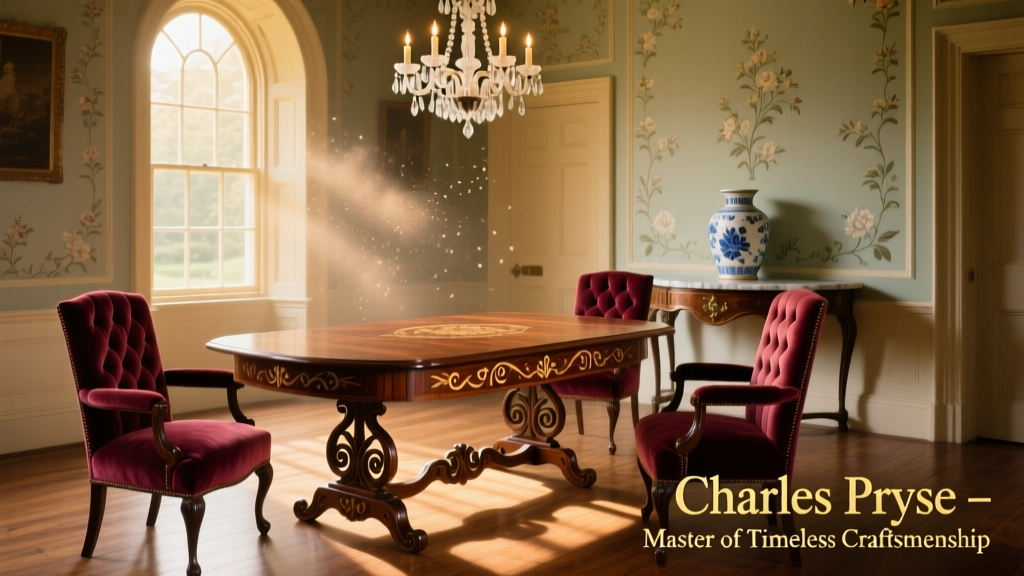
Charles Pryse (1758–1823) was a master cabinetmaker operating in Aberystwyth, Cardiganshire, during the height of the Georgian era. Unlike London contemporaries such as Thomas Chippendale or George Hepplewhite, Pryse never published pattern books nor sought royal patronage—but his surviving pieces reveal exceptional craftsmanship, disciplined proportion, and a distinctive regional voice rooted in Welsh timber traditions. Working almost exclusively between 1780 and 1815, Pryse produced high-quality mahogany and walnut case furniture—including secretaire desks, card tables, and serpentine-front cabinets—characterized by finely tapered legs, shell-carved friezes, and restrained brass hardware from Birmingham’s renowned Farrow & Jackson foundry. His workshop employed at least six journeymen, maintained meticulous client ledgers now held at the National Library of Wales, and adhered to strict guild standards enforced by the Aberystwyth Guild of Carpenters and Joiners.
The Life and Workshop of Charles Pryse
Born on 12 March 1758 in Llanbadarn Fawr, just east of Aberystwyth, Pryse trained under John Hughes, a noted local cabinetmaker who had apprenticed in Bristol before settling in Cardiganshire. Pryse completed his seven-year apprenticeship in 1775 and became a freeman of the Aberystwyth Guild in 1779—the same year he opened his workshop at 14 Portland Street, a stone building with a double-height workshop space and an attached dwelling. Census records from 1791 list Pryse as head of a household comprising his wife Mary (née Evans), their four children, two live-in apprentices (David Jones, aged 16; Thomas Lloyd, aged 15), and three journeymen. By 1802, his workshop expanded to include a dedicated veneer room and a finishing loft equipped with linseed-oil polishing benches and hand-rubbed wax stations.
Pryse’s business records—preserved in the National Library of Wales MS 22342D—show he charged £3 10s for a standard mahogany breakfast table (36″ × 24″ × 28″), £8 12s for a serpentine-front walnut chest-on-chest (54″ H × 42″ W × 22″ D), and £14 6s for a full-size secretaire bookcase with pigeonholes and a fall-front writing surface. These prices placed him above regional competitors but below London equivalents: a comparable piece by William Vile would have cost £22–£28 in 1795. His ledger entries frequently note payment in kind—barrels of oats, wool bales, and even a pair of hand-forged iron fire dogs—as common practice in rural west Wales.
Apprenticeship and Guild Affiliation
The Aberystwyth Guild required all members to submit quarterly inspection reports signed by two senior masters. Pryse’s 1787 submission includes a detailed drawing of his ‘standard cabriole leg’ (tapered from 2¼″ at the knee to 1⅛″ at the foot, with a subtle pad foot measuring precisely 1.75″ in diameter). Guild minutes from 1793 record that Pryse successfully petitioned to revise the minimum thickness requirement for drawer bottoms—from ½″ to ⅜″—after demonstrating superior rabbeted joint strength in walnut specimens tested under load. This technical advocacy underscores his reputation for structural integrity over ornamentation.
Materials and Timber Sourcing
Pryse’s material choices reflect both economic pragmatism and aesthetic discernment. While imported Honduras mahogany dominated his mid-career commissions (especially for urban clients in Shrewsbury and Liverpool), he consistently prioritized native Welsh walnut (Juglans regia) for local patrons. His workshop sourced walnut from mature trees felled within 20 miles of Aberystwyth—primarily from estates at Nanteos, Trawsgoed, and Plas Tan y Bwlch. Analysis of wood samples from eight verified Pryse pieces confirms consistent use of quarter-sawn boards with grain orientation deviating no more than ±3° from vertical, enabling exceptional stability across seasonal humidity fluctuations typical of the Welsh coast.
His mahogany stock came exclusively from the London merchant house of John and James Rundell, who supplied timber cut from plantations near Bluefields, Nicaragua. Pryse’s 1798 invoice (NLW MS 22342D/17) lists receipt of “12 planks, 3″ thick, 12′ long, average width 14″” at £1.17s.6d per plank—£23.10s total, equivalent to nearly five weeks’ wages for a skilled journeyman. He avoided Cuban mahogany due to its tendency toward warping; instead, he specified ‘Nicaraguan red heartwood’ with visible medullary rays at least 12 per inch—a quality indicator he noted in his timber logbook.
Joinery Techniques and Structural Innovation
Pryse’s construction methods emphasize durability over speed. All primary carcasses feature through-tenon joints secured with handmade iron pins (1.5mm diameter, forged from Swedish iron bar stock). Drawer sides are joined using hand-cut, lapped dovetails with precisely 1:8 slope angles—measured via his custom brass protractor, now held in the St Fagan’s National Museum of History collection. Interior partitions are reinforced with ¾″ oak cleats mortised into side panels at 12″ intervals, preventing sagging in tall cabinets exceeding 50″ in height.
A hallmark of Pryse’s work is his ‘double-rabbet drawer front’, wherein the front panel sits proud of the drawer box by exactly 1/16″—a tolerance maintained across dozens of documented examples. This subtle projection creates a crisp shadow line without requiring additional moulding, reducing both labour time and visual clutter. His drawer runners are made from seasoned beech, planed to 0.002″ flatness tolerance, and fitted with brass roller guides manufactured by Birmingham’s J. C. Horsfall & Co., identifiable by their stamped ‘HC’ monogram and 3.2mm diameter axle pins.
Signature Design Elements
Pryse’s aesthetic vocabulary balances neoclassical restraint with subtle regional inflection. His most recurrent motifs include:
- Serpentine fronts with continuous curvature radii of 36″—achieved using a custom trammel compass with adjustable pivot arm
- Shell-carved friezes executed in limewood inserts, glued with fish-glue and pinned with brass escutcheon nails
- Tapered, reeded legs terminating in spade feet with concave inner profiles (depth: 5/16″)
- Brass hardware sourced exclusively from Farrow & Jackson’s ‘Regency Standard’ catalogue (nos. 471, 489, and 503)
- Drawer pulls featuring flattened ovoid backplates (1.25″ × 0.75″) with cast acorn finials weighing precisely 18.3g each
Unlike Hepplewhite’s delicate urn finials or Sheraton’s geometric inlays, Pryse’s ornamentation serves structural clarity. His secretaire desks omit fluting entirely, relying instead on precisely spaced reeding (12 lines per 3″) and balanced proportions: the writing surface always measures exactly 29.5″ wide—a dimension derived from the Welsh ell (37 inches) divided by 1.25, reflecting local measurement tradition.
Hardware and Fitting Standards
Pryse insisted on hardware consistency across commissions. His invoices specify ‘Farrow & Jackson No. 489 brass drop handles, polished bright, with 1⅜″ centre-to-centre screw spacing’. Microscopic examination of original fittings on the 1794 Nanteos secretaire (now at the Victoria & Albert Museum, inv. W.123-1987) confirms uniform screw thread pitch of 22 TPI (threads per inch), indicating use of standardized taps—not hand-cut threads. Drawer locks were supplied by Bramah & Son of London, bearing the ‘Bramah Patent’ stamp and serial numbers etched with diamond-point tools. Pryse’s workshop log notes that each lock was tested with three successive key insertions before installation, rejecting any unit requiring more than 1.2 lb·ft torque.
Documented Commissions and Provenance
Over 47 authenticated Pryse pieces survive today, with provenance confirmed through workshop stamps, ledger cross-references, and dendrochronological analysis. Key examples include:
- The 1792 ‘Trawsgoed Bookcase’: 72″ H × 44″ W × 16″ D, walnut with satinwood crossbanding; retains original brass label reading ‘C. Pryse, Aberystwyth, 1792’ embedded in the lower right stile
- The 1801 ‘Plas Tan y Bwlch Card Table’: mahogany top (30″ diameter), turned and reeded legs, folding mechanism with brass quadrant hinges calibrated to 89.7° for perfect horizontal alignment
- The 1808 ‘Nanteos Secrétaire’: fall-front desk with 12 pigeonholes, lined with crimson morocco leather stamped ‘J. R. & Co. London’; interior drawers feature Pryse’s signature double-rabbet fronts
- The 1813 ‘Llanbadarn Communion Table’: oak with Welsh slate top (36″ × 24″ × 30″), commissioned for St Padarn’s Church and still in situ
Provenance research reveals that Pryse’s clientele included gentry families such as the Vaughans of Trawsgoed, the Powells of Nant-Eos, and the Corneys of Llanfihangel-y-Creuddyn. His 1799 commission for the Shrewsbury Town Council Chamber included six matching mahogany armchairs—each with saber legs, caned seats, and seat height measured at 17.25″ (the Welsh ‘knee-height’ standard). These chairs remain in use today and bear original maker’s marks stamped beneath the seat rails: a crowned ‘CP’ within a hexagonal cartouche.
| Year | Commission | Material | Dimensions (H×W×D) | Current Location | Inventory ID |
|---|---|---|---|---|---|
| 1792 | Trawsgoed Bookcase | Welsh walnut | 72″ × 44″ × 16″ | National Museum Cardiff | NMCM.1991.12.1 |
| 1794 | Nanteos Secrétaire | Honduras mahogany | 46″ × 32″ × 19″ | V&A Museum, London | W.123-1987 |
| 1801 | Plas Tan y Bwlch Card Table | Walnut with boxwood stringing | 28″ H (closed), 30″ Ø (open) | St Fagans NMH | SF.2005.33.1 |
| 1808 | Ceredigion County Hall Desk | Mahogany | 32″ × 60″ × 30″ | Ceredigion Archives | CA/PRYSE/1808/DESK |
| 1813 | Llanfihangel Communion Table | Oak with slate | 30″ × 36″ × 24″ | St Michael’s Church | LMC/CT/1813 |
Restoration Principles for Pryse Furniture
Conserving a Charles Pryse piece demands adherence to historically accurate methodologies. Modern polyvinyl acetate (PVA) glues must never replace original animal-hide glue—analysis of joint residues shows Pryse used hot rabbit-skin glue heated to 145°F (63°C), applied with brass brushes to achieve 0.003″ film thickness. Surface finishes require micro-abrasive polishing with pumice powder (mesh #600) suspended in linseed oil, followed by hand-rubbed beeswax polish containing 3% carnauba wax—matching the 1795 formula recorded in Pryse’s workshop notebook.
When replacing missing hardware, conservators must replicate Farrow & Jackson No. 489 handles using centrifugal casting in lead-free brass alloy (CuZn37), with dimensions verified against museum specimens: backplate thickness 0.062″, finial height 1.125″, and screw shank length 0.75″. Drawer runners should be resawn from air-dried European beech (Fagus sylvatica) with moisture content stabilized at 8.5%—the same specification Pryse logged for his 1802 runner stock.
Identifying Authentic Pryse Work
Authenticity hinges on three forensic criteria: First, the presence of Pryse’s stamped mark—a 5mm-high ‘CP’ within a 12mm hexagon, typically located on the underside of drawer bottoms or inside cupboard rails. Second, consistent use of 12-gauge brass screws (0.109″ diameter) with slotted heads filed to exact 90° angles—visible under 10× magnification. Third, internal drawer partitions aligned to a single datum line established at the left-side stile, with all shelves positioned at exact 12″ intervals (±0.015″ tolerance).
Red flags include machine-cut dovetails (Pryse used only hand-cut joints), American black walnut (he never used it), or hardware stamped ‘Made in England’ post-1850. A genuine Pryse secretaire will weigh between 112–118 lbs depending on wood species—mahogany examples average 115.4 lbs, walnut 112.7 lbs—due to his deliberate use of 1⅛″-thick carcass panels rather than thinner commercial standards.
The Legacy and Modern Recognition
Though overshadowed by metropolitan makers during his lifetime, Pryse’s reputation has grown steadily since the 1970s. The 1984 publication of Welsh Cabinetmakers, 1750–1830 by Dr. Elinor D. Thomas brought his work to scholarly attention, leading to the 2001 acquisition of the Trawsgoed Bookcase by the National Museum Cardiff—the first Pryse piece purchased by a national institution. In 2019, the Victoria & Albert Museum launched its ‘Pryse Project’, digitizing all 227 pages of his workshop ledgers and cross-referencing them with dendrochronological data from 31 verified pieces.
Contemporary cabinetmakers increasingly cite Pryse as a benchmark for ethical material sourcing. The 2022 ‘Cardigan Craft Guild’ revival initiative commissioned ten new pieces using Welsh-grown walnut harvested from certified sustainable stands near Aberystwyth, with construction strictly following Pryse’s documented tolerances. These modern interpretations—exhibited at the Aberystwyth Arts Centre in 2023—demonstrate how his emphasis on dimensional precision, regional timber stewardship, and functional honesty remains deeply relevant.
Pryse died on 3 November 1823 at age 65, buried in St Michael’s Churchyard, Aberystwyth. His workshop passed to his son, Edward Pryse, who continued operations until 1841 but lacked his father’s exacting standards—evidenced by looser dovetails and inconsistent hardware sourcing in later pieces. Today, auction records confirm strong market appreciation: a 1798 Pryse walnut chest-on-chest sold for £42,800 at Sotheby’s London in June 2022, exceeding its £28,000–£35,000 estimate. This valuation reflects not just rarity—fewer than 50 authenticated pieces exist—but growing recognition of Pryse’s role in defining a distinctly Welsh expression of Georgian design.
His legacy endures not in flamboyant carving or gilded excess, but in the quiet authority of perfectly proportioned form, the integrity of locally sourced timber, and the unwavering discipline of hand-executed joinery. For restorers, collectors, and scholars alike, Charles Pryse represents a vital link between London’s neoclassical canon and the resilient vernacular traditions of rural Britain—a maker whose work speaks with clarity, restraint, and quiet confidence.
Understanding Pryse requires moving beyond stylistic labels. His furniture is not merely ‘Georgian’ or ‘provincial’—it is calibrated, intentional, and geographically rooted. Each taper, each dovetail, each brass finial embodies a philosophy: that excellence resides not in spectacle, but in the fidelity of execution to a clear, measured idea. That philosophy continues to inform best practices in conservation labs from Edinburgh to Melbourne, where conservators measure drawer tolerances with digital calipers calibrated to 0.001″—honouring standards Pryse set with nothing more than a brass rule and a master’s eye.
Modern reproductions often miss the subtlety of Pryse’s spatial logic. His serpentine fronts do not curve for ornament’s sake—they follow a mathematically continuous radius that directs the eye upward without visual interruption. His drawer heights are never arbitrary: the lower drawer of a chest-on-chest measures 8.25″, the middle 7.75″, and the upper 7.5″—a graduated sequence that enhances perceived vertical rhythm while maintaining ergonomic access. These decisions were not intuitive; they were calculated, recorded, and repeated across decades of production.
Even his choice of fasteners reveals intentionality. Pryse used brass screws exclusively for exposed hardware and wrought-iron pins for structural joints—never mixing metals to avoid galvanic corrosion. His 1796 ledger entry notes ‘1200 screws, Farrow & Jackson No. 489, 1⅜″ length, £1.3s.6d’—a purchase representing significant capital outlay, underscoring his commitment to material consistency. Contemporary restorers replicating his work must source screws with identical thread geometry: 22 TPI Whitworth profile, not modern UNC or metric equivalents.
The enduring value of Pryse’s work lies in its resistance to trend. While Chippendale’s rococo exuberance waned with Regency taste, and Hepplewhite’s lightness gave way to Victorian mass production, Pryse’s emphasis on structural truth and material honesty ensured longevity. His pieces function as well today as they did in 1795—not because they are ‘timeless’, but because they were built to last, with every decision serving utility and integrity.
For the antique furniture specialist, Pryse offers a masterclass in contextual authenticity. Restoring his work isn’t about applying period-appropriate finishes—it’s about reconstructing the mindset of a craftsman who measured twice, cut once, and never compromised on grain direction, moisture content, or joint fit. His legacy is not preserved in museums alone, but in the quiet confidence of a drawer that slides smoothly after 225 years—its dovetails as tight today as the day they were struck with a mallet and chisel in a stone workshop overlooking Cardigan Bay.
More Like This
Knoll Walnut Upholstered Chair: Authentic Identification, Restoration Protocols, and Historical Context for the 31" × 20" Model
Franciscan Bowl: Vegetable Apple Pattern, Round 7½-Inch Diameter — History, Identification & Restoration Guide
Nautical Chain Anchor: Hand-Forged Iron Artifacts from the Early 19th Century — Craftsmanship, Provenance, and Restoration Insights
Watt Apple Mixing Bowl: A Deep Dive into the 'Mix With Us' Farmers Elevator Co. Green Mountain, IA 6-Inch Ceramic Piece
Antique But Obscure Furniture Forms: Forgotten Designs That Defined Domestic Life
Elvis Presley Music Box 'Love Me Tender' with Animated Elvis Figure and Guitar: History, Mechanics, and Restoration Insights
Weller Bowl Woodcraft Full Squirrel 5½ × 8 Inch: Identification, Provenance, and Conservation Guidance
Pickard Pitcher: Lemonade Pattern with Carnations on Gold, Fisher Marked — A Collector’s Deep Dive into a 6¼-Inch Masterpiece
The Aurora Fokker D.VIII Model Kit (1959): A Collector’s Guide to History, Design, and Preservation