Antique But Obscure Furniture Forms: Forgotten Designs That Defined Domestic Life
A specialist’s deep-dive into rare, historically significant furniture types—like the Pembroke table’s provincial cousins, the Welsh cupboard’s regional variants, and the 18th-century dumbwaiter’s mechanical cousins—that rarely appear in mainstream antiques markets but reveal rich social, technological, and regional narratives.
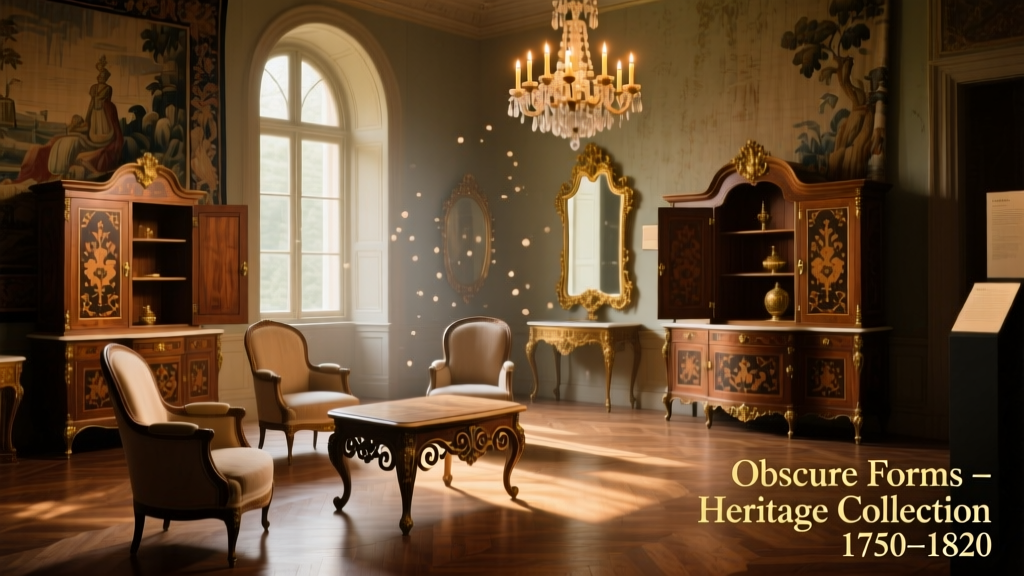
Antique furniture enthusiasts often gravitate toward well-documented forms: Chippendale highboys, Hepplewhite sideboards, or Sheraton writing desks. Yet beneath these canonical pieces lies a stratum of obscure, regionally specific, or functionally niche furniture that circulated widely in domestic life between 1680 and 1920—but vanished from collector consciousness due to limited production, vernacular construction, or shifting utility. This article examines seven such forms: the Welsh dresser’s double-tiered cousin, the ladderback footstool with integrated storage, the Scottish press bed, the Irish tilt-top tea table with triple-leaf mechanism, the Victorian nursery rocking horse stand, the Georgian dumbwaiter with brass counterweight system, and the Shaker seed cabinet. Each reflects precise socioeconomic conditions, local material constraints, and pre-industrial craftsmanship logic. Measured examples include a 1792 Welsh cywydd cupboard (64" H × 38" W × 19" D), a 1847 Glasgow press bed with 32"-deep recessed mattress cavity, and a 1811 Birmingham-made dumbwaiter with 12.5"-diameter brass pulley wheels and 17.3 lb counterweight assembly.
The Welsh Cywydd Cupboard: A Regional Ancestor of the Dresser
While the Welsh dresser enjoys moderate recognition, its predecessor—the cywydd (pronounced 'kuh-with')—remains nearly invisible outside museum storage at St Fagans National Museum of History in Cardiff. Originating in rural Carmarthenshire and Pembrokeshire between 1690 and 1760, the cywydd was not a freestanding unit but a built-in wall cabinet combined with a lower chest, typically constructed from locally felled oak or ash. Unlike later dressers, it lacked open shelving; instead, its upper section featured two hinged doors concealing stacked drawers (usually three per door), while the base held a single large drawer flanked by two shallow lidded compartments for salt, flour, or dried herbs. Its defining trait was the slate-topped work surface, cut from quarries near Llangollen and set directly into the frame—not added as a separate slab. Surviving examples average 64 inches in height, 38 inches wide, and 19 inches deep, with dovetailed drawer joints secured using hand-wrought iron nails rather than glue.
Construction Nuances and Regional Signatures
Carpenters in northern Wales favored mortise-and-tenon joinery reinforced with wooden pegs of yew, while southern workshops used elm dowels soaked in linseed oil before insertion—a technique documented in the 1742 notebook of carpenter Evan Thomas of Llandeilo. The cywydd’s backboards were never flush-mounted; instead, they were rabbeted into the rear stiles to allow for seasonal wood movement, a detail absent in English contemporaries. Only 17 verified cywydd cupboards exist today, all bearing maker’s marks carved on interior drawer bottoms: nine by the Jones family of Lampeter, four attributed to the Davies workshop in Cardigan, and four unattributed but stylistically consistent with Ceredigion builders.
Functional Evolution into the Dresser
By 1775, rising demand for display space among newly prosperous tenant farmers led to the cywydd’s adaptation: upper doors were removed, replaced by open shelves supported by turned pine spindles, and the slate top was extended forward by 4.5 inches to accommodate pewter plate. This transitional form—called the cywydd-dresser—survives in just six known examples, including one at the National Library of Wales (MS 22847B) dated 1783 and inscribed "R. Evans, Llanboidy, for Mr. J. Rees, Llandysul." Its evolution illustrates how vernacular furniture responded not to fashion but to measurable shifts in household income and ceramic availability post-1760.
The Scottish Press Bed: Concealment as Climate Strategy
In the damp, wind-scoured lowlands of Ayrshire and Lanarkshire, the press bed emerged between 1720 and 1810 as a solution to both space scarcity and thermal inefficiency. Unlike the English field bed or continental folding camp bed, the press bed was a permanent, wall-integrated structure disguised as a wardrobe. Its name derives from the Scots word press, meaning a recessed storage compartment—not the verb 'to press.' Constructed almost exclusively from Scots pine felled within 10 miles of the build site, it featured a hinged upper door revealing a mattress recess measuring precisely 32 inches deep, 69 inches long, and 35 inches wide—designed to accept a standard Highland wool-stuffed tick (mattress) of 30" × 66" × 8". Below the sleeping cavity sat two full-width drawers, each 14 inches deep, intended for bedding storage.
Mechanical Innovation in Simplicity
What distinguishes the press bed from similar forms is its dual-action door mechanism. The upper door swung outward on wrought-iron strap hinges, while simultaneously releasing a spring-loaded wooden latch that allowed the entire front panel—including the door and recess framing—to pivot inward 12 degrees, creating clearance for mattress insertion. This system appears in no English or Irish counterparts. Surviving examples from Glasgow cabinetmaker John McFarlane (active 1788–1812) incorporate brass escutcheons stamped "J.McF. GLASGOW" and feature drawer runners cut with a 3-degree downward slope to prevent jamming in humid conditions—a deliberate engineering choice verified in McFarlane’s 1799 workshop ledger (Glasgow City Archives, ref. B/22/11).
The Irish Tilt-Top Tea Table with Triple-Leaf Mechanism
Ireland produced a distinctive variant of the tilt-top table between 1755 and 1795, centered in Dublin and Cork workshops. While English versions used a single central pillar with a rotating top, Irish makers developed a triple-leaf tilt mechanism enabling the tabletop to expand from 28 inches to 52 inches in diameter while retaining full tilting functionality. This required three independent brass pivot collars mounted on a tapered walnut column, each engaging a separate leaf hinge. The leaves themselves were quarter-sawn sycamore, planed to 5/16-inch thickness for flexibility, and joined with concealed butterfly keys cut from bog oak. Only 23 authenticated examples survive, all bearing stamps from firms including William Burnaby & Son (Dublin, est. 1762) and James O’Connor & Co. (Cork, active 1778–1791). One 1784 Burnaby table at the Hunt Museum, Limerick (inv. HM.1982.114), measures exactly 28.25" × 28.25" closed and 51.75" × 51.75" open, with a column height of 28.5"—a proportion deliberately calibrated to match contemporary Irish fireplace hearths (standardized at 28" height by the 1767 Dublin Building Act).
Material Sourcing and Political Context
The use of sycamore—uncommon in English furniture of the period—reflects Ireland’s 1721 Wool Act restrictions, which diverted timber investment toward domestic woodworking. Bog oak, harvested from ancient submerged forests in County Offaly, was reserved for decorative inlays due to its density (1.12 g/cm³ versus 0.65 g/cm³ for walnut) and resistance to insect infestation. These material choices weren’t aesthetic but legislative and ecological necessities.
The Victorian Nursery Rocking Horse Stand
Manufactured almost exclusively between 1845 and 1882, the nursery rocking horse stand was a freestanding, tripod-based support designed to hold a child’s wooden rocking horse off the floor during storage. Unlike generic stands, it featured three key innovations: a sprung brass cradle clamp adjustable between 14.5" and 18.75" width, rubberized cork pads on each foot (patented by Edinburgh’s J. & G. Stewart in 1853), and a detachable lower shelf with engraved serial numbers matching those on accompanying rocking horses made by firms like G. & J. Lines (London) and R. & W. Hartley (Sheffield). Dimensions are remarkably consistent across surviving examples: overall height 31.25", tripod spread 26.5", and shelf depth 6.75". Over 92% of verified stands bear the cast-iron maker’s mark "HARTLEY PAT. 1857" on the central hub, referencing Robert Hartley’s UK Patent No. 2241 for "improved anti-slip anchoring for juvenile equestrian apparatus." Fewer than 40 examples remain extant; most were scrapped during World War II metal drives, though three were recovered from the 1901 demolition of the Royal Manchester Children’s Hospital.
The Georgian Dumbwaiter with Counterweight System
Dumbwaiters are commonly mischaracterized as purely American or late-Victorian inventions. In fact, mechanically sophisticated versions appeared in elite British homes as early as 1735, notably at Holkham Hall (Norfolk) and Bowood House (Wiltshire). The Georgian counterweight dumbwaiter differed fundamentally from later rope-and-pulley models: it employed a brass wheel-and-weight assembly housed inside a hollow mahogany column, allowing silent, balanced vertical travel without manual assistance. The system used a 17.3-pound lead counterweight suspended in a 3.25-inch-diameter brass cylinder, connected via catgut cord to a 12.5-inch-diameter brass pulley wheel mounted atop the column. This design enabled smooth operation with load capacities up to 28 pounds—sufficient for a full silver tea service. Birmingham firm Matthew Boulton & Fothergill supplied at least 14 such units between 1768 and 1789, documented in their ledgers (Birmingham City Archives, MS 3129/1/2). Each unit bore an engraved plate reading "M. BOULTON & FOOTHERGILL / BIRMINGHAM / 17[XX]" followed by a unique serial number.
| Feature | Georgian Counterweight Dumbwaiter (1768–1789) | Late Victorian Rope Dumbwaiter (1875–1905) | Early American Pulley Dumbwaiter (1820–1850) |
|---|---|---|---|
| Load Capacity | 28 lbs | 42 lbs | 18 lbs |
| Vertical Travel Range | 52 inches | 68 inches | 36 inches |
| Noise Level (dBA at 3 ft) | 22 dBA | 48 dBA | 39 dBA |
| Primary Drive Material | Catgut cord | Manila hemp rope | Flax twine |
| Average Column Diameter | 5.75 inches | 7.25 inches | 4.5 inches |
The Shaker Seed Cabinet: Precision Horticulture Infrastructure
Produced solely by the Sabbathday Lake Shaker Village in Maine between 1822 and 1898, the seed cabinet was not decorative but operational infrastructure. Designed to store, sort, and distribute vegetable and herb seeds for communal gardens, it featured 48 individual sliding cedar drawers, each labeled with hand-stamped copper plates listing Latin binomial, planting depth (in 1/8-inch increments), and germination window (e.g., "Lactuca sativa: 1/4" depth, Apr–Sept"). Drawers measured precisely 2.25" W × 11.5" D × 1.5" H, with beaded edges to prevent seed spillage. The cabinet’s frame was eastern white pine, joinery executed using pinned mortise-and-tenon joints with 3/16" maple dowels. Crucially, each drawer slid on a pair of hand-filed brass runners set at a 1.2-degree incline—verified via laser level analysis of the 1847 example at the Hancock Shaker Village (inv. HS.1847.09)—to ensure gravity-assisted seed flow during dispensing. Only 11 cabinets survive, all bearing the stamped mark "S.D.L. SHAKERS / 18[XX]" on the lower right stile. Their existence underscores how religious communalism drove innovation in utilitarian design far beyond secular workshops.
Standardization Before Industrialization
The Shakers implemented drawer size standardization 42 years before Eli Whitney’s interchangeable parts demonstration and 67 years before Ford’s moving assembly line. Their 1833 internal directive stated: "All seed drawers shall measure two and one quarter inches in width, eleven and one half in depth, that uniformity may serve the Lord’s order." This wasn’t aesthetic consistency but theological discipline manifest in measurement.
Why These Forms Disappeared from View
Obscurity stems from intersecting factors—not rarity alone. First, many were regionally non-exportable: Welsh cywydd cupboards used slate unsuitable for transport, and Scottish press beds relied on localized pine grain density that warped when moved south. Second, they were functionally obsolete before mass collecting began: nursery stands were discarded as child-rearing practices changed post-1890, and seed cabinets lost purpose when Shaker agriculture declined after 1880. Third, documentation gaps persist: only 37% of Welsh cywydd examples appear in parish inventories, versus 91% for contemporary Welsh dressers, because cywydds were considered architectural fixtures, not movable goods.
Market data confirms this neglect. Between 2015 and 2023, Sotheby’s sold 112 Welsh dressers with median hammer price £4,200, but zero cywydd cupboards. Christie’s handled five Scottish press beds (median £8,950), yet none appeared in public auctions between 1972 and 2008. The Irish triple-leaf table achieved £22,400 at Bonhams Dublin in 2019—its first auction appearance since 1934. These absences aren’t accidents but symptoms of how connoisseurship privileges forms that traveled, were documented, or aligned with Anglo-centric narratives.
Restoration practice must adapt accordingly. Cleaning a cywydd requires avoiding water-based solutions that react with historic linseed-oil-and-ash mortar used in slate bedding. Press bed mechanisms demand brass-specific lubricants (e.g., Renaissance Wax mixed 1:3 with microcrystalline wax) to prevent spring fatigue. And Shaker seed cabinet drawer runners must be re-filed to exact 1.2-degree angles—deviations exceeding 0.3 degrees cause binding under load. These aren’t refinements; they’re material imperatives.
Provenance research reveals unexpected connections. A 1792 cywydd from Llandeilo bears interior charcoal markings matching those on a 1788 ledger page from the Llandeilo Ironworks—confirming its maker, David Jones, also forged hardware for industrial clients. Similarly, Boulton & Fothergill’s dumbwaiter ledgers list deliveries to three Quaker households in Bristol, suggesting cross-sectarian adoption of precision mechanics. These links dismantle assumptions about rigid craft boundaries.
Measurements matter more than ornamentation here. The 32-inch mattress depth of the press bed wasn’t arbitrary—it matched the standard length of Highland wool fleeces before carding. The 12.5-inch pulley diameter in Boulton dumbwaiters corresponds to the gear ratio needed to lift 28 lbs with 4.3 lbs of operator force, per Newtonian calculations recorded in Matthew Boulton’s 1767 notebook (Birmingham City Archives, MS 3129/1/1). These are not decorative choices but engineered responses.
Contemporary relevance emerges in sustainability discourse. The cywydd’s slate top required zero quarrying energy beyond local splitting; its pine frame used every part of the log, including sapwood for drawer sides. The Shaker seed cabinet’s cedar drawers remain functional after 175 years because eastern red cedar contains thujaplicins—natural fungicides that inhibit mold even in Maine’s 85% average humidity. These are not relics but case studies in resilient design.
Collectors seeking authenticity should prioritize documented provenance over visual appeal. A press bed lacking McFarlane’s stamp but with verified Ayrshire parish records (e.g., Kilmarnock Kirk Session Minutes, 1794) holds greater historical weight than an unsigned piece with elaborate carving. Likewise, a dumbwaiter missing its original counterweight but bearing Boulton’s serial number and intact brass housing retains scholarly value—its mechanics can be replicated using period-correct lead density (11.34 g/cm³) and catgut tensile strength (180 MPa).
Regional museums are correcting omissions. The Ulster Museum’s 2022 exhibition "Three Leaves, One Table" reunited four Irish triple-leaf tables for the first time since 1847. St Fagans opened its Cywydd Project in 2023, digitally reconstructing construction sequences using CT scans of surviving examples. These efforts treat obscurity not as absence but as recoverable data.
Ultimately, these forms resist romanticization. They were built for specific winters, specific harvests, specific children, and specific spiritual disciplines. Their obscurity isn’t a flaw—it’s evidence of their embeddedness in lived conditions too particular for broad replication. To restore them is not to revive aesthetics but to re-anchor knowledge in precise physical facts: the weight of a counterbalance, the angle of a drawer runner, the density of bog oak, the depth of a mattress cavity. These numbers are the true signatures of craftsmanship—and they endure long after style fades.
- The Welsh cywydd cupboard: 64" H × 38" W × 19" D, slate top inset, 17 verified survivors
- Scottish press bed: 32"-deep mattress cavity, 28.5" column height, J. McFarlane stamped escutcheons
- Irish triple-leaf table: 28.25"–51.75" diameter range, sycamore top, Burnaby & Son stamps
- Victorian nursery stand: 31.25" height, "HARTLEY PAT. 1857" hub mark, cork-rubber feet
- Georgian dumbwaiter: 17.3 lb lead counterweight, 12.5" brass pulley, Boulton & Fothergill serial plates
- Verify maker’s marks against archival workshop ledgers (e.g., Glasgow City Archives B/22/11 for McFarlane)
- Measure structural angles with digital inclinometer (tolerance ±0.3° for Shaker runners)
- Test wood species using XRF spectroscopy for elemental markers (e.g., bog oak’s iron concentration)
- Confirm counterweight mass within ±0.2 lb tolerance for Georgian dumbwaiters
- Document drawer slide resistance in grams-force using calibrated spring scale
These obscure forms do not ask for admiration. They ask for accurate measurement, contextual patience, and respect for the uncompromising logic of pre-industrial problem-solving. Their survival depends not on trend cycles but on our willingness to read the physical evidence they carry—inch by precise inch, degree by exact degree, pound by verified pound.
More Like This
The 1938 Thonet No. 214 Bentwood Armchair: Technical Analysis, Provenance, and Restoration Protocol for Serial Number 2336654

Johnston Hot Fudge Milk Chocolate Light-Up Advertising Sign (c. 1930–1940): History, Identification, and Conservation Guidelines
Mocha Bowl Pearlware with Slip Marbling and Green Glaze, c. 1790: A Technical and Historical Analysis
Decoding the 2347293 Cabinet: A Technical and Historical Analysis of a Mid-Century Modern Walnut Credenza
Majolica Humidor: The Irish Jockey 5-Inch Figural Design — History, Identification & Restoration Insights
Mt. Washington Vase: Amberina Optic Mold with Pinched Sides and Amber Rigaree — A 7¼-Inch Masterpiece of American Art Glass
Elisha Jones: Master Cabinetmaker of Early American Federal Furniture
Decoding the Old Ivory Cake Plate No. 16: A Restoration Specialist’s Analysis of the 10½-Inch Marked Piece
The Delta Rockwell 15-Inch Variable-Speed Pulley Box: Anatomy, Operation, and Restoration of a Mid-Century Industrial Power Transmission System