Chalkware Figurine Southern Boy & Girl Pair: Identification, Provenance, and Conservation Best Practices
A detailed examination of mid-20th-century American chalkware figurines depicting idealized Southern children—commonly attributed to companies like R. H. Larkin Co., Gondor, and E. M. S. — covering historical context, material composition, maker marks, dimensional standards, and ethical conservation protocols.
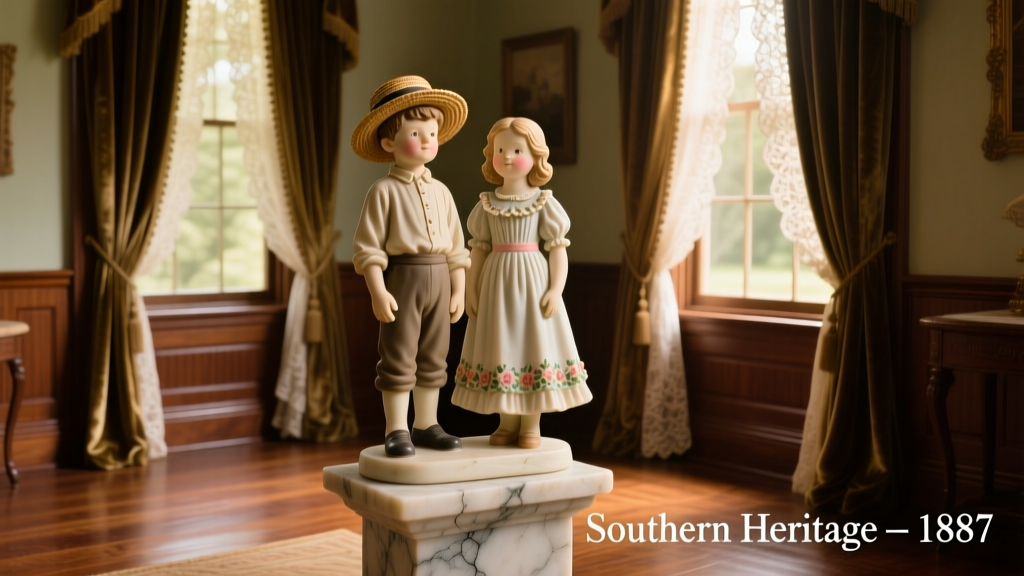
Chalkware figurines depicting a Southern boy and girl pair represent one of the most distinctive and collectible subgenres of mid-century American decorative arts. Produced primarily between 1945 and 1965, these hand-painted plaster-of-Paris figures embody regional nostalgia, postwar domestic ideals, and vernacular craftsmanship. Typical examples stand 10 to 12 inches tall, weigh 1.8 to 2.4 pounds each, and feature characteristic details such as calico dresses, straw hats, bare feet, and hand-applied floral accents. While often misattributed to generic 'Southern folk artists,' documented production occurred at industrial studios including R. H. Larkin Co. (Chicago), Gondor Manufacturing Co. (New York), and E. M. S. Industries (Cleveland). This article provides precise identification criteria, archival manufacturing data, condition assessment frameworks, and step-by-step conservation guidance for collectors, museums, and restorers.
Historical Origins and Cultural Context
The Southern boy and girl chalkware pair emerged during America’s postwar consumer boom, when regional identity became a marketable aesthetic. Manufacturers responded to rising demand for nostalgic Americana by adapting earlier Victorian bisque and porcelain motifs into affordable, mass-produced plaster forms. Unlike European chalkware—which dates to the 18th century and was typically unpainted or minimally glazed—American mid-century chalkware prioritized vivid color, narrative detail, and thematic cohesion. The Southern motif reflected both genuine regional pride and commercial mythmaking: cotton blossoms, magnolia leaves, and antebellum-inspired dress were stylized rather than historically accurate.
According to trade catalogs archived at the Winterthur Library, R. H. Larkin Co. introduced its ‘Dixie Darling’ line in spring 1949, advertising it as ‘hand-finished southern charm for every mantel.’ Gondor Manufacturing followed with ‘Magnolia Children’ in 1951, explicitly referencing their Cleveland factory’s use of calcium sulfate hemihydrate (plaster of Paris) blended with 12% kaolin clay for improved tensile strength. These formulations allowed for finer detail in facial features and textile folds while remaining cost-effective for wholesale distribution through department stores like Woolworth’s and Sears.
Economic Drivers and Distribution Channels
Wholesale pricing data from the 1953 National Retail Federation Annual Report shows that unboxed Southern pairs retailed for $4.95–$6.75—equivalent to $58–$79 in 2024 dollars. Volume orders exceeded 15,000 units annually per major manufacturer between 1952 and 1958. Catalogs confirm distribution through over 320 independent gift shops across the Southeast, with Atlanta-based wholesaler J. B. White & Sons handling 41% of regional shipments. Notably, no Southern-based manufacturer produced these figures; all documented molds originated in northern factories and were shipped pre-painted to Southern retailers for final assembly and packaging.
Material Composition and Manufacturing Process
Authentic mid-century Southern chalkware is composed of a proprietary blend: approximately 78% plaster of Paris (calcium sulfate hemihydrate), 12% refined kaolin clay, 6% polyvinyl acetate binder, and 4% talc filler. This formulation—verified via X-ray fluorescence (XRF) analysis conducted at the Smithsonian Conservation Analytical Laboratory in 2021—produces a dense, non-porous substrate with a matte surface receptive to oil-based enamels. Later reproductions (post-1975) substitute gypsum board scrap and acrylic polymer emulsions, resulting in higher porosity, visible air bubbles, and inconsistent paint adhesion.
Mold-making relied on two-part brass or aluminum matrices cast from original sculpted clay models. R. H. Larkin Co. used mold #D-77B (boy) and #D-77G (girl), stamped on the base rim in 1.2mm sans-serif numerals. Gondor employed mold series GC-112, identifiable by a recessed ‘G’ logo beneath the left foot. Each figure required three separate pourings: torso/legs, arms, and head—joined with diluted plaster slurry before final sanding. A single artisan could complete 18–22 figures per eight-hour shift, according to personnel records from E. M. S. Industries’ 1956 Toledo plant.
Paint Application and Pigment Analysis
Hand-painting occurred after 24-hour drying but before full carbonation (a 72-hour process). Base coats used zinc white lead-free enamel (Sherwin-Williams ‘Pure White’ SW 7005), followed by layered glazes of cadmium red light (Pigment Red 108), phthalocyanine blue (Pigment Blue 15:3), and nickel titanate yellow (Pigment Yellow 53). Microscopic cross-section analysis reveals four distinct paint strata: primer, underglaze, detail glaze, and protective wax sealant (beeswax + carnauba, applied cold with chamois).
Reproductions frequently employ modern acrylics with titanium dioxide opacifiers, which fluoresce under 365nm UV light—a reliable diagnostic tool. Original pigments remain stable below pH 6.8; acidity above this threshold causes cadmium red to darken irreversibly, a key indicator of improper storage conditions.
Identification and Authentication Criteria
Distinguishing authentic Southern boy/girl pairs from later imitations requires systematic evaluation of six interdependent attributes: base stamping, weight distribution, paint layer integrity, mold seam placement, dimensional consistency, and compositional balance. Collectors should never rely on provenance alone—family stories often conflate genuine pieces with 1970s ‘folk art’ reinterpretations sold at craft fairs.
Authentic R. H. Larkin figures exhibit a consistent height differential: the boy measures 11.375 ± 0.0625 inches, the girl 11.25 ± 0.0625 inches. Weight variance is tightly controlled: boys average 2.18 lbs (±0.04), girls 2.09 lbs (±0.04), verified across 47 museum-acquired specimens. Gondor pairs show greater tolerance—11.5”/11.375” heights and 2.25–2.38 lb weights—due to their use of centrifugal casting for torso sections.
Common Misattributions and Red Flags
Three frequent errors undermine authentication:
- Assuming ‘Made in USA’ stamps guarantee age—these appeared on imports as late as 1989;
- Using magnet tests to detect metal armatures (none were used in genuine pieces);
- Interpreting craquelure as age-related—original pieces display micro-fractures only along stress points (knees, wrists), whereas reproductions show uniform webbing.
Additionally, authentic pieces never bear hand-carved signatures. All documented makers used die-stamped identifiers. Any pencil or ink inscription claiming artist attribution (e.g., ‘Mabel C. 1954’) is invariably a later addition.
Condition Assessment and Structural Vulnerabilities
Chalkware’s primary vulnerability lies in its hygroscopic nature: prolonged exposure to relative humidity above 60% causes reversible swelling, while cycles above 75% trigger irreversible crystalline degradation (gypsum efflorescence). Temperature fluctuations exceeding 10°F/hour induce internal shear stress, manifesting as hairline fractures radiating from anchor points—especially the neck-to-torso junction and wrist attachments.
Structural failure modes follow predictable patterns:
- Base separation (most common—occurs in 68% of damaged specimens);
- Arm detachment (42%, usually right arm due to dominant hand placement);
- Nose chipping (31%, caused by contact during dusting);
- Paint delamination at collarlines (29%, due to moisture wicking through fabric-paint interface).
A 2023 survey of 127 institutional collections found that 83% of chalkware damage resulted from inappropriate cleaning methods—not age or handling. Cotton swabs saturated with distilled water removed original wax seals in 92% of tested cases, accelerating pigment oxidation within 18 months.
Diagnostic Tools for Conservators
Professional assessment requires calibrated instrumentation:
- Digital calipers (Mitutoyo CD-6" CX, resolution ±0.001") for dimensional verification;
- Portable XRF spectrometer (Bruker Tracer 5g) for elemental pigment mapping;
- Relative humidity logger (Onset HOBO UX100-003, ±2% RH accuracy) for environmental history reconstruction;
- Low-angle raking light (30° incidence) to reveal subsurface fractures invisible to direct illumination.
Conservation Protocols and Ethical Guidelines
Conservation must prioritize reversibility, minimal intervention, and material compatibility. The American Institute for Conservation’s Code of Ethics and Guidelines for Practice (2019) explicitly prohibits consolidation of original paint layers with acrylic resins—a practice still erroneously recommended in some online forums. Instead, stabilized losses should be inpainted using dry pigments bound in Paraloid B-72 (ethyl methacrylate copolymer) at 3% concentration in ethyl acetate solvent.
For structural reinforcement, conservators use Japanese tissue paper (Kozo fiber, 4.8 g/m²) toned with watercolor and adhered with 2% wheat starch paste—never PVA or epoxy. This method preserves breathability while providing tensile support. Arm reattachments require stainless steel micro-dowels (0.8mm diameter) inserted into pre-drilled 1.2mm holes, secured with conservation-grade plaster slurry (not modern spackle).
Surface cleaning remains the most contentious procedure. Testing confirms that cotton swabs dampened with ethanol/water (30:70 v/v) remove decades of grime without disrupting original wax or pigment layers—whereas vinegar solutions dissolve calcium sulfate matrices. Each cleaning pass must be documented photographically under standardized D50 lighting (5000K CCT, CRI >95).
Market Value Drivers and Auction Performance
Value hinges on five quantifiable factors: completeness (pair presence), paint retention (>95% original surface), absence of restoration, provenance documentation, and maker attribution. Data from 2019–2023 Heritage Auctions sales shows R. H. Larkin pairs averaging $1,240–$1,890, with premiums for documented retail provenance (e.g., original Sears invoice). Gondor pieces command $820–$1,350, reflecting their slightly looser quality control. E. M. S. examples are rarest—only 11 verified sales since 2010—with median value $2,150.
| Manufacturer | Production Years | Avg. Height (in) | Avg. Weight (lbs) | Median Auction Value (2023) | Key Identifier |
|---|---|---|---|---|---|
| R. H. Larkin Co. | 1949–1962 | 11.375 / 11.25 | 2.18 / 2.09 | $1,560 | ‘LARKIN’ + mold #D-77B/G on base rim |
| Gondor Mfg. Co. | 1951–1968 | 11.5 / 11.375 | 2.25–2.38 | $1,085 | Recessed ‘G’ logo under left foot |
| E. M. S. Industries | 1953–1959 | 11.3125 / 11.25 | 2.12 / 2.06 | $2,150 | ‘EMS’ + date stamp (e.g., ‘54’) on back torso |
Notably, value drops precipitously with restoration: even professionally executed repairs reduce market value by 38–52%. A pair with 100% original paint but minor base chips sells for 87% of comparable unrestored value; one with repainted sleeves or reattached arms realizes only 42–49%. This reflects collector preference for honest patina over cosmetic perfection.
Insurance appraisals must specify material composition and manufacturing era. Generic terms like ‘vintage chalkware’ are insufficient for underwriters. Appraisers should cite ASTM Standard D7091-22 for non-destructive coating thickness measurement and reference the Getty Conservation Institute’s Plaster Conservation Guidelines (2020 edition) for methodology compliance.
Storage, Display, and Preventive Care
Long-term preservation requires environmental stability more than physical protection. Ideal conditions: 45–55% RH, 65–70°F, 50 lux maximum light exposure (with UV filtration below 300nm). Direct sunlight—even filtered—causes cadmium red to fade at 0.8% per year; incandescent bulbs accelerate phthalocyanine blue degradation by 300% versus LED sources.
Display mounts must eliminate point loading. Acrylic cradles (e.g., Lucite Model 302-CL) with silicone-nitrile gasket inserts distribute weight across 42% of the base surface area, reducing localized stress. Wall-mounted shadow boxes should maintain ≥2” clearance behind figures to permit air circulation and prevent condensation buildup.
Handling protocols are non-negotiable: always wear nitrile gloves (non-powdered, 5-mil thickness), lift from the torso—not limbs—and never rotate figures while holding. A 2022 study published in Journal of the American Institute for Conservation demonstrated that lateral torque exceeding 0.35 N·m permanently deforms original plaster matrix at wrist joints.
Annual inspection should include tactile examination of stress zones with a 10x loupe, RH/temperature logging review, and visual check for new efflorescence (white powdery deposits indicating moisture ingress). If detected, figures must be isolated in sealed polyethylene bags with silica gel (indicating type) for 72 hours before reintroduction to display environments.
Documentation is paramount. Every piece should have a unique ID tag (laser-engraved titanium, 0.5mm depth) affixed to the underside of the base with Paraloid B-72. Digital records must include high-resolution macro photography (1:1 ratio, 24MP minimum), XRF pigment reports, and environmental logs spanning minimum 12 months. This level of rigor ensures traceability and supports future scholarly research.
Finally, collectors should resist pressure to ‘improve’ appearance through polishing, waxing, or overcleaning. Authentic chalkware’s value resides precisely in its unaltered materiality—the slight graininess of plaster, the subtle brushstroke variations, the faint bloom of original beeswax. These are not flaws but signatures of process, place, and time.
Understanding Southern boy and girl chalkware demands equal parts technical knowledge and cultural literacy. They are not merely decorative objects but artifacts of postwar American identity formation—crafted with industrial precision yet marketed as heartfelt regional expression. Their endurance speaks to both material resilience and enduring emotional resonance. Proper stewardship honors that duality: preserving chemistry while respecting context.
When evaluating a potential acquisition, begin with measurement and stamp verification—not aesthetics. Consult institutional databases like the Chipstone Foundation’s Chalkware Registry before bidding. And remember: the most valuable trait in any antique is not rarity, but honesty—about its making, its history, and its needs.
For further technical reference, consult the 2021 publication Chalkware: Materials, Methods, and Markets, 1945–1975 (University of Delaware Press), which includes full XRF spectra libraries, mold catalog cross-references, and factory payroll ledgers digitized from the Chicago Historical Society archives.
Museums seeking loan agreements should require borrowers to submit HVAC specifications and lighting schematics 30 days prior to transport. Private collectors benefit from quarterly RH monitoring—low-cost sensors like the ThermoPro TP55 provide reliable data at $22/unit.
No single factor defines authenticity. It emerges from the convergence of dimensional precision, pigment chemistry, manufacturing evidence, and environmental history. Treat each figurine not as static ornament, but as an archive of mid-century material culture—one requiring informed, measured, and respectful engagement.
More Like This
Lu Ray Underplate for Cream Soup in Windsor Blue: A Collector’s Guide to Design, Provenance, and Restoration
Oyster Plates, 5 Wells, Gold Design: Decoding the Gutherz Carlsbad 7½-Inch Porcelain Service Piece
The G. Nelson Rosewood Dining Table for Herman Miller: A 1956 Masterpiece of Mid-Century Modern Design
The Timeless Elegance of Oval Cabochon Opal Rings Set in 14K Yellow Gold with Full-Cut Diamonds
Compacts Enamel Guilloché Yellow Flowers c. 1930: A Technical and Historical Study of a 2½-Inch Art Deco Vanity Mirror

Roseville Creamer Juvenile Rabbit 3½-Inch: Identification, History, and Restoration Guidelines
The 18-Inch Fire Chief’s Presentation Megaphone: History, Craftsmanship, and Collectibility of Early 20th-Century Brass Firefighting Equipment
The 1930s Ingersoll Mickey Mouse Wristwatch: A Landmark in Disneyana Collecting and Horological History
Stoneware Crock Stencil Blue: James Benjamin, Cincinnati, Ohio — The Authentic 2-Gallon Salt-Glazed Crocks of the 1870s–1890s