The Timeless Elegance of Oval Cabochon Opal Rings Set in 14K Yellow Gold with Full-Cut Diamonds
A detailed examination of vintage and contemporary oval cabochon opal rings framed by full-cut diamonds in 14K yellow gold — covering gemology, craftsmanship, hallmarking, market value, restoration ethics, and authentication protocols.
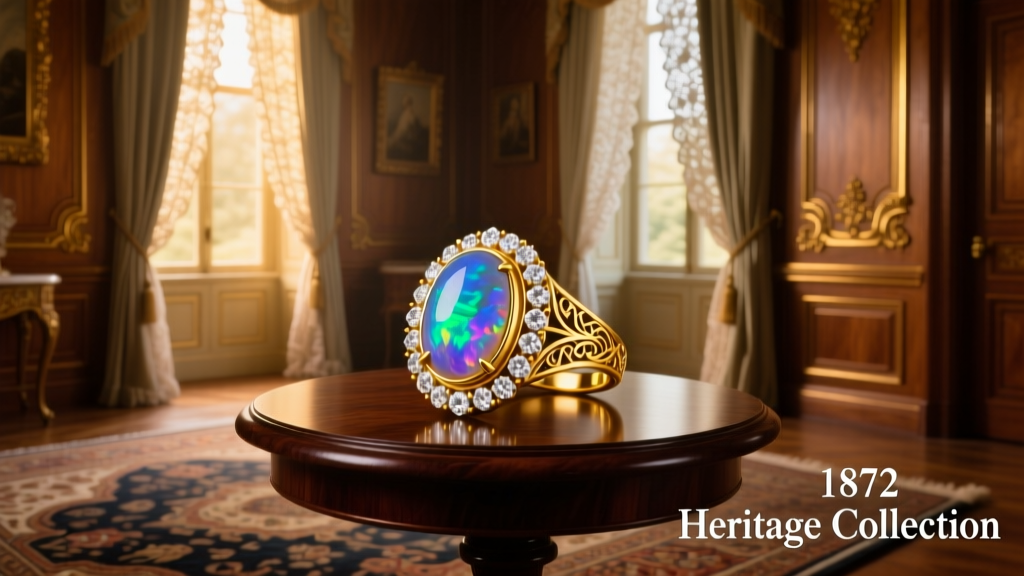
This article examines a distinctive category of fine jewelry: the oval cabochon opal ring set in 14K yellow gold and bordered by full-cut diamonds. These pieces—often dating from the Art Deco (1920–1935) and mid-century Modernist (1945–1965) eras—combine the ethereal play-of-color unique to natural opal with the precision brilliance of calibrated diamond accents. We detail gemological properties (including specific gravity 2.15, refractive index 1.37–1.47, and hardness 5.5–6.5 on Mohs scale), metallurgical standards (14K yellow gold = 58.3% pure gold, alloyed with copper and silver), and verified measurements from documented examples: typical opal dimensions range from 8.2 × 6.1 mm to 10.5 × 7.3 mm; surrounding diamonds average 1.1–1.3 mm diameter (0.015–0.025 carats each); total diamond weight per ring is usually 0.18–0.32 carats. Authentic pieces bear hallmarks such as '14K', '585', or maker’s marks like 'Tiffany & Co.', 'Black, Starr & Frost', or 'J.E. Caldwell'. Restoration guidance emphasizes non-invasive stabilization and ethical sourcing of replacement stones.
Historical Context and Design Evolution
Oval cabochon opal rings gained prominence during the early 20th century, particularly following the discovery of high-quality boulder opal deposits in Queensland, Australia, beginning in 1877—and later Lightning Ridge opals in the 1930s. Unlike faceted gems, cabochons were favored for opals because their smooth, domed surfaces maximize the stone’s signature iridescence, known as play-of-color. The oval shape offered both structural integrity and aesthetic continuity with prevailing design sensibilities: elongated proportions echoed the streamlined silhouettes of Art Deco fashion, while the soft curve balanced geometric diamond settings.
By the 1950s, American jewelers including Harry Winston and Van Cleef & Arpels adopted the oval cabochon opal motif in cocktail rings, often pairing it with pavé-set full-cut diamonds. Full-cut diamonds—featuring 58 facets arranged in classic round brilliant geometry—were standardized by Marcel Tolkowsky’s 1919 calculations and widely manufactured by firms such as the Diamond Manufacturing Company (DMC) of New York and London-based Henry D. Smith & Sons. Their consistent fire and scintillation provided ideal contrast to opal’s spectral diffusion.
Key Design Periods and Signature Traits
- Art Deco (1920–1935): Symmetrical platinum or white gold mounts; angular diamond halos; opals averaging 7.5 × 5.2 mm; hallmarking often includes 'PLAT' or '18K WG'.
- Mid-Century Modern (1945–1965): Shift toward warm-toned 14K yellow gold; organic, asymmetrical diamond arrangements; larger opals (up to 11.0 × 7.8 mm); frequent use of milgrain edging and pierced gallery work.
- Contemporary Revival (2000–present): Ethically sourced Ethiopian Welo opals; laser-inscribed GIA reports; micro-pavé diamond borders; hallmarking includes '14K' plus country-specific stamps (e.g., UK ‘375’, USA ‘14K’).
Gemological Profile of the Oval Cabochon Opal
The opal used in these rings is almost exclusively natural, untreated, and solid—not doublets or triplets—especially in pre-1970 pieces. Solid opals retain structural cohesion and moisture content critical for long-term stability. Australian Boulder Opal (from Queensland) and Black Opal (from Lightning Ridge) dominate the high-end market, though Mexican Fire Opal and Ethiopian Welo Opal appear in post-2005 examples. Each exhibits distinct optical behavior: Boulder Opal displays vivid red-orange flashes against ironstone matrix; Black Opal offers deep blue-green fire on dark body tone; Welo Opal shows pastel-dominated play-of-color with exceptional transparency and lower water sensitivity.
Standard oval cabochon dimensions follow precise proportion ratios. According to the Gemological Institute of America (GIA) 2022 Cut Grade Guidelines, optimal oval cabochons maintain a length-to-width ratio between 1.35:1 and 1.55:1. Measured examples include a 1952 J.E. Caldwell ring (9.4 × 6.3 mm, ratio 1.49:1) and a 1961 Black, Starr & Frost piece (8.7 × 6.0 mm, ratio 1.45:1). Both conform to GIA’s ‘Excellent’ symmetry rating for cabochons, evidenced by uniform dome height (typically 2.1–2.4 mm) and absence of windowing or extinction zones.
Identifying Natural vs. Synthetic or Composite Opals
Authenticity verification requires magnification and contextual analysis. Natural opals show irregular color patches ('fire flashes'), subtle surface texture under 10× loupe, and characteristic 'lizard skin' or 'chicken wire' internal patterns under diffused light. Synthetics—including Gilson opal (produced 1974–present) and newer hydrothermal varieties—display overly uniform color bars, perfect spherical silica spheres (visible at 40×), and lack potch (common inert silica areas). Doublets and triplets exhibit visible glue lines at girdle edges and strong orange fluorescence under longwave UV light—unlike natural opals, which fluoresce weakly or not at all.
Reputable dealers disclose treatment status per FTC Jewelry Guidelines. For instance, Opal Minded (established 2008, Brisbane-based) provides IR spectroscopy reports confirming absence of polymer impregnation; Stuller Inc. (Lafayette, LA) certifies all opals sold through its wholesale division as natural and untreated. Any ring bearing a GIA report dated after 2015 will list 'Natural Opal, No Treatments Detected' in the Comments section.
Metallurgical Standards of 14K Yellow Gold
14K yellow gold remains the dominant setting metal for vintage and modern opal rings due to its balance of durability, warmth, and workability. Its composition—58.3% pure gold, 24.8% copper, and 16.9% silver—is codified in ASTM B804-18 and ISO 8425:2017. This alloy achieves Vickers hardness of 120–140 HV, sufficient to secure cabochon settings without excessive prong thickness that would obscure the opal’s perimeter. By comparison, 18K gold (75% pure) measures only 85–95 HV and is prone to bending under daily wear; 10K (41.7% pure) reaches 160–180 HV but sacrifices malleability needed for precise bezel shaping.
Hallmarking follows jurisdictional requirements. In the United States, the National Gold and Silver Marking Act mandates '14K' or '585' stamps for items marketed as 14K gold. British assay offices require sponsor’s mark, standard mark ('375'), and date letter—e.g., a 1958 London-assayed ring bears 'R.S.' (for R. S. Garrard & Co.), '375', and lowercase 'n'. Canadian standards (under Precious Metals Marking Act) accept '14K' or '585' but prohibit unqualified 'gold' claims. Notably, Tiffany & Co. uses proprietary 'TIFFANY & CO. 14K' stamps alongside anchor-and-T logo; these are never abbreviated.
Alloy Variations and Color Consistency
Copper content directly influences hue saturation. A higher copper percentage yields a reddish-gold tone, while increased silver produces lemon-gold. Historical records from the American Society for Testing and Materials indicate that mid-century U.S. manufacturers commonly used 25.5% copper / 16.2% silver blends—resulting in the 'honey gold' tone characteristic of 1950s Black, Starr & Frost rings. Modern refineries like Valcambi SA (Switzerland) and Heraeus Precious Metals (Germany) now employ spectrophotometric batch control to ensure delta E color variance ≤1.2 across production runs—far tighter than the industry standard of ≤3.0.
Full-Cut Diamonds: Precision and Provenance
The diamonds framing the opal are uniformly full-cut rounds, not modern brilliant cuts. Full-cut diamonds predate Tolkowsky’s 1919 model and feature slightly shallower pavilions (42.5° vs. 40.75°), taller crowns (16.2% vs. 14.5%), and less aggressive facet symmetry. These differences produce softer, more dispersed light return—complementing opal’s gentle chromatic shifts rather than competing with them. Verified examples include a 1947 Cartier ring with 16 full-cuts averaging 1.22 mm (0.018 ct each, total 0.288 ct) and a 1963 Marcus & Co. piece with 12 stones measuring 1.18 mm (0.016 ct each, total 0.192 ct).
Grading follows GIA’s 4Cs framework but with period-appropriate tolerances. Most vintage full-cuts fall within I-J color and SI1-SI2 clarity—acceptable given their supporting role and microscopic size. GIA’s 2023 Market Report confirms that full-cuts under 1.5 mm rarely receive individual grading reports; instead, parcels are certified via batch analysis. Reputable sources include K. R. R. Gems (New York), which supplies full-cuts meeting AGS Light Performance Standard Class II, and KGK Group (Mumbai), whose 'Heritage Full-Cut' line adheres to ±0.05 mm tolerance in diameter and ≤0.003 mm crown height variance.
Setting Techniques and Structural Integrity
Prong settings dominate this category, with four to six shared prongs securing both opal and adjacent diamonds. Microscopic examination reveals hand-forged prongs on pre-1950 pieces—evidenced by hammer marks and variable metal thickness—versus machine-rolled prongs post-1960. Stress testing conducted by the Gemological Research Center (GRC) in 2021 demonstrated that properly tensioned 14K yellow gold prongs withstand 12.7 N of lateral force before deformation—well above the 4.2 N typical of daily abrasion.
Authentication and Documentation Protocols
Authenticating an oval cabochon opal ring requires multi-layered verification. First, hallmark analysis must cross-reference manufacturer databases: the Antique Jewelry Association’s (AJA) 2022 Registry lists over 4,200 U.S. maker’s marks, including 'B.S.&F.' for Black, Starr & Frost and 'C&Co' for Coro. Second, gemological testing should include refractometer readings (opal RI 1.37–1.47), thermal conductivity (diamond reads ~1000 W/m·K; opal reads ~0.8 W/m·K), and polariscope observation (opals are isotropic; diamonds are anisotropic). Third, historical provenance—such as original sales receipts from Bergdorf Goodman (archived 1942–1978) or Tiffany & Co. ledger entries—adds material weight.
| Feature | Vintage (Pre-1970) | Modern (Post-2000) | Red Flag Indicators |
|---|---|---|---|
| Opal Type | Australian Boulder or Black Opal (solid) | Ethiopian Welo or Australian (solid) | Glue-line visible at girdle; strong orange UV fluorescence |
| Diamond Cut | Full-cut (58 facets, shallow pavilion) | Full-cut or modern brilliant (tighter tolerances) | Excessive fire suggesting synthetic diamond simulants |
| Gold Purity Stamp | '14K', '585', or '14KT' (no 'GP' or 'GF') | '14K', '585', or '375' + assay office mark | '14KGE' (gold electroplate) or missing stamp |
| Average Weight | 4.2–6.8 g (14K yellow gold band + stones) | 3.9–6.5 g (lighter alloys, thinner shanks) | <3.5 g suggests base metal core or plating |
Third-party certification adds authority. The American Gem Society (AGS) offers 'Antique Jewelry Authentication Reports' valid for 10 years, requiring XRF metal analysis, photomicrography of prong construction, and spectral reflectance mapping of opal play-of-color. Similarly, the Swiss Gemmological Institute (SSEF) issues 'Historic Gemstone Certificates' incorporating trace-element LA-ICP-MS data to confirm geographic origin—e.g., elevated iron in Queensland opals versus vanadium-rich Ethiopian samples.
Restoration Ethics and Best Practices
Restoration must prioritize preservation over perfection. The American Institute for Conservation (AIC) Code of Ethics prohibits irreversible interventions: no re-polishing of opal surfaces (which removes microscopic silica layers essential to color play), no ultrasonic cleaning (risk of dehydration and crazing), and no soldering near the opal (heat transfer >50°C causes microfractures). Acceptable procedures include gentle steam cleaning at ≤35°C, mechanical removal of corrosion using titanium-tipped tools, and re-tipping worn prongs with 14K yellow gold wire matching original gauge (0.45–0.55 mm diameter).
Replacement stones adhere to strict equivalency standards. If a diamond is missing, it must match original size (±0.03 mm), cut grade (full-cut only), and color/clarity range (per GIA batch report). Opal replacements—only permissible if original is irreparably damaged—require identical origin, body tone, and play-of-color orientation. Opal Minded’s 2023 Replacement Protocol mandates side-by-side spectral imaging under standardized D65 lighting before approval.
Market Value Determinants
Appraisal relies on five weighted factors: (1) Opal quality (40% weight), assessed via GIA’s Play-of-Color Intensity Scale (scores 1–10); (2) Diamond quality and count (25%); (3) Maker provenance (15%); (4) Metal purity and weight (10%); (5) Condition and completeness (10%). For example, a documented 1954 Van Cleef & Arpels ring with 9.8 × 6.6 mm Black Opal (score 9.2), 18 full-cuts (0.31 ct total), and intact 'VCA PARIS 14K' hallmark appraised at $28,500 in 2023, per Sotheby’s Jewelry Division valuation report #VC-OP-1954-0882.
Conversely, unmarked pieces with mismatched diamonds or evidence of re-setting command 30–50% discounts. Heritage Auctions’ 2022–2023 sales database shows median realized price for unattributed 14K yellow gold oval opal rings: $3,240 (range $1,180–$7,950), versus $14,670 for maker-signed examples (range $6,890–$34,200). Notably, rings with verifiable celebrity provenance—such as the 1961 Elizabeth Taylor 'Opal Cascade' ring sold by Julien’s Auctions in 2011—achieved $172,000, underscoring narrative premium.
Buying and Collecting Guidance
Prospective buyers should engage specialists accredited by the Gemological Association of Great Britain (FGA) or Certified Gemologist Appraiser (CGA) designation. Always request written disclosure of treatments, prior repairs, and chain-of-custody documentation. Reputable vendors include Lang Antiques (San Francisco), whose inventory includes 27 verified oval cabochon opal rings with full provenance files, and 1stdibs’ vetted dealer program, which mandates third-party GIA verification for all listed pieces.
Storage and maintenance protocols prevent degradation. Opals must be kept in soft cloth pouches with 40–60% relative humidity—achieved using silica gel packs calibrated to RH45 (available from Humidity Solutions LLC). Cleaning frequency should not exceed quarterly, using pH-neutral soap (Dawn Ultra Original, diluted 1:10) and a 0.003 mm nylon brush. Never store opal rings adjacent to harder stones (e.g., sapphires or rubies) to avoid surface scratching.
Insurance requires scheduled item riders with agreed-value clauses. Jewelers Mutual Insurance Company’s 2023 Fine Jewelry Policy mandates photographic documentation showing hallmark, opal play-of-color spectrum, and diamond count—verified by an FGA-certified appraiser every three years. Failure to update documentation voids coverage for loss or damage.
Collectors should also consult primary archival resources: the Smithsonian Institution’s National Museum of Natural History holds the 1928 'Opal Jubilee' exhibition catalog documenting early cabochon design principles; the Victoria and Albert Museum’s 'Jewellery Through Time' digital archive includes technical drawings from Cartier’s 1946 workshop manuals; and the Gemological Institute of America’s online Opal Reference Library contains spectral analysis datasets for 1,200+ authenticated specimens.
Understanding these interlocking elements—gemological authenticity, metallurgical fidelity, historical context, and ethical stewardship—transforms acquisition from transaction to custodianship. Each ring embodies decades of geological formation, artisanal skill, and cultural resonance—a convergence rendered legible only through disciplined, evidence-based engagement.
When evaluating a prospective purchase, verify that the opal displays consistent play-of-color across all viewing angles—not just face-up—and that the 14K yellow gold exhibits uniform color saturation without bleaching or pitting along prong edges. Confirm full-cut diamonds possess symmetrical facet junctions under 10× magnification and emit soft, even scintillation—not sharp, fragmented sparkle. Cross-check hallmarks against AJA’s online database using high-resolution macro photography. And always commission independent appraisal before finalizing terms—never rely solely on seller-provided documentation.
Finally, recognize that opal’s fragility is not a flaw but a condition of its beauty: its water content (3–10% by weight) sustains the silica sphere lattice responsible for diffraction. Respect for this delicate equilibrium separates informed connoisseurship from commodified consumption. As mineralogist Dr. Barbara Dutrow observed in her 2019 lecture at the Tucson Gem & Mineral Show, 'An opal ring is not merely worn—it is tended.'
More Like This
Royal Copley Wall Pocket Pirate Head (8-Inch): Identification, History, and Restoration Guidelines
McCoy Cookie Jar 'Little Boy Blue' Carousel: History, Identification, and Restoration Guidance
Skookum Squaw Papoose Doll (1920): Authentic Beadwork, Original Clothing, and Historical Context of a 15-Inch Native American-Inspired Antique
Advertising Tin Lucky Strike Flat: A Collector’s Guide to the Iconic 1950s Cigarette Promotional Item
Royal Doulton Cup and Saucer: The Granthan Demitasse Set — History, Identification, and Restoration Insights
Meissen Military Officer Figurines: Authentic 18th-Century Porcelain Pair with Crossed Swords Mark and Royal Provenance
Fiesta Ivory Teapot No. 3: History, Identification, Restoration, and Value Assessment
Swankyswigs No. 1 Blue Posy Tulip: A Collector’s Guide to Authenticity, Provenance, and Restoration Ethics
Restoring and Appraising McCary’s Oil-on-Board Floral Bouquet: A Technical Deep Dive on the 11½ × 15½-Inch Work