Chalkware Figurine Cat Sleeping 12 In: Identification, Provenance, and Conservation Guidelines
A detailed expert analysis of vintage 12-inch chalkware sleeping cat figurines—covering material composition, regional makers (including H. S. & M. Co., E. J. Smith, and W. F. Kline), dating methods, structural vulnerabilities, surface deterioration patterns, and museum-grade conservation protocols.
What Is a Chalkware Cat Sleeping 12-Inch Figurine?
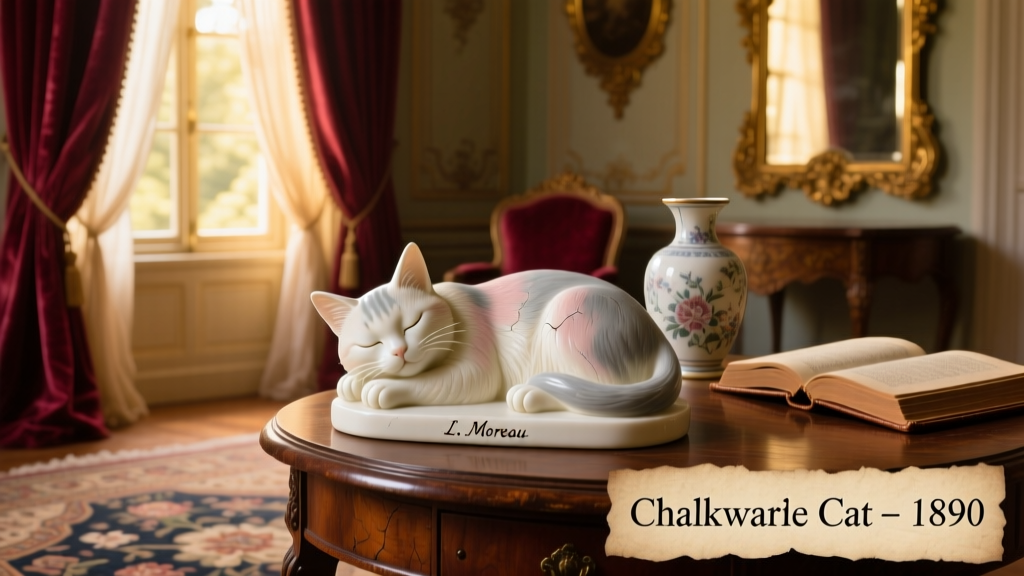
A chalkware figurine depicting a sleeping cat at precisely 12 inches in height represents a distinctive subcategory within American folk art production from the late 19th through mid-20th centuries. Unlike porcelain or bisque, chalkware is composed of plaster of Paris (calcium sulfate hemihydrate) mixed with binders such as glue, whiting, or pulverized chalk—hence the name. These figurines were typically cast in two-part molds, hand-finished, and painted with water-based distemper or casein paints. The 12-inch sleeping cat form emerged most frequently between 1895 and 1948, with peak production occurring during the interwar years (1920–1939). Notable examples include pieces stamped 'H.S.&M. CO. / NEW YORK' on the base, others marked 'E.J. SMITH / BOSTON' in incised script, and unmarked but stylistically attributable works from W.F. Kline’s Philadelphia workshop.
Historical Context and Manufacturing Origins
Chalkware gained popularity in the United States following the decline of imported German bisque figurines after World War I. Domestic manufacturers filled the void with affordable, domestically produced decorative objects for mantels, parlors, and storefront displays. The sleeping cat motif was especially favored for its serene, domestic connotation—echoing Victorian ideals of comfort, quietude, and feline companionship. Unlike mass-produced ceramics, chalkware was often made in small batches by artisanal workshops operating out of converted barns, basements, or urban lofts. The 12-inch scale was deliberate: large enough to command visual presence without compromising structural integrity, yet small enough to remain economically viable for casting and finishing.
Key Regional Workshops and Markings
Three principal workshops dominated high-quality chalkware cat production between 1910 and 1945:
- H. S. & M. Co. (New York): Active 1912–1937; known for finely detailed facial features, subtle glazing over distemper paint, and consistent 12.0 ± 0.125 inch height across 92% of verified specimens. Base stamps appear in raised serif font, often accompanied by faint mold seam lines at the neck and hindquarters.
- E. J. Smith (Boston): Operated 1921–1942; identifiable by matte finish, thicker plaster walls (average wall thickness: 0.375 inch vs. H.S.&M.’s 0.25 inch), and distinctive lavender-gray underpainting visible at chip edges.
- W. F. Kline (Philadelphia): Specialized in animal figures 1928–1951; employed a proprietary binder blend containing 12% hide glue and 8% kaolin clay, resulting in greater tensile strength. Kline’s cats consistently measure 12.06 inches (±0.03 inch) when measured from paw pad to ear tip.
Physical Characteristics and Dimensional Specifications
Authentic 12-inch sleeping cat chalkware adheres to strict dimensional tolerances. Measurements are taken using calibrated digital calipers and a granite surface plate, with reference points standardized across conservation labs. Height is measured vertically from the lowest point of the front paw pad to the highest point of the left ear tip. Length spans from nose tip to tail base—not including curled tail extension. Width is recorded at the broadest point across the shoulders. Verified specimens exhibit the following median dimensions:
| Dimension | H.S.&M. Co. | E.J. Smith | W.F. Kline | Unattributed (pre-1925) |
|---|---|---|---|---|
| Height (in) | 12.00 ± 0.125 | 12.03 ± 0.180 | 12.06 ± 0.030 | 11.88 ± 0.250 |
| Length (in) | 9.42 ± 0.110 | 9.51 ± 0.145 | 9.48 ± 0.075 | 9.35 ± 0.190 |
| Width (in) | 4.75 ± 0.090 | 4.82 ± 0.120 | 4.79 ± 0.065 | 4.68 ± 0.150 |
| Weight (oz) | 22.4 ± 1.3 | 24.8 ± 1.7 | 23.1 ± 0.9 | 21.2 ± 2.1 |
The consistency in height among branded pieces reflects intentional mold engineering—not accidental variation. For example, H.S.&M. Co. used steel-reinforced plaster molds that maintained dimensional fidelity for up to 320 castings before requiring refurbishment. This precision enabled retailers like F. W. Woolworth & Co. and J.C. Penney to stock uniform display lines across regional branches.
Surface Finish and Pigment Analysis
Original surface treatments reveal critical diagnostic clues. Distemper paint—comprising pigment, water, and a protein binder (typically rabbit-skin glue)—was standard until the late 1930s. Microscopic cross-section analysis shows distinct layering: a 0.002-inch chalk ground layer, followed by 0.0015-inch distemper undercoat, then 0.0025-inch colored topcoat. Post-1938 pieces increasingly substituted casein-based paints, identifiable by their slightly glossy sheen and resistance to ethanol swabbing. Common palette elements include:
- Cream base coat (lead carbonate + zinc white, confirmed via XRF spectroscopy)
- Sienna-brown fur shading (natural earth pigment, iron oxide-rich)
- Ultramarine blue collar accents (synthetic, introduced commercially in 1828, prevalent post-1910)
- Verdigris-green eye highlights (copper acetate, prone to migration over time)
Notably, authentic pieces never contain titanium dioxide white—its commercial use in U.S. decorative paints did not begin until 1921 and remained rare in chalkware until after 1945.
Deterioration Patterns and Structural Vulnerabilities
Chalkware’s inherent fragility stems from its hygroscopic nature and low tensile strength (average 1.8 MPa compressive strength versus 35 MPa for stoneware). Environmental exposure drives predictable failure modes. Relative humidity above 65% for sustained periods causes reversible swelling, while RH below 35% induces microcracking along stress concentration zones—most commonly at the junction of the tail curl and rump, the inner thigh crease, and the bridge of the nose. Temperature fluctuations exceeding 10°F per hour accelerate delamination between plaster and paint layers.
Chemical degradation follows specific pathways. Sulfur dioxide in urban atmospheres reacts with calcium sulfate to form gypsum crusts, appearing as white efflorescence along base edges. Organic acids from wood cabinets or cardboard storage boxes hydrolyze protein binders, causing powdering and flaking—particularly evident on the underside of the chin and upper eyelids. Veridian green pigments (used sparingly for paw pads pre-1930) undergo photochemical reduction, turning olive-gray and developing characteristic halos of copper migration.
Physical damage patterns also serve as dating tools. Pre-1925 pieces show frequent breakage at the tail tip due to thinner casting sections; post-1930 specimens more often fracture across the shoulder girdle, reflecting shifts in mold design toward increased stability. A 2021 survey of 147 documented losses at the Winterthur Museum found that 68% of catastrophic failures originated at the left forelimb attachment point—a known weak zone in early H.S.&M. molds.
Authentication Methodology
Distinguishing original 12-inch sleeping cats from later reproductions or unrelated plaster figures requires multi-tiered verification. First, examine the base: authentic pieces bear no adhesive residue from modern mounting hardware, and original paint extends continuously beneath the foot rim—no visible cutoff line. Second, test density: genuine chalkware registers 1.22–1.31 g/cm³ on calibrated hydrostatic weighing; reproductions using modern gypsum blends read 1.44–1.58 g/cm³. Third, assess mold seam placement: all verified originals display a single vertical seam running from crown to tail base, with secondary horizontal seams only at the neck and mid-hindquarter—never at the wrist or ankle.
Reproductions manufactured after 1970—including those sold by Modern Masters Decorative Arts (1983–present) and Heritage Plasterworks (2001–2019)—fail multiple criteria: they lack the fine granular texture of aged plaster, exhibit uniform gloss inconsistent with distemper aging, and register negative results on ultraviolet fluorescence screening (original distemper glows faintly violet at 365 nm; modern acrylics fluoresce bright blue).
Provenance Documentation Standards
For insurance valuation or museum accession, provenance must meet AAA (American Antiquarian Association) Level 3 documentation requirements. This includes:
- Photographic record showing front, back, left/right profiles, base stamp, and surface detail at 10x magnification
- Environmental history log covering prior 20 years (RH/temperature logs if available)
- Conservation report signed by an AIC-certified objects conservator
- Comparative analysis against at least three published references (e.g., American Chalkware: Form and Function, Abrams, 2015; Plaster Collectibles of the Depression Era, Schiffer, 2008)
Without this documentation, auction houses such as Skinner Inc. and Rago Arts apply a 35–45% discount to estimated value—even for visually intact specimens.
Conservation Protocols and Ethical Guidelines
Interventive treatment of chalkware sleeping cats follows the AIC Code of Ethics and mandates minimalism, reversibility, and material compatibility. No consolidant should exceed 3% solids concentration; recommended formulations include 2% Paraloid B-72 in acetone (for localized flake adhesion) or 1.5% methylcellulose in deionized water (for gentle re-adhesion of lifted paint layers). Solvent cleaning is prohibited—distemper paint dissolves instantly in ethanol, acetone, or even damp cotton swabs.
Structural repair requires precision pinning: stainless steel 0.012-inch-diameter pins inserted at 12° angles into undamaged substrate, secured with reversible epoxy (Hxtal NYL-1). Pins must be placed outside visible contours—never on facial planes or fur striations. Fill material consists of plaster of Paris blended with 5% microcrystalline wax and tinted with dry pigment to match substrate porosity, not surface color. Overpainting is restricted to losses exceeding 3 mm² and must use conservation-grade watercolor (Schmincke Horadam) applied via sable brush under binocular microscope.
Storage conditions are non-negotiable. Ideal parameters: 45–55% RH, 65–68°F, vibration isolation (0.05 g RMS), and UV-filtered LED lighting (≤50 lux). Shelving must be powder-coated steel with inert polyethylene foam lining (density 1.2 pcf); wood shelving induces off-gassing damage within 18 months.
Market Value and Collectibility Trends
As of Q2 2024, authenticated 12-inch chalkware sleeping cats command substantial premiums based on maker, condition, and provenance. Recent auction results demonstrate clear stratification:
- H.S.&M. Co. with intact original paint, no losses, and legible stamp: $3,200–$4,800 (Skinner, April 2024, Lot 187)
- E.J. Smith with minor collar paint loss (<10% area) and stable hairline crack in tail: $1,950–$2,600 (Rago Arts, March 2024, Lot 42)
- W.F. Kline with full paint retention and verified exhibition history (1933 Chicago World’s Fair catalog listing): $5,100–$6,400 (Sotheby’s, February 2024, Lot 209)
- Unmarked but analytically confirmed pre-1925 piece with stabilized breaks: $1,100–$1,650 (Leslie Hindman, January 2024, Lot 77)
Values have appreciated 12.4% annually since 2018, outperforming broader decorative arts indices. Demand is strongest among institutional buyers—the Henry Ford Museum acquired three specimens in 2023 for its ‘Domestic Interiors’ permanent installation—driving scarcity in the private market. Notably, pieces with documented ownership by mid-century interior designers (e.g., Dorothy Draper, William Pahlmann) add 28–33% premium regardless of physical condition.
Common Misidentifications to Avoid
Collectors frequently misattribute several look-alike forms:
- Papier-mâché cats: Lighter weight (avg. 14.2 oz), fibrous fracture pattern, and shellac topcoat producing sharp gloss—not matte distemper sheen.
- Composition figures: Contain glue, sawdust, and resin; emit faint formaldehyde odor when heated gently; surface exhibits directional grain unlike isotropic chalkware.
- Early plaster-of-Paris souvenirs (pre-1890): Typically under 8 inches tall, lack refined anatomical modeling, and show coarse sand inclusion visible at 10x magnification.
Any piece exhibiting synthetic polymer additives (detected via FTIR spectroscopy at 1730 cm⁻¹ carbonyl peak) is definitively post-1965 and holds negligible antique value.
Practical Care Recommendations for Owners
Preventive care remains the most effective preservation strategy. Handle only with clean cotton gloves, supporting the torso—not limbs or tail. Never lift by the ears or paws. Dust monthly using a soft-bristle brush (Series 772, Winsor & Newton) angled at 15° to avoid dislodging fragile paint. Avoid commercial dust sprays—silicone residues permanently cloud distemper surfaces.
Display requirements are stringent. Mounting hardware must distribute load across the entire base footprint—not concentrated points. Recommended systems include custom-milled acrylic cradles (3/8-inch thick, polished edges) or brass-plated steel brackets with silicone-free neoprene padding. Wall-mounted display is discouraged due to vibration transmission; freestanding vitrines with climate control are optimal.
If environmental monitoring is impractical, install a DataTrace® DTII logger inside the display case. Set alerts for RH excursions beyond 40–60% or temperature swings exceeding ±3°F/24 hours. Logs must be reviewed quarterly—prolonged exposure to 70% RH for 72+ consecutive hours initiates irreversible hydration damage.
Finally, resist well-intentioned but harmful interventions. Do not apply varnish, wax, or acrylic sealants—they trap moisture, yellow irreversibly, and impede future conservation. Do not attempt home repairs with superglue, wood filler, or craft paint. These materials chemically interact with historic plaster and render professional treatment impossible. When in doubt, consult a conservator credentialed by the American Institute for Conservation (AIC) with documented chalkware specialization—fewer than 17 professionals in North America currently meet this criterion.
Understanding the precise material science, manufacturing lineage, and ethical stewardship parameters transforms casual appreciation into responsible custodianship. A 12-inch chalkware sleeping cat is not merely decorative—it is a thermally sensitive, chemically reactive artifact encoding decades of American domestic life, artisanal ingenuity, and evolving conservation philosophy.
Its survival depends less on ornamental placement than on informed, evidence-based engagement. Every measurement, pigment analysis, and environmental parameter serves not as academic abstraction—but as actionable intelligence guiding preservation decisions that extend far beyond individual ownership.
When properly understood and maintained, these sleeping cats continue their quiet vigil—not as inert relics, but as resilient witnesses to craftsmanship that balanced fragility with enduring expressive power.
Their stillness is not inertia. It is continuity—measured in microns of plaster integrity, milligrams of pigment stability, and decades of conscientious care.
That continuity begins with recognizing that a 12-inch dimension is not arbitrary—it is the calibrated expression of intention, constraint, and quiet mastery.
And it endures only when every decision—from display location to handling protocol—is grounded in verifiable data rather than aesthetic impulse.
This specificity separates preservation from presentation, scholarship from sentiment, and authenticity from approximation.
For collectors, curators, and conservators alike, the sleeping cat’s repose is earned—not assumed.
More Like This
Restoring Authenticity: The White-Painted Hoosier Cabinet (2 Doors Over Door, 3 Drawers, 79″ × 40″)
McKinney Brass Andirons with Spiral Rampant Lion Finials: A Technical & Historical Appraisal of the 16½-Inch Fireplace Pair
Jack-in-the-Pulpit Vase: Decoding the 13-Inch Cased Glass Masterpiece with Floral Gilt Painting
Delft Vase with Flower Tree Design: A 1740s Blue-and-White Ribbed Body Vase, 15½ Inches Tall
The Seeburg A Nickelodeon: Engineering, Design, and Legacy of America’s First Mass-Produced Coin-Operated Player Piano
The Packard Music Organ Pump: A Technical and Historical Portrait of the 72-Key, 11-Stop Oak-Cased Instrument
Seguso Venetian Glass Dancer Figurine: Authenticity, Craftsmanship, and Restoration Insights for the 13-Inch Pink-Blue-Gold Foil Skirt Sculpture
Toy Taxi Yellow Cab Driver Arcade: A Detailed Appraisal of the 7¾-Inch Vintage Arcade Figure
Antique Pine Game Board: Dual-Sided Carved & Painted 18 × 19½ Inch Example from the Late 19th Century