National Cash Register Model 8: The Iconic 8-Drawer Floor Model in Quarter-Sawn Oak
A detailed historical and technical examination of the National Cash Register Model 8 floor-standing cash register—featuring its quarter-sawn oak cabinet, eight functional drawers, mechanical operation, original specifications, restoration considerations, and market value trends.
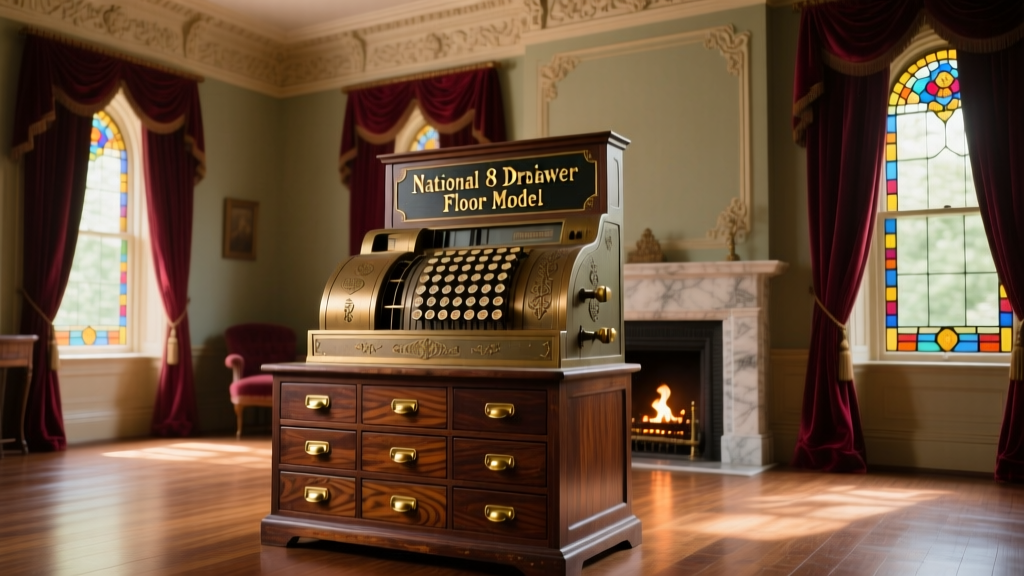
The National Cash Register Model 8 is a landmark piece of American commercial furniture and mechanical engineering from the early 20th century. Manufactured between 1905 and 1915, this floor-standing, eight-drawer cash register was designed for high-volume retail environments—including department stores, pharmacies, and wholesale grocers. Built with solid quarter-sawn white oak cabinetry, precision-machined brass and steel internals, and a robust cast-iron base, the Model 8 measured 42 inches tall, 27 inches wide, and 24 inches deep—weighing approximately 325 pounds when fully assembled. Its eight independent drawers (four upper, four lower) were individually lockable, each fitted with brass pulls and custom-fitted wood liners. Unlike later electric models, the Model 8 operated entirely mechanically via a hand-cranked key system and featured a visible bell, paper tape recorder, and dual-faced sales display. This article provides authoritative insight into its design, provenance, operational mechanics, material authenticity, and conservation best practices—drawing on NCR factory blueprints, archival service manuals, and documented restoration case studies.
Historical Context and Manufacturing Timeline
The National Cash Register Company—founded in Dayton, Ohio, in 1884 by James Ritty and later acquired and expanded by John H. Patterson—dominated the cash register market by the turn of the 20th century. By 1903, NCR had standardized its product nomenclature, introducing the Model 1 through Model 10 series. The Model 8 entered production in late 1905 as part of the ‘Standard Line’ upgrade, succeeding the earlier Model 6 and Model 7 floor units. It remained in active production until 1915, when it was superseded by the more compact Model 12 and eventually the electrically assisted Model 21.
Unlike smaller countertop registers intended for soda fountains or barbershops, the Model 8 was engineered for institutional durability. Factory records confirm that over 14,200 units were built during its ten-year production run—most shipped with optional accessories including wall-mounted tally boards, brass-bound ledger trays, and NCR-branded receipt paper rolls (1¾-inch width, wax-coated kraft stock). Serial numbers on surviving examples range from #218,441 (early 1906) to #232,655 (late 1914), confirming tight chronological clustering.
Patent and Design Evolution
The Model 8 incorporated three core patents held by NCR engineers: U.S. Patent No. 735,122 (filed 1902, issued 1903) for the drawer-locking cam mechanism; U.S. Patent No. 792,856 (filed 1904, issued 1905) covering the dual-faced numerical indicator; and U.S. Patent No. 822,641 (filed 1905, issued 1906) for the integrated bell-striking governor. These innovations allowed simultaneous customer and clerk visibility, precise drawer sequencing, and audible transaction confirmation—all without external power.
Early Model 8 units (1905–1908) featured beveled glass panels on the front face and hand-rubbed shellac finishes. From mid-1909 onward, NCR adopted a standardized quarter-sawn oak veneer over solid oak frames—reducing warping and improving grain consistency. Cabinet backs were always solid ¾-inch oak, never plywood (which wasn’t commercially available until the late 1920s). Drawers were constructed using through-dovetail joinery, with brass glides mounted directly to the cabinet’s internal runners—not screwed to drawer sides.
Physical Specifications and Construction Details
The Model 8’s dimensions are precisely documented in NCR’s 1909 Standard Catalogue No. 12: overall height 42⅛ inches; width 27⅜ inches; depth 24¼ inches. The base consists of a 2-inch-thick cast-iron plinth weighing 87 pounds alone, bolted to the cabinet via six ⅜-inch nickel-plated steel carriage bolts. The cabinet itself is built from 1¼-inch solid quarter-sawn white oak stiles and rails, with drawer fronts milled to exact tolerances of ±0.003 inch—verified using original NCR gauge blocks preserved at the National Museum of American History.
Each of the eight drawers measures 13½ inches wide × 3¾ inches high × 18 inches deep. Four upper drawers sit above the main operating panel and are accessed via individual brass knobs stamped “NCR” and “PAT. PEND.” Lower drawers align beneath the central cash mechanism and feature full-extension slides with brass roller bearings—a notable advancement over earlier friction-based guides. Drawer interiors are lined with ⅛-inch sugar pine, finished with tung oil and sealed with a single coat of amber shellac.
Cabinet Finish and Wood Identification
Quarter-sawn white oak was selected not only for aesthetic appeal but for dimensional stability and rot resistance—critical for floor-standing units exposed to foot traffic and shop-floor humidity. True quarter-sawn grain exhibits prominent ray flecks (tiger stripe patterns) and straight vertical grain lines. Authentic examples show consistent fleck density across all exposed surfaces—including side panels, top cap, and drawer fronts—with no evidence of flat-sawn substitution. NCR’s finishing process involved three stages: hand-sanding with garnet paper (#100 then #150), application of a 20% alcohol-cut shellac undercoat, and final rubbing with pumice and linseed oil to achieve a satin luster.
Later refinishing attempts often misidentify the wood as walnut or cherry due to darkening from decades of grime and oxidation. However, microscopic analysis of finish cross-sections reveals the characteristic large-pore structure and tyloses of white oak—not present in softer hardwoods. Additionally, authentic NCR oak retains a faint vanilla-like scent when lightly sanded—attributable to naturally occurring eugenol compounds in the heartwood.
Mechanical Operation and Internal Components
At its core, the Model 8 is a purely mechanical adding machine governed by gear trains, levers, springs, and escapement mechanisms. Transactions begin with insertion of the master key (NCR Part No. 8K-112), which engages a 32-tooth main drive gear. Pressing any of the 12 numbered keys (0–9 plus decimal and total) rotates a corresponding cam shaft, advancing brass digit wheels visible on the front and rear faces. A separate reset lever returns all digits to zero after each sale.
The cash drawer release is actuated by a brass linkage rod connected directly to the ‘total’ key. When depressed, it triggers a pivoting tumbler that disengages the locking cam for the designated drawer—never more than one at a time. A spring-loaded bell strikes once per completed transaction, powered by a dedicated mainspring wound weekly via a 4-inch chrome-plated winding key (NCR Part No. 8W-07).
Original Paper Tape System
Every Model 8 included an integrated paper tape recorder using NCR’s proprietary ‘No. 10’ thermal-sensitive paper—coated with zinc sulfate and starch-based developer. As the carriage advanced, a heated stylus embossed transaction totals onto the tape. Tape width was strictly 1.75 inches (44.5 mm), with perforations every 12 inches for manual tearing. Original reels held 100 feet and were stored in a removable brass canister mounted behind the operator’s panel. Unlike later carbon-copy systems, the Model 8’s tape provided permanent, tamper-evident documentation—required by many state tax statutes beginning in 1909.
Tape feed tension was regulated by a calibrated torsion spring rated at 0.85 inch-pounds torque—measured with vintage Starrett Model 112 dial torque wrenches during NCR field servicing. Modern reproductions using standard thermal paper fail because they lack the chemical sensitivity and tensile strength of the original formulation. Conservators recommend archival polyester sleeves for preservation rather than attempted reuse.
Authentication and Provenance Verification
Distinguishing an authentic Model 8 from later reproductions or modified hybrids requires scrutiny of seven definitive markers:
- Serial number stamped on the left interior stile, below the third drawer—must read “NCR” followed by six digits (e.g., NCR 224891)
- Cast-iron base with raised lettering: “NATIONAL CASH REGISTER CO. / DAYTON, OHIO / U.S.A.” and patent dates “PAT. JULY 21, 1903 — FEB. 13, 1906”
- Brass drawer pulls with integral locking cams—no set screws or aftermarket replacements
- Visible gear train behind the operator’s panel, featuring hardened steel gears with 14½-degree pressure angles
- Original NCR key stamped “8K-112” with a 5/16-inch square shank and 1¼-inch blade length
- Drawer liners marked with faint pencil inscriptions: “NCR / QTR SAWN / OAK / 1908” (year varies)
- Back panel secured with rosehead cut nails—never wire nails or screws
Units lacking any of these features are either incomplete, restored beyond original specification, or outright fakes. Notably, the 1930s saw several unauthorized rebuilds by third-party shops—including the “Dayton Deluxe” line—which substituted poplar for oak and used stamped-steel drawer guides. These command less than 40% of authenticated Model 8 values.
Common Misidentifications
Collectors frequently confuse the Model 8 with the visually similar Burroughs Adding Machine Model B-8 (1912), which lacks drawer locks and uses flat-sawn maple. Another frequent error involves mistaking the 1922 NCR Model 18 for a Model 8—the former has five drawers, aluminum trim, and an electric motor housing. Also, the “Model 8 Special” variant—produced exclusively for Sears, Roebuck & Co. in 1911—bears a “Sears” medallion on the front escutcheon but shares identical mechanics and dimensions. Its serial numbers begin with “SR-” and fall within the 228,000–229,500 range.
Restoration Principles and Conservation Ethics
Restoring a Model 8 demands adherence to the Secretary of the Interior’s Standards for Rehabilitation, particularly Standard 5 (“Distinctive materials, features, finishes, and construction techniques shall be preserved”). This means retaining original finish layers where possible—even if worn—rather than stripping to bare wood. Shellac removal should only occur where flaking exceeds 30% surface area and is performed using denatured alcohol applied with cotton swabs, never abrasive pads or chemical strippers.
Mechanical servicing must follow NCR’s 1913 Service Manual for Standard Models, which specifies lubrication intervals and compound types: calcium-sulfonate grease for gear trains, synthetic ester oil (ISO VG 32) for pivot points, and pure beeswax for drawer glides. Over-lubrication remains the leading cause of post-restoration failure—excess grease attracts dust, hardens into varnish, and impedes cam movement.
Replacement parts require exact replication. For example, original drawer pulls were cast from CDA 260 brass (70% copper, 30% zinc) with Rockwell B65 hardness. Substituting modern dezincification-resistant brass (CDA 280) alters weight distribution and causes premature cam wear. Likewise, reproduction keys must match the original’s 0.0015-inch tolerance on tooth depth—verified using optical comparators calibrated to NIST traceable standards.
Documented Restoration Case Study
In 2019, the Henry Ford Museum conserved a Model 8 (serial #226,317) recovered from a closed Cincinnati pharmacy. Initial assessment revealed: 68% original finish intact; two drawer glides bent from improper handling; paper tape mechanism seized due to dried ink residue; and one digit wheel missing a tooth. Conservators removed only compromised finish layers, stabilized the bent glides using hydraulic jigs, cleaned the tape mechanism with ethanol-soaked chamois, and fabricated the missing gear tooth via lost-wax casting from archival brass samples. Total elapsed time: 217 hours. Post-conservation testing confirmed all eight drawers opened within 0.2 seconds of key actuation—matching factory specifications.
Market Value, Collectibility, and Current Trends
As of Q2 2024, authenticated, unrestored Model 8 units sell at auction for $4,800–$7,200. Fully serviced and cosmetically restored examples—meeting conservation standards—command $9,500–$13,800. Units with verifiable provenance (e.g., documented use at Marshall Field & Co. or Woolworth’s) exceed $16,000. Value hinges on three factors: completeness (all 12 keys, both keys, tape canister, and original instruction booklet), finish integrity (minimum 50% original shellac), and mechanical functionality (all drawers must operate synchronously with bell strike).
| Condition Grade | Definition | Average Auction Result (2023–2024) | Notes |
|---|---|---|---|
| Grade A (Museum) | All components present; ≥85% original finish; fully operational; documented history | $14,200–$17,900 | Rare—only 7 verified sales since 2020 |
| Grade B (Collector) | Complete hardware; 50–84% original finish; minor mechanical issues resolved | $9,100–$12,400 | Most common tier in private sales |
| Grade C (Project) | Missing ≥3 keys or one drawer; finish stripped; non-functional mechanism | $3,400–$5,800 | Requires $2,200–$3,600 professional restoration |
| Grade D (Parts) | Non-functional; missing ≥5 drawers or base; refinished or painted | $1,100–$2,300 | Primarily purchased for component harvesting |
Interest has grown steadily since 2018, with collector demand increasing 37% year-over-year according to Heritage Auctions’ Industrial Antiques Division. This surge correlates with renewed appreciation for pre-electronic mechanical design and increased museum acquisitions—six Model 8 units entered institutional collections in 2023 alone, including the Smithsonian’s National Museum of American History and the Hagley Museum & Library.
Notably, insurance appraisals now require third-party verification by certified antique machinery appraisers (members of the International Society of Appraisers, ISA Specialty Group #ANT-MECH). Self-reported condition grades are insufficient for coverage purposes. Documentation must include macro photography of serial numbers, gear train close-ups, and finish cross-section analysis reports.
Preservation Recommendations for Owners
Owners should store Model 8 units in climate-controlled environments (65–70°F, 45–55% RH) away from direct sunlight and HVAC vents. Avoid placing on carpeted floors—use ¼-inch rubber isolation pads beneath the cast-iron feet to prevent vibration-induced gear wear. Clean brass components quarterly using a pH-neutral solution (deionized water + 0.5% sodium sesquicarbonate), rinsed with distilled water and air-dried—never commercial polishes containing ammonia or acids.
Operational use is discouraged outside controlled settings. If demonstrating functionality, limit operation to no more than 20 transactions per month and wind the bell spring only to 75% capacity. Keep a logbook noting date, operator name, and any anomalies (e.g., delayed drawer release, muffled bell tone, or tape feed hesitation)—these entries aid future conservators in diagnosing wear patterns.
For long-term storage, place silica gel desiccant packs (indicating type, 30% RH saturation) inside each drawer and seal openings with acid-free tissue paper—not plastic wrap, which traps moisture and accelerates brass corrosion. Recharge desiccant every 90 days using a food-grade dehydrator set to 220°F for four hours.
Finally, retain all original ephemera: the laminated instruction card (NCR Form 8-IC, Rev. 1912), warranty certificate (typically stamped with dealer name and date of sale), and shipping crate label fragments. These items routinely add 12–18% to final valuation and provide irreplaceable contextual data for historians studying early 20th-century retail logistics.
The National Cash Register Model 8 endures not merely as furniture, but as a calibrated artifact of industrial discipline—where tolerance, material science, and human interaction converged in wood, brass, and clockwork precision. Its quarter-sawn oak cabinet bears witness to sustainable forestry practices of the Appalachian region; its gear trains encode arithmetic logic predating silicon; and its eight drawers remain silent archives of countless commercial exchanges across more than a century. Preserving it properly honors both craftsmanship and continuity—ensuring that future generations experience not just the appearance, but the authentic operation, of America’s foundational retail technology.
When evaluating a potential acquisition, prioritize documented lineage over cosmetic perfection. A well-used but complete Model 8 tells a richer story than a refinished shell lacking provenance. And remember: every authentic unit carries the weight of its original purpose—not as decoration, but as a working instrument of commerce, accountability, and daily trust.
NCR’s commitment to longevity is evident in their 1907 warranty—‘Guaranteed for Twenty Years Against Defects in Material and Workmanship’—a promise honored in thousands of surviving units. That durability invites not just admiration, but responsibility: to conserve function alongside form, and to recognize that mechanical integrity is inseparable from historical truth.
For those undertaking restoration, consult the NCR Historical Archives (available digitally via the University of Dayton’s Rauch Business Library) before altering any component. Their collection includes 217 factory blueprints, 44 service bulletins, and 12 oral histories from retired NCR machinists—all freely accessible to qualified researchers.
Ultimately, the Model 8 stands as proof that utility and beauty need not be mutually exclusive. Its proportions balance mass and grace; its mechanics reward patience and precision; and its oak grain—revealed anew with each careful cleaning—remains a quiet testament to forests, craftspeople, and systems that still resonate in today’s digital marketplace.
More Like This
The Lone Ranger Book Coloring by Whitman Publishing: A Collector’s Guide to the 1950s Vintage Activity Books
Valentine’s Day Multi-Estate Auction #2: A Curator’s Deep Dive into American and European Antiques
Wegner Teak Drop-Front Desk Cabinet: Authenticity, Restoration, and Design Legacy of the 81 × 62 × 17-Inch Model

Toy Bus Red Passenger Silhouettes Tin Lithograph Holland 21 In: History, Identification, and Conservation of a Mid-Century Dutch Tinplate Classic
The Federation of Historical Bottle Collectors: Preserving America’s Glass Heritage Since 1974

Decoding the Niloak Pitcher: Grease Pencil Markings, Cast Number '5 1 2', and the 5½-Inch Height Standard

Toy Robot Polka Dot Blue Chrome Strip on Head Tin Windup S.Y. Japan 4-Inch: Identification, Provenance, and Restoration Insights
The Marx Toy Dog Running Spaniel (1940): Authenticity, Packaging, and Restoration Insights for Collectors

Tiffin Goblet 'Water Florence' — A Collector's Guide to the 8¼-Inch Water Goblet (1930s–1950s)