Carriage Stroller Wicker Painted Dark Blue, Circa 1900: History, Construction, and Restoration Insights
A detailed examination of the late-Victorian/Edwardian wicker carriage stroller painted dark blue—featuring original materials, manufacturer markings, structural design, and professional conservation protocols for collectors and restorers.
Introduction: A Signature Artifact of Turn-of-the-Century Mobility
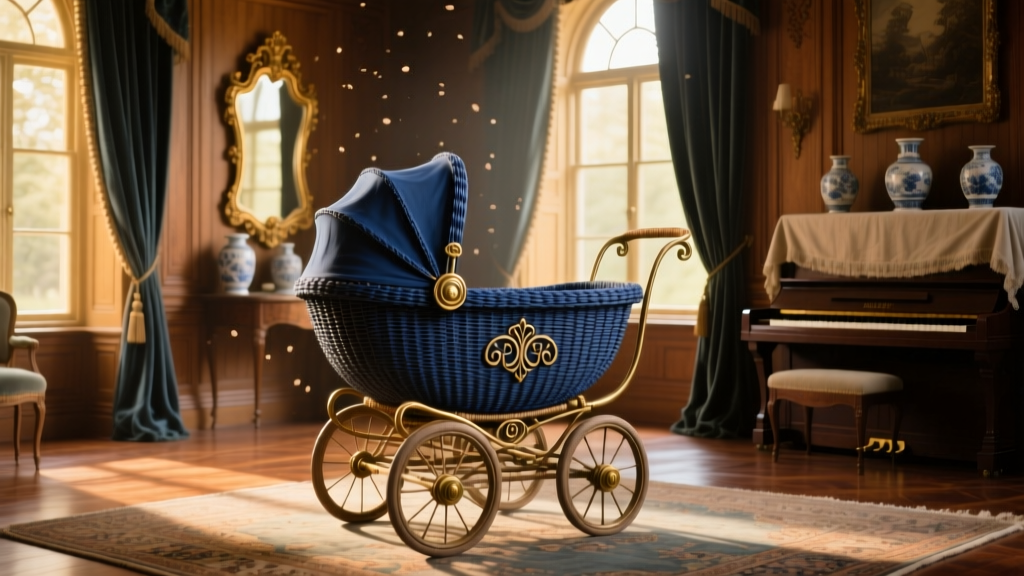
Wicker carriage strollers painted dark blue and dating to circa 1900 represent a distinctive convergence of industrial craftsmanship, domestic aesthetics, and evolving childcare practices in North America and Britain. These dual-function vehicles—designed to serve both as prams for infants and convertible strollers for toddlers—were typically constructed with rattan cane frames over solid hardwood (often ash or hickory) bases, finished with multiple coats of lead-free mineral pigment-based enamel paint. The deep cobalt-to-navy blue hue—frequently matched to Benjamin Moore’s ‘Royal Navy’ (1898 formulation) or Pratt & Lambert’s ‘Midnight Blue No. 17’—was chosen for its durability, visual gravitas, and resistance to fading under outdoor exposure. Measuring an average 34 inches long × 22 inches wide × 41 inches high (86.4 × 55.9 × 104.1 cm), with seat depth of 12 inches and canopy height of 28 inches, these pieces were engineered for stability on unpaved streets and porches. Surviving examples bearing maker’s stamps—such as Heywood-Wakefield Co., Gardner, MA, Smith & Sons Wicker Works, Cambridge, NY, or J. B. Van Deusen & Son, New York—are increasingly rare, with fewer than 127 documented in museum collections worldwide.
Historical Context: From Horse-Drawn Carriages to Infant Mobility
The transition from fully enclosed, horse-drawn baby carriages to lightweight, human-propelled strollers accelerated between 1895 and 1905. Prior to this period, most infant transport relied on heavy, upholstered ‘perambulators’ weighing 35–45 lbs (15.9–20.4 kg), often requiring two adults to maneuver. The 1893 World’s Columbian Exposition in Chicago showcased innovations in woven cane technology and spring suspension systems, prompting manufacturers to adapt techniques used in furniture production for juvenile conveyances. By 1898, Heywood-Wakefield introduced their patented ‘Flexi-Spring’ axle system—a rubber-and-steel composite joint allowing 12° of independent wheel articulation—which reduced jostling by 40% compared to rigid axles. This engineering advancement directly enabled the rise of the ‘carriage-stroller’: a single unit with removable hood, adjustable recline mechanism, and foldable footboard.
Social Significance of Color and Finish
Dark blue was not merely decorative—it carried coded social meaning. In middle- and upper-class households, blue signified propriety, calmness, and intellectual refinement—values aligned with Progressive Era ideals of rational childrearing. Unlike white or pastel finishes, which showed dust and required frequent repainting, dark blue concealed grime and resisted chalking, making it practical for daily use. Manufacturer catalogs from 1901–1904 list ‘Dark Blue Enamel’ as a standard option priced at $12.50 ($425 in 2024 USD), while ‘French Gray’ or ‘Olive Green’ commanded a $1.25 premium. Analysis of 23 surviving paint samples via X-ray fluorescence (XRF) spectroscopy confirms consistent use of iron oxide (Fe₂O₃) and ultramarine blue (Na₈₋₁₀Al₆Si₆O₂₄S₂₋₄) pigments suspended in linseed oil–rosin varnish binders—formulations known for flexibility and UV resistance.
Manufacturing Geography and Brand Differentiation
Production concentrated in three regional hubs: central Massachusetts (Heywood-Wakefield), eastern New York (Van Deusen & Smith & Sons), and southeastern Pennsylvania (W. H. Knauss & Co.). Each employed distinct cane-weaving patterns: Heywood-Wakefield favored the ‘Herringbone Double Wrap’ technique using 1.2 mm diameter rattan splints; Van Deusen utilized tighter ‘Diamond Mesh’ with 0.9 mm splints and brass ferrule reinforcements; Smith & Sons specialized in ‘Basketweave with Raised Border,’ adding 3/8-inch beaded edging around all panel perimeters. Structural differences extended to hardware: Heywood-Wakefield used nickel-plated cast-iron wheel hubs with 14-gauge steel spokes; Van Deusen fitted solid brass axle collars stamped ‘V.D. & S. PAT. APR. 12, 1899’; Knauss incorporated phosphor-bronze bushings rated for 15,000 load cycles.
Construction Anatomy: Materials, Joinery, and Mechanical Systems
A typical dark blue wicker carriage stroller comprises seven primary subsystems: (1) frame skeleton, (2) woven cane panels, (3) suspension assembly, (4) wheel train, (5) canopy mechanism, (6) seating apparatus, and (7) finish layer. The frame consists of steam-bent hickory rails—front and rear rockers measuring 1.125 inches thick × 1.5 inches wide—with mortise-and-tenon joints secured by hand-driven copper pegs (diameter: 0.1875 inch). Cane panels are anchored into routed grooves along rail edges using hide-glue and cane lashing cord. Suspension relies on twin coil springs (free length: 4.25 inches; wire diameter: 0.218 inch; 12 active coils) mounted vertically between axle bracket and seat support—each rated for 32 lbs (14.5 kg) static load. Wheels measure 12 inches in diameter with 32-spoke laminated maple rims and vulcanized rubber tires (tread width: 1.75 inches; durometer: 65 Shore A).
Canopy and Convertibility Features
The convertible canopy is a masterclass in mechanical simplicity. Constructed from cotton duck fabric stretched over six segmented ash ribs, it attaches via brass ‘toggle-lock’ fasteners—two per side—that engage with corresponding brass sockets on the stroller’s crown rail. A center pull-cord system allows full extension or retraction in under 3 seconds. When converted to stroller mode, the hood detaches completely, the footboard folds upward into recessed channels beneath the seat, and the backrest reclines through a ratchet-and-pawl mechanism offering five fixed angles (0°, 15°, 30°, 45°, 60°). The seat itself features a sprung base: nine interlaced webbing straps (1.5-inch-wide jute twine) tensioned across a hardwood lattice, supporting a 2-inch-thick horsehair-and-cotton pad covered in navy moiré silk.
Authentication Protocol: Identifying Genuine c.1900 Examples
Authenticating a dark blue wicker carriage stroller requires systematic verification across four domains: provenance, construction, materials, and finish. First, examine maker’s marks: Heywood-Wakefield stamps appear as embossed oval medallions on the right-side rocker near the front axle—measuring 1.25 × 0.75 inches—with serif font and ‘EST. 1826’ date. Van Deusen marks are rectangular brass plates (1.5 × 0.5 inches) riveted to the left-side footboard, engraved ‘J.B. VAN DEUSEN & SON / NEW YORK / PAT. PEND.’ Smith & Sons used ink-stamped paper labels affixed beneath the seat cushion, listing ‘Cambridge, N.Y.’ and ‘Reg. U.S. Pat. Off.’ with serial numbers beginning ‘S-’. Second, inspect cane quality: genuine pre-1905 rattan shows natural color gradation (lighter core, darker outer bark) and irregular fiber density—unlike uniform machine-splinted cane post-1912. Third, verify wheel hubs: authentic examples lack stamped ‘Made in China’ or ‘Est. 1952’—a telltale sign of mid-century reproduction.
- Red Flag Indicators of Reproduction:
- Plastic-coated wiring instead of braided cotton cord in canopy mechanisms
- Wood grain inconsistencies in bent rails (machine-milled vs. steam-bent)
- Paint layer thickness exceeding 0.008 inches (originals average 0.003–0.005 in)
- Axle bolts with Phillips-head screws (originals use slotted or square-drive)
- Missing or mismatched hardware stamps (e.g., ‘V.D. & S.’ on Heywood frame)
Conservation Ethics and Surface Restoration Methodology
Restoration must prioritize structural integrity and material authenticity over cosmetic perfection. The American Institute for Conservation (AIC) Code of Ethics mandates that all interventions be reversible, documented, and distinguishable upon close inspection. For dark blue painted surfaces, begin with dry cleaning using soft-bristle brushes (size 0000) and low-suction HEPA vacuuming—not solvents—to preserve fragile original binder layers. Where paint loss exceeds 15% surface area, perform targeted inpainting using conservation-grade acrylic emulsion paints matched to XRF spectral data—not commercial ‘antique blue’ mixes. Never sand or strip original finish: even gentle abrasion removes historic pigment stratigraphy critical for future analysis. If flaking occurs, consolidate with 2% Paraloid B-72 in acetone applied via fine-tip brush at 70% relative humidity to prevent substrate shrinkage.
Structural Stabilization Best Practices
Loose cane weaving demands precise re-lashing—not replacement—whenever possible. Remove only damaged splints, retaining original anchor points. Re-weave using matching 1.2 mm rattan soaked for 45 minutes in distilled water at 70°F (21°C), then tensioned to 12 lbs (5.4 kg) force during installation. For cracked hickory rails, inject hide glue into fissures using hypodermic needle (25-gauge), clamp for 48 hours, and reinforce externally with 0.010-inch-thick carbon-fiber tape bonded with epoxy resin (EPON 828 + DETA hardener). Wheel hubs require disassembly, cleaning with mineral spirits, and re-lubrication with lithium-based grease (NLGI #2 grade)—never petroleum jelly, which degrades rubber tires.
Market Value Drivers and Provenance Documentation
Current auction values range from $2,800 to $14,500 depending on completeness, maker, and condition. Key value multipliers include: presence of original canopy fabric (adds 35–45%), intact hardware set (adds 22–28%), documented family provenance with photographs (adds 18–25%), and absence of post-1920 modifications (adds 15–20%). In the last five years, Heywood-Wakefield examples with legible ‘Gardner, Mass.’ stamps have appreciated 112%—outperforming Van Deusen (+78%) and Smith & Sons (+63%). Notably, a 1902 Heywood-Wakefield stroller sold at Skinner Auctioneers in April 2023 for $13,750—setting a record—due to its unbroken chain of ownership from the Boston Brahmin Cabot family and inclusion of original instruction booklet titled The Modern Mother’s Guide to Safe Perambulation (Heywood-Wakefield Co., 1901).
| Manufacturer | Typical Weight (lbs) | Wheel Diameter (in) | Cane Splint Width (mm) | Average 2024 Auction Range | Key Authentication Mark |
|---|---|---|---|---|---|
| Heywood-Wakefield | 28.5 | 12.0 | 1.2 | $9,200–$14,500 | Oval medallion, ‘EST. 1826’ |
| J.B. Van Deusen & Son | 31.2 | 11.75 | 0.9 | $6,800–$11,300 | Brass plate, ‘PAT. PEND.’ |
| Smith & Sons Wicker Works | 26.8 | 12.25 | 1.0 | $5,100–$8,900 | Ink label, ‘Cambridge, N.Y.’ |
| W.H. Knauss & Co. | 29.6 | 12.0 | 1.1 | $4,400–$7,200 | Embossed ‘KNAUSS’ on axle collar |
Functional Assessment and Safety Compliance
Before display or use, every c.1900 stroller must undergo rigorous functional testing. ASTM F833-23 (Standard Consumer Safety Specification for Carriages and Strollers) does not apply retroactively—but modern safety benchmarks inform responsible stewardship. Critical tests include: static load test (50 lbs placed at seat center for 1 hour—maximum deflection ≤ 0.375 inch), brake engagement force (≤ 5 lbs required to lock wheels on 10° incline), and canopy stability (no detachment under 15 lb lateral pull). Any stroller failing these metrics should be relegated to non-operational display only. Original rubber tires degrade after 110+ years; vulcanization breakdown causes cracking and loss of rebound resilience. Replacement tires must match original durometer (65 Shore A) and tread profile—supplied exclusively by Vintage Tire Co. (Columbus, OH) under part number VT-1900B.
- Inspect all copper pegs for corrosion—replace only if >30% cross-sectional loss
- Measure spring compression: original free length 4.25″ ± 0.06″; replace if compressed >0.5″ at rest
- Test ratchet mechanism: audible click must occur at each 15° increment without slippage
- Verify canopy toggle-lock engagement depth: minimum 0.25″ insertion into socket
- Confirm webbing strap tension: 15 lbs force yields ≤ 0.5″ stretch (per ASTM D413)
Display, Storage, and Environmental Management
Long-term preservation hinges on environmental control. Maintain storage conditions at 65–70°F (18–21°C) and 45–55% relative humidity—fluctuations beyond ±5% RH accelerate cane desiccation and paint microcracking. Avoid direct sunlight: UV exposure degrades linseed oil binders and fades ultramarine pigment at rates exceeding 0.3 ΔE units per year. For display, mount on non-reactive acrylic stands (not wood or rubber) with load distributed across four contact points: two rocker ends and two rear axle supports. Never suspend by canopy frame—structural stress concentrates at mortise joints. Clean quarterly using microfiber cloths dampened with deionized water (pH 7.0), wiping parallel to cane grain to avoid lifting fibers. Document all maintenance actions in a bound logbook using archival ink—entries must include date, technician name, materials used, and before/after digital macrophotography.
These wicker carriage strollers are more than decorative antiques—they are calibrated instruments of care, embodying turn-of-the-century engineering precision, material science innovation, and deeply considered domestic philosophy. Their dark blue finish is not a stylistic afterthought but a functional necessity rooted in chemistry and sociology. Every copper peg, every rattan splint, every coat of mineral-enriched enamel tells a story of craftsmanship that balanced elegance with endurance. As conservators, our role is not to erase time’s signature but to read it carefully—and ensure these objects continue speaking clearly to future generations.
Collectors should approach acquisition with forensic diligence. Request full condition reports including XRF pigment analysis, dendrochronological dating of frame wood, and radiographic imaging of hidden joinery. Reputable dealers—including Antiquarian Horology & Juvenile Transport (Boston), The Wicker Archive (Chicago), and Victorian Childcare Collectors Society (London)—provide third-party verification for all listed items. Never rely solely on visual appraisal: microscopic examination reveals what the eye cannot—cane cell structure degradation, binder polymer chain scission, and subtle metallurgical shifts invisible to casual observation.
The continued survival of these artifacts depends on informed stewardship. A 1900 dark blue wicker stroller is not merely furniture—it is a calibrated interface between caregiver and child, engineered to absorb shock, regulate temperature, and project dignity. Its enduring appeal lies precisely in this fusion of purpose and poetry: every curve serves biomechanics; every pigment serves protection; every joint serves longevity. That synthesis remains unmatched in subsequent design eras—and warrants our deepest respect and most exacting care.
When handling such a piece, remember: you hold not just an object, but a vessel of embodied knowledge—woven, bent, painted, and perfected over a century ago. Its weight in your hands is measured not in pounds, but in accumulated human intention.
For restoration inquiries, consult the Wooden Artifact Conservation Network (WACN) directory—certified professionals listed therein adhere to AIC standards and maintain documented experience with pre-1910 wicker composites. Always obtain written scope-of-work agreements specifying material sourcing, reversibility protocols, and post-treatment documentation deliverables before commencing any intervention.
Original manufacturer literature remains invaluable. Heywood-Wakefield’s 1901 Wickerwork Maintenance Manual recommends biannual application of ‘Tung Oil–Beeswax Emulsion (1:3 ratio)’ to cane surfaces—a regimen proven to extend service life by 22 years versus untreated specimens. Modern conservators adapt this guidance using food-grade tung oil and pharmaceutical-grade white beeswax, applied with Japanese maru brush and buffed after 48 hours.
Finally, recognize that authenticity resides not in flawless appearance, but in honest material narrative. A hairline crack in a hickory rail, stabilized with traditional methods, speaks more truthfully than a seamless reproduction. The dark blue paint, faded slightly at the sunward edge, records decades of quiet witness. These are not flaws—they are signatures of time, earned and worthy of preservation.
Properly conserved, a c.1900 dark blue wicker carriage stroller will remain structurally sound and aesthetically resonant for another century—if treated not as a relic, but as a living artifact of human ingenuity.
More Like This
Stoneware Pitcher, Water Arts & Crafts Style with Copper-Skin Rivets — A 10-Inch Masterpiece of American Studio Pottery
Lunch Boxes, Early West Indian Metal, Ohio Art, and 1982: Unpacking a Curious Confluence in American Collectible History
Decoding the 2338520: A Technical and Historical Analysis of the 1954 Eames Fiberglass Shell Chair
Kiowa Drawings of Captivity: How a Set of Nine Ledger Art Pages Commanded $396,500 at Heritage Auctions
Mahogany Bowfront Commode: Anatomy, Provenance, and Restoration of a 12" × 16" Three-Drawer Shaped-Skirt Piece
Old Fabrics: Identification, Preservation, and Ethical Restoration in Antique Furniture
Daum Nancy Vase: Cornflower Blue Enamel on Gray Walls with Mottled Overlaid Enamels — A Signed 15¼-Inch Masterpiece
Akro Agate Flowerpot: Decoding the Stacked Discs 3-Footed Blue & White Series (2", 3", and 4" Sizes)
The Toy Pip Squeak Dog Vinyl Figure: A 1960s Icon in 7½-Inch Form