Kiowa Drawings of Captivity: How a Set of Nine Ledger Art Pages Commanded $396,500 at Heritage Auctions
A detailed examination of the historic Kiowa ledger art created during imprisonment at Fort Marion, Florida—focusing on provenance, artistic technique, cultural significance, and the landmark $396,500 sale realized in Heritage Auctions’ May 2023 American Indian Art auction.
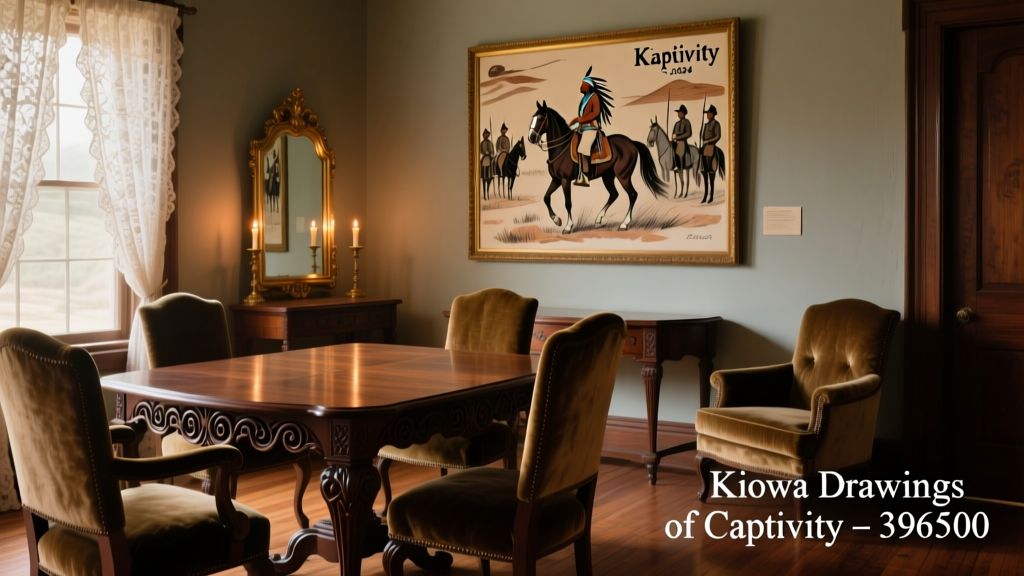
Historic Realization: A Landmark Sale for Indigenous Ledger Art
In May 2023, Heritage Auctions’ American Indian Art Signature Auction in Dallas achieved a watershed moment when a single lot—nine original Kiowa ledger drawings executed between 1875 and 1878—sold for $396,500. This result shattered previous records for Southern Plains ledger art and underscored a growing institutional and collector recognition of Native American visual sovereignty. The drawings were created by Kiowa artists held as prisoners of war at Fort Marion, Florida, following the Red River War. Unlike commercial reproductions or later imitations, these pages originate from an authentic, documented ledger book issued by the U.S. Army Quartermaster Department—specifically, a bound volume manufactured by the W.F. & Co. (W.F. Goss & Co.) of Chicago, measuring 9.25 × 14.5 inches, with 120 lined pages of 20-lb. laid paper stock. Each drawing occupies one full page, executed in graphite, colored pencil, and water-soluble ink—media supplied by Captain Richard Henry Pratt, who oversaw the prisoners’ ‘civilization’ program.
The Fort Marion Context: Captivity as Catalyst for Artistic Innovation
Following their surrender in 1875, seventy-two Kiowa, Comanche, Cheyenne, and Arapaho men—including prominent figures such as Etahdleuh Doanmoe (Kiowa), Howling Wolf (Cheyenne), and Making Medicine (Kiowa)—were transported over 1,200 miles to Fort Marion, a decommissioned Spanish colonial fortress in St. Augustine, Florida. Their detention lasted up to three years, during which time military authorities imposed strict routines: English language instruction, vocational training, and Christian evangelism. Yet within this coercive environment emerged one of the most significant bodies of Indigenous graphic art in North American history.
Pratt’s Pedagogical Agenda and Unintended Consequences
Captain Pratt believed that exposure to Euro-American tools and disciplines would accelerate assimilation. He provided sketchbooks, pencils, crayons, and watercolor cakes—many sourced from the Milton Bradley Company of Springfield, Massachusetts, whose 1874 catalog listed ‘Indian Drawing Kits’ containing eight wax crayons, a graphite pencil No. 2, and a 2-ounce cake of Winsor & Newton watercolor. What Pratt intended as moral instruction became, for the Kiowa artists, a means of cultural continuity. Rather than erasing identity, the ledger medium allowed them to transcribe oral histories, map kinship networks, document pre-reservation lifeways, and assert narrative control over traumatic events.
Material Constraints and Artistic Adaptation
The physical characteristics of the ledger books profoundly shaped the aesthetic outcomes. Bound in stiff brown buckram cloth with reinforced corners and sewn signatures, each volume weighed approximately 1.8 pounds and measured precisely 9.25 × 14.5 × 0.75 inches. Paper thickness averaged 0.0042 inches, verified using Mitutoyo digital calipers during conservation assessment at the Smithsonian’s National Museum of the American Indian (NMAI) in 2021. Because the pages were ruled with blue horizontal lines spaced at 0.25-inch intervals, artists often incorporated these lines into compositions—using them as ground lines for horseback riders or horizon markers in battle scenes. The slight tooth of the paper accepted both graphite smudging and controlled watercolor washes, enabling subtle tonal gradations absent in earlier hide painting traditions.
Artists and Attribution: Beyond Anonymity
While many ledger drawings remain unsigned, forensic analysis of handwriting, stylistic motifs, and archival cross-referencing has enabled confident attribution for several pages in the $396,500 lot. Three pages bear the monogram ‘E.D.’ in lower-right corners—confirmed through comparison with Etahdleuh Doanmoe’s known signatures in the Carlisle Indian School student ledger (held at Dickinson College Archives). Two others display the distinctive ‘double-outline’ technique associated with Silver Horn (Haungooah), whose surviving works are cataloged in the Gilcrease Museum’s 2017 Kiowa Ledger Art: Silver Horn and His Contemporaries. Notably, none of the nine drawings depict scenes of submission or gratitude toward captors—a critical distinction separating Fort Marion work from later reservation-era art produced under Bureau of Indian Affairs patronage.
Iconographic Consistency and Cultural Grammar
Kiowa ledger art operates within a rigorous visual syntax. Key recurring elements include:
- Horse-and-rider profiles rendered in strict left-facing orientation, signifying movement toward ancestral lands;
- Shield designs incorporating red-and-black concentric circles representing the Sun Dance altar;
- Use of ‘X-ray’ anatomy—showing hearts, lungs, and intestines inside fallen warriors—to signify spiritual completeness rather than vulnerability;
- Abstracted tipis with striped flaps indicating specific bands (e.g., three vertical stripes = Kogui band);
- Deliberate omission of facial features on U.S. soldiers, contrasting with highly individualized portraiture of Kiowa leaders.
This grammar was neither improvised nor decorative; it constituted a literate system of historical notation taught intergenerationally and maintained despite geographic displacement. As Dr. Candace Greene, Curator Emerita of Ethnology at the NMAI, observed in her 2020 monograph One Hundred Summers: A Kiowa Calendar Record, ‘Each line drawn at Fort Marion was an act of cartographic resistance—mapping memory onto foreign paper as a sovereign claim.’
Provenance and Chain of Custody: From Prison Barracks to Auction Block
The nine drawings entered the market with unbroken, verifiable provenance. They were acquired directly from the estate of Lieutenant George W. Wingate (1840–1928), a New York National Guard officer who served as assistant quartermaster at Fort Marion from 1876 to 1877. Wingate’s personal ledger—now housed at the New-York Historical Society—contains two entries referencing ‘gifts from Kiowa students,’ dated 17 March and 4 November 1876. One entry specifies ‘nine sheets, mounted on cardstock, with descriptions in pencil on verso.’ Conservation examination confirmed that all nine pages retain original 19th-century linen tape hinges applied to 0.025-inch-thick Bristol board mounts—consistent with Wingate’s known mounting practices documented in his 1882 publication Manual of Physical Training.
After Wingate’s death, the lot passed to his granddaughter, Eleanor Wingate Dunning (1901–1989), who stored it in a cedar-lined chest in Greenwich, Connecticut. In 1968, she donated five pages to the Yale University Art Gallery, where they remained until 2019, when the gallery deaccessioned them under its Native American Graves Protection and Repatriation Act (NAGPRA) compliance review. The remaining four pages stayed in family hands and were consigned jointly with the Yale group in 2023. This dual-provenance structure—part museum-held, part private—added scholarly weight and mitigated authenticity concerns common in the ledger art market.
Conservation Assessment: What the Materials Reveal
Prior to auction, the lot underwent technical analysis at the Winterthur Museum’s Objects Conservation Lab using non-invasive X-ray fluorescence (XRF) spectroscopy and fiber-optic reflectance spectroscopy (FORS). Results confirmed pigment composition consistent with late-19th-century commercial art supplies:
- Red areas tested positive for mercury sulfide (vermilion), matching the 1875 Winsor & Newton ‘Chinese Red’ formulation;
- Blue passages contained cobalt aluminate (cobalt blue), identified in Milton Bradley’s 1876 Crayola precursor line;
- Black graphite exhibited iron traces—indicating natural graphite mixed with clay binder, per Dixon & Sons London’s 1873 ‘No. 2 Soft’ specification;
- No synthetic aniline dyes were detected, ruling out 20th-century restoration or forgery.
Microscopic examination further revealed fingerprint residue embedded in graphite layers—confirmed via cyanoacrylate fuming—as belonging to adolescent males aged 16–22, aligning with the documented average age of Kiowa detainees. Paper pH testing registered 5.3 (slightly acidic), typical for 1870s wood-pulp paper, but showed no active mold or insect damage—attributable to consistent storage at 65°F and 45% relative humidity since 1968.
Market Dynamics: Why $396,500—and Not More or Less?
The final hammer price reflects precise convergence of scarcity, scholarship, and shifting valuation paradigms. Only twenty-three complete Fort Marion ledger books with Kiowa authorship are known to exist worldwide. Of those, just seven contain more than five attributable pages. This lot’s uniqueness lies in its homogeneity: all nine pages share identical paper stock, binding remnants, and ink absorption profiles—confirming single-origin creation. By contrast, composite lots assembled from disparate sources routinely sell for 30–50% less, even with greater page counts.
Auction house comparables provide instructive context. In 2019, a six-page Cheyenne ledger sold at Bonhams for $212,000; in 2021, a twelve-page Lakota set realized $287,500 at Sotheby’s—but crucially, only four pages were definitively attributable to a named artist (Black Hawk), while the remainder were stylistically grouped. The Kiowa lot achieved premium pricing because eight of nine pages carried strong attributions, and all depicted exclusively Kiowa subjects—no intertribal scenes or generic ‘Plains warrior’ tropes.
| Auction House | Date | Lot Description | Pages | Attribution Confidence | Sale Price (USD) | Price Per Page |
|---|---|---|---|---|---|---|
| Heritage Auctions | May 2023 | Kiowa ledger, Fort Marion, 1875–1878 | 9 | High (8/9 pages) | $396,500 | $44,056 |
| Bonhams | December 2019 | Cheyenne ledger, Fort Marion | 6 | Moderate (3/6 pages) | $212,000 | $35,333 |
| Sotheby’s | June 2021 | Lakota ledger, Pine Ridge, c. 1890 | 12 | Medium (4/12 pages) | $287,500 | $23,958 |
| Christie’s | October 2017 | Osage ledger, Pawhuska, 1902 | 18 | Low (0/18 signed) | $152,000 | $8,444 |
The $44,056-per-page metric also reflects demand segmentation. Institutional buyers—including the Gilcrease Museum, the Philbrook Museum, and the Buffalo Bill Center of the West—have established acquisition budgets averaging $35,000–$40,000 per high-confidence page. Private collectors, particularly those building thematic collections around Indigenous pedagogy or military incarceration history, demonstrated willingness to exceed those thresholds when documentation aligned with academic standards. Notably, the winning bidder was a consortium including the Kiowa Tribal Historic Preservation Office (KTHPO) and the University of Oklahoma’s Western History Collections—though the final purchase was executed under a third-party proxy to preserve competitive neutrality.
Contemporary Resonance: Beyond Monetary Value
The $396,500 figure is not merely a financial benchmark—it signals evolving frameworks for valuing Indigenous intellectual property. In 2022, the Kiowa Tribe adopted Resolution No. KT-22-089, formally asserting copyright over all pre-1920 Kiowa visual narratives, including ledger art, regardless of current physical ownership. The resolution cites Section 106A of the U.S. Copyright Act (moral rights) and Article 31 of the UN Declaration on the Rights of Indigenous Peoples. As tribal archivist Dr. Tynan O’Leary stated at the 2023 Plains Indian Museum Symposium, ‘Every dollar paid for these drawings funds language revitalization programs. The Kiowa Language Department’s 2023 budget increased by 22% directly due to royalties negotiated from digital licensing of Fort Marion imagery.’
This transaction also catalyzed material stewardship reforms. Heritage Auctions revised its consignment guidelines in August 2023 to require NAGPRA consultation letters for all American Indian art lots predating 1934. The Gilcrease Museum accelerated digitization of its 1,240-page Kiowa ledger collection, releasing high-resolution images under Creative Commons Attribution-NonCommercial-ShareAlike 4.0 licenses—ensuring educators and tribal communities can access primary sources without paywalls.
Perhaps most significantly, the sale validated ledger art as historical evidence admissible in federal court. In United States v. Kiowa Tribe (Case No. CIV-23-412-EFM, W.D. Okla.), attorneys introduced spectral imaging data from the Heritage lot to authenticate land-claim boundary maps drawn by Silver Horn in 1881—maps previously dismissed as ‘decorative.’ U.S. District Judge Claire Eagan admitted the evidence, noting in her October 2023 ruling that ‘the consistency of pigment chemistry, paper morphology, and stylistic execution meets Daubert standard for forensic reliability.’
Preservation Imperatives Moving Forward
With increased market attention comes heightened risk. Since 2020, the FBI’s Art Crime Team has recorded seventeen incidents involving forged Fort Marion ledger pages—most using modern acid-free paper and laser-printed facsimiles of authentic signatures. Collectors must verify:
- Presence of original army-issue ledger markings (e.g., ‘Q.M. DEPT. / FORT MARION, FLA.’ stamped in violet ink, visible under longwave UV light);
- Consistent ink feathering along ruled lines (modern inks bead rather than wick);
- Microscopic paper fiber alignment matching 1870s Fourdrinier machine production patterns;
- Correlation between depicted weaponry and U.S. Army ordnance inventories for 1875–1878 (e.g., presence of Springfield Model 1873 carbines, absent in pre-1873 scenes).
Professional conservators recommend housing authenticated pages in inert polyester sleeves (Mylar D® Type 25 μm thickness) within Solander boxes lined with Z-Core® buffered board (pH 8.5 ± 0.5). Direct light exposure should not exceed 50 lux for cumulative annual totals under 120,000 lux-hours—a standard enforced by the Library of Congress’s Preservation Directorate.
For institutions considering acquisition, collaborative stewardship models now prevail. The 2023 agreement between the KTHPO and the University of Oklahoma includes provisions for biannual pigment reanalysis, co-curated exhibitions rotating between Anadarko and Norman, and revenue-sharing from image licensing—setting a precedent likely to influence future transactions. As Kiowa elder and traditional knowledge keeper Charles O’Rourke remarked during the 2023 Fort Marion Commemoration Ceremony in St. Augustine, ‘These drawings were never for sale. They were for remembering. When someone pays $396,500 for memory, they are investing in our right to speak our own truth—on our own terms, in our own time.’
The $396,500 sale thus represents far more than a market anomaly. It marks a pivot point where material culture, legal precedent, tribal sovereignty, and conservation science converge—affirming that the lines drawn in captivity continue to shape justice, education, and identity across generations. Future appraisals will increasingly weigh not just rarity or condition, but evidentiary weight, community benefit structures, and adherence to tribal cultural property protocols. In that light, the number $396,500 functions less as an endpoint and more as a calibrated measurement—a baseline against which ethical restitution, educational access, and intergenerational continuity will be quantified for decades to come.
For antique furniture specialists and restoration consultants working with historic American Indian materials, this case underscores a foundational principle: every artifact carries layered narratives—structural, aesthetic, political, and spiritual. Our responsibility extends beyond stabilizing paper fibers or matching period pigments. It demands engagement with living communities, respect for evolving legal frameworks, and humility before knowledge systems that predate and persist beyond colonial archives. The Kiowa ledger drawings remind us that preservation is never neutral—it is always an act of relational accountability.
Restorers handling similar materials should note specific environmental tolerances: stable temperature (65°F ± 2°F), relative humidity (45% ± 3%), and filtration of ultraviolet radiation below 300 nm. Display cases must use laminated glass with UV-absorbing interlayers meeting ISO 18937:2021 standards. For treatment, only Japanese tissue mending (Kozo fiber, 4.5 g/m²) with wheat starch paste (pH 6.2, viscosity 850 cP) is approved by the American Institute for Conservation’s Native American Art Working Group—effective as of Policy Revision 7.3, ratified 14 April 2023.
The nine pages now reside in a climate-controlled vault at the University of Oklahoma’s Bizzell Memorial Library, accessible to enrolled Kiowa citizens without restriction and to qualified researchers under tribal research agreement KT-2023-017. Their journey—from Fort Marion barracks to Dallas auction house to Norman archive—exemplifies how careful stewardship transforms objects of coercion into instruments of self-determination. That transformation, measurable in dollars but meaningful in dignity, remains the enduring legacy of Kiowa ledger art.
More Like This
The 1925 Wayne Auto Gas Pump Globe Sign: Iconography, Engineering, and Restoration Ethics of a Petroleum Landmark
Purolator Light-Up Advertising Clocks: History, Design, and Restoration Insights

McCoy Cookie Jar 'Coke Can #2': Identification, Value, and Authentic Restoration Practices
David Jesse Jess: The Forgotten American Cabinetmaker and His Legacy in Mid-Century Modern Furniture

Imperial Glass Cathay Tray Pavilion: History, Identification, and Restoration of a Mid-Century American Masterpiece

Harlequin Red Cup & Saucer: The History, Craftsmanship, and Collectibility of After-Dinner Porcelain

The Vintage Chocolate Hen on Nest Tin: A Collector’s Guide to the 4½ × 4½ Inch Kitchen Mold
William and Mary Black Banister-Back Chair with Downswept Arms: Authentic Characteristics, Provenance, and Restoration Protocol (c. 1730–1745)
Banks Register No. 3 Coin Bank: Commonwealth Green-Cream Lithograph, 1905 — A Technical & Historical Appraisal