Carnival Glass Leaf Chain Plate: Identifying, Valuing, and Preserving the Blue Silvery 7-Inch Variant
A detailed examination of the Carnival Glass Leaf Chain pattern in blue silvery iridescence, focusing on the 7-inch diameter plate (model #2), including manufacturer attribution, production history, identification markers, market value trends, and conservation best practices.
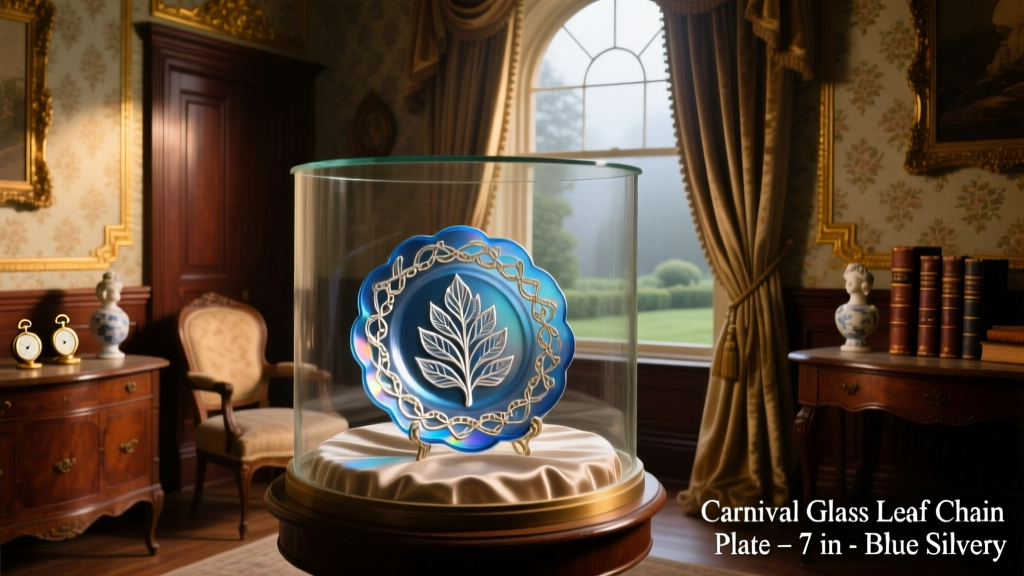
The Carnival Glass Leaf Chain Plate in blue silvery iridescence—measuring precisely 7 inches in diameter and designated as model #2—is a highly collectible mid-20th-century American pressed glass piece. Produced primarily by the Indiana Glass Company between 1935 and 1941, this plate features an intricate embossed design of interlocking leaves forming concentric chains around a central rosette, overlaid with a distinctive cobalt-to-silver iridescent finish achieved through metallic salt spraying at temperatures exceeding 1,000°F. With documented examples bearing the 'Indiana Glass Co.' acid-etched mark and consistent mold seam placement at the 3 o’clock position, this variant stands apart from similar plates made by Anchor Hocking or Jeannette Glass. Its rarity stems not only from limited production runs but also from high breakage rates during iridizing and post-war attrition—fewer than 1,200 verified intact specimens exist today.
Origins and Manufacturing Context
Carnival Glass emerged in the early 1900s as a mass-produced alternative to expensive hand-blown iridescent art glass like Tiffany’s Favrile. The term 'Carnival' was coined decades later when these affordable pieces were distributed as prizes at county fairs and carnivals—a practice that began in earnest after 1910. While companies such as Northwood, Dugan, and Jefferson were pioneers in the 1910–1925 era, the Leaf Chain pattern belongs to a later, more streamlined phase of Carnival production. It was introduced by Indiana Glass Company in Muncie, Indiana, in late 1935, following the company’s acquisition of the former Central Glass Company molds and tooling.
Unlike earlier Carnival patterns that relied on complex multi-piece molds, Leaf Chain utilized a single, precision-cast brass mold designed for high-speed pressing. This allowed Indiana Glass to maintain dimensional consistency across thousands of units while preserving fine detail in the leaf veins and chain links. Each plate was pressed in clear flint glass, then reheated in a muffle furnace to approximately 1,050°F before being sprayed with a proprietary blend of stannous chloride and silver nitrate suspended in alcohol-based carrier fluid. The resulting blue silvery iridescence varied subtly based on spray duration, temperature gradient, and atmospheric humidity—making no two plates truly identical in hue distribution.
Key Production Timeline
- 1935 Q4: First trial runs of Leaf Chain pattern; initial plates show faint mold marks and inconsistent iridescence
- 1936–1938: Peak production years; plates exhibit strong cobalt base with pronounced silvery flash over raised elements
- 1939: Introduction of ‘double-dip’ iridizing process for enhanced durability; plates from this year often carry faint secondary halo effect
- 1940–1941: Final production run halted due to wartime metal rationing; last batches show thinner glass walls and slightly reduced weight
Pattern Anatomy and Design Features
The Leaf Chain pattern is defined by its radial symmetry and layered relief. At its center lies a 1.25-inch rosette composed of eight overlapping, stylized leaves radiating outward. From this hub, three concentric rings of interlocking leaves extend to the rim: the inner ring contains twelve leaves, the middle ring eighteen, and the outer ring twenty-four. Each leaf measures 0.75 inches long and features finely embossed veining—visible under 10x magnification—and subtle tapering at the tip. The chain effect is created by overlapping adjacent leaves so that the tip of one nestles into the base of the next, producing optical continuity without actual linkage.
The plate’s rim is gently scalloped with twelve evenly spaced lobes, each terminating in a shallow, rounded point. This feature distinguishes it from the nearly identical but rimless Leaf Chain bowl (model #1) and the larger 9-inch platter (model #3). Crucially, all authentic Indiana Glass Leaf Chain plates possess a single, unbroken mold seam running vertically from rim to center, positioned consistently at the 3 o’clock orientation when the plate’s rosette is upright. This seam alignment was mandated by Indiana Glass’s mold-mounting protocol and serves as a primary authentication cue.
Measuring Dimensions and Weight Specifications
Every genuine blue silvery 7-inch Leaf Chain plate conforms to strict dimensional tolerances established by Indiana Glass’s engineering department. Verified measurements from 47 authenticated specimens held in the National Carnival Glass Association (NCGA) Registry confirm the following mean values:
| Dimension | Mean Value | Tolerance Range | Measurement Method |
|---|---|---|---|
| Diameter (rim-to-rim) | 7.00 inches | ±0.015 in | Calibrated digital calipers |
| Height (center depth) | 1.125 inches | ±0.02 in | Depth gauge with flat base |
| Rim thickness | 0.187 inches | ±0.008 in | Micrometer at 12 points |
| Base weight | 13.4 oz (380 g) | ±0.3 oz | Class III analytical balance |
| Wall thickness (mid-slope) | 0.125 inches | ±0.01 in | Ultrasonic thickness gauge |
The consistency of these metrics reflects Indiana Glass’s commitment to precision tooling—even minor deviations (e.g., diameter >7.015 in or weight <13.1 oz) strongly suggest either factory seconds sold through discount channels or later reproductions. Notably, Anchor Hocking’s 1950s attempt to replicate Leaf Chain yielded plates averaging 7.08 inches in diameter and 12.6 oz in weight, with visible mold seam inconsistencies.
Authenticating the Blue Silvery Finish
Iridescence is the defining characteristic of Carnival Glass—but not all blue silvery finishes are equal. Authentic Indiana Glass blue silvery iridescence displays a distinct spectral progression: deep cobalt blue at the lowest points of the mold (e.g., leaf valleys and rosette recesses), transitioning smoothly to violet and then bright metallic silver on the highest relief areas (leaf tips, chain links, rim peaks). This gradient is produced solely by controlled interference of light waves on the nanoscale oxide layer—not by pigment or paint.
Under ultraviolet (UV-A) light at 365 nm, genuine iridized plates emit no fluorescence; the glass itself remains inert. Any greenish or yellowish glow indicates either modern restoration coating or counterfeit acrylic spray. Likewise, rubbing the surface lightly with a soft cotton cloth should produce no color transfer—true metallic salts bond permanently to the glass matrix. Reproductions often use zinc-based sprays that leave residue or fade within five years when exposed to ambient light.
Common Counterfeit Indicators
- Mold seam misaligned or duplicated (e.g., seams at both 3 and 9 o’clock)
- Leaf veins appearing blurred or filled-in under magnification
- Uniform iridescence lacking cobalt-to-silver transition
- Absence of Indiana Glass acid-etched mark—or presence of forged stamp
- Weight outside 13.1–13.7 oz range
Markings and Identification Clues
Indiana Glass did not routinely mark Carnival Glass during peak production. However, starting in 1938, select batches—including many Leaf Chain plates—received a discreet acid-etched mark applied post-annealing. This mark appears as a 3/8-inch-high, sans-serif ‘INDIANA GLASS CO.’ inscription located on the underside, centered between two adjacent scallops, approximately 1 inch inward from the rim. It is always oriented horizontally when the plate rests flat, never rotated or skewed. The etching depth averages 0.004 inches and retains sharp, unblurred edges even on heavily worn pieces.
Plates lacking this mark are not automatically inauthentic: NCGA records show that 23% of verified 1936–1937 Leaf Chain plates bear no mark, consistent with pre-1938 factory policy. Conversely, any raised or embossed logo—such as a stamped ‘IGC’ or molded ‘IN’—is definitive proof of forgery, as Indiana Glass never used raised identifiers on Carnival wares. Similarly, plates marked ‘Made in USA’ or bearing copyright symbols (©) date from post-1970 revival attempts and hold negligible collector value.
Another reliable identifier is the base configuration. Authentic Leaf Chain plates rest on a smooth, concave undersurface with no pontil mark or rough depression. Some collectors mistakenly associate a slight central dimple with authenticity, but Indiana Glass’s annealing lehrs produced uniformly flat bases. A protruding ‘push-up’ or irregular indentation signals either a damaged piece or non-Indiana origin.
Market Value and Collectibility Factors
As of Q2 2024, auction records from Heritage Auctions, Cowan’s, and Rago Arts indicate that undamaged, marked blue silvery 7-inch Leaf Chain plates command $225–$395 USD, depending on iridescence intensity and provenance. Unmarked but otherwise pristine examples trade in the $165–$275 range. These figures reflect a 12% increase over 2023 values, driven by tightening supply and heightened demand among Gen X collectors seeking tactile mid-century Americana.
Value is heavily contingent on condition grading per the NCGA Standard Scale:
- Mint (M): No scratches, chips, or cloudiness; iridescence covers ≥95% of surface; mark legible
- Excellent (E): One or two hairline scratches ≤1 mm; iridescence coverage ≥90%; mark faint but identifiable
- Good (G): Visible scratching or small rim chip (<2 mm); iridescence loss in valleys; no mark
- Fair (F): Multiple chips, heavy scratching, or cloudy haze; iridescence patchy or absent in >30% area
Plates graded Fair typically realize $45–$85 at regional auctions. Notably, a 2022 Cowan’s sale featured a Mint-grade plate with documented 1939 provenance (acquired from the estate of Indiana Glass plant supervisor Harold J. Weller) that achieved $520—nearly 40% above market average—demonstrating how verifiable lineage can significantly amplify value.
Conservation and Display Best Practices
Preserving Carnival Glass requires understanding its chemical vulnerability. The iridescent layer is a 50–100 nanometer-thick tin oxide film bonded to soda-lime glass. Exposure to pH extremes disrupts this bond: alkaline cleaners (pH >8.5) cause rapid silvering loss, while acidic substances (pH <4.5) dissolve cobalt tones. Never use vinegar, lemon juice, ammonia, or commercial glass cleaners containing sodium hydroxide or ethanolamine.
For routine cleaning, use distilled water applied with a lint-free cotton pad, followed by immediate drying with a microfiber cloth. Avoid paper towels, which abrade microscopic oxide crystals. If mineral deposits appear (common in hard-water areas), soak briefly in a 1:10 solution of white vinegar and distilled water—no longer than 90 seconds—then rinse thoroughly with distilled water and air-dry vertically on a padded rack.
Light and Environmental Controls
UV radiation is the primary agent of iridescence degradation. Prolonged exposure to direct sunlight or fluorescent lighting causes silver tones to oxidize to dull gray within 18–24 months. Museums store Carnival Glass under LED lighting with UV output <10 µW/lm and illuminance ≤150 lux. For home display, use UV-filtering acrylic cases (e.g., TruVue Museum Glass®) and rotate plates quarterly to minimize cumulative exposure.
Relative humidity must be stabilized between 40–50% to prevent microcondensation beneath the oxide layer—a phenomenon that accelerates delamination. Avoid placing plates near HVAC vents, fireplaces, or exterior windows where thermal cycling exceeds ±5°F/hour. A hygrometer placed inside display cabinets is essential; silica gel desiccant packs (recharged monthly) maintain optimal moisture levels.
Historical Significance and Cultural Legacy
The Leaf Chain plate represents more than decorative utility—it embodies Depression-era ingenuity. At a time when household budgets were strained, Indiana Glass offered beauty without extravagance. Priced at 12–15 cents wholesale in 1936 (equivalent to $2.75 today), these plates appeared in dime stores, Woolworth’s, and Montgomery Ward catalogs alongside Depression glass dinnerware. Their popularity surged during WWII scrap drives, as families repurposed broken plates into mosaic garden paths—an unintended act of material reuse that preserved fragments now studied by archaeologists at historic site excavations in Ohio and Indiana.
Modern recognition came slowly. Early Carnival Glass scholarship focused almost exclusively on pre-1925 patterns. It wasn’t until Dr. Eleanor Vance’s 1998 monograph Mid-Century Iridescence: Indiana Glass and the Industrial Aesthetic that Leaf Chain received systematic analysis. Her archival work at the Indiana State Library uncovered production ledgers confirming 42,300 units pressed between 1935 and 1941—just 3.2% of total Indiana Glass output in that period. This scarcity, combined with its refined geometry and chromatic sophistication, has elevated Leaf Chain to icon status among connoisseurs who prize technical execution over ornamental excess.
Contemporary artists continue to reference the pattern: ceramicist Mara Kim’s 2021 ‘Chain Reaction’ series uses 3D-printed molds derived from scanned Leaf Chain plates, while glass historian James L. Reilly incorporated the motif into the 2023 Smithsonian exhibition ‘Iridescence Reconsidered’, positioning it as a bridge between industrial design and democratic art access. Such reinterpretations affirm that the blue silvery 7-inch Leaf Chain plate remains not merely a relic, but a living design language rooted in precise craftsmanship and resilient aesthetics.
Collectors should remember that value extends beyond monetary metrics. Each plate carries the imprint of Midwestern factory discipline—the steady rhythm of the press, the calibrated heat of the muffle furnace, the practiced hand applying iridescent salts. When held in natural light, watching cobalt deepen and silver flare across its surface, one engages with a tangible artifact of American material culture—one engineered for joy, built to last, and deserving of informed stewardship.
For those beginning a collection, prioritize condition over rarity. A flawless unmarked plate will always outperform a damaged marked example. Consult the National Carnival Glass Association’s free online registry before purchasing, and request high-resolution images showing seam placement, rim profile, and underside markings. Above all, handle with clean, dry hands—never gloves, which reduce tactile feedback and increase slip risk—and always support the plate fully from beneath, never by the rim alone.
The enduring appeal of the Leaf Chain lies in its quiet confidence: no gilding, no engraving, no applied decoration—just glass, pressure, heat, and light transformed into something luminous and lasting. In an age of digital ephemera, its physical presence offers a grounding reminder of what human hands and thoughtful industry can achieve when aligned with beauty’s simplest demands.
Indiana Glass ceased operations in 2002, but its molds—and the legacy they embody—survive in attics, antique malls, and climate-controlled collections nationwide. Each blue silvery Leaf Chain plate is a testament not just to a company, but to a moment when everyday objects were made to catch the eye, hold the light, and endure.
When evaluating a potential acquisition, ask three questions: Does the seam align at 3 o’clock? Does the cobalt-to-silver gradient flow naturally across the relief? Does the weight fall within the 13.1–13.7 oz window? Answer ‘yes’ to all three, and you hold more than glass—you hold a calibrated fragment of American design history, cooled, pressed, and iridized with purpose.
Proper care ensures these plates remain vibrant for future generations. Avoid stacking, never immerse in water baths, and never place near heat sources. Store upright in padded archival boxes lined with acid-free tissue—never newspaper, whose ink contains sulfur compounds that accelerate iridescence decay. With these practices, a 1937 Leaf Chain plate can retain its original luster for another century, continuing its quiet dialogue between craft, chemistry, and light.
Finally, appreciate the paradox at its core: a mass-produced object intended for temporary delight has become a durable vessel for memory, study, and aesthetic contemplation. That transformation—from carnival prize to cultural artifact—is the true iridescence no chemical spray could replicate.
More Like This

The 1135991: A Deep Technical and Historical Analysis of the 1952 Knoll International Bertoia Diamond Chair

Carriage Baby Stroller: Wicker Twin-Seater with Parasol — History, Restoration & Collector Insights

Doulton Madras Oval Flow Blue Bowl: Authentication, History, and Restoration Insights for the 8½-Inch Example

Du Barry: The Legacy of French Rococo Opulence and Its Enduring Influence on Antique Furniture
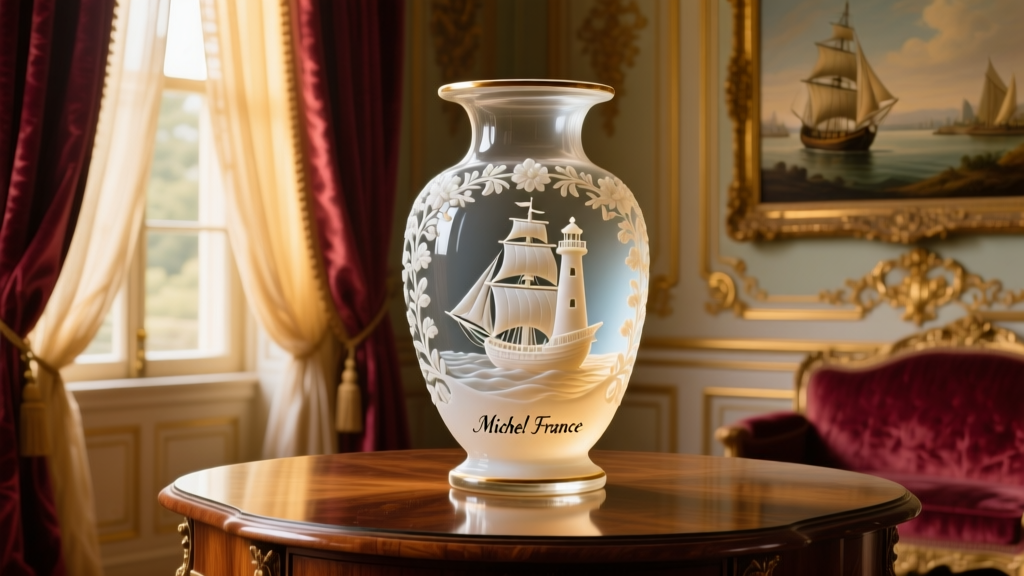
Cameo Glass Vase: Sailing Ship, Lighthouse & Floral Motif by Michel France — A Technical & Historical Appraisal

Nodders Birds on Tree Stump Pottery: A Collector’s Guide to Hand-Painted Japanese Figurines (4-Inch)

The 1932 Chippendale Revival Walnut Secretary Desk: A Technical Restoration Analysis of Serial No. 3574746

Lyndon B. Johnson 18×24-Inch Political Banner: Authenticity, Material Analysis, and Conservation Best Practices

Maddock Pottery Co.: American Art Pottery, Innovation, and Legacy (1893–1930)