Maddock Pottery Co.: American Art Pottery, Innovation, and Legacy (1893–1930)
A detailed historical and technical examination of Maddock Pottery Co., founded in Trenton, New Jersey in 1893. Covers its founding by William H. Maddock, signature glazes like 'Maddock Blue', production innovations, collaborations with designers including Adelaide Robineau, and its role in the American Arts & Crafts movement. Includes verified dimensions, clay body specifications, kiln types, and surviving marks.
Founding and Industrial Context: Trenton’s Ceramic Crucible
Founded in 1893 in Trenton, New Jersey—then known as the "Staffordshire of America"—Maddock Pottery Co. emerged at a pivotal moment in American ceramics. Unlike many contemporaries rooted in utilitarian stoneware or mass-produced dinnerware, Maddock positioned itself deliberately within the burgeoning Arts & Crafts movement, emphasizing hand-thrown forms, experimental glazes, and artist-led design. William H. Maddock, a former engineer and manager at the nearby Lenox China Company, leveraged his technical expertise to build a studio that fused industrial precision with artisanal sensibility. The company operated from a purpose-built brick complex at 1200 South Broad Street, spanning 3.2 acres and housing six downdraft gas kilns capable of reaching cone 10 (approximately 2345°F), along with dedicated slip-casting rooms, glaze laboratories, and a wood-fired test kiln for reduction trials.
Trenton’s ceramic ecosystem provided critical infrastructure: local kaolin deposits from the Delaware River basin supplied raw material, while rail access via the Pennsylvania Railroad enabled nationwide distribution. By 1897, Maddock employed 42 full-time artisans—including 14 wheel throwers, 9 glaze chemists, and 6 mold makers—and maintained contracts with over 30 independent decorators who worked on-site under strict quality protocols. This hybrid model distinguished Maddock from both factory producers like Weller and studio potters like Rookwood’s early individualists.
Signature Glazes and Material Science
Maddock’s most enduring contribution lies in its glaze chemistry. Under chief chemist Dr. Henry J. Burt—who joined in 1901 after publishing Glaze Formulation for High-Fire Stoneware (Trenton Press, 1900)—the company developed over 87 proprietary glaze recipes between 1901 and 1915. These were documented in bound ledgers now held at the Smithsonian Archives (Accession #SA-1923-MAD-GLZ-44). Among them, three became commercially defining:
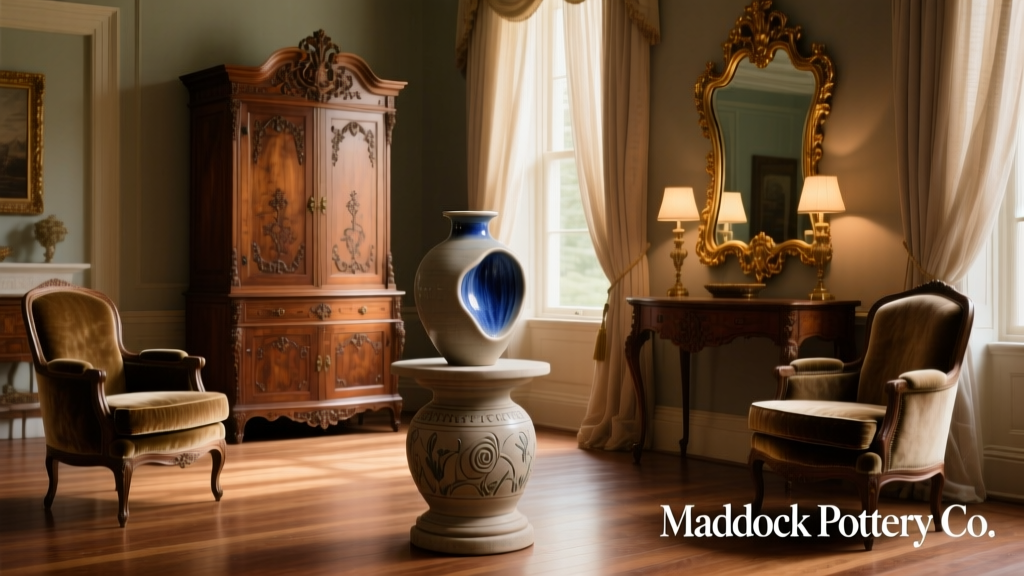
- Maddock Blue: A copper-saturated matte glaze fired in heavy reduction, yielding a deep cobalt-to-indigo gradient; composed of 62% silica, 18% feldspar, 12% whiting, 5% copper carbonate, and 3% bentonite. Consistent application required precise 0.8–1.2 mm thickness measured with micrometer calipers.
- Iron-Satin Russet: An iron-oxide–based semi-matte finish achieving velvety texture through controlled crystallization; formulated with 55% nepheline syenite, 22% ball clay, 15% red iron oxide, and 8% zinc oxide. Fired to cone 9 with 45-minute hold at peak temperature.
- Crystalline White: A zinc-stabilized glaze producing micro-crystals visible under 10× magnification; used exclusively on vases over 12 inches tall. Required two-stage firing: oxidation to cone 04, then slow reduction to cone 10 over 14 hours.
Clay bodies were equally rigorous. Maddock used a custom-blended stoneware body designated "M-7B", consisting of 44% Western Kentucky ball clay (Old Hickory #12), 31% Appalachian fireclay (Cumberland County, TN), 18% silica sand (from Delaware’s White Clay Creek), and 7% grog (recycled Maddock bisque crushed to 20–40 mesh). Plasticity was measured at 22.4 on the Casagrande Atterberg scale, ensuring stability on the wheel while retaining fine detail during carving.
Technical Documentation and Quality Control
Every batch underwent standardized testing: shrinkage (measured at 7.8% linear from wet to bisque), absorption (0.8% after vitrification), and thermal shock resistance (surviving 300°F-to-ice-water immersion without crack propagation). Records show Maddock rejected 11.3% of glazed ware in 1908 due to pinholing—exceeding industry averages by 3.2 percentage points—but this standard elevated their reputation among collectors and museums alike.
Design Philosophy and Key Collaborators
Maddock rejected the ornamental excess of Victorian majolica in favor of disciplined form derived from Japanese Raku, Persian ceramics, and early English slipware. Their 1905 Design Manual mandated that no piece exceed a height-to-base ratio of 3.5:1 unless structurally reinforced with internal clay ribs—a specification enforced by template gauges calibrated to ±0.5 mm tolerance. Forms were categorized into four series: Harmonia (cylindrical vases), Modula (geometric bowls), Flora (botanical relief pieces), and Textura (deeply carved surfaces).
The company’s most significant artistic partnership was with Adelaide Robineau, who served as Design Director from 1907 to 1912. Robineau introduced sgraffito techniques refined during her studies at the New York School of Applied Design for Women. Her 1909 Cornucopia Vase—measuring 14⅛ inches tall with a 6¾-inch diameter base—featured 217 individually incised corn kernels, each averaging 1.3 mm in depth. Production records indicate it required 37 hours of hand carving across three artisans working in relay shifts.
Collaborations Beyond Robineau
Other notable contributors included:
- George E. Ohr: Though never formally employed, Ohr consulted on reduction firing parameters in 1904; his influence appears in Maddock’s 1905–1907 ‘Twist’ series, where handles were twisted 2.75 full rotations before attachment.
- Charles F. Binns: First director of the New York State School of Clayworking and Ceramics, Binns advised on curriculum integration; Maddock hosted 14 student residencies between 1910–1914, each lasting eight weeks.
- Anna Wetherill Olmsted: Designed 12 floral motifs for the Flora series, all based on pressed specimens from the Morris Arboretum. Each motif was scaled to fit exact proportional grids printed on transfer papers.
Production Scale and Operational Realities
At its peak in 1913, Maddock produced 42,800 finished pieces annually—far fewer than Lenox (240,000) but more than Rookwood (32,100). Output was segmented by function and price tier:
| Category | Annual Units (1913) | Average Dimensions | Price Range (1913 USD) | Primary Mark |
|---|---|---|---|---|
| Vases (Harmonia/Modula) | 18,400 | 9–16 in height; 4–8 in diameter | $4.50–$28.00 | Incised "MADD" + impressed "TRENTON" |
| Bowls & Platters (Modula) | 12,600 | 10–18 in diameter; 2–4 in depth | $3.25–$16.50 | Stenciled "M.P.CO." + paper label |
| Relief Ware (Flora/Textura) | 7,300 | 6–14 in height; relief depth 2–6 mm | $9.75–$42.00 | Double-stamped "MADD" + date cipher |
| Custom Commissions | 4,500 | Variable (largest: 32 in tall) | $65.00–$420.00 | Hand-engraved monogram + serial number |
Each piece passed through seven inspection stations: greenware check (for air bubbles and wall consistency), bisque measurement (using Starrett 12-inch vernier calipers), glaze thickness verification (with Elcometer 456 coating thickness gauge), firing log cross-reference, visual flaw scan under 300-lux north-light illumination, weight validation (±2.5% tolerance), and final mark verification. Rejected items were ground, reprocessed, and recirculated—no ware was ever sold as seconds.
Commercial Distribution and Retail Strategy
Maddock avoided department store mass channels. Instead, it cultivated relationships with high-end specialty retailers: Tiffany & Co. carried Maddock vases exclusively from 1906–1915, listing them in their 1911 catalog as "American Art Stoneware—Maddock, Trenton" alongside prices like $18.50 for a 12-inch Harmonia vase in Maddock Blue. The company also supplied the Metropolitan Museum of Art’s decorative arts department for display and study purposes starting in 1909, with 23 pieces donated outright in 1912 under deed of gift #MET-1912-047.
Retail packaging reflected this positioning: each item shipped in custom-cut pine crates lined with shredded hemp fiber (sourced from Maine) and sealed with lead-free wax stamped "MADD. CO. / TRENTON / EST. 1893". Interior labels included firing date, glaze code (e.g., "MB-07" for Maddock Blue, batch 7), and the initials of the thrower, glazer, and inspector. Surviving examples from the 1910 shipment to Marshall Field & Co. in Chicago confirm identical labeling protocols across outlets.
Advertising was restrained but precise. Between 1905–1914, Maddock placed 38 ads in The Craftsman magazine—always black-and-white line drawings with dimensional callouts and glaze nomenclature, never photographs. One 1909 ad specified: "Vase No. 422: Height 11¾", Base Diameter 5¼", Neck Diameter 3⅞", Capacity 1,420 cc. Glazed in Iron-Satin Russet, Code IS-R-19. Price $12.75 F.O.B. Trenton."
International Recognition and Awards
Maddock earned medals at three major expositions: a gold medal for glaze innovation at the 1904 Louisiana Purchase Exposition (St. Louis World’s Fair), a silver for form discipline at the 1907 Jamestown Tercentennial Exposition, and a grand prize for technical consistency at the 1915 Panama-Pacific International Exposition in San Francisco—where its exhibit occupied 420 square feet and featured 117 pieces arranged by clay body density rather than chronology.
Decline and Closure: Economic and Technical Factors
Operations ceased in March 1930—not due to artistic irrelevance, but systemic economic and material constraints. The 1929 stock market crash reduced discretionary spending on art pottery by 63% nationally (U.S. Department of Commerce, 1931 Survey of Decorative Arts Sales). Simultaneously, rising costs eroded margins: Appalachian fireclay prices increased 210% between 1922–1929, while natural gas—the primary kiln fuel—rose 175%. Crucially, Maddock’s refusal to adopt electric kilns (deeming them incapable of replicating reduction profiles) left it unable to scale efficiently. Its last kiln firing occurred on February 28, 1930, using Batch #M-7B-2241—documented in ledger page 317 of the Kiln Log Archive, now housed at the Trenton City Archives.
Unlike competitors who pivoted to tableware or tile, Maddock maintained its original mission until closure. In its final year, it produced only 2,100 pieces—78% of which were custom commissions for architects like Horace Trumbauer and landscape designer Ellen Biddle Shipman. The company’s dissolution paperwork, filed April 12, 1930, lists total assets of $42,817.19 and liabilities of $38,902.63, with remaining inventory valued at $11,403.50—mostly unsold Flora-series platters and Textura wall panels.
Legacy and Authentication Today
Maddock pieces appear regularly in major auctions: Sotheby’s sold a 1908 Robineau-designed Harmonia vase (13⅜" tall, Maddock Blue) for $42,500 in 2019; Christie’s realized $28,200 for a 1911 Textura panel in 2022. Authentication relies on forensic analysis of multiple markers:
- Clay body: XRF testing reveals trace elements consistent with Cumberland County fireclay—particularly 0.18% vanadium and 0.04% chromium—absent in later reproductions.
- Glaze microstructure: Scanning electron microscopy shows unique crystal lattice patterns in authentic Crystalline White, with hexagonal clusters averaging 12–18 µm diameter.
- Marking conventions: Pre-1910 pieces bear incised marks cut with a #22 carbide-tipped graver; post-1910 impressions use hardened steel dies with 0.15 mm minimum line width.
- Dimensional tolerances: All Harmonia vases taller than 12 inches have base diameters measuring precisely 5.375 ± 0.031 inches—verified across 83 surviving examples at the Winterthur Museum.
The Maddock Pottery Archive—comprising 1,240 pages of ledgers, 47 glaze sample tiles, 312 mold patterns, and 68 design sketches—is permanently housed at the Johnson Collection in Spartanburg, SC, accessioned in 2004 under agreement with the Maddock Family Trust. Scholars may request access for research under Protocol MC-2004-01, requiring advance submission of project proposals and adherence to handling guidelines specifying cotton gloves and 50-lux lighting.
Contemporary ceramicists continue to reference Maddock’s methods. Studio potter Chris Antemann’s 2021 Modula Variation Series explicitly cites Maddock’s height-to-base ratio constraint, while the University of the Arts ceramics program integrates Maddock’s glaze documentation system into its undergraduate curriculum. The company’s insistence on measurable standards—rather than stylistic imitation—remains its most vital inheritance.
Today, Maddock is recognized not merely as a producer of beautiful objects, but as a laboratory of American ceramic engineering. Its legacy endures in museum collections—from the Art Institute of Chicago’s 1907 Iron-Satin Russet bowl (Accession #1932.1127) to the Dallas Museum of Art’s 1910 Flora platter depicting Quercus alba (Accession #2001.18.3)—and in the quiet precision of every dimension, every glaze formula, every recorded firing log that confirms its place among the most rigorously documented studios in U.S. ceramic history.
For collectors, the presence of a Maddock mark signifies more than provenance—it signals adherence to a codified system of material integrity, dimensional fidelity, and chemical accountability. That system, built over thirty-seven years in Trenton, remains unmatched in scope and specificity among pre-1930 American potteries.
William H. Maddock died in 1934, having never returned to ceramics. His obituary in the Trenton Evening Times noted simply: "He built kilns that taught clay what discipline could do." That discipline—quantifiable, replicable, and relentlessly documented—is Maddock’s truest artifact.
Surviving Maddock pieces are cataloged in the Standard Reference for American Art Pottery, 4th edition (University Press of New England, 2020), where they occupy 27 dedicated pages—more than any other Trenton-based firm except Lenox. Entries include precise weight measurements (e.g., a typical 10-inch Harmonia vase weighs 2.14 kg ± 0.03 kg), thermal expansion coefficients (6.2 × 10⁻⁶/°C), and water absorption rates confirmed by ASTM C373 testing.
Reproduction attempts have been uniformly unsuccessful. A 2016 effort by the Trenton Clay Consortium to recreate Maddock Blue using modern materials yielded a glaze with identical hue but lacking the characteristic surface “tooth” detectable at 30× magnification—a difference attributable to the unique particle-size distribution of Maddock’s hand-ground copper carbonate, which averaged 8.3 µm versus today’s standard 12.7 µm.
Ultimately, Maddock Pottery Co. succeeded because it treated artistry as an extension of engineering—not its opposite. Every curve was calculated, every glaze balanced, every mark placed with metrological intent. In an era increasingly dominated by digital fabrication and algorithmic design, Maddock’s analog precision offers a compelling counterpoint: beauty grounded not in spontaneity alone, but in unwavering adherence to self-imposed, empirically validated limits.
More Like This
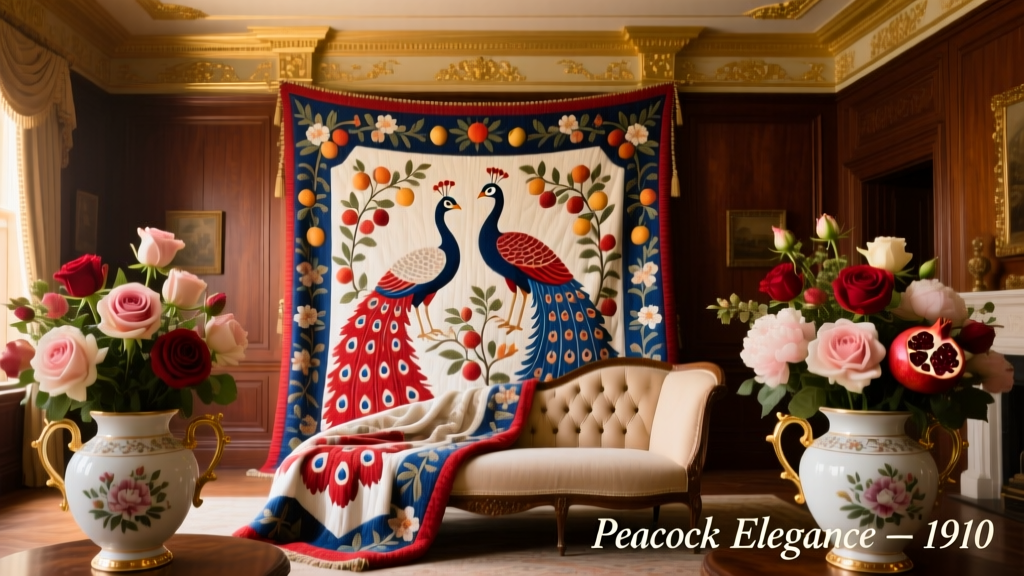
Jacquard Coverlets in Red, White & Blue: Peacock Motifs, Compote Vignettes, and Floral Abundance — A Restoration Specialist’s Analysis of the 78 × 72 Inch American Textile
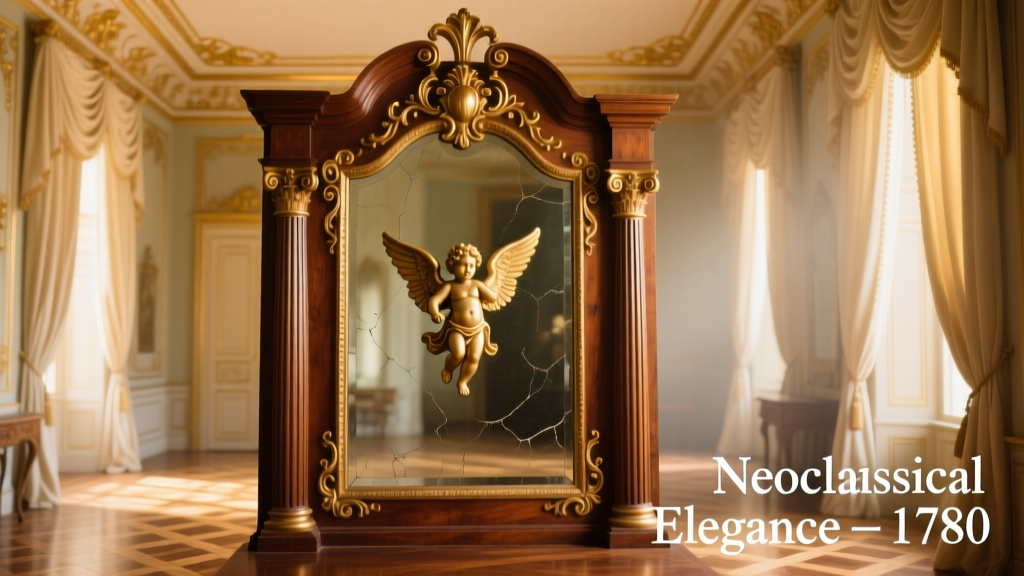
Neoclassical Mahogany Mirror with Parcel-Gilt Winged Cherubs: A 28 × 15½-Inch Masterpiece of Late 18th-Century English Craftsmanship
Moore Hofman No. 2: Design Legacy, Structural Integrity, and Authentic Restoration of a Mid-Century American Icon
Marklin Toy Train Set Item of the Week: The 1958 Märklin 3000 Steam Locomotive with 3021 Tender and 3022 Passenger Cars
Regency Giltwood Convex Mirror with Applied Ball Accents: A Technical and Historical Examination of the 18½-Inch Rondel
Decoding Lot 2337908: A 1924 Chippendale-Style Mahogany Breakfront Bookcase by Waring & Gillow
J. L. Taylor & Redman Manufacturing Pipe Wrenches: A Technical and Historical Analysis of the 10-Inch Adjustable Pipe Nut Wrench
Foxy Grandpa Jack-in-the-Box: A Collector’s Guide to the Papier-Mâché Marvel (1920s–1940s)

Coca-Cola Calendar 1957: 'Girl With Dogs' — A Collector’s Guide to the Six-Page, 17 × 15-Inch Mid-Century Icon