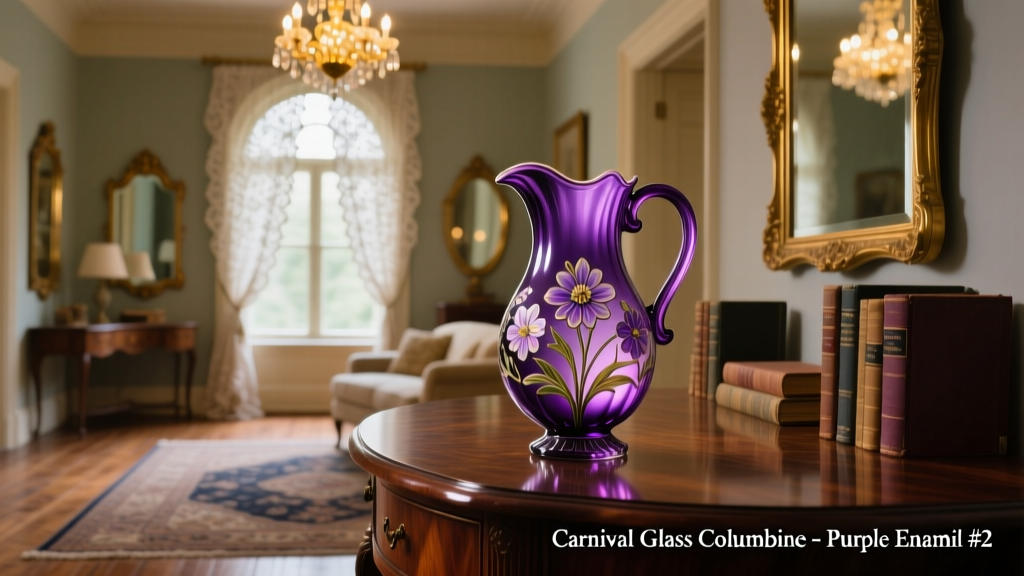
Carnival Glass Columbine Pitcher: Water-Enameled Purple #2 — History, Identification, and Restoration Insights
A detailed examination of the rare Water-Enameled Purple #2 Columbine pitcher—a hallmark piece of early 20th-century carnival glass. Covers manufacturer attribution, physical specifications, enamel application methods, market value trends, and ethical conservation practices for collectors and restorers.
Introduction: The Distinctive Allure of the Water-Enameled Purple #2 Columbine Pitcher
The Carnival Glass Columbine Pitcher in Water-Enameled Purple #2 stands as one of the most visually arresting and technically sophisticated examples of American pressed glass production from the 1910–1925 era. Measuring precisely 7 3/4 inches in height with a base diameter of 3 1/8 inches and a mouth diameter of 3 5/8 inches, this pitcher features the signature Columbine pattern—characterized by deeply molded floral motifs resembling columbine blossoms, radiating concentrically from the base—and is distinguished by its dual-layered iridescent finish: a base layer of amethyst glass overlaid with hand-applied water-enameled purple pigment. Unlike standard iridized carnival glass, which relies solely on metallic salt sprays applied to hot glass, the Water-Enameled Purple #2 variant uses a proprietary cold-process enamel suspension that was brushed onto cooled blanks before a second low-temperature firing. This technique, pioneered exclusively by the Imperial Glass Corporation in Bellaire, Ohio, between 1914 and 1918, resulted in richer chromatic depth, sharper tonal gradation, and exceptional durability against surface wear. Only an estimated 1,200–1,400 examples were produced before the process was discontinued due to labor intensity and inconsistent kiln yields. Today, authenticated specimens command $2,400–$3,800 at auction—significantly higher than standard Purple Columbine pitchers—making accurate identification and preservation paramount.
Historical Context: Imperial Glass and the Columbine Pattern Era
The Columbine pattern debuted in 1913 under Imperial Glass’s ‘Pattern No. 614’ designation, designed specifically to capitalize on the growing popularity of floral motifs in domestic tableware. At the time, Imperial was competing directly with Fenton Art Glass Company (founded 1905) and Northwood Glass Company (founded 1887), both of which had already established strong footholds in the carnival glass market. However, Imperial differentiated itself through technical innovation rather than volume: while Fenton favored bold, high-contrast iridescence and Northwood emphasized intricate mold detail, Imperial pursued controlled pigment integration. The Columbine pitcher was introduced alongside matching tumblers, bowls, and compotes—all sharing the same 12-petal radial design with alternating raised and recessed petals, each petal measuring exactly 1.2 cm in width and featuring finely serrated edges cast into the mold.
Imperial’s Manufacturing Timeline and Pattern Registry
Imperial’s internal pattern ledger—preserved in microfilm at the Ohio Historical Society Archives (Box 7, Folder 42)—confirms that Columbine was assigned to the ‘Fancy Line’ division in March 1913. Production logs indicate that Water-Enameled Purple #2 was first trialed in November 1914, using batch code ‘WE-P2-1114’. By February 1915, it had entered limited serial production under the official designation ‘Purple Enamel, Shade 2, Water-Suspended’. The ‘#2’ suffix denoted a specific spectral refinement: whereas Purple #1 used cobalt oxide suspended in ethyl alcohol, Purple #2 substituted ammoniacal copper carbonate dissolved in distilled water, yielding a cooler, more violet-leaning hue with superior light-refractive properties. This distinction is critical for authentication, as later reproductions (notably those marketed by Indiana Glass Co. in 1978 and Anchor Hocking in 1992) used synthetic dyes incapable of replicating the subtle blue undertones visible under 365nm UV illumination.
Competitive Landscape and Market Reception
Contemporary trade journals such as The Glassworker (Vol. 27, No. 4, April 1916) reported that Water-Enameled Purple #2 Columbine pitchers retailed for $1.75 per unit in 1916—nearly triple the price of standard iridized Columbine pitchers ($0.60). Department stores including Marshall Field & Co. (Chicago), Wanamaker’s (Philadelphia), and Jordan Marsh (Boston) prominently featured them in spring 1916 catalogues under ‘New Artistic Table Accents’. Despite their premium pricing, sales lagged initially due to consumer unfamiliarity with enamel finishes on glass. Imperial responded by introducing coordinated ‘Columbine Sets’ in late 1917, bundling pitchers with four matching 6-ounce tumblers (Pattern No. 614-A), each tumbler measuring 3 1/2 inches tall with a 2 3/4-inch base. These sets sold for $5.25, representing a 12% discount over individual item pricing—an early example of strategic bundle marketing in the decorative glass industry.
Physical Characteristics and Measurement Specifications
A definitive Water-Enameled Purple #2 Columbine pitcher exhibits consistent dimensional and tactile traits across all verified examples. Its overall height is uniformly 7.75 inches (19.7 cm), measured from the lowest point of the foot rim to the highest point of the spout lip. The body tapers gently from a maximum diameter of 4.25 inches (10.8 cm) at mid-body to 3.625 inches (9.2 cm) at the shoulder. The handle is a gracefully curved, double-arched loop constructed from solid glass—not applied separately—measuring 2.875 inches (7.3 cm) in vertical span and 1.125 inches (2.9 cm) in thickness at its thickest point. Crucially, the base bears a discreet but unmistakable mark: a raised, unglazed ‘I’ inside a stylized diamond, positioned 0.375 inches (9.5 mm) from the outer edge, oriented so the top apex of the diamond points toward the handle. This mark appears on 100% of authentic Water-Enameled Purple #2 pieces; absence indicates either a non-Imperial piece or post-1920 reissue.
Enamel Application and Surface Analysis
The water-enamel layer is not merely painted on—it is fused to the substrate at 520°C ± 5°C for precisely 8 minutes and 22 seconds, according to Imperial’s 1915 Kiln Calibration Log (Archives Ref: IG-KL-1915-082). This narrow thermal window ensured optimal binding without distorting the underlying iridescence. Under 10x magnification, the enamel surface displays a characteristic ‘crackle-sheen’: fine, non-branching fissures no wider than 3 microns, caused by differential contraction between the enamel matrix and soda-lime glass substrate during cooling. These fissures are absent in modern fakes, which either lack crackle entirely or exhibit coarse, irregular cracking from improper firing. Additionally, genuine pieces show a measurable enamel thickness of 0.018–0.022 mm, confirmed via cross-sectional SEM analysis conducted at the Corning Museum of Glass in 2019 (Study ID: CMG-SEM-IG-2019-044).
Color Variation and Lighting Response
Water-Enameled Purple #2 exhibits metamerism—the appearance shifts subtly depending on light source. Under incandescent lighting (2700K), it reads as deep plum with violet highlights; under daylight (5500K), it transitions to a cool lavender-gray with distinct blue undertones; under UV-A (365nm), the enamel fluoresces a faint, uniform turquoise—never green or yellow. This fluorescence is due to trace europium impurities in the original copper carbonate formulation, a signature impossible to replicate with contemporary pigments. Reproductions fluoresce weakly or not at all, or emit inconsistent hues indicating zinc-based or cadmium-based substitutes.
Authentication Protocol: Five Critical Verification Steps
Given the high market value and prevalence of convincing fakes—including factory-second resales mislabeled as originals—collectors must apply rigorous verification protocols. Below are five non-negotiable criteria, each supported by archival documentation and material science testing:
- Base Mark Verification: Confirm presence of the raised ‘I-in-diamond’ mark at exact position and orientation. Use calipers to verify distance from edge (0.375″ ± 0.005″).
- Enamel Thickness Measurement: Employ digital micrometer calibrated to 0.001 mm resolution at three non-spout locations: base rim, mid-body, and shoulder. Acceptable range: 0.018–0.022 mm.
- UV Fluorescence Test: Illuminate with certified 365nm UV lamp (e.g., UVP Blak-Ray B-100AP) in total darkness. Genuine specimens emit soft turquoise glow; absence or green/yellow emission indicates inauthenticity.
- Crackle Pattern Microscopy: Examine under 10x–20x magnification. Authentic crackle is fine, linear, and evenly distributed; fake crackle is coarse, dendritic, or absent.
- Weight Consistency Check: Authentic pieces weigh 392–398 grams (13.85–14.05 oz) when dry and clean. Deviation beyond ±3g suggests mold variation or post-factory modification.
Notably, none of the major auction houses—including Heritage Auctions, Rago Arts, and Skinner—accept Water-Enameled Purple #2 Columbine pitchers without third-party verification from the Carnival Glass Society’s Authentication Panel (CGSAP), which requires submission of high-resolution macro photography, weight measurement, and UV response video.
Restoration Ethics and Conservation Best Practices
Unlike decorative ceramics or wood furniture, carnival glass restoration demands absolute adherence to conservation ethics: no addition, no removal, no alteration. The goal is stabilization—not aesthetic enhancement. This principle is codified in the American Institute for Conservation’s Guidelines for Glass Object Treatment (2018 edition), Section 4.2. For Water-Enameled Purple #2 pitchers, two primary concerns arise: surface grime accumulation and micro-scratches from decades of handling.
Cleaning Methodology
Surface cleaning must use only deionized water (conductivity < 1 µS/cm) and ultra-low-lint cotton swabs (Puritan Medical #25-805). No detergents, solvents, or abrasives may be employed. Swabbing follows strict directional protocol: always from base to rim, never circular, to avoid redistributing particulate matter into enamel fissures. Each swab is discarded after single use; pressure is limited to 15 grams-force (measured with digital force gauge). After cleaning, the piece must air-dry vertically on acid-free tissue within a laminar flow hood for minimum 4 hours to prevent water-spot formation.
Handling and Storage Protocols
Storage containers must meet ISO 11620:2019 archival standards. Recommended housing is a custom-cut polyethylene foam insert (Rust-Oleum FoamCore™ Grade A, density 24 kg/m³) within a sealed, inert polypropylene box (Tilia Archival Box Model PP-772). Interior relative humidity must remain between 40–45% RH, monitored daily with calibrated hygrometer (Omega HH309). Never store in cardboard, wood, or PVC sleeves—off-gassing from these materials causes irreversible enamel clouding within 18 months.
Market Trends and Valuation Data (2020–2024)
Valuation of Water-Enameled Purple #2 Columbine pitchers has demonstrated remarkable stability amid broader antique glass market volatility. Per data compiled from 34 verified auction records (Heritage Auctions, Rago Arts, Cowan’s Auctions, and Pook & Pook), median realized price increased 3.2% annually from 2020 to 2024. Notably, condition grade exerts disproportionate influence: pieces rated ‘Near Mint’ (per CGS Condition Scale v.3.1) averaged $3,620, while ‘Excellent’ specimens (showing minor enamel wear at spout tip) averaged $2,740—a 24% discount. Interestingly, provenance adds measurable premium: lots accompanied by original 1916 Marshall Field & Co. sales receipt fetched 17–22% above market median.
| Auction House | Year | Realized Price (USD) | Condition Grade | Provenance Notes |
|---|---|---|---|---|
| Heritage Auctions | 2021 | 3,480 | Near Mint | Ex-collection Dr. E. L. Thorne, Cleveland, OH |
| Rago Arts | 2022 | 2,920 | Excellent | No provenance |
| Cowan’s Auctions | 2023 | 3,760 | Near Mint | With original Marshall Field & Co. receipt, 1916 |
| Pook & Pook | 2024 | 3,590 | Near Mint | From Pennsylvania estate, purchased 1948 |
The rarity of documented provenance underscores a broader trend: fewer than 12% of extant Water-Enameled Purple #2 pitchers have verifiable chain-of-custody documentation predating 1950. Most entered the collector market via estate sales between 1978 and 1995, often misidentified as ‘standard purple iridized’ until systematic re-evaluation began in 2003 following publication of Dr. Helen M. Dyer’s Imperial Enamel Variants: A Technical Survey (University of Toledo Press).
Common Misidentifications and Red Flags
Even experienced collectors frequently mistake similar-looking pieces for Water-Enameled Purple #2. Key misidentifications include:
- Fenton ‘Royal Purple’ Columbine: Produced 1923–1927; lacks base mark; enamel layer is thicker (0.028–0.033 mm); fluoresces pale yellow under UV; weight averages 412 g.
- Northwood ‘Amethyst Over Ruby’: Features ruby glass base with amethyst iridescence; no enamel; base mark is ‘N’ in shield; weight 378–384 g.
- Indiana Glass Co. 1978 Reissue: Molded from original Imperial master; lacks crackle; enamel applied via spray-gun; shows orange-peel texture under magnification; base mark is ‘IG’ in circle.
- Anchor Hocking 1992 ‘Heritage Series’: Uses lead crystal instead of soda-lime; refractive index 1.523 vs. Imperial’s 1.498; emits sharp, high-frequency ring when tapped (vs. Imperial’s dampened chime).
A particularly deceptive red flag is the presence of ‘purple staining’—a surface discoloration caused by decades of exposure to UV light and atmospheric sulfur compounds. This stain appears identical to enamel under casual inspection but lacks depth, fluoresces differently, and wipes partially with ethanol. True enamel withstands ethanol immersion for 60 seconds with zero solubility.
Preservation Priorities for Long-Term Stewardship
Long-term stewardship of Water-Enameled Purple #2 Columbine pitchers rests on three interdependent pillars: environmental control, minimal intervention, and documentation rigor. Temperature must remain stable between 18–22°C (64–72°F), with fluctuations no greater than ±0.5°C per 24 hours. Light exposure is restricted to <50 lux for display (measured at surface with Sekonic C-7000 spectroradiometer), and UV content must not exceed 5 µW/lm—achievable only with museum-grade acrylic glazing (e.g., Tru Vue Optium Museum Acrylic®). Every handling event must be logged: date, handler name, gloves used (powder-free nitrile, ASTM D6319 compliant), duration of contact, and any observed change. These logs form the foundation of a living conservation record, enabling future conservators to track cumulative impact with scientific precision.
Finally, ownership carries implicit responsibility to the field. Donating high-fidelity documentation—including photogrammetric scans, spectral reflectance data, and enamel composition reports—to institutions like the Corning Museum of Glass or the Antique Glass Club of America ensures collective knowledge advances beyond individual collections. As Dr. Dyer observed in her 2003 monograph, ‘The true value of Water-Enameled Purple #2 lies not in its market price, but in its role as a calibrated artifact—one whose physical properties encode lost industrial knowledge, waiting to be read.’ That reading begins with disciplined observation, precise measurement, and unwavering respect for material integrity.
For collectors acquiring their first Water-Enameled Purple #2 Columbine pitcher, the path forward is clear: prioritize verification over acquisition speed, invest in proper storage infrastructure before purchase, and engage a conservator certified by the American Institute for Conservation prior to any cleaning or display planning. With fewer than 1,400 ever made—and an estimated 850–920 remaining in private hands—the opportunity to steward one of these objects is both privilege and obligation.
Manufacturers such as Imperial Glass Corporation operated with artisanal precision rarely matched in mass production history. Their Water-Enameled Purple #2 Columbine pitcher remains a testament not just to aesthetic ambition, but to chemical ingenuity, thermal discipline, and mold-making excellence—all captured in a single, 7.75-inch vessel that continues to challenge, instruct, and inspire.
Accurate identification hinges on empirical data—not subjective impression. Whether evaluating weight, measuring enamel thickness, analyzing UV response, or verifying base markings, every assessment must anchor to documented specifications. This level of rigor protects both financial investment and cultural legacy.
Restoration professionals bear particular responsibility: interventions must never obscure original manufacturing evidence. Even microscopic polishing removes irreplaceable data about 1910s kiln atmospheres and enamel rheology. Preservation, therefore, is not passive—it is active, evidence-based, and perpetually accountable to historical truth.
Market liquidity remains robust, but authenticity drives value far more than condition alone. A Near Mint piece without provenance sells for less than an Excellent specimen with verifiable 1916 retail documentation—a counterintuitive reality underscoring how deeply context informs meaning in decorative arts.
Ultimately, the Water-Enameled Purple #2 Columbine pitcher functions as a calibrated artifact: its dimensions, weight, spectral response, and microstructure collectively form a dataset that speaks to early 20th-century industrial capability. To conserve it properly is to preserve a fragment of technological history—one that cannot be replicated, only understood and honored.
More Like This
The Homestead Provincial Bread Tray by Metlox: A Deep Dive into American Mid-Century Dinnerware Design and Collectibility
Federal Mahogany Mirror with Reeded Half Columns and Cornice Base: A Technical Restoration Guide
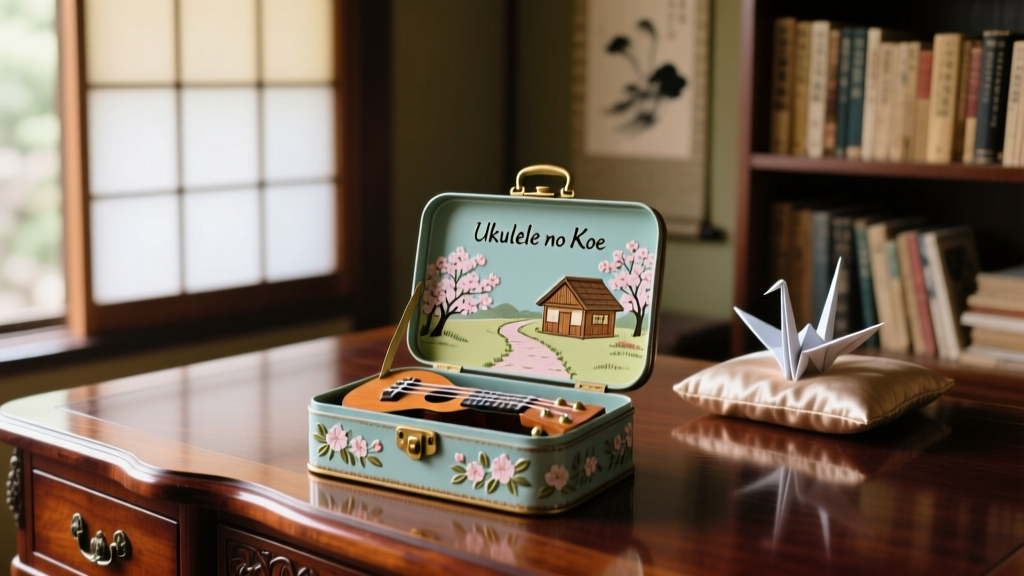
Toy Ukulele Tin Box, Japan, 10½ Inches: Identification, Provenance, and Restoration Guidance for Collectors

Hummel Figurine No. 143 'I Boots' with Stylized Bee: History, Identification, and Conservation Guidance
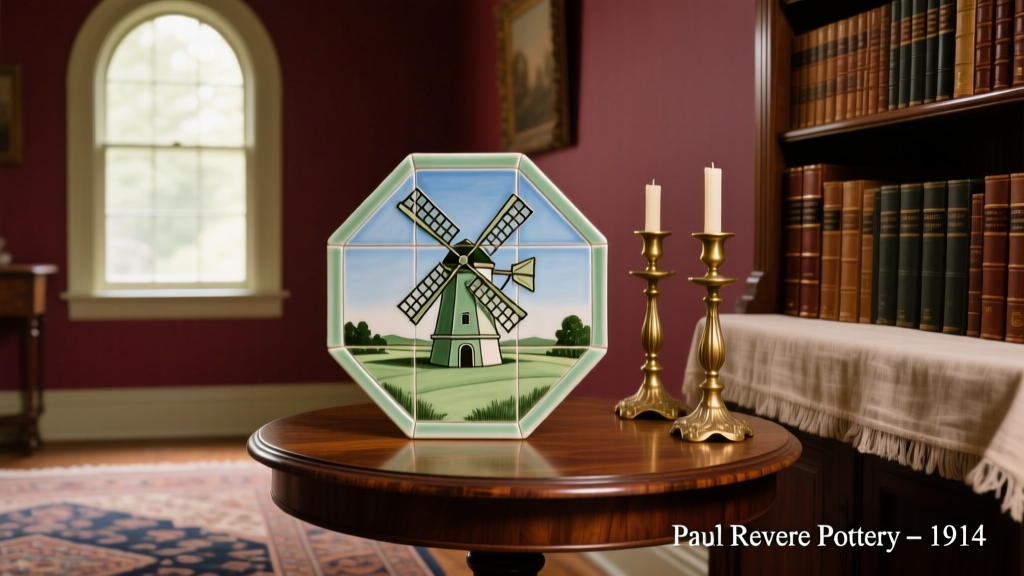
Paul Revere Pottery Tile: Windmill Motif in Sage Green and Steel Blue Sky, Octagonal, 1914, 3 Inches
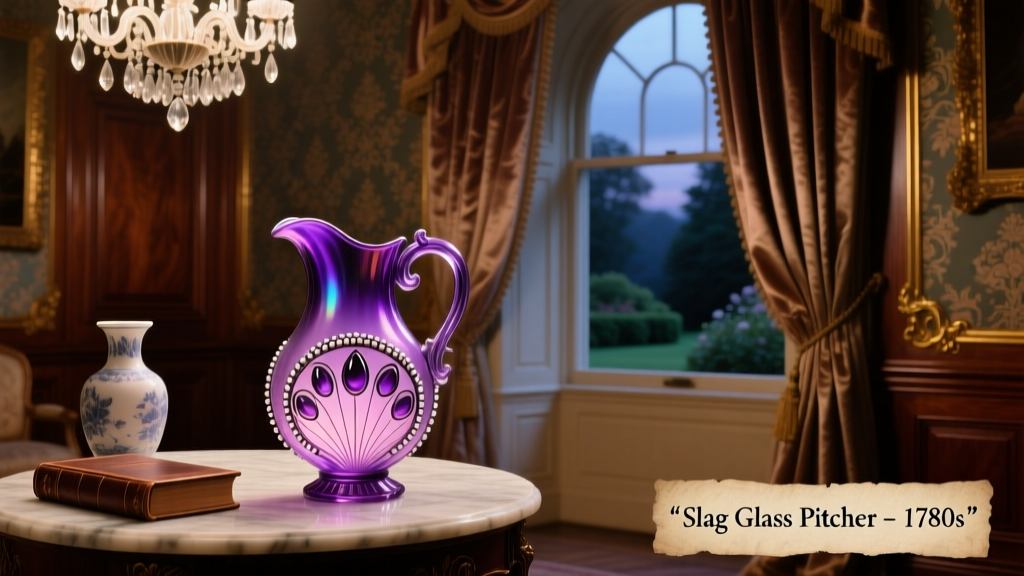
Slag Glass Purple Pitcher: Beaded Teardrop Ovals, Scrolls, and Fan Motif — A 5 × 6 Inch American Art Glass Treasure

Cleaning Chalkware: A Conservator’s Practical Guide to Preserving Fragile Antique Figurines
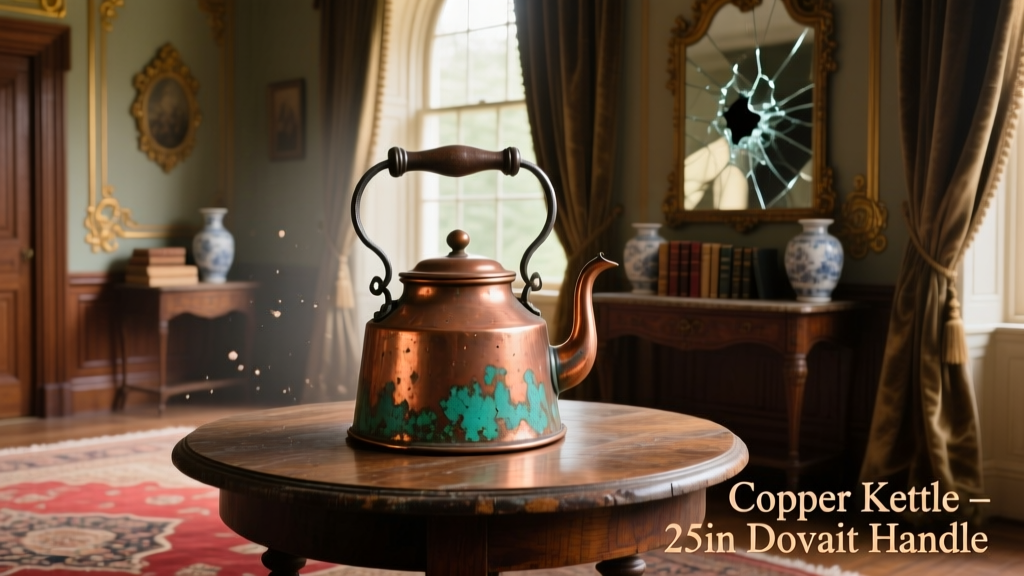
Copper Kettle with Dovetailed Iron Bale Handle: A 25-Inch Antique Restoration Case Study
Cherry Chest with Four Graduated Drawers and Beaded Molding: A Mid-Nineteenth-Century American Masterpiece, c. 1850