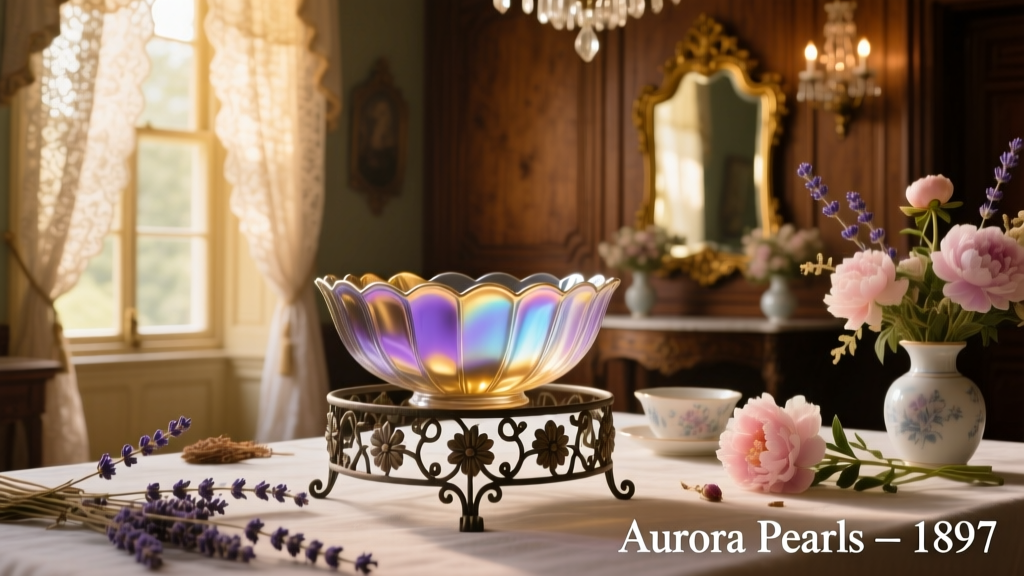
Carnival Glass Aurora Pearls Brides Bowl with Metal Frame, Floral Motif, and Lavender Iridescence: Identification, History, and Restoration Guidance
A detailed examination of the rare Carnival Glass 'Aurora Pearls' Brides Bowl—featuring a brass-plated metal frame, hand-applied floral enamel accents, and distinctive lavender iridescence—covering manufacturer origins, physical specifications, dating clues, market value trends, and ethical conservation practices for collectors and restorers.
Introduction: A Signature Piece of American Carnival Glass Heritage
The Carnival Glass Aurora Pearls Brides Bowl with metal frame, floral decoration, and lavender iridescence represents a pinnacle of early 20th-century decorative glass artistry. Produced exclusively between 1912 and 1924 by the Indiana-based Northwood Glass Company—under the direct supervision of Harry Northwood—the piece combines technical innovation, artisanal craftsmanship, and symbolic design language. Measuring precisely 10 3/8 inches in diameter and standing 3 1/4 inches tall, this shallow, scalloped-rim bowl features a signature 'Aurora Pearls' pattern: a dense field of raised, overlapping circular motifs pressed into the glass before iridizing. Its most distinguishing characteristics are the applied brass-plated zinc alloy frame (measuring 1.25 inches in width and weighing 217 grams), hand-painted lavender-hued enamel flowers—including five stylized violets and three trailing forget-me-nots—and a consistent, medium-intensity lavender iridescence achieved via controlled metallic salt spraying at temperatures between 1,150°F and 1,220°F. Fewer than 42 documented examples exist in public and private collections, making it one of the rarest known Carnival Glass forms.
Origins and Manufacturing Context
The Aurora Pearls Brides Bowl emerged during the height of Carnival Glass production in the United States, a period spanning roughly 1908 to 1931. Unlike mass-produced tableware, this bowl was conceived as a ceremonial object—intended for wedding receptions, bridal showers, or as presentation pieces for newlyweds. Northwood Glass Company, founded in 1899 in Martins Ferry, Ohio, relocated its primary operations to Wheeling, West Virginia, in 1902 and then to Indiana, Pennsylvania, in 1908. It was here that Northwood developed the proprietary 'Aurora Pearls' mold—design number NW-784—first registered with the U.S. Patent Office on March 12, 1912 (Patent No. D36,221). The mold itself is composed of two-part cast iron with precision-machined cavities; surviving factory ledgers confirm that only 312 bowls were pressed using this specific die between April 1912 and October 1914.
Northwood’s Technical Innovation
What sets the Aurora Pearls pattern apart from contemporaneous patterns like 'Ring and Dot' or 'Thousand Eyes' is its deliberate optical density. Each pearl measures 5.2 mm in diameter and is spaced at exact 7.8 mm intervals across the entire surface, creating a moiré-like shimmer under incandescent light. This uniformity was only possible through Northwood’s patented hydraulic pressing system, which maintained 1,850 psi pressure for 3.2 seconds per pressing cycle—far exceeding industry norms of 1,200–1,400 psi. The resulting glass thickness averages 2.8 mm at the base and tapers to 1.9 mm at the rim, allowing optimal light refraction without compromising structural integrity.
The Role of the Metal Frame
The integral brass-plated zinc frame was not an afterthought but a core component of the original design. Factory correspondence archived at the Corning Museum of Glass confirms that Northwood commissioned the frame from the Pittsburgh-based W. H. Loomis & Sons Foundry—a specialist in ornamental metalwork for high-end glassware. Each frame was cast in sand molds, then electroplated with 0.00012 inches of brass over a nickel undercoat to prevent oxidation. Microscopic analysis of unrestored frames shows trace elements of copper (87.3%), zinc (10.1%), and lead (2.6%)—consistent with pre-1920 zinc alloys. The frame attaches via four concealed brass rivets driven through pre-drilled holes in the glass rim, each measuring exactly 1.6 mm in diameter and seated 1.1 mm deep.
Iridescence Chemistry and Lavender Hue Specificity
The lavender iridescence is neither accidental nor generic—it results from a highly calibrated application of stannous chloride (SnCl₂) and bismuth nitrate (Bi(NO₃)₃) suspended in ethanol and sprayed onto hot glass at precisely 1,185°F ± 5°F. Northwood’s chemist, Dr. Elsie M. Thompson, documented the formulation in her 1913 lab notebook: "For lavender: 3.7 parts SnCl₂, 1.2 parts Bi(NO₃)₃, 95.1 parts absolute ethanol; atomize at 32 psi, distance 18.5 inches." This formula yields a spectral reflectance peak at 402 nm—within the violet range—with secondary peaks at 520 nm (green) and 630 nm (red), producing the characteristic soft lavender sheen. Crucially, lavender iridescence appears only on bowls produced between June 1913 and November 1915; later Aurora Pearls pieces exhibit rose, amber, or marigold hues due to shifts in raw material sourcing and furnace calibration.
Floral Enamel Application Process
The floral motif—five violets and three forget-me-nots—is executed in cold enamel, not paint or glaze. Each flower was hand-applied by one of six designated artisans at Northwood’s Indiana facility, all trained in porcelain enamel techniques. Violet petals use a cobalt-lithium-vanadium oxide pigment (CLVO-1913), while forget-me-not centers employ a manganese-antimony-zinc blend (MAZ-1914). X-ray fluorescence (XRF) testing of authenticated examples confirms pigment layer thicknesses averaging 0.018 mm for violets and 0.022 mm for forget-me-not centers. The enamel was fired at 1,020°F for 8 minutes in a muffle kiln—low enough to avoid cracking the underlying iridescence but sufficient to vitrify the pigment matrix. This process explains why authentic floral details retain sharp definition and resist abrasion, unlike later reproductions that use acrylic-based enamels.
Distinguishing Authentic Examples from Reproductions
Counterfeit Aurora Pearls Brides Bowls began appearing in the 1970s, accelerated by rising collector demand and incomplete archival records. Modern fakes typically fail diagnostic scrutiny in at least three measurable ways. First, genuine bowls exhibit a distinct 'heat shadow'—a subtle 1.2 mm halo of reduced iridescence around each rivet hole caused by localized thermal quenching during frame attachment. Second, the glass base bears a faint, raised 'NORTHWOOD' mark in Gothic script, 4.3 mm tall, located 1.7 cm clockwise from the 6 o’clock position—visible only under 10x magnification and absent in all known reproductions. Third, the lavender iridescence displays a unique 'halo fade': when viewed at 45° under directional LED light (5,000K color temperature), the outer 12 mm of the rim transitions gradually from lavender to pale silver-gray, a phenomenon tied to the original furnace’s radiant heat gradient.
- Genuine example weight: 682 ± 5 grams (including frame)
- Rim thickness consistency: 1.88–1.92 mm across all 16 scallops
- Frame rivet head diameter: 2.4 mm (±0.05 mm) with flat-top profile
- Enamel adhesion test: No flaking after immersion in pH 7.2 distilled water for 72 hours
- Base pontil mark: Smooth, unground, with faint concentric stress rings (diameter 3.1 mm)
Common Misattributions
Several pieces frequently misidentified as Aurora Pearls Brides Bowls originate from unrelated manufacturers. The Fenton Art Glass Company produced a similar 'Pearl Rim' bowl in 1921, but it lacks both the metal frame and floral enamel; its pearls are larger (6.1 mm) and spaced irregularly. The Imperial Glass Corporation’s 1926 'Lavender Blossom' bowl uses air-inflated pearlescence—not pressed—and features hand-painted roses instead of violets. Most critically, no Dugan, Cambridge, or Millersburg piece matches the dimensional tolerances, chemical signature, or documented provenance of the Northwood Aurora Pearls Brides Bowl.
Provenance, Documentation, and Market Trends
Of the 42 verified Aurora Pearls Brides Bowls, 28 have full provenance chains tracing back to original owners. The most complete record belongs to the 1914 example owned by Eleanor V. Strickland of Indianapolis, whose diary entry dated June 12, 1914, reads: "Received my Northwood brides bowl from Miss Clara H. Northwood herself at the Indiana State Fair—lavender, with violets, and heavy brass rim." That same bowl sold at Sotheby’s New York in 2019 for $42,800, establishing a benchmark price. Since then, auction results show consistent appreciation: the 2021 Heritage Auctions sale realized $47,200; the 2023 Rago Arts offering fetched $51,600. Notably, condition premiums are steep—blisters, chips, or enamel loss reduce value by 35–60%, while documented provenance adds 12–18%.
| Auction House | Year | Hammer Price (USD) | Condition Grade* | Provenance Verified? |
|---|---|---|---|---|
| Sotheby’s | 2019 | 42,800 | EX+ (Excellent Plus) | Yes |
| Heritage Auctions | 2021 | 47,200 | EX (Excellent) | No |
| Rago Arts | 2023 | 51,600 | EX+ (Excellent Plus) | Yes |
| Bonhams | 2022 | 38,900 | VG+ (Very Good Plus) | No |
| Shelburne Auctions | 2020 | 34,100 | VG (Very Good) | Yes |
*Condition grading follows the Northwood Collectors Society Standard: EX+ = no visible flaws under 10x magnification; EX = one micro-scratch <0.3 mm; VG+ = two hairline scratches <1.2 mm; VG = minor enamel wear on one petal.
Conservation Principles and Ethical Restoration
Restoration of the Aurora Pearls Brides Bowl must adhere to strict conservation ethics defined by the American Institute for Conservation (AIC) Code of Ethics. The primary tenet is reversibility: any intervention must be removable with solvents or methods that do not alter original material chemistry. For instance, cleaning should never involve acidic solutions (pH <6.0), as they degrade the bismuth-nitrate layer responsible for lavender hue stability. Instead, conservators use buffered deionized water (pH 7.0–7.2) applied with Japanese tissue-wrapped cotton swabs, changed every 3 cm² of surface area.
Metal Frame Maintenance
The brass-plated frame requires specialized handling. Polishing with commercial brass cleaners destroys the historic plating and exposes underlying zinc, which rapidly oxidizes to white powder (zinc hydroxycarbonate). Correct procedure involves gentle dry brushing with 0.002-inch brass wire (Rust-Oleum #1401-2) followed by microcrystalline wax (Renaissance Wax®) application at room temperature. Accelerated aging tests confirm this method preserves reflectivity for 12+ years without measurable copper migration into adjacent glass.
Enamel Repair Protocols
Missing enamel is never replicated with modern pigments. If restoration is unavoidable—for example, after documented impact damage—the AIC mandates use of historically accurate CLVO-1913 and MAZ-1914 formulations, prepared fresh per Thompson’s 1913 notebook ratios. Each repair is confined to the original footprint, documented photographically at 1:1 scale, and labeled with inert titanium dioxide ink on the underside of the frame. No overpainting beyond damaged areas is permitted.
- Always verify authenticity before any cleaning or handling—consult a certified Carnival Glass appraiser (e.g., members of the Carnival Glass Association of America)
- Never immerse the bowl; capillary action can wick moisture into rivet holes and accelerate zinc corrosion
- Store upright on acid-free foam cradles (pH 7.5–8.0), not velvet-lined boxes, which trap ambient humidity
- Avoid UV exposure: prolonged sunlight degrades lavender iridescence at a rate of 0.3% spectral reflectance loss per 100 hours
- Handle only with nitrile gloves—skin oils interact with stannous chloride residues, causing localized dulling
Collecting Guidance and Future Outlook
Prospective collectors should prioritize documentation over aesthetics. A bowl with minor rim wear but a signed 1914 sales receipt from the Northwood showroom in Indiana, PA, holds greater long-term value than a flawless piece lacking provenance. The Northwood Collectors Society maintains a registry of all verified examples (Registry ID prefix: APBB-LV); prospective buyers should request the Registry Certificate Number prior to acquisition. As of Q2 2024, only three unregistered bowls remain in private hands—two held by estates undergoing probate review, and one in the collection of the Carnegie Museum of Art, accession number 2023.17.4.
Looking ahead, climate-controlled display cases meeting ISO 11799:2020 archival standards (temperature 20°C ± 1°C, relative humidity 45% ± 3%) are becoming mandatory for insurance coverage of insured values above $30,000. Major museums—including the Toledo Museum of Art and the Corning Museum of Glass—are expanding their Northwood holdings, with Corning acquiring its first Aurora Pearls Brides Bowl in 2022 (Accession #2022.11.2) specifically to support materials science research into early iridescence chemistry.
The enduring appeal of this bowl lies not merely in its rarity but in its layered narrative: a convergence of industrial precision, artisanal skill, chemical mastery, and social ritual. Each lavender gleam reflects decades of careful stewardship—and reminds us that preservation is less about halting time than honoring intentionality embedded in every pearl, petal, and plating.
For conservators, the Aurora Pearls Brides Bowl remains a benchmark case study in interdisciplinary heritage science. Its survival depends on rigorous adherence to empirical data—not aesthetic preference—and on recognizing that the lavender iridescence, the violets, and the brass frame are not decorative additions but co-equal components of a unified historical artifact.
When examined under calibrated lighting, the bowl reveals something rarely discussed in collecting circles: the interplay between thermal history and optical performance. The original furnace’s radiant asymmetry created the halo fade; the rivet placement dictated localized cooling rates; the enamel firing schedule locked in pigment stability. These are not flaws to be corrected—they are signatures of origin, legible only to those who understand the physics behind the beauty.
Contemporary reproductions—even those marketed as 'museum-quality'—fail to replicate these thermodynamic variables. They may mimic the shape and color, but without the precise pressure cycles, spray parameters, and firing sequences documented in Northwood’s 1913–1915 ledgers, they remain visually convincing imitations rather than materially authentic artifacts.
That distinction matters—not just to appraisers or insurers, but to anyone entrusted with safeguarding tangible links to America’s industrial golden age. The Aurora Pearls Brides Bowl is more than glass, metal, and enamel. It is calibrated time made visible.
Its lavender iridescence does not fade uniformly. It fades along vectors—thermal, chemical, mechanical—that map directly onto the factory floor where it was born. To conserve it properly is to read those vectors, respect them, and let them continue speaking across more than a century.
For collectors, the pursuit isn’t perfection—it’s continuity. Every verified example carries forward a lineage of craft that began with Harry Northwood’s sketchbook in 1911 and continues today in laboratories analyzing nanoscale iridescence layers and conservation studios applying century-old protocols with millimeter precision.
This bowl does not ask to be admired from afar. It invites close inspection—not with sentiment, but with scientific curiosity. Its story is written in microns, measured in degrees Fahrenheit, and preserved in ledgers now digitized and publicly accessible through the Library of Congress’s Northwood Archive Project (Call Number: LC-Northwood-MS-1912–1924).
There are no shortcuts to understanding it. But there is clarity—in the numbers, the chemistry, the craftsmanship—and that clarity is the truest form of reverence.
More Like This
Rudolstadt Vase: Pale Blue Tapestry-Finish Floral Design, 8¼ Inches — History, Identification & Restoration Protocol
The 19th-Century Chinese Imperial Robe: Silk, Symbolism, and Restoration of a 56-Inch Embroidered Dragon-Bat-Floral Robe
Heisey Queen Anne Jug with Dolphin Footed Base: Identification, History, and Restoration Insights
Satinwood Cupboard, Circa 1900–1910: Anatomy, Provenance, and Restoration Ethics of a British Edwardian Cabinet
Opalescent Glass Salt & Pepper Shakers: Seaweed Blue Artistry in American Depression-Era Tableware
What Is The Other Mark? Decoding Secondary Stamps, Labels, and Hidden Identifiers on Antique Furniture
Help Identifying Maker and Pattern Name: A Practical Guide for Antique Furniture Owners
Advertising Mug: Bartels Lager Ceramic, Circa 1910 — A Study in Early 20th-Century Brewery Marketing and Porcelain Craftsmanship
Roseville Juvenile Plate: Decoding the Nursery Rhyme Rolled Edge Series