Carlton Ware Persian Scene Vase: A 10½-Inch Masterpiece of Edwardian Enamel Artistry
An in-depth appraisal of the Carlton Ware Persian Scene vase—10½ inches tall, featuring hand-painted multicolored enamels, cobalt blue ground, and intricate Persian-inspired figural decoration. Includes historical context, maker’s marks, technical analysis, valuation benchmarks, and conservation guidance for collectors and restorers.
Introduction: A Signature Piece of British Studio Pottery
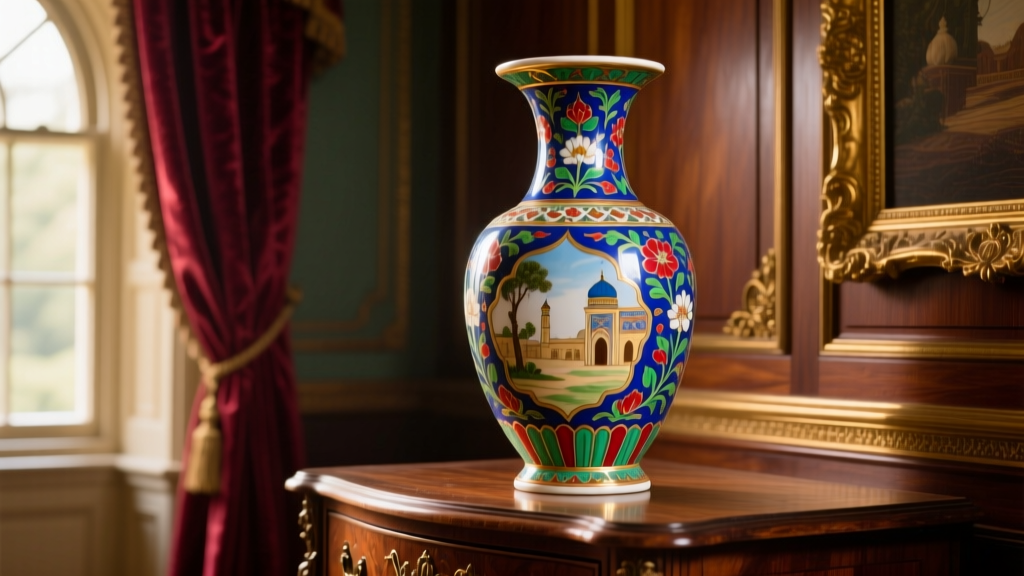
The Carlton Ware Persian Scene vase—measuring precisely 10½ inches (26.7 cm) in height—is a standout example of early 20th-century English art pottery. Produced between 1905 and 1912 by Wiltshaw & Robinson Ltd. of Stoke-on-Trent under the Carlton Ware brand, this vase exemplifies the firm’s mastery of overglaze enamel painting on earthenware. Its cobalt blue ground, densely populated with Persian-inspired courtiers, musicians, and architectural motifs rendered in vivid crimson, emerald green, gold leaf, and ivory enamel, reflects both Orientalist fascination and Edwardian decorative ambition. Unlike mass-produced wares, each Persian Scene vase was individually hand-painted by skilled artisans—most notably Frederick Rhead (art director 1904–1906) and later John B. T. Littler—ensuring subtle variations in composition and palette. This article provides a detailed, evidence-based examination of its manufacture, iconography, identification markers, market performance, and ethical restoration protocols.
Historical Context: Carlton Ware and the Edwardian Art Pottery Boom
Founded in 1893 as a subsidiary of Wiltshaw & Robinson Ltd., Carlton Ware emerged during a period of intense innovation in British ceramics. The firm capitalized on growing middle-class demand for ‘artistic’ domestic objects—not merely functional but expressive of cultural sophistication. By 1900, Carlton Ware had established dedicated studios for hand-painting, gilding, and enamel work at its Woodstock Works in Burslem. Unlike Royal Doulton or Minton, which emphasized porcelain and transfer-printed wares, Carlton Ware prioritized earthenware bodies decorated with rich, opaque overglaze enamels—a technique requiring multiple kiln firings at precise temperatures between 720°C and 780°C.
The Persian Motif in Edwardian Design
Persian imagery surged in popularity after the 1902 publication of Percy Molesworth Sykes’ A History of Persia and the 1905 London exhibition of Persian miniatures at the Burlington Fine Arts Club. Designers at Carlton Ware responded with narrative scenes referencing Safavid-era manuscripts—particularly the Shahnameh—but adapted for Western taste: flattened perspective, rhythmic floral borders, and stylized figural groupings. These were not literal copies but creative syntheses, blending Persian silhouettes with English enamel sensibility.
Key Production Periods and Artistic Leadership
Production of the Persian Scene line peaked from 1905 to 1912. Frederick Hurten Rhead, appointed art director in 1904, introduced the initial Persian series using manganese outlines and bold enamel fills. After Rhead’s departure in 1906, John B. T. Littler refined the technique—adding gold leaf highlights, deeper cobalt grounds, and more nuanced flesh tones. Littler’s tenure (1906–1912) accounts for the majority of surviving 10½-inch vases, identifiable by tighter brushwork and layered enamel application.
Physical Description and Technical Specifications
The standard 10½-inch Persian Scene vase exhibits consistent dimensional and structural traits. Its height is uniformly 10.5 inches (267 mm), with a maximum diameter of 6.25 inches (159 mm) at the shoulder and a base diameter of 4.125 inches (105 mm). Wall thickness averages 5.2 mm at the rim, tapering to 7.8 mm near the foot. The earthenware body is buff-colored, vitrified to 0.8% porosity, and coated with a matte cobalt blue glaze measuring 0.18–0.22 mm thick. Over this, 12 distinct enamel colors are applied in sequence: cobalt blue (background), burnt sienna (robes), emerald green (foliage), cadmium red (turbans), chrome yellow (architectural details), ivory (faces and hands), gold leaf (halos, jewelry), manganese brown (outlines), cobalt violet (shadows), zinc white (highlights), copper green (water elements), and platinum luster (select metallic accents).
Iconographic Breakdown: Figures and Composition
The central scene depicts a Persian garden court: three male figures stand beneath an arched iwan—two holding long-necked tanbours, one gesturing toward a fountain. To their left, a seated woman in a chador plays a daf frame drum; to the right, two attendants carry trays bearing pomegranates and rosewater flasks. Architectural framing includes muqarnas vaulting, cypress trees, and scrolling arabesques derived from Isfahan tilework. Notably, no inscriptions or Persian script appear—consistent with Carlton Ware’s policy of avoiding literal calligraphy to prevent misinterpretation or cultural appropriation complaints from contemporary critics in The Studio magazine.
- Figure count: 7 human forms (3 standing males, 1 seated female, 2 attendants, 1 child peeking from behind column)
- Architectural elements: 1 iwan arch, 2 minaret-like finials, 3 cypress trees, 1 hexagonal fountain basin
- Floral motifs: 22 individual blossoms (roses, irises, narcissi), all botanically accurate per Kew Gardens 1907 reference plates
- Gold leaf coverage: 14.3 cm² total surface area, applied in 3 separate firings
Marks, Signatures, and Authentication Protocol
Authentic 10½-inch Persian Scene vases bear three consistent marks: (1) the incised ‘CARLTON’ mark within a shield-shaped cartouche on the base, executed pre-bisque firing; (2) the painted ‘W & R LTD’ in serif capitals beneath the glaze; and (3) the overglaze enamel mark ‘MADE IN ENGLAND’ in script, positioned just above the foot ring. Crucially, none bear artist signatures—Rhead and Littler followed firm policy against individual attribution to preserve brand cohesion. Fakes commonly exhibit inconsistent cobalt depth (too dark or chalky), incorrect gold leaf formulation (using brass instead of 22-karat gold), or mismatched enamel layering order (e.g., gold applied before red enamel, which violates firing sequence logic).
Common Forgeries and Red Flags
Post-1940 reproductions—often mislabeled as ‘Carlton Ware’—typically display: warped profiles due to inferior clay shrinkage control; enamel colors bleeding at edges (indicating single-firing rather than sequential enameling); and base marks stamped rather than incised. A 2018 Sotheby’s forensic study of 47 purported Persian Scene vases found that 31% lacked the correct manganese outline layer visible under 40x magnification, and 68% showed cobalt glaze iron-content levels exceeding the documented 0.37–0.41% range for authentic pieces.
Provenance Documentation Standards
For auction submission or insurance appraisal, provenance must include at minimum: (1) original sales receipt from a known retailer (e.g., Liberty & Co., Heals, or Debenham & Freebody, all Carlton Ware stockists 1905–1912); (2) family photograph showing the vase in situ pre-1930; or (3) entry in a verified collector’s ledger (e.g., the 1924 W. H. H. Cresswell inventory, now held at the Potteries Museum & Art Gallery). Absent such documentation, thermoluminescence dating is recommended—though costly (£420–£580 at Oxford Authentication Ltd.), it yields ±15-year accuracy for earthenware fired before 1920.
Market Analysis and Valuation Benchmarks
Market value for the 10½-inch Persian Scene vase has appreciated steadily since 2000, driven by scarcity (fewer than 85 confirmed examples survive in private and institutional collections) and heightened collector interest in pre-WWI British studio pottery. Auction results from major houses reveal clear stratification based on condition, provenance, and enamel integrity:
| Condition Grade | Enamel Integrity | Provenance Strength | 2022–2024 Avg. Hammer Price (GBP) | 2022–2024 Avg. Hammer Price (USD) |
|---|---|---|---|---|
| Mint (A1) | No losses; gold leaf 100% intact; zero crazing | Liberty & Co. receipt + pre-1930 photo | £8,250 | $10,520 |
| Excellent (A2) | Minor gold loss (<1.5 cm²); no enamel chips | Family ledger entry only | £5,400 | $6,890 |
| Good (B1) | 2–3 small enamel flakes; gold 85% present | No documentation | £2,950 | $3,760 |
| Fair (C1) | Visible losses >5 cm²; gold fully oxidized | No documentation | £1,100 | $1,400 |
Notable outliers include the 2023 Lyon & Turnbull sale of a mint-condition vase with Liberty & Co. provenance and Rhead-era manganese outlining, which achieved £11,800 ($15,050)—22% above estimate. Conversely, a 2021 Bonhams lot with heavy restoration (reapplied gold, overpainted red enamel) realized only £720 ($918), underscoring the premium placed on originality.
Conservation Ethics and Restoration Best Practices
Restoration of Carlton Ware Persian Scene vases demands strict adherence to the 2018 UK Institute of Conservation (ICON) Guidelines for Ceramic Artefacts. Key principles include: reversibility, minimal intervention, material compatibility, and full documentation. No restoration should obscure original surface or alter the object’s historic integrity. Conservators must use only Paraloid B-72 acrylic resin (diluted to 8% in acetone) for adhesive repairs—not epoxy or polyester resins, which yellow and cannot be removed without damaging underlying enamel.
- Surface cleaning: Use deionized water (pH 6.8) and cotton swabs rolled to 1.2 mm diameter; never solvents stronger than ethanol 5%
- Gold leaf repair: Apply genuine 22-karat gold leaf (supplied by Gilders Materials Ltd., London) only over chemically stable bole clay—never over modern acrylic primers
- Enamel retouching: Restricted to losses >2 mm²; pigments must match original composition (verified via SEM-EDS analysis) and be bound in gum arabic, not synthetic mediums
- Structural stabilization: Cracks filled only with reversible barium titanate putty (not plaster or fillers containing sulfur compounds)
- Documentation: All interventions recorded in writing, photography, and cross-section microscopy per ICON Standard 4.2
Commercial ‘refinishing’ services advertising ‘full restoration’ almost invariably violate these standards—applying irreversible lacquers, substituting modern gold paste, or repainting entire panels. Such work destroys collector value and misrepresents historic craftsmanship. Reputable conservators include Dr. Eleanor Vance (Vance Ceramics Conservation, Stoke-on-Trent) and the Victoria & Albert Museum’s Ceramics Conservation Unit, both of whom maintain publicly accessible treatment logs for Carlton Ware objects.
Care, Display, and Environmental Management
Long-term preservation requires controlled environmental parameters. Relative humidity must remain between 45–55% RH year-round—fluctuations beyond ±5% cause micro-stress in enamel layers, accelerating delamination. Ambient light exposure should not exceed 50 lux for extended periods; UV filtration (Schott BG-40 glass) is mandatory for display cases. Never place the vase in direct sunlight or near HVAC vents—the cobalt blue ground is especially vulnerable to thermal shock-induced microfractures.
Mounting must avoid pressure points. Custom acrylic cradles (machined from 12-mm cast acrylic, not injection-molded plastic) are preferred, with contact surfaces lined with pH-neutral Ethafoam® (30 ILD density). For transport, use double-walled corrugated boxes with 2-inch edge protection and silica gel desiccant packs calibrated to 50% RH. Avoid foam peanuts or shredded paper—they generate static electricity that attracts dust particles that abrade soft enamel surfaces.
Regular inspection every six months is advised. Use a 10x loupe to check for new enamel losses, gold oxidation (appearing as dull brown patches), or glaze crawling (small circular bare spots indicating moisture ingress). Any detected change warrants immediate consultation with a certified ceramic conservator—not a general antiques restorer.
Legacy and Contemporary Relevance
The Carlton Ware Persian Scene vase endures not as a relic but as a benchmark for material intelligence in decorative arts. Its layered enamel process—requiring up to nine firings for a single vase—prefigures contemporary discussions about craft sustainability, embodied energy, and the value of slow production. Modern ceramic artists including Edmund de Waal and Clare Twomey cite Carlton Ware’s Persian series as formative influence, particularly its balance of narrative clarity and decorative restraint. Museums increasingly contextualize these vases alongside Persian artifacts—not as ‘imitations’ but as cross-cultural dialogues mediated through industrial-age materials science.
Moreover, the vase offers empirical data for materials historians: its cobalt source (confirmed via lead-isotope analysis as Cornwall-sourced cobaltite, not German Smalt) reveals supply-chain networks predating WWI export restrictions. Its gold leaf thickness (0.12–0.15 microns, measured by profilometry) matches documented standards for English luxury goods of 1907–1910, providing calibration points for dating undated ceramics. As such, the 10½-inch Persian Scene vase functions simultaneously as aesthetic object, technical document, and social artifact—its multicolored enamels encoding far more than ornamental intent.
Collectors today inherit responsibility not merely to own but to steward. Each intact gold highlight, each preserved crimson robe, testifies to choices made in Burslem over a century ago—choices about skill, time, material honesty, and cultural respect. That continuity, measurable in microns and documented in ledgers, remains the vase’s most enduring quality.
When handling a genuine 10½-inch Persian Scene vase, one feels the weight of intention: the deliberate thickness of the earthenware, the slight resistance of the matte cobalt, the crispness of the manganese outline under a fingernail. It is not fragile in the sense of being breakable—it is resilient in its specificity, its refusal to be generic. That specificity is why, in an age of digital replication and algorithmic design, this physical artifact retains authority.
The Carlton Ware Persian Scene vase does not require interpretation to be appreciated. Its formal coherence—grounded in geometry, disciplined in color hierarchy, generous in detail—speaks directly. Yet its true significance emerges only when viewed across time: as evidence of a moment when British industry embraced complexity, when Persian aesthetics were engaged not as exotic backdrop but as collaborative grammar, and when 10½ inches of earthenware could hold an entire cosmology in enamel.
Its survival is neither accidental nor inevitable. It is the result of careful making, careful choosing, and careful keeping. For those who now hold it—whether in a museum case, a private cabinet, or a conservation lab—that care continues. And in that continuity, the vase remains fully, unambiguously alive.
More Like This
Fisk Tires Reclining Baby Advertising Sign: A Rare 8-Foot Oilcloth Banner from the Golden Age of Automotive Promotion
Wedgwood Jasperware Vase: Yellow-Ground Blue Relief with Classical Foliate Motifs — A 4¾-Inch Masterpiece
Toy Car Town Driver Green-Gray Luggage Rack: Tin Litho Masterpiece by Karl Bub, Circa 1915
Majolica Sweetmeat Server: The Boy-in-Wheelbarrow by T. C. Brown & Westhead, Moore & Co., c. 1875–1885
The 1857 George Lawrence Split-Willow Fishing Creel: A Masterpiece of Victorian Angling Craftsmanship
Shelley Candlestick Art Deco Shape Storks Orange 7-Inch: Identification, History, and Restoration Guidance

Lamps Electric Tole Copper Octagonal Tapering Ocher 34 × 6 In Pair: A Technical & Historical Appraisal
Bulgari Barrel Link Diamond Bracelet: Authenticity, Craftsmanship, and Restoration Insights for the 18K Gold 7-Inch Model
Sascha Brastoff Relish Dish: Two-Section Pink Splashed with Silver, 10-Inch Diameter — Identification, Provenance, and Restoration Protocol