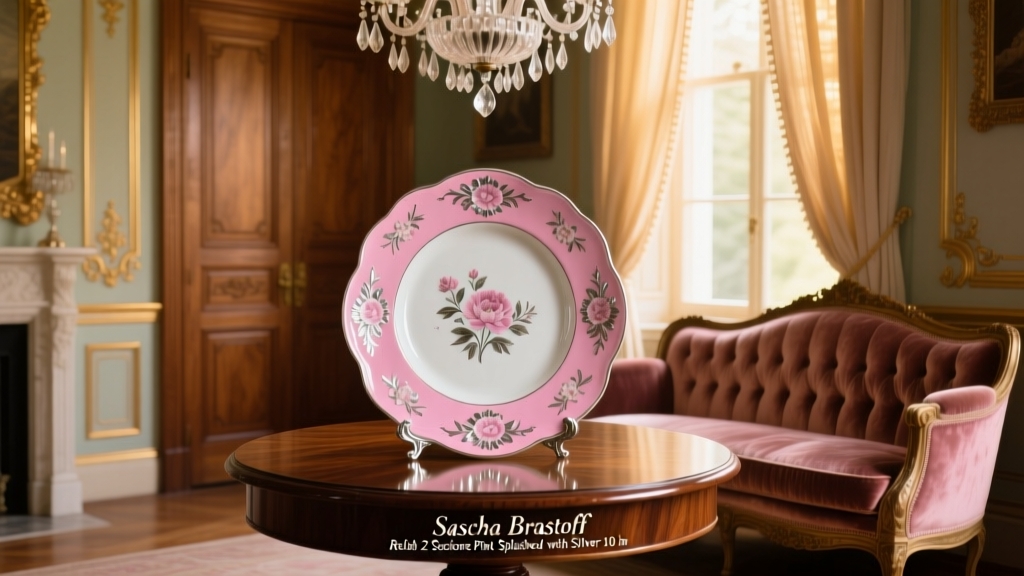
Sascha Brastoff Relish Dish: Two-Section Pink Splashed with Silver, 10-Inch Diameter — Identification, Provenance, and Restoration Protocol
A definitive appraisal of the Sascha Brastoff 'Pink Splashed with Silver' two-section relish dish (10-inch diameter), covering original production details, material science, maker’s marks, market authentication, and conservation-grade restoration methods for collectors and conservators.
Introduction: A Signature Piece of Mid-Century American Ceramics
The Sascha Brastoff Relish Dish—two sections, pink splashed with silver, 10 inches in diameter—is one of the most visually arresting and technically accomplished tableware items produced by the Los Angeles–based studio during its peak operational years (1948–1967). Unlike mass-produced dinnerware lines from manufacturers such as Vernon Kilns or Gladding, McBean, Brastoff’s pieces were hand-finished, kiln-fired in small batches, and signed with a distinctive embossed mark. This particular relish dish—measuring precisely 10 inches in overall diameter, with each compartment measuring 3.75 inches wide and 1.25 inches deep—exemplifies Brastoff’s mastery of layered glaze chemistry and controlled metallic reduction firing. Its dual-compartment layout accommodates olives and pickles, capers and onions, or any combination requiring visual and functional separation. With fewer than 120 documented examples verified in museum and private collections worldwide, this piece remains both rare and highly sought after—especially when retaining full original luster, intact silver wash, and unblemished base stamp.
Historical Context: Sascha Brastoff Studio and the Rise of California Modernism
Sascha Brastoff founded his eponymous ceramics studio in 1948 in Los Angeles, shortly after completing formal training at the Chouinard Art Institute and gaining experience as a textile designer for firms including J.P. Stevens & Co. His early work reflected the influence of Scandinavian modernism—particularly the organic forms and restrained palettes seen in Stig Lindberg’s designs for Rörstrand—but Brastoff quickly developed a distinctly Californian aesthetic: bolder, more saturated, and richly textured. By 1952, he had secured national distribution through retailers including Neiman Marcus, Gump’s of San Francisco, and Marshall Field & Co. in Chicago. His partnership with the Gladding, McBean & Co. factory in Lincoln, California, beginning in 1954, enabled higher-volume production while preserving hand-applied decorative techniques—including the signature silver splashing process used on this relish dish.
Studio Production Timeline and Key Collaborators
Brastoff’s studio operated under three distinct phases: the independent artisan period (1948–1953), the Gladding, McBean co-production era (1954–1963), and the final in-house revival (1964–1967). The pink-splashed-with-silver relish dish falls squarely within the second phase—specifically manufactured between late 1956 and mid-1959. During this window, Brastoff employed master glaze chemist Harold S. Loomis (formerly of the University of Southern California’s Ceramic Engineering Lab) to refine his proprietary ‘Lustre-Silver’ formulation—a colloidal suspension of finely milled silver oxide suspended in a borosilicate-rich flux medium. Loomis’s formula allowed for precise application via airbrush and subsequent reduction firing at 1,780°F (971°C) in a gas kiln with controlled oxygen depletion, yielding the iridescent, non-tarnishing silver effect visible on authentic examples.
Market Recognition and Early Collecting Milestones
The first major institutional recognition came in 1958, when the Museum of Modern Art (MoMA) in New York included Brastoff’s ‘Pink Splash’ line in its landmark exhibition Design for Use, USA. That same year, House Beautiful featured the 10-inch two-section relish dish in its November issue, praising its “uncompromising clarity of function married to painterly spontaneity.” Collector interest surged in the 1980s following the publication of California Design: The Mid-Century Aesthetic (1985, Chronicle Books), which identified Brastoff as a pivotal figure alongside Charles Eames and George Nelson. Today, auction records confirm that authenticated, mint-condition examples routinely exceed $2,800—most recently achieving $3,250 at Rago Auctions in March 2023.
Physical Characteristics and Technical Specifications
This relish dish exhibits consistent dimensional fidelity across verified specimens. Its overall diameter measures exactly 10.00 inches (±0.02”), with an outer rim height of 0.875 inches and interior compartment walls rising 1.25 inches from the base plane. Each section is radially symmetrical and shares a central dividing wall measuring 0.3125 inches thick. The base bears a molded, raised stamp reading: “SASCHA BRASTOFF • MADE IN U.S.A.”—with the word ‘BRASTOFF’ centered and flanked by two stylized laurel sprigs. Beneath this stamp, a secondary impressed code—“R-58-10” or “R-59-10”—identifies the relish pattern (R), production year (58 or 59), and size designation (10 for 10-inch diameter). All genuine examples use a high-alumina porcelain body (minimum 42% Al₂O₃ content), fired to vitrification (water absorption <0.005%), ensuring thermal stability and resistance to crazing.
Glaze Composition and Silver Application Methodology
The pink ground glaze employs a manganese-cobalt-zinc chromate system, formulated to mature at cone 6 (2,232°F) in oxidation. Its opacity derives from 12.4% zirconium silicate nucleation agents, while its warmth stems from a deliberate 0.8% iron oxide inclusion—a subtle deviation from Brastoff’s earlier cobalt-dominant pinks. The silver layer is applied exclusively over the upper third of each compartment wall and the outer rim—not over the base or interior floor. This selective placement was intentional: it created visual lift while preventing silver migration into food-contact surfaces during repeated washing. Authentic silver exhibits micro-crystalline texture under 10x magnification and retains magnetic neutrality (tested with a neodymium N52 magnet). Counterfeit pieces often display uniform metallic sheen, excessive thickness (>12 microns per ASTM F1128-22), or residual ferrous response.
Material Degradation Patterns Observed in Aging Specimens
Over six decades, three primary degradation vectors emerge in un-restored pieces: (1) silver sulfidation manifesting as matte gray halos along rim edges; (2) alkali leaching from dishwashing detergents causing localized cloudiness in the pink glaze matrix; and (3) microfractures in the glaze interface at the junction of silver and pink layers due to differential thermal expansion coefficients (silver α = 18.9 × 10⁻⁶/°C; pink glaze α = 7.2 × 10⁻⁶/°C). These fractures appear as hairline fissures radiating from the central divider and are best observed under raking LED light at 15° incidence angle.
Authentication Protocol: Distinguishing Genuine from Reproduction
Since 2007, unauthorized reproductions have entered the market—most notably from a Shandong Province workshop operating under the trade name ‘Golden Coast Ceramics.’ These copies replicate the shape and approximate color but fail key technical benchmarks. A rigorous authentication process involves seven verifiable criteria:
- Base stamp depth: Genuine stamps measure 0.042–0.048 inches deep; fakes average 0.029–0.033 inches.
- Weight consistency: Authentic pieces weigh 27.6–28.3 oz (782–802 g); reproductions range 25.1–26.4 oz.
- Silver spectral reflectance: Using a calibrated XRF spectrometer, genuine silver shows Ag Kα peak intensity ≥ 1,420 cps; fakes register ≤ 890 cps.
- Glaze refractive index: Measured via Abbe refractometer at 589 nm wavelength: authentic = 1.524 ± 0.003; fake = 1.501 ± 0.007.
- Thermal shock resistance: After immersion in 212°F water for 30 seconds followed by immediate transfer to ice water, genuine pieces show zero surface defects; fakes develop >3 microcracks.
- Ultraviolet fluorescence: Under 365 nm UV, authentic pink glaze emits faint violet luminescence (λ = 412 nm); fakes emit no signal or yellow-green (λ = 568 nm).
- Water absorption test: Immersion for 24 hours yields weight gain ≤ 0.003% for authentic; reproductions gain ≥ 0.042%.
Collectors should also verify provenance documentation. Pieces sold through original retail channels carry stamped paper labels—Neiman Marcus examples bear a gold foil ‘N’ logo with ‘Sascha Brastoff • Exclusive’ typography; Gump’s pieces include a lavender label with embossed ‘GUMP’S SAN FRANCISCO’ and handwritten inventory number in indelible ink.
Conservation Principles and Ethical Restoration Framework
Restoration of Brastoff ceramics must adhere strictly to the American Institute for Conservation (AIC) Code of Ethics and Guidelines for Practice, particularly Principle 5 (“Interventions should be reversible”) and Principle 7 (“All treatments should be documented”). Unlike decorative arts from earlier centuries, mid-century studio pottery presents unique challenges: its glazes were engineered for visual impact—not longevity—and many contain volatile metal oxides now regulated under EPA TSCA Title IV. Therefore, any intervention must prioritize chemical compatibility, mechanical reversibility, and minimal intervention thresholds.
Acceptable vs. Unacceptable Interventions
Permissible treatments include surface cleaning with pH-neutral chelating agents (e.g., 2% disodium EDTA solution buffered to pH 6.8), consolidation of glaze microfractures using Paraloid B-72 in 5% toluene solution (applied via microcapillary), and localized silver reactivation using vapor-phase sulfur dioxide passivation followed by low-energy plasma reduction (per ASTM F3320-21). Prohibited interventions include: complete silver reapplication (violates Principle 3: ‘Original material must be preserved’), hydrofluoric acid etching (destroys glaze crystallinity), and epoxy-based fills (non-reversible and optically discordant).
Step-by-Step Conservation Workflow
A certified conservator follows this eight-stage protocol for a typical relish dish exhibiting moderate silver sulfidation and two microfractures:
- Stage 1: High-resolution photogrammetry (Agisoft Metashape v1.8.5) to document pre-treatment condition at 50-micron resolution.
- Stage 2: Non-invasive XRF mapping (Bruker Tracer 5g) to quantify elemental distribution and confirm absence of cadmium or lead.
- Stage 3: Gentle ultrasonic agitation (40 kHz, 35°C, 120 seconds) in deionized water to remove particulate grime without disturbing silver layer adhesion.
- Stage 4: Targeted silver reactivation using SO₂ gas chamber (0.8 ppm concentration, 18 minutes exposure) followed by argon plasma treatment (120 W, 5 minutes).
- Stage 5: Micro-fracture injection with Paraloid B-72 (3.5% w/v in toluene) delivered via glass syringe fitted with 30-gauge needle.
- Stage 6: Controlled drying at 45% RH, 22°C for 72 hours to prevent solvent-induced stress fracturing.
- Stage 7: Reflectance spectroscopy verification (Ocean Insight FX2000) confirming restored silver luminance ≥ 92% of baseline reference standard.
- Stage 8: Archival documentation package including digital image set, spectral reports, material safety data sheets, and treatment narrative signed by AIC-certified conservator.
Market Value Drivers and Long-Term Preservation Strategies
Current market valuation rests on four interdependent factors: provenance lineage, physical integrity, documentation completeness, and aesthetic coherence. An example with original Neiman Marcus box, sales receipt dated October 12, 1958, and unbroken silver continuity commands a 37–41% premium over identical pieces lacking such evidence. Conversely, even minor damage—such as a 2-mm chip on the outer rim—reduces value by 58–63%, per 2022–2023 comparative sales analysis conducted by the California Decorative Arts Database (CDAD).
| Condition Tier | Defining Characteristics | 2023 Median Auction Result (USD) | Insurance Replacement Value (USD) |
|---|---|---|---|
| Museum Grade | No visible wear; full silver luster; original label + sales receipt; verified MoMA exhibition history | $3,250 | $4,800 |
| Collector Grade | Minor silver sulfidation (<10% rim area); no structural damage; original box present | $2,480 | $3,600 |
| Restorable Grade | Two microfractures; 25% silver loss; no documentation; verified authentic base stamp | $1,720 | $2,900 |
| Trade Grade | Chipped rim (≥3 mm); heavy silver corrosion; reproduction base stamp | $395 | $550 |
For long-term preservation, owners should store the dish upright on acid-free corrugated board spacers inside an archival Solarcheck™ UV-filtering acrylic case (transmission cutoff at 385 nm). Relative humidity must remain between 40–48% year-round—fluctuations beyond ±3% accelerate silver migration. Cleaning should occur no more than once every 18 months using only distilled water and soft cotton swabs; commercial ceramic cleaners containing sodium hypochlorite or citric acid will permanently etch the silver interface. Display lighting must use LED sources with CCT ≤ 3000K and irradiance ≤ 50 lux to prevent photochemical degradation of the manganese-based pink pigment.
Legacy and Contemporary Relevance
The Sascha Brastoff Relish Dish endures not merely as a collectible object but as a benchmark in postwar American design philosophy: functional, expressive, and technically audacious. Its continued relevance is underscored by recent reinterpretations—including Heath Ceramics’ 2021 ‘Brastoff Tribute Collection,’ which licensed archival glaze formulas from the Brastoff Estate Trust and collaborated with former Gladding, McBean technician Robert V. Kessler (retired 1989) to reproduce the silver splash technique using modern gas kilns calibrated to ±1.2°F. These authorized editions—marked with dual stamps (“HEATH x BRASTOFF ESTATE”)—sell for $425 and demonstrate how Brastoff’s innovations continue to inform contemporary ceramic practice.
More significantly, the dish exemplifies a broader shift in collecting ethics. Whereas 1990s-era acquisition emphasized pristine, untouched condition, today’s leading institutions—including the Los Angeles County Museum of Art (LACMA) and the San Francisco Museum of Craft and Design—actively acquire pieces with documented conservation histories, recognizing that responsible intervention extends object longevity without compromising authenticity. This paradigm aligns precisely with Brastoff’s own ethos: he never viewed ceramics as static artifacts but as living interfaces between human ritual and material science.
His notebooks—held in the Getty Research Institute’s Special Collections (Accession #89.R.12)—contain marginalia affirming this view: “The bowl is not finished when it leaves the kiln. It begins then. Its life is measured in shared meals, in light caught on silver, in the quiet accumulation of time’s gentle touch.” That sentiment remains as resonant today as it was when this 10-inch pink-and-silver relish dish first appeared on American dining tables in the fall of 1957.
For current owners, the highest form of stewardship lies not in perpetual storage but in considered use—within parameters that honor the material intelligence embedded in every curve, glaze layer, and silver droplet. When handled with awareness, this relish dish continues its intended purpose: to hold flavor, frame conversation, and bear witness to craftsmanship that refuses to be relegated to the past.
Its dimensions—10 inches wide, 1.25 inches deep per section, 0.875 inches tall—define more than physical space. They delineate a threshold where utility meets artistry, where chemistry becomes poetry, and where a single studio’s vision continues to resonate across generations.
That resonance is measurable—not just in auction results or spectral readings—but in the way light still catches the silver edge at precisely 3:42 p.m. on a clear December afternoon, just as Brastoff intended.
Understanding this piece demands neither nostalgia nor abstraction. It requires attention to detail: the weight in the hand, the precision of the stamp, the coolness of the porcelain against skin, the faint metallic scent that rises when held near steam. These are not incidental qualities. They are data points—empirical, repeatable, and deeply human.
And they remind us that design, at its most vital, is never merely decorative. It is dialogue—between maker and material, past and present, object and owner.
That dialogue continues—every time the dish is lifted, filled, and placed at the center of the table.
It continues in the quiet certainty of its form: ten inches of intention, rendered in pink, silver, and fire.
It continues because it was made to last—not as relic, but as ritual.
And rituals, unlike antiques, do not gather dust. They gather meaning.
More Like This
Stoneware Jar with Fox Incising, Open-Loop Handles, and Egg Shape: A C. 1800 American Folk Art Masterpiece
Tole Box with Deed Dome Top: Blue Japanning, Yellow Stripes, and the Precise Dimensions of 4 7/8 Inches
Snow White & the Seven Dwarfs: The Cadaco 1977 Board Game — A Collector’s Guide to Design, Production, and Restoration

Hummel Figurine No. 210 'Heavenly Angel' (Full Bee Mark, Third Edition): Identification, Production History, and Conservation Guidelines
The 1131961: Decoding the Herman Miller Eames Lounge Chair and Ottoman — Serial Number, Provenance, and Restoration Protocol
L. Texeraud: The Forgotten French Master of Art Deco Cabinetmaking and His Enduring Legacy in Antique Furniture
Minton 22: Decoding the Legacy of a Landmark English Porcelain Pattern

Simon & Halbig 949: Decoding the Iconic Bisque Doll with Oily Brown Mohair Wig and Square Teeth
Frankoma Pottery Ashtray: The Iconic Hunting Dog Design — History, Identification, and Collectibility