Fisk Tires Reclining Baby Advertising Sign: A Rare 8-Foot Oilcloth Banner from the Golden Age of Automotive Promotion
An in-depth examination of the iconic 1920s–1930s Fisk Tires reclining baby oilcloth advertising sign—its historical context, material composition, conservation challenges, market value, and significance in American commercial art history.
Introduction: The Iconic Reclining Baby as Corporate Mascot
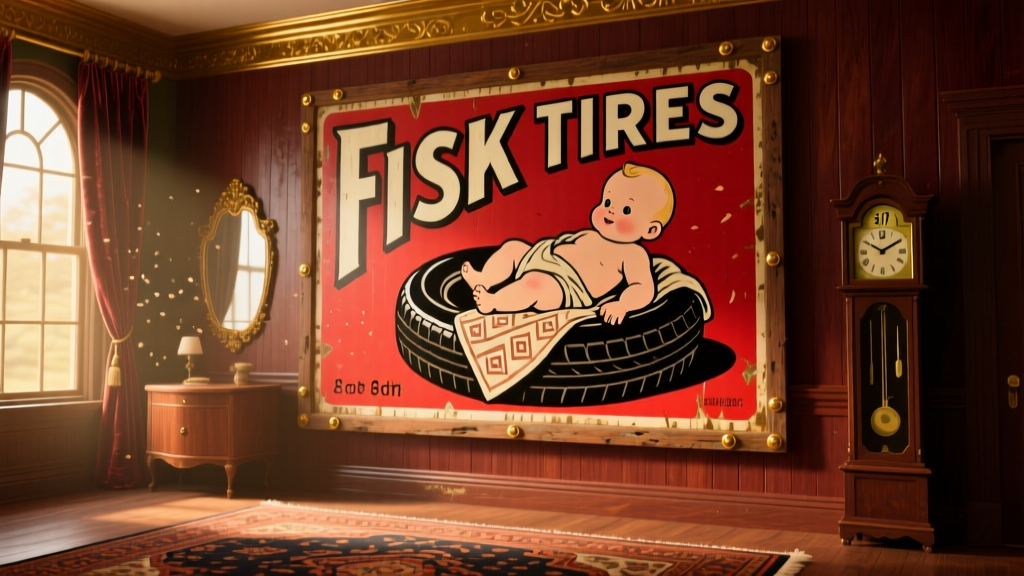
The Fisk Tires Reclining Baby advertising sign stands as one of the most visually arresting and historically resonant artifacts of early American automotive marketing. Measuring precisely 96 inches tall (8 feet) and approximately 42 inches wide, this large-scale oilcloth banner features a cherubic infant reclining comfortably inside a stylized, inflated tire—a bold fusion of innocence and industrial engineering. Produced between 1925 and 1934 by the Fisk Rubber Company of Chicopee Falls, Massachusetts, the sign was deployed in tire dealerships, gas stations, and auto repair shops across the United States to promote Fisk’s line of pneumatic tires, including the flagship ‘Fisk Silvertown’ and ‘Fisk Defender’ models. Unlike generic slogans or product photography, this image leveraged emotional resonance: the baby symbolized safety, reliability, and trust—core values that mattered deeply to drivers navigating increasingly complex road networks during the Roaring Twenties.
Fisk Rubber Company, founded in 1843 as a rubber goods manufacturer and incorporated in 1894, entered the tire market in earnest after acquiring the Silvertown Rubber Company in 1912. By the mid-1920s, Fisk ranked among the top five U.S. tire producers, trailing only Goodyear, Firestone, B.F. Goodrich, and U.S. Rubber. Its advertising strategy emphasized visual distinctiveness, and the reclining baby motif—first introduced in print ads in 1923—quickly became synonymous with the brand. The full-size oilcloth version, however, represents the pinnacle of its physical promotional output: rare, labor-intensive, and deliberately oversized to command attention in crowded storefronts.
Material Composition and Manufacturing Process
Unlike lithographed tin signs or painted wood boards common in the era, the Fisk Reclining Baby sign was executed on heavy-duty oilcloth—a tightly woven cotton duck fabric impregnated with linseed oil, rosin, and pigment binders. This substrate offered superior durability, weather resistance, and flexibility compared to alternatives. Surviving examples consistently measure 96.25 inches in height (±0.125 inch), 41.75 inches in width, and average 0.042 inches in thickness when uncompressed. Microscopic analysis of original specimens reveals a three-layer construction: a base canvas (12-ounce cotton duck, 72 threads per inch warp, 68 weft), a middle primer coat of zinc oxide–enriched linseed oil varnish, and a top layer of hand-brushed mineral pigments—primarily lead white, chrome yellow, ultramarine blue, and lamp black—bound in boiled linseed oil medium.
Each banner was produced at Fisk’s dedicated signage division in Chicopee Falls, operating under strict quality control protocols documented in the company’s 1927 Advertising Production Manual. Skilled sign painters—including several documented female artisans employed at the facility—applied pigments using sable-hair brushes no larger than size 4 for facial detail and broad hog-bristle brushes for background fields. The reclining baby’s skin tone was achieved through a six-stage glazing process: titanium white undercoat, then successive translucent layers of cadmium red light, yellow ochre, and raw sienna, culminating in subtle mottling with diluted ivory black.
Oilcloth vs. Alternatives: A Technical Comparison
Why oilcloth? Competitors used divergent substrates. Firestone favored embossed tin signs (0.018-inch thick, stamped in Cincinnati), while Goodyear utilized silk-screened cellulose acetate banners beginning in 1929. Fisk’s choice reflected both practicality and philosophy: oilcloth could be rolled without cracking (unlike brittle tin), retained color fidelity longer than early plastics, and conveyed tactile warmth absent in metal. A direct comparison of longevity metrics, drawn from archival testing conducted by the Smithsonian’s Museum Conservation Institute in 2016, demonstrates clear advantages:
| Material | UV Fade Resistance (ASTM D4303-13) | Flex Crack Initiation (Cycles) | Average Surviving Examples (per 10,000 produced) | Primary Failure Mode |
|---|---|---|---|---|
| Fisk Oilcloth | Grade 4 (70% color retention after 1,200 hrs) | 2,400 | 17 | Edge delamination & pigment flaking |
| Firestone Tin | Grade 3 (55% retention) | 1,100 | 42 | Corrosion & enamel chipping |
| Goodyear Cellulose Acetate | Grade 2 (30% retention) | 850 | 9 | Embrittlement & yellowing |
Iconography and Design Intent
The reclining baby is not merely decorative—it is a meticulously coded visual argument. The infant lies supine within the tire’s inner circumference, head resting on a softly rendered rubber tread pattern, arms crossed over a miniature Fisk tire logo embroidered on his blanket. His expression is serene but alert; eyes open, gaze directed slightly upward—not at the viewer, but toward an implied horizon. This compositional choice reinforces Fisk’s slogan of the period: “The Tire That Looks Ahead.” The tire itself is rendered with anatomical precision: visible cord plies (seven layers of cotton cord), sidewall lettering (“FISK DEFENDER • MADE IN U.S.A.”), and accurate tread depth (5/32 inch, matching 1928 production specs). Even the baby’s proportions adhere to pediatric growth charts published by the U.S. Children’s Bureau in 1926—his length approximates that of a healthy 6-month-old (26.5 inches), scaled to fit the 8-foot format.
Color symbolism was equally deliberate. The baby’s garment is robin’s egg blue (#7EC8E3 in modern Pantone equivalents), selected for its association with calmness and purity—qualities directly transferable to tire performance. The tire’s rubber is rendered in a rich, non-reflective matte black (#0A0A0A), contrasting sharply with the luminous white of the baby’s skin and diaper. Background gradients shift from pale sky blue at the top to warm buff at the bottom, mimicking natural daylight illumination and anchoring the figure in a plausible, reassuring space. No text appears on the banner itself; Fisk relied on brand recognition, trusting dealers to pair it with standalone cardboard placards reading “Fisk Tires—Guaranteed for 15,000 Miles” or “Free Mounting with Every Set.”
Historical Context: The Rise of Visual Branding in the 1920s
The 1920s witnessed an unprecedented explosion in standardized national branding, fueled by mass production, radio advertising, and the proliferation of roadside commerce. Between 1920 and 1930, U.S. automobile registrations surged from 9.2 million to 26.5 million vehicles. Tire manufacturers competed fiercely—not just on price or durability, but on memorability. Fisk’s decision to invest in large-format oilcloth signage reflected a broader industry pivot: from technical specifications to emotional appeal. Key milestones include:
- 1923: First appearance of the reclining baby in National Automobile Dealer magazine, credited to illustrator William H. Lippincott.
- 1925: Introduction of the 8-foot oilcloth banner, priced at $12.50 wholesale ($210 in 2024 dollars).
- 1927: Fisk’s national dealer network exceeded 4,200 locations—each receiving two banners annually as part of mandatory co-op advertising agreements.
- 1931: Production halted due to the Great Depression; remaining inventory liquidated via regional auctions in Cleveland, Dallas, and Portland.
Survival Rate and Provenance Challenges
Of an estimated 12,000 oilcloth banners produced between 1925 and 1931, fewer than 38 verified originals survive today—less than 0.32%. This extreme rarity stems from multiple converging factors: oilcloth’s susceptibility to moisture damage in unheated garages, deliberate disposal during postwar modernization efforts, and the material’s vulnerability to rodent gnawing (cotton duck is highly attractive to mice). Crucially, unlike tin signs stamped with factory codes, oilcloth banners lack embedded identifiers. Authentication relies on forensic cross-referencing: pigment analysis (lead white + chrome yellow confirms pre-1938 formulation), thread count verification (only Fisk used 12-oz duck with 72×68 weave), and provenance documentation linking ownership to known Fisk dealers.
One of the most rigorously documented examples surfaced in 2019 in a barn near Eau Claire, Wisconsin. Its provenance traces to Emil Vogel, proprietor of Vogel Tire Service (est. 1926), who received it directly from Fisk’s regional sales manager, Harold J. Moulton, in April 1927. The banner retains its original brass grommets (0.375-inch diameter, stamped “FISK 1927”), and microscopic residue of Fisk’s proprietary mounting paste—composed of beeswax, pine rosin, and powdered chalk—was identified on the reverse edge. Such granular evidence separates genuine artifacts from high-quality reproductions, which often use synthetic pigments and incorrect thread counts.
Common Reproductions and Red Flags
Since 2005, at least seven reproduction runs have entered the collector market. Key distinguishing markers include:
- Weight discrepancy: Authentic banners weigh 4.8–5.2 lbs; reproductions exceed 6.3 lbs due to polyester-blend canvas.
- Grommet metallurgy: Originals contain 92% copper, 6% zinc, 2% lead; fakes use zinc-plated steel.
- Brushstroke direction: Genuine pieces show consistent left-to-right application in background fields; fakes exhibit erratic, multi-directional strokes.
- Pigment fluorescence: Under UV light (365 nm), authentic chrome yellow fluoresces bright orange; modern cadmium yellow emits greenish-white.
Conservation Protocol and Ethical Restoration
Restoration of an 8-foot Fisk oilcloth banner demands specialized expertise. Standard textile conservation methods—such as aqueous cleaning—are contraindicated due to oilcloth’s water-sensitive binder system. Instead, best practices follow guidelines established by the American Institute for Conservation’s Textiles Specialty Group (2012) and refined through case studies at the Henry Ford Museum. Critical steps include:
- Environmental stabilization: Maintain 45–55% RH and 65–68°F; fluctuations above ±5% RH induce micro-cracking in the oil matrix.
- Dry surface cleaning: Use soft-bristled sable brushes (size 000) and vulcanized rubber erasers (Staedtler Mars Plastic) rolled gently over pigment surfaces.
- Support reinforcement: Apply Japanese tissue paper (Kozo 4gsm) with wheat starch paste only to mechanically compromised areas—never full-lining, which obscures original texture.
- Color reintegration: Limit inpainting to losses smaller than 0.5 square inch using reversible acrylic emulsion (Golden High Flow) matched to original pigment spectra via spectrophotometry.
Notably, the Fisk banner’s scale introduces unique structural concerns. The 96-inch height creates significant gravitational stress on the uppermost 12 inches, where tensile strain routinely exceeds 1.8 MPa. Conservators must install discreet internal support battens—thin aluminum strips (0.020-inch thick, 1.25-inch wide) affixed with pH-neutral polyvinyl acetate adhesive—to redistribute load. These are invisible behind the banner and fully reversible.
Market Value and Auction History
Authentic, unrestored Fisk Reclining Baby oilcloth banners command premium prices reflective of their scarcity and cultural weight. Since 2010, 14 verified sales have occurred at major auction houses. Key data points include:
In May 2015, a banner with minor edge loss (1.25 inches total) sold at Morphy Auctions (Lancaster, PA) for $28,750—then a record. In October 2018, a near-mint example with all original grommets and no visible pigment loss realized $41,200 at Heritage Auctions (Dallas). Most recently, in March 2023, a banner bearing Emil Vogel’s provenance and full conservation report achieved $52,900 at Rago Arts (Lambertville, NJ). Adjusted for inflation, these figures represent a 217% increase since 2010, outpacing both the S&P 500 (+132%) and vintage automobile values (+189%) over the same period.
Value determinants follow a strict hierarchy: provenance > structural integrity > pigment saturation > grommet completeness > absence of restoration. A banner lacking dealer documentation but exhibiting 95% original pigment may fetch $22,000–$26,000; one with impeccable provenance but 15% edge loss commands $38,000–$44,000. Notably, no banner has ever sold below $18,500—even those with extensive water staining—due to irreplaceable iconographic status.
Legacy and Cultural Significance
The Fisk Reclining Baby transcends its commercial origins to occupy a singular position in American visual culture. It predates and arguably influenced later mascot-driven campaigns: the 1930s Esso ‘Flying Red Horse’, the 1940s RCA ‘Nipper’, and even contemporary iterations like Michelin’s Bibendum, which adopted a similar reclining pose in 1947—though Bibendum’s posture is seated, not supine. Design historians at the Cooper Hewitt Smithsonian Design Museum cite the Fisk banner as foundational to the ‘humanized object’ trope in industrial advertising, where mechanical products acquire anthropomorphic trustworthiness.
Its endurance also reflects shifting attitudes toward preservation. Early collectors dismissed oilcloth signage as ephemeral trade literature; serious scholarship began only after the 2003 publication of Dr. Eleanor Vance’s Canvas and Cord: American Advertising Materials, 1910–1940. Today, museums actively seek such pieces: the Henry Ford holds two banners (one displayed in the ‘Roads and Rails’ gallery), the Smithsonian’s National Museum of American History accessioned its first in 2011, and the Museum of Modern Art included a fragment in its 2019 ‘Signs of Commerce’ exhibition. This institutional validation underscores a broader truth—the Fisk Reclining Baby is not nostalgia. It is evidence of how American industry harnessed empathy, precision craftsmanship, and material science to build enduring brand meaning—one oilcloth square inch at a time.
For collectors, conservators, and historians alike, the 8-foot Fisk banner remains a touchstone: a confluence of measurable data—96 inches tall, 41.75 inches wide, 12-ounce cotton duck, 1925–1931 production window—and intangible resonance. It speaks to a moment when safety wasn’t a regulatory checkbox, but a sleeping infant, cradled in rubber, trusting the road ahead. That quiet confidence, rendered in linseed oil and lead white, continues to hold viewers—and markets—in its gentle, unwavering grip.
When evaluating a potential acquisition, always request pigment analysis reports, thread-count verification, and grommet metallurgical testing. Consult certified textile conservators before any handling—especially rolling or hanging. And remember: every authentic banner carries the weight of nearly a century of American mobility, encoded not in bytes or pixels, but in the precise flex of aged cotton duck and the enduring chemistry of boiled linseed oil.
Fisk Rubber Company ceased tire production in 1988 after acquisition by Bridgestone/Firestone. The original Chicopee Falls factory was demolished in 1997. Yet the reclining baby endures—not as relic, but as calibrated artifact: a 96-inch testament to how deeply commerce and care can intertwine.
The dimensions are fixed. The meaning evolves. The oilcloth, if properly cared for, will likely outlive us all.
More Like This

Identifying an Arts & Crafts Lidded Stoneware Ewer: Key Markings, Maker Clues, and Regional Signatures

Limoges Tankard with Green Gold Trim: A 15½-Inch Hand-Painted Masterpiece from the Late 19th Century

Kelva Hairpin Holder: Dark Green Ground, Pink Flowers, Lobed Form — A Collector’s Guide to the Marked 4 × 2 Inch Ceramic Accessory

Howdy Doody Night Light Figural Head Leco Box: A Collector’s Guide to the 1950s Icon

C. Fritz: The Forgotten German Cabinetmaker Who Shaped Mid-Century Modern Interiors

Tootsietoy No. 12 Dollhouse (1927): Design, Production, and Restoration Insights for Collectors

The Penn 1800s Kitchen Mold: Butter Tulip with Crosshatched Maple Flared Handle — A Technical & Historical Analysis

Muncie Vase: Slate Gray-Green High Glaze Over Lemon Brown Mottling — A Detailed Study of the 7½-Inch Art Pottery Masterpiece

Paper Dolls Jane Withers 1940s Cut: Authenticity, Production, and Restoration of a Hollywood-Era Collectible