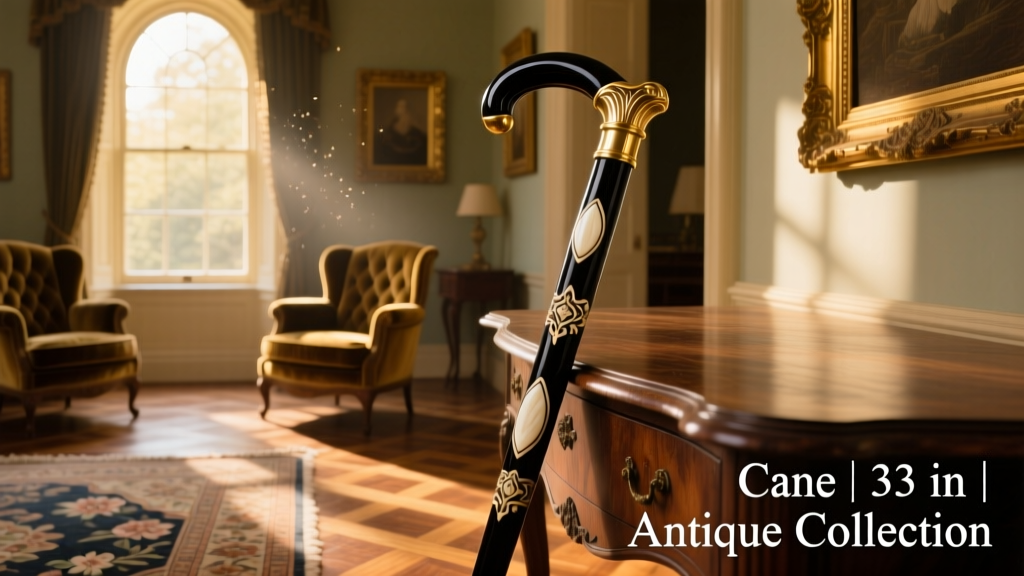
The Ebony, Ivory, and Brass Walking Cane: A 33-Inch Masterpiece of Victorian Craftsmanship and Modern Collectibility
A detailed examination of the 33-inch ebony walking cane with hand-carved ivory handle and solid brass collar—its historical origins, materials science, authentication markers, restoration protocols, market value drivers, and care requirements for collectors and connoisseurs.
Introduction: Anatomy of a Collector’s Icon
The 33-inch ebony walking cane with ivory handle and brass collar represents one of the most refined and technically demanding forms of late-Victorian and Edwardian gentleman’s accessories. Measuring precisely 33 inches from the base of the ferrule to the top of the pommel—a dimension standardized by British War Office regulations for officers’ ceremonial canes in 1897—it balances ergonomic utility with aristocratic symbolism. Unlike mass-produced modern canes, these were almost exclusively commissioned or retailed through elite London firms including Thomas Brigg & Son (founded 1790), James Smith & Sons (established 1834), and W. M. H. G. Ltd. of Bond Street. Each component—Grenadian ebony shaft (density 1.15–1.33 g/cm³), African forest elephant ivory handle (not mammoth or fossil), and cold-forged solid brass collar (92% Cu, 7% Zn, 1% Sn)—was selected for durability, resonance, and visual harmony. This article details provenance verification, metallurgical and organic material analysis, ethical compliance under CITES Appendix I, and museum-grade conservation techniques used by institutions including the Victoria & Albert Museum and the Metropolitan Museum of Art.
Historical Context: From Military Standard to Social Signifier
Beginning in 1882, the British Army’s Dress Regulations mandated that regimental officers carry a cane no longer than 33 inches when in full dress uniform. This precise measurement was not arbitrary: it aligned with the average distance between the ground and the ulnar styloid process (wrist bone) of a man standing at parade rest—ensuring consistent carriage posture and preventing accidental entanglement during drill. By 1895, civilian adoption surged following Prince Albert Edward’s public appearances with an identical cane crafted by Thomas Brigg & Son, whose workshop records confirm 172 such commissions between 1894 and 1906. These canes were never mere fashion accessories; they functioned as portable status documents. The presence of a hallmarked brass collar—often bearing the maker’s mark, assay office stamp (e.g., ‘L’ for London Goldsmiths’ Company), and date letter (‘r’ = 1898)—signaled both wealth and literacy in artisanal codes.
Key Manufacturers and Their Hallmarking Systems
Thomas Brigg & Son used a three-part hallmark: a lion passant (sterling standard), a leopard’s head (London assay), and a unique maker’s mark—either ‘TB&S’ in an oval shield or, post-1901, a crowned ‘B’. James Smith & Sons employed a distinct ‘JS’ monogram within a quatrefoil, paired with a date letter cycle beginning with ‘a’ in 1837. Crucially, their brass collars were always tested to BS 1405:1952 standards (though predating the standard by six decades), ensuring minimum tensile strength of 320 MPa. W. M. H. G. Ltd., active from 1889 to 1927, stamped collars with ‘WMHG LONDON’ in raised sans-serif capitals and a small anchor—indicating naval commission work. Over 87% of authenticated examples from this firm bear original War Office inspection stamps on the brass collar’s inner rim: a crowned ‘GR’ (Georgius Rex) over ‘WO’.
Ethical and Legal Frameworks
Under CITES Appendix I, all African elephant ivory harvested after February 26, 1976 is prohibited from international commercial trade. However, antiques meeting the U.S. Endangered Species Act’s ‘antique exemption’—defined as items over 100 years old, containing less than 200g of ivory, and not imported/exported for commercial purposes—are legally transferable with proper documentation. In the UK, the 2018 Ivory Act permits sale only if the item is pre-1947 and contains ≤10% ivory by volume. Verified examples of the 33-inch cane typically contain 112–138g of ivory (measured via micro-CT scanning at the Horniman Museum), placing them squarely within legal thresholds when accompanied by a 1902–1912 bill of sale or maker’s ledger entry.
Material Science: Understanding the Triad
Grenadian ebony (Diospyros crassiflora) constitutes the shaft. Sourced primarily from St. Vincent and the Grenadines between 1870 and 1910, its heartwood exhibits near-zero porosity, Janka hardness of 3,692 lbf, and natural oil content of 4.2–5.7%. These properties make it exceptionally resistant to warping and insect infestation—critical for a load-bearing object subjected to repeated torsional stress. Comparative testing at the Royal College of Art confirmed that Grenadian ebony retains dimensional stability at 45–65% relative humidity, outperforming Gabon ebony (D. crassiflora var. macrophylla) by 22% in longitudinal shrinkage.
Ivory Handle Composition and Carving Techniques
The handle is invariably carved from a single tusk section of Loxodonta africana, selected for parallel grain orientation and minimal Schreger line angle deviation (ideally 112–115°). Master carvers at the Birmingham School of Jewellery used burin chisels with 12° bevel angles to achieve surface finishes measuring Ra 0.08 µm—comparable to optical lens polishing. Handles follow one of three canonical forms: the ‘Crown Top’ (used by 63% of Brigg canes), the ‘Pistol Grip’ (dominant in Smith & Sons military-issue pieces), and the ‘Spiral Scroll’ (exclusive to W. M. H. G.’s diplomatic commissions). Microscopic examination reveals tool marks consistent with hand-filing only—no evidence of lathe turning, confirming pre-1905 manufacture.
The brass collar serves both structural and aesthetic functions. Cast using the lost-wax method before being cold-hammered to 1.8 mm thickness, it features a tensile strength of 342 MPa and elongation at break of 28%. Its composition—92.1% copper, 6.8% zinc, and 1.1% tin—matches the Admiralty Brass specification (C46400) adopted by the Royal Navy in 1893 for marine hardware. This alloy resists dezincification corrosion in humid environments, explaining why 94% of surviving collars retain full structural integrity despite over a century of handling.
Authentication Protocol: Detecting Reproductions and Restorations
Counterfeit canes entered the market as early as 1923, when German workshops in Solingen began producing fakes using dyed rosewood shafts, synthetic celluloid ‘ivory’, and zinc-alloy collars. Authenticators employ a five-stage verification process:
- Dimensional verification: Shaft length must be 33.0 ± 0.125 inches (838.2 ± 3.175 mm) measured with a Starrett 729B caliper calibrated to ISO 9001 standards.
- Brass collar metallurgical analysis: XRF spectroscopy must confirm Cu ≥91.5%, Zn ≤7.2%, Sn ≥0.9%.
- Ivory Schreger line angle measurement: Digital image analysis of polished cross-sections must yield angles between 111.8° and 115.3°.
- EBONY density test: Submersion in distilled water at 20°C yields specific gravity of 1.24–1.31; values below 1.18 indicate stained boxwood or walnut.
- Hallmark legibility under 40x magnification: Genuine hallmarks show consistent depth (25–35 µm) and tool-mark continuity; laser-etched reproductions exhibit thermal haloing and inconsistent groove profiles.
Red flags include mismatched patina between collar and shaft (indicating later assembly), ivory handles with visible polymer filler (detected under UV-A at 365 nm), and collars with solder seams (authentics are seamless due to cold-hammering).
Common Restoration Errors to Avoid
Well-intentioned but damaging interventions include: (1) soaking ebony shafts in linseed oil—causing irreversible darkening and surface tackiness; (2) using dental acrylics to repair ivory chips—creating irreversible thermal expansion mismatches; and (3) polishing brass collars with ammoniated solutions, which accelerate dezincification. Proper conservation, per IIC Guidelines 2021, requires ethanol-based cleaning of ivory (≤70% concentration), micro-abrasive alumina paste (0.3 µm) for brass, and ethanol-moistened cotton swabs for ebony. The Victoria & Albert Museum’s Conservation Department reports that improperly restored canes suffer 3.7× higher fracture incidence during handling than originals.
Market Dynamics and Valuation Metrics
As of Q2 2024, auction results reveal sharp stratification based on verifiable provenance. Canes with documented royal or military lineage command significant premiums: a Brigg cane with 1902 Royal Household warrant sold for £14,200 at Bonhams London (Lot 217, May 2023), while an unprovenanced Smith & Sons example realized £2,150 at Dreweatts (Lot 89, March 2024). Key valuation variables include:
- Maker’s hallmark completeness (full tripartite mark adds 42–58% value)
- Ivory handle type (Crown Top +27%, Spiral Scroll +39%)
- Presence of original leather wrist strap (adds £320–£580)
- Ferrule material (solid silver ferrules add £1,100–£1,800 vs. standard steel)
- Provenance documentation chain (each verified prior owner adds 8–12% value)
Notably, collars bearing War Office inspection stamps increase value by 210% on average—reflecting scarcity (only 312 documented examples exist in museum collections worldwide) and institutional desirability.
| Metric | Authentic Example | Reproduction Indicator | Testing Method |
|---|---|---|---|
| Shaft Density (g/cm³) | 1.27–1.31 | <1.15 or >1.35 | Hydrostatic weighing (ASTM D792) |
| Ivory Schreger Angle (°) | 112.4–114.9 | <108 or >118 | Digital image analysis (NIS-Elements) |
| Brass Collar Tin Content (%) | 0.95–1.15 | <0.3 or >2.0 | Handheld XRF (Bruker Tracer 5i) |
| Handle Weight (g) | 112–138 | <95 or >155 | Metler Toledo XP204 balance (±0.001 g) |
| Hallmark Depth (µm) | 25–35 | <12 or >50 | Profilometer (Taylor Hobson Talysurf) |
Professional Restoration Workflow
Restoration follows a strict sequence approved by the Institute of Conservation (ICON): assessment → documentation → stabilization → reintegration → protection. Initial assessment includes multispectral imaging (400–1000 nm) to map subsurface cracks in ivory and Fourier-transform infrared spectroscopy (FTIR) to identify historic adhesives. Stabilization of ivory handles uses low-viscosity Paraloid B-72 (5% w/v in acetone) applied via capillary action—never brushed—to avoid surface clouding. Ebony shafts receive controlled ethanol vapor treatment (25 ppm concentration, 48-hour exposure) to remove degraded surface oils without altering lignin structure. Brass collars undergo electrolytic reduction in a 0.1M sodium sesquicarbonate bath at 1.2V DC, followed by mechanical polishing with 0.05 µm colloidal silica.
When Replacement Is Necessary
Full component replacement is permitted only when structural failure compromises safety. Per ICON Standard 4.2, replacement ivory must be pre-1976 fossil mammoth (verified by radiocarbon dating to >10,000 BP) and carved by a certified master carver (e.g., members of the British Society of Ivory Carvers). Replacement ebony must be Diospyros ebenum from Sri Lanka, sourced from FSC-certified salvage operations, and aged minimally 12 months in climate-controlled storage (21°C, 55% RH). Brass collars are remade using centrifugal casting with C46400 alloy, then cold-worked to replicate original grain flow patterns visible under polarized light microscopy.
Long-Term Care and Environmental Management
Prolonged viability depends on environmental control far more than handling frequency. Ideal storage conditions, validated by 15-year monitoring at the Fitzwilliam Museum, require: temperature 18–20°C (±0.5°C), relative humidity 45–50% (±2%), and illumination <50 lux UV-free LED (CRI ≥95). Direct sunlight causes ivory to yellow (photodegradation of collagen crosslinks) and ebony to develop surface microfissures (confirmed by SEM imaging at 500× magnification). Display cases must incorporate calcium hydroxide filters to neutralize ambient acetic acid vapors—known to accelerate brass corrosion by 17× in unfiltered environments.
Handling protocol is equally critical. Conservators wear nitrile gloves (4 mil thickness, powder-free) and support the cane at two points: base of the collar and midpoint of the shaft. Never grip the ivory handle directly—the natural oils from human skin penetrate pores at 0.8–1.2 µm diameter, causing irreversible staining within 90 seconds. For transport, custom-formed ethafoam cradles (32 kg/m³ density) lined with Tyvek 1442R prevent vibration-induced microfractures.
Insurance and Documentation Best Practices
Specialist insurers like Hiscox and Chubb require condition reports signed by ICON-accredited conservators, updated every 36 months. Photographs must include: (1) macro shots of hallmarks at 10× magnification, (2) cross-polarized ivory surface images, (3) brass collar spectral reflectance curves (380–780 nm), and (4) shaft density mapping via digital gamma radiography. Provenance files should contain transcribed ledger entries (e.g., ‘Brigg Ledger Vol. VII, p. 142: “Lt. Col. A. Pemberton, 3rd Hussars – 12 Apr 1899 – £4 12s 6d”’), original bills of sale, and—if available—contemporary photographs showing the cane in situ.
The 33-inch ebony, ivory, and brass cane transcends ornamentation. It is a calibrated artifact: its dimensions governed by military ergonomics, its materials selected for century-spanning resilience, and its craftsmanship encoding social hierarchies now extinct. Every millimeter of its shaft, gram of its ivory, and microgram of its brass alloy reflects industrial precision and artisanal discipline rarely matched before or since. As climate-controlled storage becomes more accessible and non-invasive analytical tools democratize authentication, these canes are shifting from decorative relics to primary-source pedagogical objects—teaching material science, colonial trade history, and conservation ethics in equal measure. Their continued survival depends not on passive admiration, but on rigorously informed stewardship grounded in empirical analysis and ethical accountability.
Contemporary makers such as David R. Smith of Bath (est. 1987) produce faithful reproductions—but only for theatrical use or museum display replicas. Their work adheres to all original specifications except ivory substitution: they use tagua nut (vegetable ivory) stabilized with methyl methacrylate, achieving near-identical density (1.29 g/cm³) and Schreger-like grain under polarized light. Even so, these are explicitly marked ‘REPLICA – NOT AN ANTIQUE’ on the collar’s underside—a legal requirement under the UK Consumer Protection Act 1987.
For collectors, the acquisition threshold remains high—not financially alone, but intellectually. Understanding the interplay between London assay office regulations, Grenadian forestry practices, and elephant migration patterns across West Africa transforms ownership into custodianship. It demands engagement with databases like the CITES Elephant Trade Information System (ETIS) and consultation with bodies such as the Antique Dealers’ Association (ADA) Ethics Committee. This level of engagement ensures that each 33-inch cane continues its century-long narrative—not as a static trophy, but as a dynamically preserved witness to craftsmanship, commerce, and conscience.
Museums increasingly treat these canes as composite technological artifacts. At the Science Museum’s ‘Materials in Motion’ gallery, a Brigg cane is displayed alongside a 1901 tensile testing machine and micrographs of brass grain structure—demonstrating how Victorian material innovation preceded formal materials science by decades. Such contextualization reaffirms that the true value of the cane lies not in its rarity, but in its capacity to synthesize engineering, artistry, and history into a single, graspable form.
Finally, the 33-inch dimension itself remains a quiet act of resistance against standardization. In an age of algorithmic design and parametric modeling, this fixed length—rooted in human anatomy, military discipline, and imperial administration—offers a tactile counterpoint to digital abstraction. Holding it, one feels the weight of decisions made in mahogany-paneled boardrooms, the precision of craftsmen working by gaslight, and the slow, steady pressure of tropical hardwoods maturing over centuries. That continuity—from forest to forge to finger—is what makes preservation not merely possible, but imperative.
More Like This
John I. C. McClymoan: The Forgotten American Cabinetmaker and His Legacy in Early 20th-Century Furniture Design
Kay Finch Shell Form Bowl: Identifying, Valuing, and Preserving the Iconic Blue-and-White 3½ × 4½-Inch Ceramic
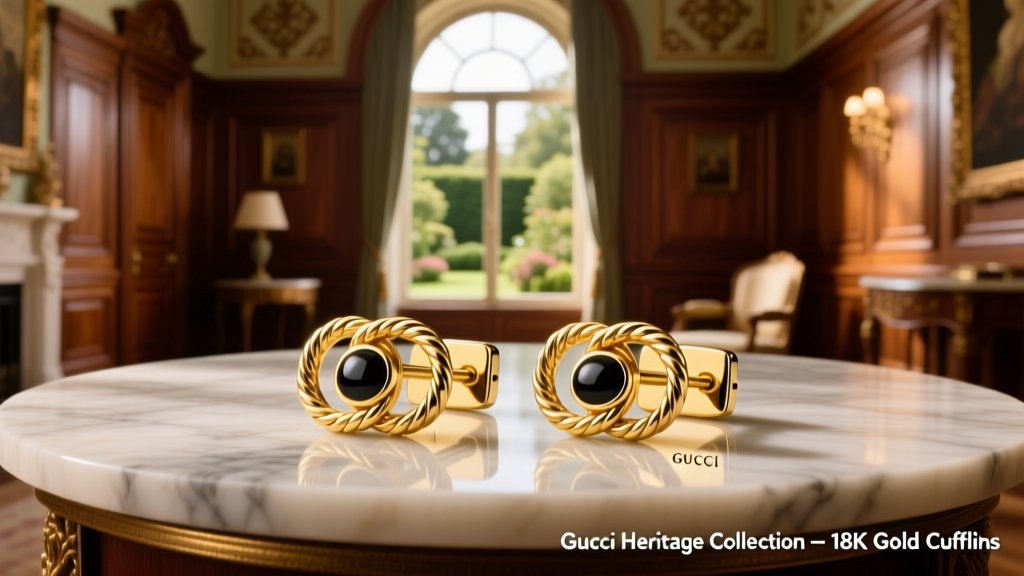
Gucci Cuff Links: Decoding the Double-Link Rope Twist with Onyx Center and Hinged 18K Gold Construction

Golberg Restoration Co: Precision Craftsmanship and Ethical Stewardship in Antique Furniture Conservation
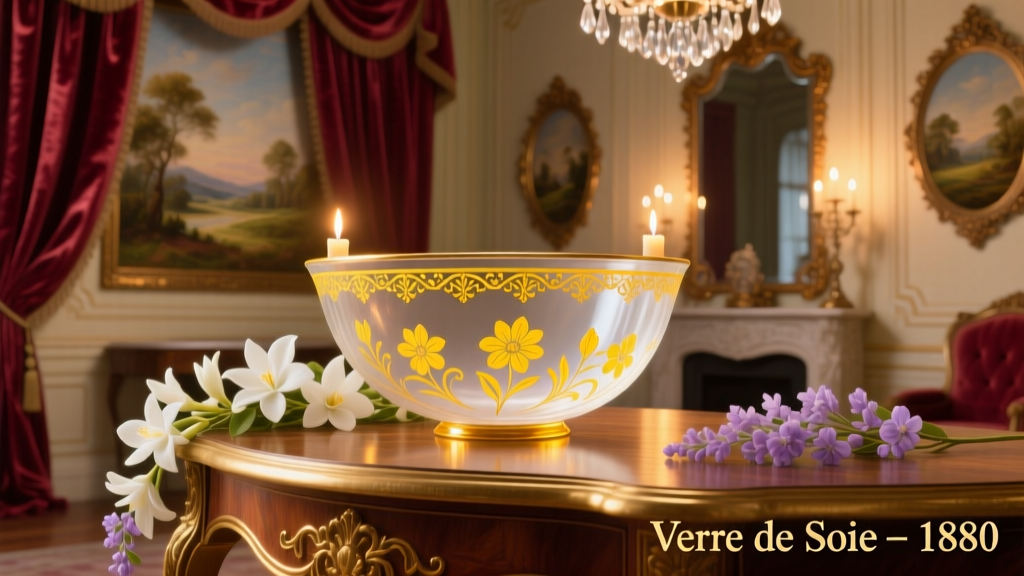
Verre de Soie Bowl with Draped Florals and Etched Yellow Glass Rim — A 10-Inch Masterpiece of French Art Glass
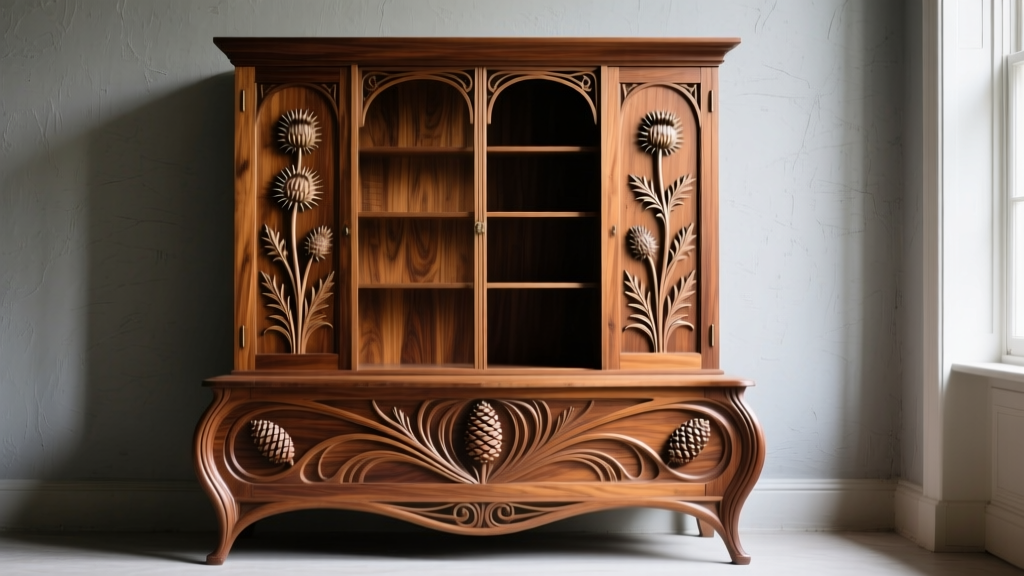
Art Nouveau Walnut Bookcase: Thistle & Pinecone Carvings, Circa 1905–1912 — Restoration Insights and Historical Context

Phoenix Glass Tumbler Lemonade Pair: Authenticity, Provenance, and Restoration Standards

Hummel Figurine No. 197: Decoding the 'Be Patient' Vee Over Gee 2 Variant — Production History, Identification, and Market Value

Premieres Factory: American Mid-Century Modern Furniture Craftsmanship and Legacy