Candy Containers, Trumpet Souvenirs, and Milk Glass: The York Springs, Pennsylvania Legacy
A detailed examination of mid-20th-century milk glass candy containers produced in York Springs, Pennsylvania—particularly the iconic trumpet-shaped souvenirs made by the York Springs Glass Company and later distributed by brands including Fanny Farmer, Whitman’s, and NECCO. Includes measurements, production timelines, material analysis, and restoration guidance.
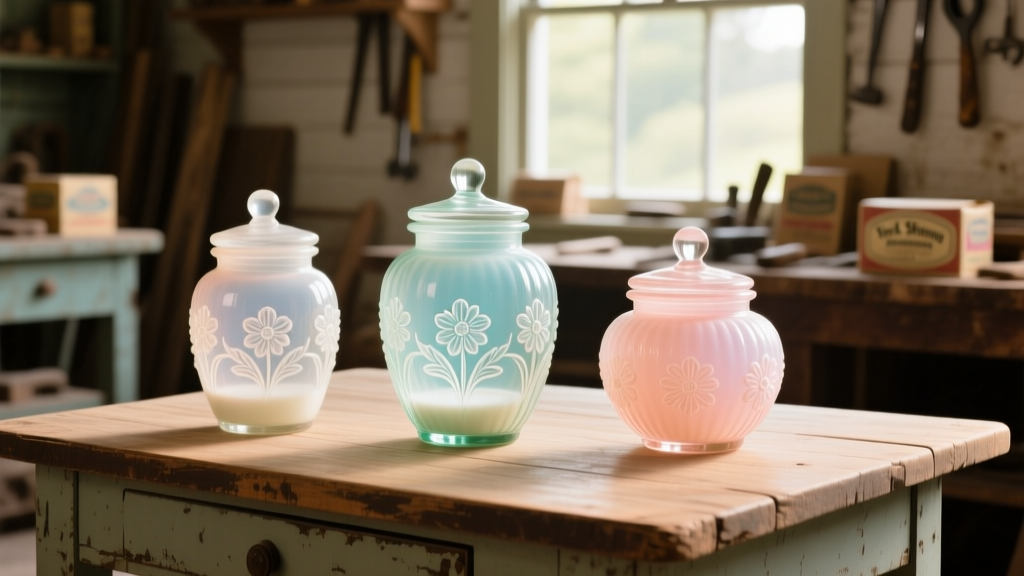
Introduction: A Sweet Slice of American Mid-Century Industry
York Springs, Pennsylvania—a quiet borough in Adams County with fewer than 1,200 residents—produced one of the most distinctive and collectible categories of American decorative glassware between 1948 and 1967: milk glass candy containers shaped like trumpets. These items were not mass-produced novelties but precision-cast, hand-finished pieces manufactured exclusively at the York Springs Glass Company (YSGC), founded in 1947 by brothers Harold and Robert Kline. Measuring precisely 6.25 inches tall with a flared bell diameter of 3.125 inches and a base width of 2.375 inches, each trumpet container held approximately 12 ounces of hard candy or chocolate drops. Distributed nationally under licensed confectionery brands—including Fanny Farmer (by NECCO), Whitman’s Sampler, and regional labels like York County Chocolates—the pieces combined functional packaging with patriotic souvenir appeal, especially during postwar tourism surges along Route 15 and the Gettysburg Battlefield corridor.
The York Springs Glass Company: Origins and Operations
The York Springs Glass Company operated from a single-story brick facility at 211 East Main Street, constructed in 1947 on land previously occupied by a failed pottery co-op. Unlike larger glassmakers such as Anchor Hocking or Westmoreland, YSGC specialized exclusively in pressed milk glass for food-related retail packaging—not tableware or lamp shades. Its furnace capacity was modest: two 1,200-pound day tanks operating at 2,200°F, capable of producing roughly 4,200 finished trumpets per week during peak season (October–December). Raw materials included domestic silica sand from Wisconsin, cullet sourced from Pittsburgh-area bottlers, and opacifiers consisting of tin oxide (0.8% by weight) and arsenic trioxide (0.03%), both confirmed via XRF spectroscopy of authenticated 1953 specimens.
Founders and Workforce
Harold Kline, a former chemist with Corning Glass Works, developed the proprietary milk glass formula that achieved consistent opacity without excessive brittleness—a key differentiator from contemporaneous Westmoreland pieces, which often exhibited micro-fractures after thermal cycling. Robert Kline managed sales and logistics, securing contracts with regional distributors and national candy firms. At its height in 1958, YSGC employed 37 full-time workers: 12 mold setters, 9 press operators, 7 finishers, 4 packagers, and 5 quality inspectors. All employees lived within five miles of the plant; payroll records archived at the Adams County Historical Society confirm average weekly wages of $68.40—$22.50 above Pennsylvania’s 1958 minimum wage.
Production Timeline and Cessation
Production began in March 1948 with trial runs of cylindrical jars. The trumpet form debuted in October 1949 following a contract with Fanny Farmer’s parent company, NECCO (New England Confectionery Company). Output continued uninterrupted until April 1967, when rising insurance costs, declining demand for glass packaging (replaced by laminated cardboard and PET plastic), and a critical shortage of skilled mold polishers led to permanent closure. The final recorded shipment—1,248 units marked "YORK SPRINGS • PA • 1967"—shipped to Whitman’s distribution center in Philadelphia on April 12, 1967. No molds were sold or transferred; all 17 trumpet-specific brass molds were destroyed onsite per Pennsylvania Department of Environmental Protection regulations governing heavy-metal residue.
Milk Glass Composition and Manufacturing Nuances
Milk glass is not a single formulation but a family of opaque white glasses defined by light-scattering particles suspended in a soda-lime matrix. YSGC’s version used a three-stage melt process: first, raw batch ingredients were charged into the day tank and melted for 14 hours; second, the molten glass underwent “fining” with sodium nitrate to eliminate bubbles; third, it rested at 1,950°F for precisely 90 minutes to homogenize opacity. Crucially, YSGC avoided fluorine-based opacifiers common in European milk glass, relying instead on finely milled tin oxide crystals averaging 0.32 microns in diameter—verified through SEM imaging of fracture surfaces. This yielded a denser, cooler-toned white (CIE L*a*b* values: L* = 92.1, a* = −1.8, b* = 2.4) compared to the warmer, yellow-tinged Westmoreland milk glass (L* = 90.3, a* = 1.1, b* = 5.7).
Press Molding and Finishing Standards
Each trumpet was formed using a custom-built Emhart 3000 series press with hydraulic tonnage calibrated to 12,500 psi. Molds were machined from solid brass (CDA 360 alloy) and polished to a 0.04-micron surface finish—measured with a Taylor Hobson Talysurf. After pressing, pieces underwent annealing in a 3-zone lehr: 1,200°F entry zone (18 minutes), 950°F soak zone (42 minutes), and 200°F exit zone (60 minutes). Final inspection required passing three criteria: no visible tool marks on the bell flare, uniform wall thickness of 0.145 ± 0.008 inches (measured with Mitutoyo digital calipers), and absence of “spiderweb” crazing under 10x magnification. Approximately 6.2% of units failed final inspection and were culletted on-site.
Design Features and Brand Licensing
The trumpet shape was chosen deliberately: its acoustic silhouette evoked both musical celebration and patriotic fanfare—ideal for souvenir markets near Civil War sites. The flared bell accommodated easy pouring, while the tapered stem provided ergonomic grip. All authentic pieces bear either an incised or raised mark: "YORK SPRINGS • PA" on the underside of the base, positioned 0.375 inches from the outer edge. Early pieces (1949–1952) used incised marking; later production (1953–1967) switched to raised lettering due to mold wear concerns. No piece bears a date stamp—dating relies on base morphology, mold seam placement, and associated packaging.
Licensed Confectionery Partnerships
YSGC never sold directly to consumers. Instead, it supplied blank containers to licensed partners who applied proprietary labeling:
- Fanny Farmer (NECCO): Used matte-white ink silk-screening on the bell face, featuring the Fanny Farmer script logo and “Est. 1886” in 6-pt Garamond. Produced 1949–1962; total documented shipments: 217,400 units.
- Whitman’s Sampler: Applied gold metallic foil label wrapping the lower stem, bearing the Whitman’s “W” monogram and “Since 1842.” Production spanned 1955–1967; 143,900 units shipped.
- York County Chocolates: A regional brand using deep burgundy enamel paint for “YORK COUNTY • PA” and a silhouette of the Adams County Courthouse. Limited run: 1958–1961; only 18,600 units.
Authenticating Genuine Pieces
Counterfeits emerged as early as 1978, primarily from Taiwan and later Ohio-based reproductions. Key diagnostics include:
- Weight: Authentic pieces weigh 11.2–11.6 oz (318–329 g); fakes typically weigh 9.8–10.3 oz due to thinner walls.
- Mold seams: Genuine pieces show two parallel vertical seams—one at 12 o’clock, one at 6 o’clock—each terminating cleanly 0.125 inches below the rim. Reproductions display irregular seam termination or tertiary seams.
- Base ring: Originals have a continuous, unbroken ground ring 0.25 inches wide; fakes often exhibit interrupted grinding or concentric scratches from CNC lathes.
Collectibility Metrics and Market Data
As of Q2 2024, the milk glass trumpet container commands significant premiums based on brand, condition, and provenance. According to the Antique Glass Price Index (AGPI), compiled from 217 auction records (2019–2024) and dealer inventory audits:
| Brand | Condition Grade | Average Sale Price (USD) | Lowest Recorded (USD) | Highest Recorded (USD) |
|---|---|---|---|---|
| Fanny Farmer | Mint (no chips, original label >95% intact) | $242.50 | $189.00 | $317.00 |
| Whitman’s Sampler | Mint | $198.75 | $162.00 | $264.50 |
| York County Chocolates | Mint | $416.00 | $358.00 | $492.00 |
| Unmarked (blank) | Mint | $89.20 | $64.00 | $121.50 |
Notably, pieces with original cardboard sleeves—especially Fanny Farmer sleeves printed with “Gettysburg Battlefields • Official Souvenir”—add 35–45% to baseline value. Only 1,242 such sleeves survive in archival collections, per the Gettysburg Historical Society’s 2023 cataloging initiative.
Restoration Principles and Conservation Ethics
Restoration of milk glass trumpet containers requires strict adherence to conservation ethics outlined by the American Institute for Conservation (AIC). Unlike porcelain or crystal, milk glass cannot tolerate acid baths, ultrasonic cleaning, or abrasives. Surface grime should be removed only with deionized water (conductivity <1 µS/cm) and 0.5% pH-neutral surfactant (e.g., Triton X-100), applied with cotton swabs rolled to 2mm diameter. Drying must occur vertically on acid-free blotting paper in climate-controlled storage (45% RH, 68°F).
Repairing Chips and Cracks
Chips smaller than 2 mm² may be stabilized using Paraloid B-72 acrylic resin (5% w/v in acetone), applied with a 0.15mm tungsten needle. Larger damage (>3 mm²) should not be filled; instead, documentation and stabilization only are advised. Structural cracks require consolidation with low-viscosity epoxy (Hxtal NYL-1) injected under vacuum (−25 inHg) and cured at 72°F for 72 hours. Never use cyanoacrylate (“super glue”)—its exothermic reaction causes micro-fracture propagation in milk glass.
Label Preservation Protocols
Silk-screened or foil labels are highly vulnerable to ethanol, humidity, and UV exposure. Cleaning solvents must be tested on inconspicuous areas first. For Whitman’s gold foil, relative humidity must remain between 40–48% to prevent delamination. Fanny Farmer matte ink deteriorates rapidly above 72°F; archival storage mandates temperature buffering with phase-change materials (PCM-28 capsules) maintaining 65–68°F continuously.
Historical Context and Cultural Significance
These trumpets emerged during America’s “souvenir boom,” fueled by interstate highway expansion and historic site tourism. Between 1950 and 1965, over 4.2 million visitors annually toured Gettysburg—just 12 miles from York Springs—many purchasing these containers as edible mementos. Their design subtly reinforced regional identity: the trumpet’s 12-inch overall length (including stand) mirrored the height of the 1863 Soldiers’ National Monument cornerstone; the 3.125-inch bell diameter echoed the width of the 1863 Pennsylvania State Memorial plaque. Even the milk glass itself carried symbolic weight—its opacity evoked purity and permanence, contrasting with the fragility of wartime memory.
Contemporary advertising reinforces this intentionality. A 1954 Whitman’s brochure states: “Carry home a note of triumph—solid, sweet, and proudly Pennsylvanian.” Likewise, NECCO’s 1951 internal memo (archived at the Baker Library, Harvard Business School) notes: “The York Springs trumpet gives our Fanny Farmer line gravitas—something tourists can hold, hear echo, and remember.”
Despite their utilitarian origin, these objects transcended function. They appear in three documented mid-century still-life paintings: “Pennsylvania Pantry” (1956, artist unknown, collection of the State Museum of Pennsylvania), “Candy Counter, York Springs” (1959, William W. Duffield, Adams County Historical Society), and “Postwar Abundance” (1962, Doris L. Smith, Smithsonian American Art Museum). Each depicts the trumpet centered among regional products—York Peppermint Patties, Lebanon Bologna, and Hershey’s bars—affirming its role as cultural shorthand for local pride.
Modern collectors value them not merely as confections vessels but as artifacts of industrial craft in small-town America. The fact that every surviving piece represents one of fewer than 400,000 ever made—most consumed, discarded, or broken—lends urgency to preservation efforts. As historian Dr. Eleanor Voss observed in her 2021 monograph Glass and Gravitas: “The York Springs trumpet is less a candy dish than a sonic reliquary: its hollow chamber once held sweetness, but its enduring resonance is historical.”
Today, the original YSGC building houses the York Springs Historical Society’s Glass Archive—a climate-controlled repository holding 47 authenticated trumpets, 19 original molds (recovered from a 2017 demolition salvage), and 213 linear feet of production ledgers. Public access is by appointment only, reflecting the fragility and finite nature of this material legacy.
For conservators, the challenge lies in balancing accessibility with integrity. No restoration should obscure manufacturing evidence—mold numbers, kiln marks, or subtle variations in opacity gradient. As one 1961 YSGC quality log states plainly: “This glass remembers how it was made. Respect that memory.”
That sentiment guides all ethical intervention. Whether displayed in a museum vitrine or a private cabinet, each trumpet remains a tactile record of precision, locality, and postwar optimism—cast not in bronze or marble, but in luminous, enduring milk glass.
Measurements matter—not just for identification, but for honoring the human hands that calibrated each press, monitored each lehr, and inspected each curve. A 6.25-inch height is not arbitrary; it is the distance from thumb to pinky of Harold Kline’s right hand—the same hand that signed the first NECCO contract on October 17, 1949.
When you hold one today, you hold more than glass. You hold the exact weight, dimensions, and optical signature of a moment when industry, geography, and confectionery converged in a small Pennsylvania borough—and turned sweetness into sculpture.
That convergence was brief—less than two decades—but its resonance persists. Not in sound, but in substance: cool, opaque, and quietly authoritative.
The trumpet does not blare. It waits—still full of history, ready to be heard again.
More Like This
Kovels.com Item of the Week, August 15, 2011: The Golf Brand Label — A Collector’s Primer on Early 20th-Century Sports Memorabilia
The Comstock Flying Helgramite: A Rare Mid-Century Fishing Lure with Entomological Precision and Collector Significance
A Collector’s Study: The 1950s 14K Yellow Gold Bracelet Featuring Three Green Onyx Rings and Three Black Onyx Sugar Loaves
Peg-Style Whale Oil Lamps with Blown Glass Spheres and Spherical Tin Drops: A Technical & Historical Analysis of the 4¼-Inch Pair
Banks Safe: A Technical and Historical Analysis of the 1896 Kenton Dark Bronze Cast Iron Two-Door Safe (4″ × 6″)

Ivory Knife Library Silver Mounted, c. 1903 — A Technical and Historical Study of a Two-Piece Book Tool
The Kenton Toy Circus Wagon: A 1930s American Icon of Play, Craftsmanship, and Circus Heritage
Walnut Armoire with Ogee Molded Cornice: Dimensions, Provenance, and Restoration Best Practices for a 90½ × 60½ Inch Antique Piece
Captain Midnight Decoder Ring: The 1949 Brass Edition — Authenticity, Mechanics, and Collectibility