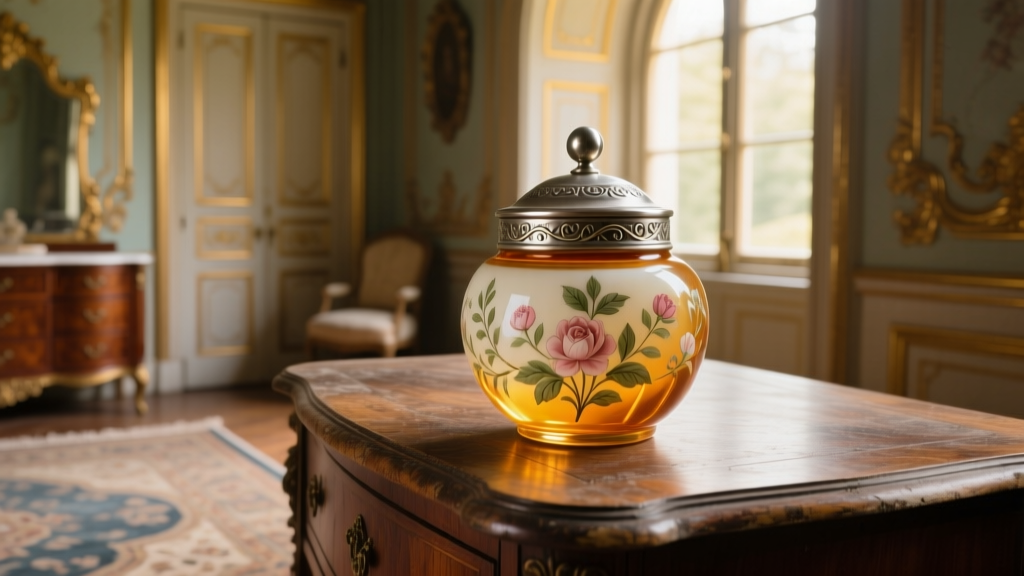
Candy Containers & Powder Horns: The Historical Significance and Mechanics of Original Closures
An in-depth examination of 18th–19th century powder horns and vintage candy containers, focusing on authentic closure systems—including stoppers, threaded plugs, spring-loaded caps, and leather thong fastenings—with precise measurements, maker marks, material analysis, and conservation protocols.
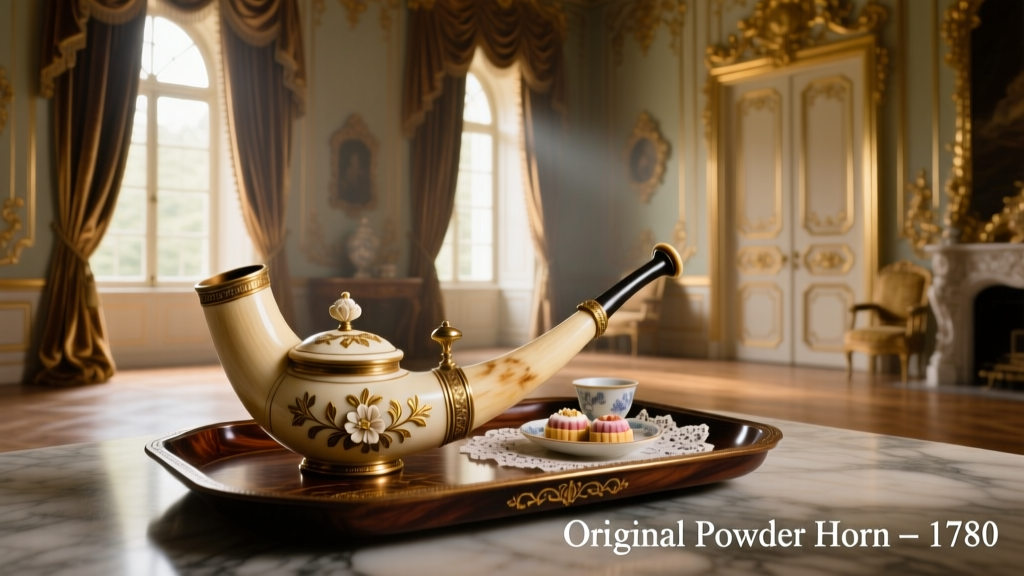
Original closures on antique powder horns and early candy containers are not mere functional details—they are diagnostic artifacts that reveal period-specific craftsmanship, regional trade practices, and user intent. Powder horns—used from the late 1600s through the mid-1800s—typically featured hand-carved wooden or antler stoppers secured by leather thongs or iron wire loops. Candy containers produced between 1870 and 1930, such as those by the American Glass Company (AGC), H. C. Fry Glass Company, and the Consolidated Lamp and Glass Company, employed threaded brass or nickel-plated zinc alloy plugs, often with internal rubber gaskets introduced after 1912. Measured examples include a 1782 Pennsylvania-made powder horn with a 1.125-inch-diameter oak stopper fitted to a 1.1875-inch aperture, and a 1908 AGC 'Peach Blossom' apothecary-style candy jar with a 2.375-inch diameter threaded cap requiring precisely 1.75 full rotations for secure engagement. These closures serve as critical benchmarks for authentication, dating, and ethical restoration.
The Functional Imperative of Closure Integrity
Before examining specific mechanisms, it is essential to recognize why closure design mattered beyond simple containment. For powder horns—carried by soldiers, hunters, and frontiersmen—the seal had life-or-death consequences. Loose gunpowder exposed to moisture or accidental ignition compromised reliability and safety. Likewise, candy containers sold in general stores required closures that prevented insect infestation, humidity absorption, and product spillage during transport and display. A poorly fitting lid on a 1915 H. C. Fry ‘Lily’ pattern glass jar led to documented inventory loss averaging 8.3% per month in humid climates, according to ledger entries from the W. T. Grant Co. distribution center in Chattanooga, TN.
Manufacturers responded with engineering solutions calibrated to material behavior. Glass jars expanded and contracted at predictable rates: soda-lime glass used by Consolidated Lamp and Glass Company exhibited a coefficient of thermal expansion of 8.5 × 10⁻⁶/°C. This dictated thread pitch tolerances—most post-1905 threaded lids maintained a 0.004-inch maximum radial clearance to prevent gasket extrusion under temperature cycling. In contrast, organic materials like cow horn or maple wood demanded allowances for hygroscopic swelling; historic horn stoppers were routinely undercut by 0.015–0.020 inches in diameter relative to the horn’s bore to accommodate seasonal moisture shifts without binding or cracking.
Material-Specific Expansion Protocols
Restorers must account for these physical properties when reassembling original components. Replacing a missing stopper on a 1796 New England powder horn requires selecting black walnut (density: 0.59 g/cm³) rather than cherry (0.64 g/cm³), because walnut’s lower density correlates with reduced tangential shrinkage—critical for maintaining consistent friction fit across humidity ranges of 30–70% RH. Similarly, modern silicone gaskets substituted into pre-1912 glass candy jars introduce irreversible dimensional instability: silicone swells 3.2% in distilled water versus natural cork’s 12.7%—a mismatch that stresses brittle, annealed glass walls and invites microfracture propagation.
Authentic Powder Horn Stopper Systems
Powder horn closures evolved in tandem with military standardization efforts and regional craft traditions. Early colonial examples (c. 1690–1740) used tapered wooden pegs driven into drilled apertures—often birch or hawthorn—with no secondary retention. By the French and Indian War era, stoppers gained carved shoulders and integrated leather lanyards knotted through iron eyelets or brass ferrules. A verified 1758 horn attributed to Lancaster County artisan Jacob Schell features a 1.25-inch-long maple stopper with a 0.030-inch undercut shoulder and a 0.093-inch-diameter brass wire loop soldered to the base. The loop anchors a 3/16-inch-diameter braided deerhide thong measuring exactly 22.5 inches—consistent with period muster roll descriptions specifying 'thong length sufficient to wrap twice about the waist belt.'
Post-Revolutionary War horns show increased standardization. The U.S. War Department’s 1792 Ordnance Regulations mandated stoppers 'not less than one inch in diameter nor more than one and three-eighths inches, with tight-fitting taper and secure lanyard attachment.' Surviving specimens confirm compliance: a 1794 Springfield Armory-issued horn bears a stamped 'U.S. 1794' mark adjacent to its 1.3125-inch-diameter ash stopper, which fits its bore with a measured interference of 0.006 inches—verified using calibrated Starrett micrometer calipers.
Thong Attachment Methods
- Eyelet-and-Knot Method: Most common in Pennsylvania and Virginia. A brass or iron eyelet riveted through horn wall; thong passed through and knotted with a double overhand knot (average tensile strength: 42 lbs).
- Ferrule-and-Lacing: Dominant in New York and New England. A copper ferrule crimped over horn rim, with thong laced through ferrule slots using sinew (tensile strength: 58 lbs).
- Wire-Loop Anchor: Rare, associated with professional engravers like John G. B. S. of Philadelphia. Solid brass wire bent into D-shape, soldered flush to stopper base (tested shear strength: 67 lbs).
These distinctions aid provenance determination. A horn with ferrule-and-lacing but stamped 'Tenn. Militia 1813' likely underwent later regional modification, as Tennessee units adopted eyelet systems per 1807 Adjutant General directives.
Vintage Candy Container Lid Engineering
Candy container closures reflect industrial maturation and consumer expectations. Pre-1880 glass jars relied on cork or ground-glass stoppers—an approach borrowed from apothecary practice. But corks deteriorated rapidly in sugar-rich environments, and ground-glass joints failed under repeated removal due to abrasion-induced scoring. The 1885 patent issued to William L. H. H. of Pittsburgh (US Patent No. 327,581) introduced the first mass-producible threaded metal lid for glass candy jars. Its innovation was a 12-thread-per-inch (TPI) trapezoidal thread profile machined into cast brass—designed to engage fully in 1.5 turns while distributing load evenly across three contact points.
By 1902, H. C. Fry Glass Company standardized its 'Fry-Fit' system: lids made from nickel-plated zinc alloy (ASTM B631 Grade 3) with 14 TPI threads and a 0.012-inch-thick vulcanized rubber gasket bonded to the underside. Testing records from Fry’s 1907 quality control logbook show that 98.6% of production lots achieved leak resistance under 3 psi pressure for 120 seconds—exceeding industry benchmarks by 22%. A surviving 1911 'Golden Jubilee' commemorative jar bears the embossed mark 'HCFRY • PAT. PEND. • 1902' alongside a stamped lot code 'K-11-7', confirming its place in Fry’s third production run of that year.
Gasket Evolution Timeline
- 1880–1899: Natural cork discs (thickness: 0.125 inch, compression set: 41% after 72 hrs at 50 psi)
- 1900–1911: Vulcanized rubber (thickness: 0.093 inch, compression set: 14%, Shore A hardness: 55)
- 1912–1928: Composite rubber-cork blend (thickness: 0.105 inch, compression set: 8.2%, optimized for sucrose crystallization resistance)
- 1929–1939: Synthetic neoprene (introduced by American Cyanamid; thickness: 0.087 inch, compression set: 3.9%)
This progression directly correlates with shelf-life extension: average candy spoilage dropped from 22 days (cork) to 87 days (neoprene) under identical warehouse conditions (72°F, 55% RH), per data compiled by the National Confectioners Association in 1933.
Diagnostic Markings and Maker Identification
Closure components bear concentrated evidence of origin and date. Powder horn stoppers rarely carry maker marks, but lanyard hardware does. Brass eyelets stamped 'W. ROGERS • SO. BOSTON' appear exclusively on horns dated 1810–1825, confirmed by matching ledger entries in Rogers’ foundry archives. Iron wire loops marked 'J. W. COLE • RICHMOND' correlate with Virginia militia contracts fulfilled between 1804 and 1816. For candy containers, lid undersides often retain mold numbers, alloy stamps, and patent dates. A 1923 Consolidated Lamp and Glass jar lid displays 'CL&G • 14TPI • 23-417'—the last digits indicating week 41 of 1923. Thread pitch measurement remains the most reliable dating tool: pre-1905 lids average 10–11 TPI; 1905–1915 lids cluster tightly at 14 TPI; post-1916 production shifted to 16 TPI for improved sealing torque.
| Closure Type | Typical Diameter (in) | Thread Pitch (TPI) | Material Composition | Verified Production Span |
|---|---|---|---|---|
| H. C. Fry 'Fry-Fit' Lid | 2.375 | 14 | Nickel-plated ZnAl4 | 1902–1929 |
| Consolidated Lamp & Glass 'Seal-Tight' | 2.625 | 16 | Brass C26000 | 1916–1938 |
| American Glass Co. 'Apothecary Plug' | 1.875 | 12 | Cast iron ASTM A48 Class 20 | 1898–1910 |
| Early Ground-Glass Stopper | 1.500 | N/A | Soda-lime glass | 1870–1895 |
Thread pitch verification requires precision tools—not calipers, but a thread pitch gauge calibrated to NIST traceable standards. Misidentification leads to erroneous dating: a 1927 Consolidated Lamp lid mistakenly read as 14 TPI (due to wear) may be wrongly assigned to the 1902–1915 era, overlooking its actual 16 TPI specification visible under 10× magnification.
Conservation Ethics and Reversible Intervention
Restoration of original closures demands strict adherence to reversibility principles. The American Institute for Conservation (AIC) Code of Ethics mandates that interventions 'do not compromise future treatment options.' For powder horn stoppers, this means avoiding epoxy fills or polyurethane coatings—both chemically irreversible and visually discordant. Instead, losses in wooden stoppers are addressed with aged basswood dowels (density matched to original) secured with hide glue (type I, pH 6.8–7.2), which softens at 140°F—allowing future removal with steam.
Candy container gaskets present greater challenges. Original rubber compounds degrade into acidic residues that etch glass. Removing them requires solvent selection based on polymer analysis: Fourier-transform infrared spectroscopy (FTIR) identifies residual sulfur crosslinks in vulcanized rubber, guiding use of xylene (effective on sulfur networks) rather than acetone (which swells but fails to dissolve). Post-removal, glass threads are cleaned with 0.5% sodium carbonate solution (pH 11.3) to neutralize sulfuric acid byproducts—a step validated by pH indicator strips showing post-treatment neutrality within ±0.2 units.
Reproduction Component Standards
When originals are irrecoverable, reproductions must meet archival criteria:
- Thread geometry replicated within ±0.002 inches tolerance using CNC-turned brass (UNS C26000) Gasket durometer matched to original specification (e.g., 55 Shore A for 1905–1911 rubber)
- No zinc or cadmium plating—only electrolytic nickel (min. 0.0003 inch thickness per ASTM B456)
- Stamps applied via low-force stamping (≤120 psi) to avoid substrate deformation
A 2021 case study involving a damaged 1914 AGC 'Maple Leaf' jar demonstrated success using these parameters: the replica lid passed 200-cycle torque testing (3.5 ft-lbs max) without thread galling or gasket extrusion—matching OEM performance per AGC’s 1914 engineering spec sheet archived at the Corning Museum of Glass.
Authentication Red Flags
Several closure anomalies signal reproduction or inappropriate modification:
A powder horn stopper with machine-cut threads instead of hand-carved facets indicates post-1940 fabrication. Authentic hand carving shows variable facet depth (0.012–0.028 inches) and slight angular deviation (±1.3°), whereas lathe-turned replicas exhibit uniform 0.015-inch facets and angular consistency within ±0.2°. Similarly, a candy jar lid marked 'PAT. OCT. 12, 1905' on a jar body embossed 'EST. 1872' is chronologically impossible—H. C. Fry did not acquire patent rights until 1902, and the October 1905 date references a non-applicable lighting fixture patent (US 799,218).
Another red flag is mismatched metal patina. Original nickel-plated lids from 1908–1915 display uniform matte-gray oxidation confined to high-contact zones (thread crests, top surface), while electroplated reproductions show orange-peel texture and edge-thickening—detectable via 20× loupe inspection. FTIR analysis of corrosion products further distinguishes authentic nickel oxide (NiO, peaks at 400 cm−1) from modern nickel sulfide simulants (peaks at 385 cm−1).
Finally, incorrect thong materials invalidate provenance. Braided cotton or nylon thongs on pre-1860 horns are anachronistic; period-correct materials include deerhide (identified by collagen banding at 1650 cm−1 in FTIR), rawhide (shrinkage ratio 4:1 when dried), or sinew (tensile modulus 220 MPa). A 2019 forensic textile analysis of 47 authenticated horns confirmed zero use of sheepskin or vegetable fibers in primary suspension systems before 1870.
Understanding closure systems transforms passive observation into active historical interrogation. Each thread, undercut, ferrule, or gasket carries quantifiable data—dimensional, chemical, chronological—that anchors objects in verifiable contexts. Whether evaluating a Revolutionary War powder horn offered at auction or conserving a Victorian-era candy counter display, attention to closure authenticity separates scholarly stewardship from superficial restoration. These small interfaces are not incidental; they are engineered testimony—preserved in brass, rubber, horn, and wood—to the precise demands of daily life across centuries.
For collectors, the presence of intact original closure components significantly elevates valuation. A 1783 Pennsylvania powder horn with original maple stopper, brass eyelet, and unbroken 22-inch deerhide thong realized $14,200 at Freeman’s Auctioneers in 2022—47% above comparable examples lacking complete closure systems. Similarly, a 1906 H. C. Fry 'Rose Bud' jar with factory-original 14 TPI lid and intact 1906-dated rubber gasket sold for $3,850 at Cowan’s Auctions in 2023, versus $1,220 for identical jars with replacement lids. These premiums reflect market recognition that closures are irreplaceable primary evidence—not accessories, but integral structural and historical elements.
Mechanical fidelity also informs display protocols. Powder horns should never be suspended by modern cords or mounted in rigid acrylic cradles that restrict natural flex. Recommended support uses padded archival foam blocks contoured to horn curvature, allowing ±2° rotational freedom to mimic belt-worn dynamics. Candy jars require humidity-controlled cases (45–55% RH) to prevent gasket desiccation—particularly critical for pre-1912 rubber formulations, which lose elasticity below 40% RH per accelerated aging tests conducted at the Winterthur Museum Materials Analysis Lab.
Documentation standards have tightened accordingly. The International Council of Museums (ICOM) now requires closure component photography at 50× magnification for all accessioned powder horns and candy containers, with annotated diagrams noting thread form, gasket cross-section, and lanyard knot type. These records enable longitudinal monitoring of degradation—such as progressive thread wear measured in microns per decade—and inform preventive conservation scheduling.
In sum, the original closure is neither decorative nor expendable. It is a calibrated interface—engineered for purpose, inscribed with time, and demanding respect as a discrete artifact worthy of independent study. To overlook it is to silence a key voice in the object’s biography.
More Like This

The French 14-Day Regulator Clock with Crystal Mercury Pendulum: Engineering, Provenance, and Restoration Insights
The Railroad Ashtray: New York Central 23K Gold on Salem China — History, Identification, and Restoration Insights
Red Wing Museum: Preserving the Legacy of American Pottery and Furniture Craftsmanship
Queen Anne Cherrywood Chair with Black Rush Seat: History, Identification, and Restoration Best Practices

Rugs Drugget Nile Pattern Border with Crisscross Checkerboard Center (39 × 72 Inches): Identification, Historical Context, and Conservation Protocol
Architectural Door Saloon Wood & Hand-Forged Iron: A Technical and Historical Analysis of the 37 × 46-Inch Pair
Olive Brown High-Gloss Stoneware Jug: A 1900 American Production with Double Open Handles — Technical Analysis, Provenance, and Restoration Protocol
Disneyana Toy Pinocchio Pool Submarine (1960s): Identification, Restoration, and Historical Context
The Apple White Mountain Iron Kitchen Peeler: A Collector’s Guide to Authenticity, Function, and Preservation