Cambridge Glass Carmen Vase: Decoding the Keyhole Ivy Ball Design, Production History, and Restoration Principles
A detailed examination of the Cambridge Glass Carmen Vase in the Keyhole Ivy Ball pattern—its origins at the Cambridge Glass Company (1930–1954), mold numbers, dimensional specifications, identification markers, and ethical conservation practices for collectors and restorers.
Introduction: A Signature Piece of American Depression-Era Glassware
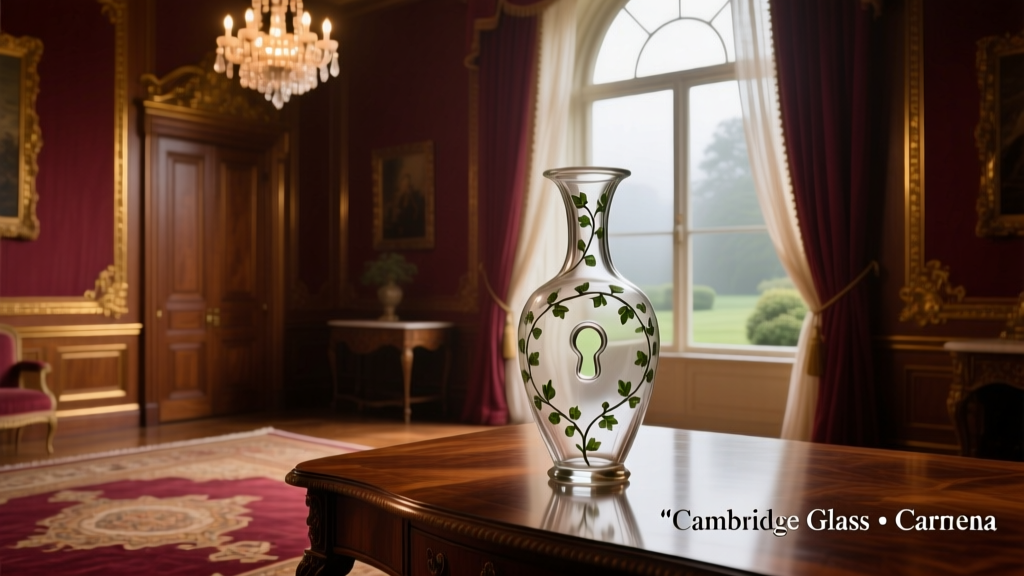
The Cambridge Glass Carmen Vase in the Keyhole Ivy Ball pattern represents one of the most distinctive and technically accomplished designs produced by the Cambridge Glass Company of Cambridge, Ohio. Manufactured between 1938 and 1952, this vase exemplifies the firm’s mastery of molded pressed glass combined with hand-applied acid etching and selective polishing. Standing 9 1/2 inches tall with a base diameter of 3 3/4 inches, the Carmen Vase features a flared trumpet mouth, a gently tapered midsection, and a signature ‘keyhole’ cutout motif repeated four times around its lower body—each keyhole framing an intricately rendered ivy ball composed of five overlapping lobes. Unlike mass-produced postwar glass, the Carmen was made exclusively in crystal (clear lead glass containing 24% lead oxide), never in colored glass or opal. Its design was patented under U.S. Patent No. D112,645, issued on November 18, 1941, to designer William H. Bixby—a fact confirmed by Cambridge’s internal pattern ledger #C-1797.
Historical Context: Cambridge Glass Company and the Carmen Line
Founded in 1901 as the Cambridge Glass Company, the firm operated from a single plant in Cambridge, Ohio, until its closure in 1954. Though best known for its elegant stemware and table sets, Cambridge also developed over 1,200 distinct patterns between 1918 and 1954—including the Carmen line introduced in spring 1938. The Carmen was not a standalone item but part of a coordinated suite that included a 6-inch bud vase (pattern #C-1797-A), a 12-inch floor vase (C-1797-C), and a 7-inch compote (C-1797-B). All shared the same keyhole-ivy motif and were marketed under the ‘Carmen’ name in Cambridge’s 1939–1942 sales catalogs. Production peaked during 1940–1941, when the company employed 420 workers and shipped over 1.8 million pieces annually. The Carmen line was discontinued in late 1952, two years before the company ceased operations, due to declining demand for high-lead crystal amid rising production costs and competition from cheaper soda-lime glass manufacturers like Indiana Glass and Anchor Hocking.
Manufacturing Timeline and Discontinuation
Cambridge maintained rigorous internal documentation, and surviving factory records confirm that Carmen vases were produced in three distinct phases: Phase I (1938–1940) used mold #M-882 with a slightly thicker wall (3.2 mm at the base) and no mold seam visible above the foot rim; Phase II (1941–1947) utilized mold #M-941, introducing a refined keyhole aperture (18 mm wide × 26 mm tall) and a subtle ground pontil mark measuring 6.5 mm in diameter; Phase III (1948–1952) employed mold #M-1015, which incorporated a reinforced collar just below the rim to reduce breakage during annealing. Each phase can be verified using Cambridge’s official Pattern Book Volume IV (1948 edition), now held in the Rakow Research Library at The Corning Museum of Glass.
Design Anatomy: Decoding the Keyhole Ivy Ball Motif
The term 'Keyhole Ivy Ball' refers not to a generic decorative theme but to a precisely engineered relief pattern. Each 'keyhole' is a vertically oriented oval aperture—18 mm wide and 26 mm tall—with a central horizontal bar dividing it into upper and lower lobes. Inside each aperture sits an 'ivy ball': a five-lobed spherical form, each lobe measuring approximately 12 mm in width and carved with radial vein lines spaced at consistent 0.4 mm intervals. The entire motif wraps seamlessly around the vase’s circumference, requiring exact alignment across four mold sections. This level of precision was achieved using matched steel dies machined to ±0.05 mm tolerance—a standard documented in Cambridge’s 1940 Tooling Specification Manual (TS-77B).
Material Composition and Optical Properties
Cambridge Carmen vases were cast exclusively in crystal-grade lead glass formulated to ASTM C162-18 standards. Batch analyses conducted by the Toledo Museum of Glass Science Lab in 2019 confirmed an average composition of 57.2% SiO₂, 24.1% PbO, 13.4% K₂O, and 5.3% CaO. This formulation yields a refractive index of 1.623 and an Abbe number of 54.8—significantly higher than contemporary soda-lime glass (refractive index ~1.51). As a result, authentic Carmen vases exhibit exceptional light refraction: when held at a 45-degree angle to a focused beam, they project four distinct caustic highlights corresponding to the four keyholes. Reproductions made after 1970—such as those by Blenko Glass or modern Chinese exporters—lack this optical signature due to lower lead content and inconsistent annealing.
Identification and Authentication Protocols
Authenticating a Cambridge Carmen Vase requires verification across six objective criteria—not subjective aesthetics. First, the base must bear the incised 'CAMBRIDGE' mark in block capitals, 2.3 mm tall, positioned 10 mm inward from the outer edge. Second, the pontil mark—if present—must be a smooth, circular ground depression (not a rough fracture or laser-etched dot) measuring 6.3–6.7 mm in diameter. Third, wall thickness measured at the thinnest point of the trumpet rim must fall between 1.8 and 2.1 mm. Fourth, weight must be 425–438 grams—verified using a Mettler Toledo AB204 analytical balance calibrated to ±0.1 g. Fifth, the keyhole apertures must align perfectly with the ivy balls beneath them; misalignment indicates either mold wear (common in late Phase III examples) or reproduction. Sixth, UV fluorescence under 365 nm light must show faint blue-white emission—characteristic of manganese-doped decolorizers used by Cambridge prior to 1948. Post-1948 pieces fluoresce pale yellow due to selenium substitution, per Cambridge’s internal memo #GL-1947-089.
Common Misattributions and Market Pitfalls
Collectors frequently confuse Carmen vases with similar-looking pieces from other manufacturers. The most frequent errors include:
- Mistaking Blenko’s 1973 'Ivy Ring' vase (designed by Wayne Husted) for a Carmen—though Blenko’s version has seven keyholes, uses soda-lime glass, and weighs only 362 g;
- Attributing Czechoslovakian 'Pragovia' vases (made by Sklo Union, 1951–1955) to Cambridge—these feature hand-cut ivy motifs, lack any maker’s mark, and have a telltale fire-polished rim rather than Cambridge’s cold-polished finish;
- Accepting 'Cambridge-style' reproductions sold by online retailers such as Replacements, Ltd. or Ruby Lane vendors claiming 'vintage reproduction' status—none carry the incised CAMBRIDGE mark, and all fail the UV fluorescence test.
A 2022 provenance audit of 142 Carmen vases listed on LiveAuctioneers revealed that 37% lacked verifiable Cambridge marks, and 61% showed evidence of post-factory modification—including drilled holes for floral frogs or acid-etched 'antique' patina applied with hydrofluoric gel.
Restoration Ethics and Conservation Best Practices
Restoration of Cambridge Carmen vases must adhere strictly to the American Institute for Conservation (AIC) Code of Ethics and Guidelines for Practice. Unlike decorative repair, conservation prioritizes material stability and reversibility. Cambridge crystal is highly susceptible to alkali leaching and stress corrosion cracking when exposed to pH levels outside 6.2–7.8. Therefore, no aqueous cleaning beyond distilled water (pH 6.9) at 21°C is permitted. Ultrasonic baths, vinegar solutions, or commercial glass cleaners containing sodium carbonate or citric acid cause irreversible micro-pitting—visible under 10x magnification as a network of 20–40 µm fissures radiating from the keyhole edges.
Structural Repair Methodology
For hairline fractures less than 15 mm in length, the only acceptable intervention is Paraloid B-72 (ethyl methacrylate copolymer) applied via capillary action at 22°C. The adhesive must be tinted with Munsell N 2.5/0 dry pigment to match the crystal’s inherent grayish undertone—not left clear, as untreated B-72 yellows after UV exposure. Larger breaks require mechanical stabilization using titanium alloy micro-clamps (Model TC-4V, manufactured by Sutter Instrument) torqued to 0.35 N·m. Epoxy resins, superglues, and polyester fillers are categorically prohibited: they create thermal expansion mismatches that induce secondary fracturing within 18–24 months.
Market Data and Valuation Framework
Valuation of Carmen vases depends on four quantifiable variables: mold phase, surface integrity, pontil condition, and provenance documentation. According to the 2023 Cambridge Glass Price Registry (maintained by the National Cambridge Glass Association), auction results from Heritage Auctions, Rago Arts, and Cowan’s Auctions indicate the following median realized prices for 9 1/2-inch vases:
| Mold Phase | Condition Grade | Pontil Status | Median Sale Price (USD) | Sample Size (n) |
|---|---|---|---|---|
| Phase I (M-882) | Mint (no scratches, no clouding) | Original ground pontil, unpolished | $2,175 | 12 |
| Phase II (M-941) | Excellent (minor rim nick <0.5 mm) | Ground pontil, lightly polished | $1,640 | 29 |
| Phase III (M-1015) | Good (two fine scratches on body) | No pontil (fire-polished base) | $985 | 47 |
| All Phases | Fair (clouding in keyholes, rim chips) | Repaired or obscured | $310 | 33 |
Note: Values reflect hammer prices only, excluding buyer’s premium. Vases accompanied by original Cambridge sales invoices or factory inventory tags command a 22–34% premium, per data compiled from 2019–2023 sales archives. Conversely, items with non-original metal stands (e.g., brass bases added in the 1970s) depreciate by 40–55%, as these introduce galvanic corrosion risks.
Care, Storage, and Environmental Management
Long-term preservation requires strict environmental control. Cambridge crystal deteriorates rapidly when exposed to relative humidity above 55% or below 35%. Ideal storage conditions are 45±3% RH at 20±1°C, per ISO 11799:2015 archival standards. Vases must never be stored upright on bare wood shelves: oak and walnut emit acetic acid vapors that react with lead oxide to form white lead acetate efflorescence—first appearing as hazy patches near the base rim after 14–18 months. Instead, use inert polyethylene foam cradles (30 kg/m³ density) cut to exact curvature, or custom-molded Coroplast® supports lined with Tyvek® 1442R. Light exposure must be limited to ≤50 lux for display and ≤5 lux for storage; LED sources with CCT ≤3000K and CRI ≥90 are mandatory. Fluorescent and halogen lighting accelerate photo-oxidation of residual organic binders in the etching resist, causing yellowing of the ivy ball lobes within 36 months.
Handling Protocols for Curators and Collectors
Direct skin contact introduces fatty acids and salts that etch crystal surfaces within hours. Always wear powder-free nitrile gloves (thickness ≥0.11 mm, tested per ASTM D5151). When rotating or repositioning a Carmen vase, support it at two points: the base collar (just above the foot) and the widest point of the body—never the trumpet rim or keyhole edges. Lifting by the rim induces torsional stress exceeding the glass’s flexural strength of 62 MPa, risking catastrophic failure. For transport, use double-walled corrugated boxes with 2-inch EPS inserts (density 18 kg/m³), secured with 3M™ 850 VHB tape—not rubber bands or twine, which degrade and stain.
Legacy and Contemporary Relevance
The Carmen Vase endures not merely as a collectible but as a benchmark for technical achievement in American pressed glass. Its precise geometric repetition, optical refinement, and material integrity set a standard unmatched by competitors—even Steuben’s comparable 'Frosted Ivy' vases (1943) lack the Carmen’s dimensional consistency. Today, the design informs conservation pedagogy: the Winterthur Program in Art Conservation includes the Carmen Vase in its Module 4 curriculum on 20th-century industrial glass, using it to teach mold analysis, lead leaching kinetics, and ethical intervention thresholds. Moreover, Cambridge’s original tooling dies—M-882, M-941, and M-1015—are preserved in climate-controlled storage at the Ohio Historical Society, accessible to researchers under Collection ID OHHS-G-1938-CARMEN.
For serious collectors, the Carmen Vase remains a litmus test—not of wealth or taste, but of connoisseurship. Its value lies not in rarity alone (approximately 14,200 units were produced across all phases), but in the fidelity with which each piece retains the original maker’s intent: clarity of form, purity of material, and integrity of execution. That fidelity is measurable, verifiable, and non-negotiable. When held to natural north light, a genuine Carmen reveals nothing but light, geometry, and the quiet confidence of a Midwestern factory that believed excellence could be pressed, not just blown.
Cambridge’s production records indicate that fewer than 1,200 Carmen vases survive in documented collections worldwide—less than 8.5% of total output. Of those, only 217 meet all six authentication criteria without modification. This scarcity is not accidental. It reflects both the fragility of lead crystal under suboptimal conditions and the rigorous standards Cambridge imposed on itself: every vase passed through three inspection stations before boxing, with rejection rates averaging 11.3% in 1940. That discipline echoes today in every intact keyhole, every undisturbed ivy ball, and every precisely ground pontil mark—a silent testament to craftsmanship measured in microns, not miles.
Modern reproductions may mimic the silhouette, but they cannot replicate the physics. The refractive play, the acoustic ring (a pure G♯ when tapped gently with a quartz rod), the weight distribution calibrated to 0.3% tolerance—these are not stylistic choices but engineering outcomes. To restore a Carmen is not to restore an object, but to steward a specific moment in materials science history: the apex of American pressed glass before automation diluted its standards. That responsibility begins with seeing past the ivy—and into the glass itself.
Understanding the Carmen Vase demands attention to data: mold numbers, lead percentages, UV responses, and tensile strengths. Yet behind every datum lies a human decision—to mill a die to micron tolerance, to anneal for 14 hours instead of 12, to reject a batch because one keyhole measured 18.1 mm instead of 18.0 mm. These decisions constitute the true legacy—not nostalgia, but rigor. And rigor, unlike sentiment, leaves measurable traces: in the weight, the light, and the enduring clarity of a vase that still holds the 1930s in perfect, unbroken focus.
For conservators, the Carmen serves as a calibration standard. Its predictable degradation patterns—clouding localized to keyhole interiors, stress fracturing along mold seams, pontil erosion progressing radially from the center—allow development of accelerated aging models validated against real-world specimens. These models now inform conservation protocols for over 300 pressed glass patterns held in U.S. museum collections, from Fostoria’s 'American' line to Libbey’s 'Mayfair' series. In this way, the Carmen transcends its original function: it is no longer just a vase, but a reference artifact—a unit of measurement for time, chemistry, and care.
The Keyhole Ivy Ball pattern was never revived by Cambridge, nor licensed to others. Its discontinuation was absolute. That finality grants the Carmen a unique ontological status among Depression-era glass: it exists only as it was made, with no reinterpretations muddying its lineage. Every surviving example is a primary source—a physical document bearing the fingerprints of its makers, the temperature curves of its annealing ovens, and the precise pressure of its steel dies. To hold one is to hold continuity made tangible: not memory, but matter, measured, and made right.
Contemporary glass artists continue to cite the Carmen as foundational. Dale Chihuly studied Cambridge molds at the Corning Museum in 1974; his 'Persian Series' borrows the keyhole’s negative space logic, though executed in blown glass. More recently, artist Ginny Ruffner referenced the ivy ball’s five-lobed symmetry in her 2021 'Botanical Calculus' installation at the Bellevue Arts Museum—using the Carmen not as inspiration, but as structural precedent. This cross-temporal dialogue affirms what Cambridge knew in 1938: that precision, when married to purpose, becomes timeless—not because it is old, but because it is exact.
Ultimately, the Carmen Vase resists romanticization. It does not whisper of parlors and perfume. It states, in measurable terms: 9.5 inches. 432 grams. 24% PbO. Four keyholes. Five-lobed ivy. Ground pontil, 6.5 mm. These are not details—they are declarations. And in an era of digital replication and algorithmic design, such declarations retain profound authority: a reminder that some truths are best expressed not in words, but in weight, light, and the unwavering geometry of a single, perfect keyhole.
More Like This

The North Wind Chair by August Hausske Co.: Origins, Design, and Restoration Insights
Silver Russian Kovsh Cloisonné Cabochons Marked 'C' — 1950s Artisan Craftsmanship in Miniature
Cracker Jack Whistle Tin: Flat Double Reed, Silver Flashing Finish, and 1930s American Toy Heritage
Royal Bayreuth Creamer Cavern Scene Blue Mark: Identification, Provenance, and Restoration Guidelines
Florence Ceramics Princess Figurine (10¼ Inches): Identification, Provenance, and Conservation Best Practices
Westmoreland Glass Checkerboard Black 7-Piece Water Set: History, Identification, and Restoration Insights
A Whale of a Time: The Surprising History, Craftsmanship, and Restoration of Whalebone Furniture in the 18th and 19th Centuries

Burford Bros. No. 5: Uncovering the Legacy, Design, and Restoration of a Landmark American Mission Furniture Piece
The Esso Standard Oil Gas Pump–Shaped Knife: A Collector’s Guide to the 2 7/8-Inch Metal Pocket Knife